Physical Address
304 North Cardinal St.
Dorchester Center, MA 02124
Physical Address
304 North Cardinal St.
Dorchester Center, MA 02124


A plain guide to arb bots, crypto arbitrage, and hidden execution risk.
An arb bot is software that scans crypto markets for price gaps and can alert, hedge, or execute arbitrage trades.
The word “arb” is short for arbitrage. It does not automatically mean the ARB token or Arbitrum. In crypto, an arb bot can be a useful scanner, a serious trading system, or scam bait with a confident Telegram admin.
That range is where the risk starts. Arbitrage is real, but a pretty spread is only the opening clue. The hard part is getting both sides filled after fees, slippage, gas, latency, permissions, funding, and market competition take their turn.
An arb bot in crypto is an arbitrage bot: software built to find price differences between markets and act on them faster than a human can. It may compare two exchanges, two DEX pools, a spot market and a perpetual futures market, or several trading pairs inside one venue.
The basic idea is old. If BTC is cheaper on one market and more expensive on another, arbitrage tries to buy where it is cheaper and sell where it is richer. A bot helps because crypto moves all day, spreads can last seconds, and manual clicking is usually too slow.
There is no single arb bot product type. Some bots only scan and send alerts. Some route trades through exchange APIs. Some run on-chain transactions. Some hedge spot and perpetual positions. Some are just fake dashboards wearing a lab coat.
That is why wording changes the risk:
A legitimate arb bot still needs rules, capital, accounts, permissions, logging, and loss controls. It does not turn market gaps into guaranteed money. It only automates parts of the search and execution.
So do not stop at, “Can a bot find a spread?” Many can. Ask whether that spread survives the trip from screen to settled balance.
An arb bot finds price gaps by collecting market data, comparing venues, estimating execution costs, and deciding whether the gap is large enough to act on. The scanning part can be simple. The trade-quality check is where the work starts.
A cross-exchange bot might watch order books on two centralized exchanges. A DEX bot might watch liquidity pools and router quotes. A funding-rate bot watches spot prices, perpetual futures prices, and funding payments. More advanced systems also track latency, available balances, borrow cost, gas prices, and failed-order history.
The workflow often looks like this:
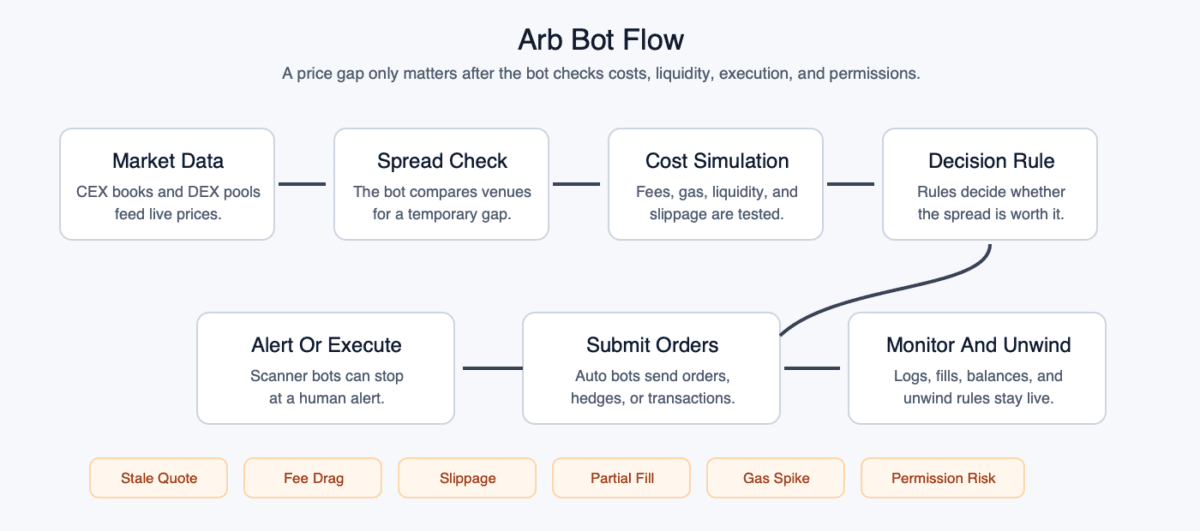
A scanner bot stops after the alert. It might tell you that ETH trades slightly cheaper on one venue than another. That can teach market structure, but you still have to check balances, fees, withdrawal timing, and actual liquidity.
An execution bot goes further. It can submit orders, route through a DEX, hedge a perpetual, or close a position when a rule triggers. That adds speed, but also raises the damage ceiling. A bad scanner wastes time. A bad auto-execution bot can waste money fast.
Good arb bots simulate the trade before acting. They ask whether the order book has enough depth, whether a DEX swap will move the price, whether gas has spiked, and whether both legs can fill. If any answer is weak, the clean-looking spread becomes noise.
An arb bot spread is not profit because the spread is the gross gap before execution costs. It is the headline number. Fees write the footnotes.
For example, a bot may spot a 0.45% difference between two venues. That sounds attractive until trading fees, slippage, withdrawal fees, gas, borrow costs, funding, and partial-fill risk are added. If the net result is negative, the bot found a real spread and still found a bad trade.
The simple formula is: gross spread minus all trading friction. That friction changes by venue, asset, chain, order size, and speed.
| Cost Or Friction | How It Can Shrink The Spread |
|---|---|
| Trading fees | Maker or taker fees reduce both legs of the trade. |
| Slippage | Your own order moves the price before the fill completes. |
| Gas fees | On-chain trades can become unprofitable during congestion. |
| Withdrawal fees | Moving funds between exchanges can erase small gaps. |
| Transfer delays | The price gap may close before funds arrive. |
| Funding payments | A spot-perp hedge can stop paying or turn negative. |
| Partial fills | One side executes while the hedge or exit fails. |
| Tax records | Many small trades create reporting work and possible costs. |
The painful part is that costs do not arrive politely in a single line item. They stack. A small fee here, a late fill there, and one gas spike can turn a smart trade into a spreadsheet apology.
This is also why screenshots of profitable bot dashboards deserve skepticism. A dashboard can show gross opportunities, backtest returns, or ideal routes. Your account balance only cares about the net result after the trade actually settles.
Crypto arb bots come in several types, and each type can break in a different way. Knowing the category helps you avoid judging a funding-rate bot like a DEX bot, or mistaking a scanner for a system that actually controls orders.
Most beginners first see cross-exchange arbitrage. The bot compares the same asset across two venues. If SOL is cheaper on one exchange and richer on another, the bot may alert or try to trade both sides. The trap is that transfers, withdrawal limits, and inventory split across venues can make the trade less simple than it looks.
Other arb bots stay inside one venue or one chain. Triangular bots rotate through pairs, such as BTC to ETH to USDT and back. DEX bots compare pools. CEX-to-DEX bots try to bridge centralized and on-chain liquidity. Funding-rate bots hedge spot and perps. Statistical bots look for price relationships that may mean-revert, which is a different problem with sharper edges.
| Arb Bot Type | Where It Trades And What Can Go Wrong |
|---|---|
| Cross-exchange | Uses two exchanges. Transfer delays, withdrawal limits, and stale quotes can break it. |
| Triangular | Uses three pairs on one venue. Fees and thin books can erase the loop. |
| DEX-to-DEX | Uses on-chain pools. Gas, slippage, and MEV competition are major risks. |
| CEX-to-DEX | Connects exchange and wallet liquidity. Custody, timing, and bridge friction can break it. |
| Scanner-only | Sends alerts. Lower custody risk, but no automatic profit. |
| Statistical | Trades relationships. Correlations can break hard. |
| Funding-rate | Hedges spot and perps. Funding flips, basis moves, and liquidation can break it. |
That list is not a shopping menu. It is a risk map. If a bot seller cannot explain which type they run, where it trades, and what happens when one leg fails, the pitch is already too vague.
A cleaner starting point is observation. Watch what the bot flags, calculate the net spread manually, and ask what would happen if the market moved against the route while orders were still pending.
Funding-rate arb bots try to capture payments between spot and perpetual futures positions. The common setup is long spot and short the related perpetual when funding is positive, so the short side may collect funding while the spot side offsets price direction.
That sounds calmer than directional trading, but hedged does not mean harmless. Funding can flip from positive to negative. The perp can move away from spot. Margin interest can eat returns. A sharp move can create liquidation risk if collateral is thin or stuck in the wrong place.
Spot-perp arb also has sizing problems. If the spot and perp quantities do not match, the hedge leaks. If one side closes and the other does not, the user suddenly has directional exposure. The Crypto.com Help Center explains that open perpetual positions in its arbitrage bot are marked to market at the end of each hour. That is a useful reminder that margin pressure can keep updating even when the trade looks hedged. The same note lists risks such as adverse funding, quantity mismatch, basis risk, liquidation, and margin costs for this style of bot.
Funding-rate bots are often more transparent than fake Telegram “daily yield” bots, but they still need supervision. Watch funding history, margin buffers, fee tiers, unwind rules, and what happens when funding turns flat.
An arb bot becomes MEV or flash loan trading when the strategy moves on-chain and competes inside block production. At that point, the bot is not just comparing prices. It is fighting other searchers for transaction ordering.
Flash loan arbitrage borrows capital inside one transaction, trades across pools, repays the loan, and keeps the difference if the full transaction succeeds. If it fails, the transaction reverts, but gas and opportunity cost can still hurt. Capital-light does not mean effort-light.
MEV changes the contest. A public transaction can reveal the route before it lands. Other bots may copy it, outbid it, or reorder around it. That is why serious searchers care about simulation, private relays, private RPC, priority fees, and reliable infrastructure. This is bot-versus-bot competition, not a casual side hustle.
The practical failure points are specific:
This is why many flash-loan bot tutorials are better treated as education than income plans. They can teach routing, AMM math, and smart-contract execution. But a public, copyable strategy with no private edge usually meets a faster bot very quickly.
If you are building in this area, start with simulation and logs. A profitable-looking route without failure data is just a nice drawing.
An arb bot is not passive income because it automates activity, not edge. It can watch markets while you sleep, but it cannot make fees disappear, create liquidity, or guarantee that another bot will not get there first.
The “passive income” pitch works because arbitrage sounds market-neutral. Buy low, sell high, pocket the gap. In practice, the gap is small, crowded, and time-sensitive. The user still needs accounts funded in the right places, working API keys, risk limits, monitoring, records, and a plan for failed trades.
Retail users also compete with market makers, professional traders, and on-chain searchers. Those players may have lower fees, better infrastructure, direct exchange relationships, faster data, and more capital. A public bot sold to thousands of users is unlikely to keep a private edge for long.
That does not make every arb bot useless. A scanner can teach where spreads appear. A funding-rate bot can help structure a hedge. A home-built bot can teach API handling and market mechanics. But those are active tools.
Watch for these passive-income warning signs:
When “free money” language appears, ask who supplies the money. Sometimes the answer is real market inefficiency. Sometimes the answer is a trapped buyer with a username.
Arb bot risks are not limited to bad trades. The bigger risk stack includes execution failures, account permissions, margin pressure, custody mistakes, and recordkeeping that grows faster than expected.
Partial fills are one of the classic problems. The bot buys on one venue, but the sell order fails or fills only partly. Now the user has an open position, not an arbitrage. The same can happen when an API times out, an exchange pauses withdrawals, a DEX route reverts, or a price feed lags.
Margin adds another layer. A funding-rate or statistical arb bot can look hedged while still needing collateral. If price moves sharply, one leg can demand margin before the offsetting leg helps. The trade may be direction-light, but liquidation engines are not sentimental.
Security risk needs its own check. API keys should use the smallest possible permissions. Wallet approvals should be limited and reviewed. If a bot needs custody of funds, withdrawal rights, or broad smart-contract approvals, you should know exactly what can be moved and by whom.
Before connecting anything, check these points:
A scanner-only setup has lower custody risk because it does not trade for you. That does not make its alerts profitable, but it does limit the blast radius. For many users, that is the right first boundary.
Before you use or connect an arb bot, prove that the setup can lose safely. That means testing permissions, exits, logs, and small trades before the bot ever touches meaningful capital.
Start by asking what the bot can do without you. Can it trade only, or can it withdraw? Can it approve tokens? Can it interact with any contract, or only a known router? Can you stop it quickly? If the answer is unclear, pause.
Then check the operating controls:
The phrase “set and forget” is a risk signal. A real arb setup needs monitoring because markets, funding, gas, liquidity, and venue status change. If the bot cannot explain how it fails, it has not explained how it trades.
Arb bot scams use the language of arbitrage to make fake returns sound technical. The trade may start as a friendly tip, a Telegram group, a “VIP” dashboard, or a site that shows small withdrawals before demanding larger deposits.
The scam is not always a wallet drain on day one. Some fake arb setups imitate real trading tools. They show balances, routes, profit charts, and support messages. Then the exit gets blocked by a tax payment, release fee, verification charge, bridge delay, or sudden “liquidity requirement.”
The strongest red flags are simple:
Some scams behave like a soft rug, where the dashboard seems alive while withdrawals, fees, or balances slowly turn against the user. Others look more like a hard rug, where the site, group, or operator vanishes once enough funds are trapped.
That does not mean every arb bot is fake. Real arbitrage tools exist. But real tools do not need guaranteed-return theater, withdrawal release fees, or secret invite pressure. If the pitch gets louder when you ask basic questions, listen to that.
Building an arb bot can be useful even when using one for profit is unlikely. It teaches market data, exchange APIs, order books, AMM pricing, transaction simulation, error handling, and why the easy-looking spread is rarely easy.
The build path usually starts with a scanner. Pull price data from two venues, compare timestamps, normalize fees, and log opportunities. That is already valuable. It shows how many “opportunities” vanish once liquidity, size, and freshness are added.
Live execution is the step that changes the risk. Now the bot must size orders, protect against partial fills, handle API failures, retry safely, manage balances, track positions, and stop when assumptions break. On-chain versions add gas estimation, private RPC, transaction simulation, and approval safety.
For a learning project, a builder can keep the scope tight:
Buying a bot has a different burden. You are judging someone else’s controls. Ask for strategy type, custody model, audit trail, permissions, fee assumptions, trade export, and clear examples of losing conditions. If the seller only shows wins, they are hiding the half of the product you need to see.
The honest answer is boring but useful: build one to learn, use one only with strict limits, and require live profit to prove itself slowly.
Start with an arb bot by observing markets, not by depositing large funds. The first goal is to learn whether the bot’s signals survive basic cost checks.
Pick one simple route. That might be one coin across two exchanges, one DEX pair across two pools, or one spot-perp funding setup. Track the gross spread, then subtract every fee, slippage estimate, transfer cost, funding payment, and expected delay.
Then run a paper log. For each signal, record what would have happened if you acted at the displayed size. Mark stale quotes, missed fills, gas spikes, funding flips, and exits. After enough entries, the bot’s edge will look either more real or much thinner.
A practical starting checklist looks like this:
If you are building, make the first version a market-structure lab. If you are using a third-party tool, make the first week a permission and accounting test. Either way, the right starting point is control, not confidence.
Keep the first live run deliberately dull. Use one venue pair, tiny size, one stop rule, and one log review. Expanding too early only adds more ways to misunderstand the result.
The best early signal is not a large win. It is whether the bot records losses, rejected trades, stale data, and missed exits honestly.
Arb bot discussions often pull in a few nearby ideas. Arbitrage is the core trading concept: buying and selling related markets to capture a temporary price difference.
MEV is the on-chain version of the speed fight. It describes value that can be extracted through transaction ordering, inclusion, or routing. Start with PVP in crypto if you want the plain-language version of bot-versus-bot competition.
The funding rate explains the payment side of spot-perp arb. That rate can create an arb setup, but it changes over time. Positive funding today does not promise positive funding tomorrow.
API key and wallet approval are the access controls. They decide what a bot can do to an exchange account or connected wallet. In arb trading, boring permissions are beautiful.
Scam language is the last related idea to know. If an arb bot pitch makes the user supply the money, the fees, and the patience while someone else controls the exit, the exit liquidity concept explains the danger cleanly.
Yes. In crypto trading, an arb bot usually means an arbitrage bot. It is software that searches for price differences and may alert, route, hedge, or execute trades based on arbitrage rules.
The only common confusion is ARB, the Arbitrum token ticker. If the conversation is about spreads, exchanges, DEX pools, funding rates, or flash loans, the term is almost always about arbitrage.
No. An arb bot cannot guarantee profit because fees, slippage, latency, partial fills, gas, funding changes, and competition can erase the spread.
Even a real arbitrage opportunity can fail in execution. Guaranteed-return claims are a warning sign, especially when the seller asks for custody, withdrawal permissions, or extra fees to release funds.
Funding-rate arb bots can reduce direction exposure, but they are not risk-free. They still carry funding flips, basis movement, margin interest, liquidation, exchange, and execution risk.
They can be easier to understand than some MEV or statistical bots because the hedge is visible. But the hedge has to stay balanced, funded, and monitored.
No, not for normal arb bot trading. A bot that trades on an exchange usually needs trade permissions, not withdrawal permissions.
Use the narrowest API scope possible. If a third-party bot, Telegram group, or unknown dashboard demands withdrawal access, that is a serious custody warning.
Building an arb bot can be worth it as a learning project. It teaches market data, fees, APIs, routing, logs, and how fast clean-looking spreads disappear.
It is a weaker plan as a beginner income strategy. Live trading needs infrastructure, capital, supervision, and a real edge that survives costs.
Sometimes, but not usually in trading searches. “ARB” can refer to Arbitrum or the ARB token, while “arb bot” usually means arbitrage bot.
Look at the surrounding words. If the topic mentions price gaps, flash loans, funding rates, spreads, or CEX and DEX routes, it is almost certainly about arbitrage.