Physical Address
304 North Cardinal St.
Dorchester Center, MA 02124
Physical Address
304 North Cardinal St.
Dorchester Center, MA 02124


Cabal coin explained without ticker confusion.
A cabal coin is either a CABAL-named crypto token or meme-coin slang for a launch suspected of insider coordination.
The tricky part is that both meanings can appear in the same search. One tab may show a CABAL price chart, another may show a wallet swap page, and a third may use “cabal” as a warning about insiders, KOLs, and early wallets. The name alone is not enough proof to buy, accuse, or relax.
Cabal coin in crypto does not mean one thing every time. It can point to a token using the CABAL name or ticker. It can also describe a meme coin traders suspect has insider coordination behind it.
That split comes before any chart reading. A token page may track one asset, while a social post may warn about a launch where early wallets, private groups, or promoters seem to have an edge.
A CABAL price page, a wallet swap route, and a social post can all look relevant while answering different questions. The price page tracks an asset. The wallet route helps you swap a specific contract. The social post may be making a risk claim about who got in early.
Keep the first read simple:
For example, one user may ask about Cabal coin because a wallet app offered a swap route. Another may ask because someone on CT called a fresh meme coin “cabal-backed.” Those are different questions hiding under the same name.
So slow the first click. Identify the exact asset first, then check whether the risk story has evidence behind it. If the chain, contract, pool, and official links do not match, the label “Cabal coin” is still too vague to trust.
Cabal coin search results can point to different tokens because crypto names and tickers are not unique identity systems. Many assets can use similar names, and different pages may track different contracts, pools, or chains.
That is why the same search can surface a price tracker, a DEX chart, a wallet swap route, a scanner result, and a generic slang discussion. Each source may be useful, but none of them settles the identity question by itself.
Use this table to keep the evidence in its lane:
| What You See | What It Does Not Prove |
|---|---|
| Token name | That every Cabal coin page refers to the same asset |
| Ticker | That the ticker is unique or official |
| Logo | That the token is legitimate |
| Price chart | That liquidity is deep enough to exit |
| Token address | That the pool or venue is safe |
| Pool address | That the token itself is the right one |
| Website | That the site is official or current |
| Scanner label | That the asset is safe or unsafe in every context |
The cleanest identity check starts with chain plus token address. A Solana token address, an Ethereum-style contract, and a pool address are different pieces of evidence. Mixing them can send a user to the wrong asset.
Ticker confusion is especially ugly in meme coins because speed rewards shortcuts. If a chart is green and the name looks right, the swap button feels close. That is exactly when the boring address check earns its keep.
Cabal coin and crypto cabal slang are related, but they are not the same thing. Cabal coin can refer to a named token, while “cabal” in crypto usually means a suspected insider group, whale cluster, KOL circle, or private trading room.
The slang carries suspicion. People use it when they think a launch was tilted before public buyers arrived. But the word is often loose shorthand, not evidence.
Separate the asset question from the behavior question. A CABAL token page asks, “Which asset is this?” A cabal accusation asks, “Who had the advantage before everyone else showed up?” Mixing those questions is how a normal price page turns into a rumor mill.
On CT slang, cabal talk usually points to patterns like these:
That language can be useful if it sends you toward wallet and liquidity checks. It becomes less useful when it turns every red candle into a conspiracy post with a candlestick attached.
Capitalization helps, but only a little. Uppercase CABAL often points to a ticker, branded asset, or token page. Lowercase cabal usually points to trader slang. Search results do not always respect that split, so you still need the contract and chain.
Read the word “cabal” as a risk prompt. It should make you ask who had early access, who promoted, who can sell, and whether the token facts line up. It should not make you declare fraud from a nickname alone.
Cabal coin hype can form when private access, social proof, and thin liquidity meet at the same time. A risky token can pump before most users understand who holds supply or how exits work.
The alleged pattern usually starts before public attention. Early wallets buy, a few accounts amplify the ticker, and a DEX chart begins to look alive. Then trending pages and group chats do the rest.
The common sequence looks like this:
This is where narrative coin mechanics show up. A story can pull in attention before the token has much verified substance. The story may be funny, urgent, or hostile to anyone asking basic questions.
In its Solana rug-pull report, Solidus Labs reported that 98.6% of Pump.fun tokens it analyzed collapsed into worthless pump-and-dump schemes shortly after launch. That does not prove any named Cabal coin was manipulated. It does explain why users should check the mechanics before trusting speed.
The hard part is that hype can be real and risky at once. A cabal coin can pump because demand is real, because supply is tight, or because the best-positioned wallets already know where exits sit. You need checks that survive all three possibilities.
Checking a Cabal coin contract means proving that the asset in front of you is the exact one you meant to inspect. Start with identity, then move to liquidity, holders, controls, and sellability.
Do not begin with the chart. Begin with the source trail. Find the official link, confirm the chain, copy the token address, then compare that address across the DEX pool, wallet route, tracker page, and explorer.
A practical check sequence looks like this:
Liquidity deserves special attention. A pool can let a small buy enter while still making a larger exit brutal. A hard rug risk gets sharper when liquidity control, sellability flags, and unclear ownership all point the same way.
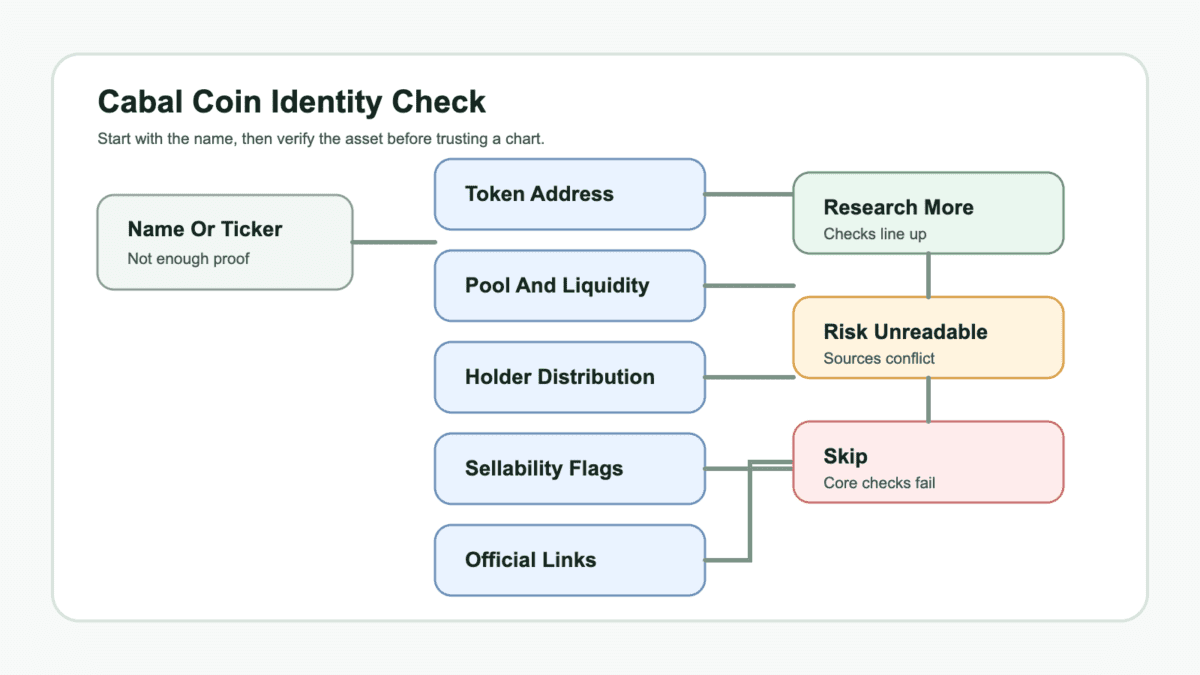
_A Cabal coin name or ticker is only the starting point. The contract checks decide whether the risk is readable._
No scanner can do all this thinking for you. A scanner can flag taxes, authorities, holder issues, or known risks. It cannot prove the team is honest, the liquidity will stay, or the social hype is organic.
The best outcome is not always “safe.” Sometimes the best outcome is “risk unreadable.” That is still useful. It tells you the evidence is too messy for a clean trade.
The main Cabal coin risks are identity confusion, weak exits, insider advantage, and false confidence from tools or social proof. Many losses start before the buy, when someone accepts the first plausible chart.
Same-name and same-ticker impersonators are the first problem. If two pages point to different contracts, one token may have nothing to do with the other. A pool page, price widget, or wallet route is not enough.
> When a Cabal coin chart is already moving fast, the late buyer may be funding someone else’s exit instead of joining a fair launch.
That is the exit liquidity fear behind most cabal language. The public sees momentum. Earlier wallets may see a chance to sell into fresh volume.
The main risk signals include:
The scanner point is easy to miss. A clean result can be stale, limited, or focused on one contract type. A danger label can also be contract-specific rather than a verdict on every CABAL-named token.
Use tools as witnesses, not judges. If the chart, holders, liquidity, contract controls, and official links disagree, the safe answer is not to pick the friendliest tab.
Cabal coin trading usually happens through DEX routes, wallet swap pages, chart tools, aggregators, or small venue listings, depending on the exact contract. Availability can change by chain, region, and liquidity.
That means you may be handling self-custody, slippage, contract impersonation, and failed transactions at the same time. It is not the same as buying a large listed asset with deep support.
Most users are really asking, “where can I buy Cabal coin?” Before that, confirm which Cabal coin the page loads. A swap route is only as reliable as the contract behind it.
If a wallet or aggregator preloads a contract, compare it before signing. Check the chain, token address, pool, and official links. A clean-looking interface can still route to the wrong same-name asset.
The fast-moving meme coin trenches create a different checklist:
Buying intent deserves an answer, but it should come after contract identity. If a Cabal coin is only visible through one thin pool, one wallet route, or one scanner page, the access path may be the least important part of the decision.
Think about support before the signature too. On a DEX, there may be no listing desk, reversal option, or customer support queue that can unwind a bad contract choice. The signature is yours, and so is the mistake.
Before trading, ask whether you can explain what you are buying. If the contract, liquidity, holder map, and official links do not line up, finding another swap route just gives the problem a nicer button.
Start Cabal coin research by proving the asset identity first, then checking whether the risk is understandable enough to continue. If the basic facts conflict, walking away is a valid result.
This order keeps the research practical. It also stops the chart from setting the mood before you know what the chart represents.
Use this five-step order:
A Cabal coin can fade into a dead coin quickly if hype disappears and liquidity dries up. That does not mean every risky token dies. It means the exit can change faster than the story.
Write down what would make you skip before the chart moves. Examples include conflicting contracts, unreadable liquidity control, top-holder concentration, fake official links, or sellability warnings. Prewritten rules are boring. Boring is useful when the candle starts shouting.
The final check is personal. If you cannot explain the contract, the liquidity, the holder risk, and the reason the hype exists, you do not have an investment thesis. You have a tab open.
Close the tab if that is the honest answer.
No. Cabal coin can refer to a CABAL-named token, while a meme coin cabal is slang for a suspected insider group or coordinated launch pattern. The two can overlap in discussion, but they are not automatically the same thing.
Cabal coin safety depends on the exact contract, chain, liquidity, holders, controls, and venue. The name alone cannot prove safety. A green chart, wallet listing, or scanner result should lead to more checks, not instant trust.
Cabal coins can pump fast when early wallets, private chats, KOL attention, low liquidity, and DEX visibility combine. That speed can attract new buyers before they understand the contract or exit risk.
Match the Cabal coin contract across the official links, chain, token address, DEX pool, wallet route, and block explorer. If different sources point to different addresses, stop and resolve the mismatch before trading.
No. A scanner can flag contract controls, taxes, holder issues, or known risks, but it cannot prove a Cabal coin is safe. Use scanners with liquidity checks, holder review, source matching, and sellability checks.