Physical Address
304 North Cardinal St.
Dorchester Center, MA 02124
Physical Address
304 North Cardinal St.
Dorchester Center, MA 02124


Learn what cabal means in crypto before chasing a loud coin.
In crypto, a cabal is a suspected small group of insiders, whales, KOLs, snipers, or private traders believed to coordinate token supply, hype, wallets, or exits before ordinary traders can react.
The word shows up most around meme coins, Crypto Twitter, Telegram groups, and fast launches where timing decides who gets the clean entry. It does not prove wrongdoing by itself, but it usually means someone thinks the game was tilted before public buyers got the link.
Cabal in crypto means a suspected insider group that may have coordinated before a token became public or popular. The accusation is usually about access: who knew early, who bought early, who promoted, and who can sell into later demand.
The accused group can include developers, whales, paid KOLs, snipers, bots, market makers, or private Telegram and CT circles. Sometimes the word is used carefully. Other times it is thrown at any ugly chart, which is how good risk language turns into chart therapy with extra drama.
The useful split is simple:
That split keeps the word useful. Crypto slang moves faster than proof. A token can be unfair without being formally illegal, and a token can look suspicious without being controlled by one group. Translate the accusation into checks you can actually run.
Traders call a token a cabal coin when they believe insiders had a better entry, better information, or better exit path than the public. The phrase is common in meme coins because launches can move from zero to chaos before slower buyers finish reading the ticker.
In that setting, fairness depends on timing. Early wallets may buy before the crowd, split supply across addresses, seed hype through callers, then sell once public volume arrives. That is why cabal talk often sits beside exit liquidity: the fear is that late buyers are funding earlier exits.
Binance Research describes memecoin cabals as groups tied to pump-and-dump behavior, fresh addresses, and paid KOL promotion. That does not mean every meme coin with loud promotion is controlled. It means the pattern is common enough to check before you buy.
The phrase also fits the meme coin trenches because speed rewards preparation. If a private group knows the launch, supply split, caller schedule, or liquidity plan first, the public chart can look organic while the best trade already happened.
The risk is not only the dump. It is buying a story after the people with the cheapest supply have already moved from “community” to “distribution.”
A crypto cabal is usually suspected when early buying, social promotion, and selling look too coordinated to be random. The pattern is not always provable, but the same sequence appears often enough in meme-coin risk checks.
The rough flow looks like this:
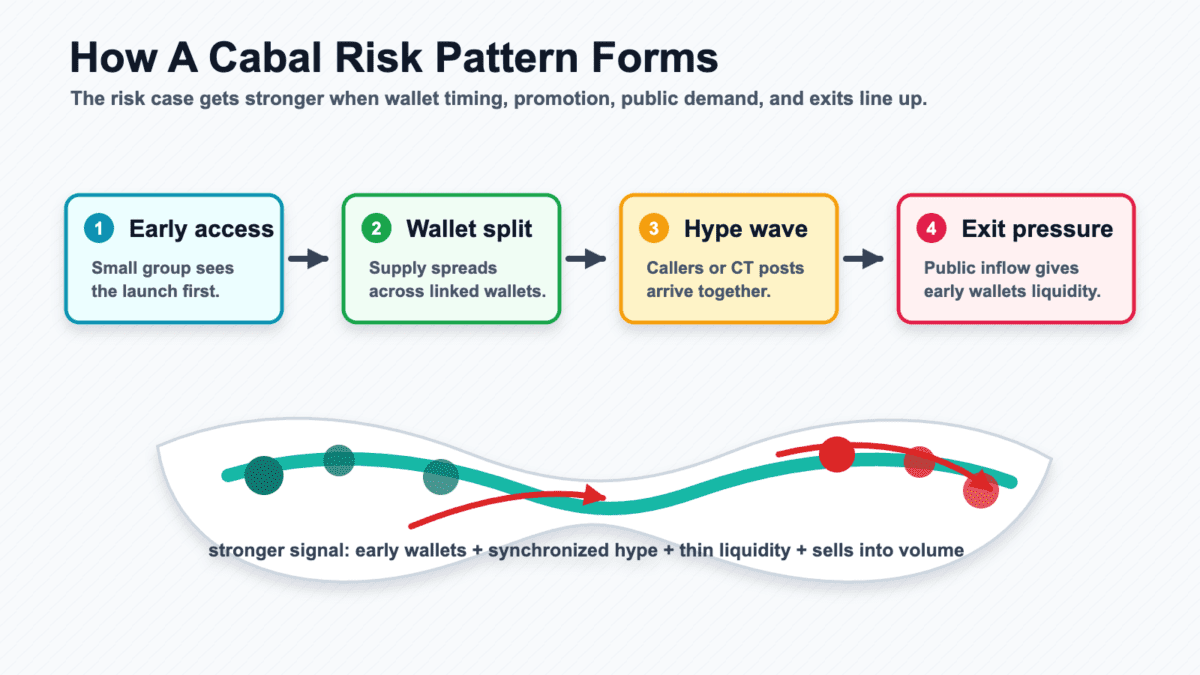
That sequence can be hard to prove because coordination rarely announces itself. A cluster of fresh wallets may be snipers. A synchronized KOL wave may be paid promotion. A sudden sell wall may be normal profit-taking. The danger is the combination.
A stronger cabal signal appears when several clues line up: early wallets share funding sources, those wallets bought before promotion, liquidity is thin, and the loudest accounts arrived after insiders already had size. One clue is noise. A stacked pattern is a risk case.
The missing piece is usually intent. You may not know whether wallets planned the move together, but you can still see whether early access, promotion, and exits line up too neatly for comfort.
A cabal-style meme coin usually looks staged, while an organic meme coin grows through broader participation over time. Neither label guarantees safety, but the difference changes how you read the chart, the holder base, and the hype.
Organic growth tends to feel messier. Different accounts find the coin at different times, wallets build unevenly, and community posts are not perfectly synchronized. Cabal-style growth often looks more polished early because coordination can create the appearance of momentum before real demand exists.
Use the table as a pattern check, not a verdict:
| Pattern | What It Suggests |
|---|---|
| Holder spread grows gradually | Broader participation may be forming |
| Many fresh wallets bought before hype | Early coordination or sniping may exist |
| KOLs post similar lines at once | Promotion may be paid or staged |
| Liquidity is thin versus market cap | Exits can move price hard |
| Community answers hard questions clearly | Risk may be lower, though not gone |
| Early wallets sell into volume | Public demand may be funding exits |
The trap is assuming organic means safe. Organic communities can still overpay, ignore risk, or become the attention economy wearing a mascot. Ask a narrower question: does the coin need new buyers for insiders to escape, or does demand look broad enough to survive questions?
Common cabal signals are clues that early access, wallet control, or staged promotion may be shaping a token. They are not verdicts, so the goal is to build a risk picture instead of hunting one magic red flag.
Start with wallets and liquidity. If a few wallets hold a large supply share, the chart can break when they sell. If many early wallets look fresh, share funding, or bought in the same narrow window, the holder spread may be less organic than it looks.
An arXiv study revised in 2026 found that 82.8% of high-return meme coins it analyzed showed evidence of artificial growth strategies. So cabal checks should focus on stacked patterns rather than one noisy wallet.
Then check how the social layer lines up with the on-chain layer:
Rug risk deserves its own pass. A hard rug can drain liquidity or block normal exits, while a soft rug can bleed users through slow selling, abandoned work, or endless hype resets.
Be careful with the wallet you use around scanners, Telegram bots, or checker tools. Keep risky tools away from your main wallet, and review wallets before connecting anything that can request permissions.
None of these checks makes a trade safe. They only show whether the chart has enough hidden pressure to make “just a quick buy” more expensive than it sounds.
A cabal claim can point you toward real risk, but it cannot prove manipulation on its own. A Reddit post, Dexscreener flag, chart dump, or angry holder thread is a lead, not a conviction.
Turn each claim into a check:
| Claim | Better Check |
|---|---|
| “The team owns everything” | Inspect top holders and deployer wallets |
| “Those wallets are bundled” | Check wallet funding and buy timing |
| “All KOLs are paid” | Compare post timing with early buys |
| “Liquidity is fake” | Check depth, locks, and removable liquidity |
| “The chart proves it” | Match price action with wallet sells |
| “The dev is hiding” | Compare claims with doxxed or public history |
Evidence is usually cumulative. One wallet cluster may be harmless. One paid post may be normal marketing. One sell into volume may be profit-taking. But when wallet age, funding links, KOL timing, and liquidity weakness all point the same way, the risk case gets harder to ignore.
Keep the language tight. Say “this setup has cabal risk” or “the wallets look coordinated” before saying “this is a cabal.” Precision will not make the chart nicer, but it can keep your risk checks from becoming rumor recycling.
CABAL can be a token, a project name, or just slang, depending on the context. That is why the word can feel messy in the wild: some pages track a ticker, some describe a platform, and some use the word as a market accusation.
Lowercase cabal usually means the slang covered here. Uppercase CABAL may refer to a token ticker or price-page label. Branded names such as The Cabal or cabal.md can refer to specific products that use the word, not the general meme-coin accusation.
Decrypt reported on a 2024 CABAL meme-coin airdrop involving influencers, which is one reason the ticker and slang can blur. That example does not make every CABAL-named asset the same thing. Context decides which meaning fits.
So check the context before drawing a conclusion. A price tracker is not a slang guide. A protocol doc is not a scam verdict. And a Telegram message saying “cabal” is not a full due-diligence packet, however confidently it is typed.
Cabal can also appear in crypto governance when users think a small group is steering decisions, events, DAO votes, grants, or narratives. In that setting, the word is less about meme-coin supply and more about influence.
On CT, cabal accusations often show up when people believe insiders had private access, early agenda control, or social power that regular users did not. The same caution applies: the claim may reveal a real concern, but it still needs evidence.
Separate influence from coordination. A whale voting on a proposal, a delegate arguing publicly, or a founder pushing a roadmap is visible power. Cabal language becomes more useful when decisions move through private chats, grant paths are unclear, or the same accounts steer every vote while calling it community consensus.
Governance use should stay specific. Ask who has voting power, who controls proposals, who funds delegates, and whether discussions happen in public. Avoid vague “hidden elites control everything” language. That framing brings baggage from outside crypto and usually makes the analysis worse.
Keep it observable. If a small group can shape outcomes without transparent checks, say that. If the evidence is only vibes and screenshots, say that too. Crypto has enough actual coordination risk without adding fog machines.
When a coin is called cabal, slow down before you buy, add, or panic-sell. The label means the setup deserves checks, not that the correct move is instantly obvious.
Start by reducing the decision size. If you cannot explain who holds supply, where liquidity sits, and why loud accounts arrived together, the trade probably deserves a smaller position or no position. A conviction play should have a reason beyond “the cabal might pump it.”
Use a simple reaction list:
Some traders try to profit from suspected cabal coins by tracking wallets or copying flows. That can work in rare cases, but it also turns the trade into a lottery ticket with worse information than the people being copied.
Late followers often become the bagholder because they see the signal after the best entry. If you do trade it, define the exit before the candle starts screaming. Otherwise jeeting early may look foolish until staying late looks worse.
Cabal overlaps with several crypto slang terms, especially in meme-coin markets. These terms help explain the risk without turning every bad token into the same accusation.
Jeets are traders who sell quickly, often before a community wants them to. In a cabal setup, early jeets may be insiders taking fast profit, or just nervous buyers leaving before the room gets smoky.
Trenches describes the high-speed zone where fresh tokens, Telegram calls, wallet watching, and bad decisions share one tab. Cabal language spreads there because traders need short words for ugly patterns.
A narrative coin runs on a story that traders can repeat. A cabal can exploit that when it controls early supply and pushes a story before public buyers see the setup.
Meta describes the current market theme. Cabal-style groups may chase a hot meta because attention is already there. That does not make every themed coin coordinated, but it explains why crowded narratives attract staged launches.
Rotation becomes important after the first pump. If money leaves the theme or early wallets rotate out, late buyers can be left holding a chart that only looked alive while insiders had reason to stay.
Cabal in crypto means a suspected coordinated insider group with early access to supply, hype, wallets, or exits. It usually appears around meme coins, CT, Telegram calls, and fast launches where traders think public buyers entered after insiders already had the advantage.
No, a cabal coin is not always a scam. The label can point to insider risk, staged hype, or unfair supply, but it still needs evidence. Check holder concentration, fresh wallets, liquidity control, early sells, and promotion timing before making a judgment.
Cabal wallets are wallets suspected of being linked to insiders, snipers, private traders, or coordinated promoters. Traders usually look for fresh wallets, shared funding sources, same-window buys, large early allocations, and selling during public hype. Those clues can suggest coordination, but they do not prove one owner by themselves.
Cabals can make money from meme coins by getting early supply, creating attention, attracting public buyers, and selling into the new liquidity. The profit comes from timing and information advantage. The public sees the hype, while early wallets may already be planning the exit.
CABAL can be a token ticker or project name, but cabal crypto slang is broader. A CABAL price page may refer to a specific asset. A message saying “this coin is cabal” usually means someone suspects coordinated insiders, not that the token ticker is CABAL.
You can profit from a cabal coin, but the risk is high because insiders may have better entries, faster exits, and more information. Spotting possible coordination may explain why a token pumps. It does not guarantee you can exit before the people who planned the move.
If a coin is called cabal, start with checks you can verify instead of the loudest thread. The goal is not to win the argument. It is to avoid buying a setup where someone else already owns the exit.
Move slowly enough to write down the reason for the trade. If the only reason is “someone knows something,” you are already late to the part you hoped to copy.
Use this order:
If the evidence is unclear, size down or skip. A smaller trade gives you room to be wrong, and skipping saves your attention for cleaner setups.
There will be another coin, another chart, and another group chat pretending urgency is a trading plan. The edge is not knowing every cabal. It is refusing to buy when the risk only becomes obvious after the insiders have sold.