Physical Address
304 North Cardinal St.
Dorchester Center, MA 02124
Physical Address
304 North Cardinal St.
Dorchester Center, MA 02124


Read CLOB depth before a thin book teaches the lesson.
A central limit order book (CLOB) is an exchange system that lists buy and sell limit orders, ranks them by price and time, and matches trades when prices cross.
In crypto, a CLOB is the order-book model behind many centralized exchanges and some DEX designs. It gives traders more control than a basic swap button, but it also asks more from them. You need to read the spread, depth, order type, custody model, and fill risk before the blinking numbers become an expensive lesson.
A central limit order book (CLOB) in crypto is a live list of buy and sell limit orders that an exchange uses to match trades. Buyers post bids. Sellers post asks. The highest bid and lowest ask form the top of the book.
The gap between those two prices is the bid-ask spread. The amount available at each price level is market depth. A deep book has enough posted orders to absorb larger trades without moving the price much. A thin book can look fine at the top, then punish the next impatient click.
The basic pieces are worth naming before the jargon starts breeding:
Imagine ETH has a best bid at $3,000 and a best ask at $3,002. If you place a limit buy at $2,995, your order may sit in the bid queue. If you place a market buy, you cross the spread and take the lowest available asks until your order fills.
That is the useful beginner split. A CLOB does not create liquidity by itself. It organizes liquidity that other traders, market makers, and venues provide. The order book can show you the available path, but it cannot make that path good.
A central limit order book (CLOB) works by receiving your order, checking it against the opposite side of the book, and either filling it, partially filling it, posting it, canceling it, or letting it expire. The matching engine applies the venue’s rules.
Most CLOBs use price-time priority. Better prices go first. If two orders have the same price, the older order usually gets priority. That is why queue position can matter, especially for active traders trying to be makers instead of takers.
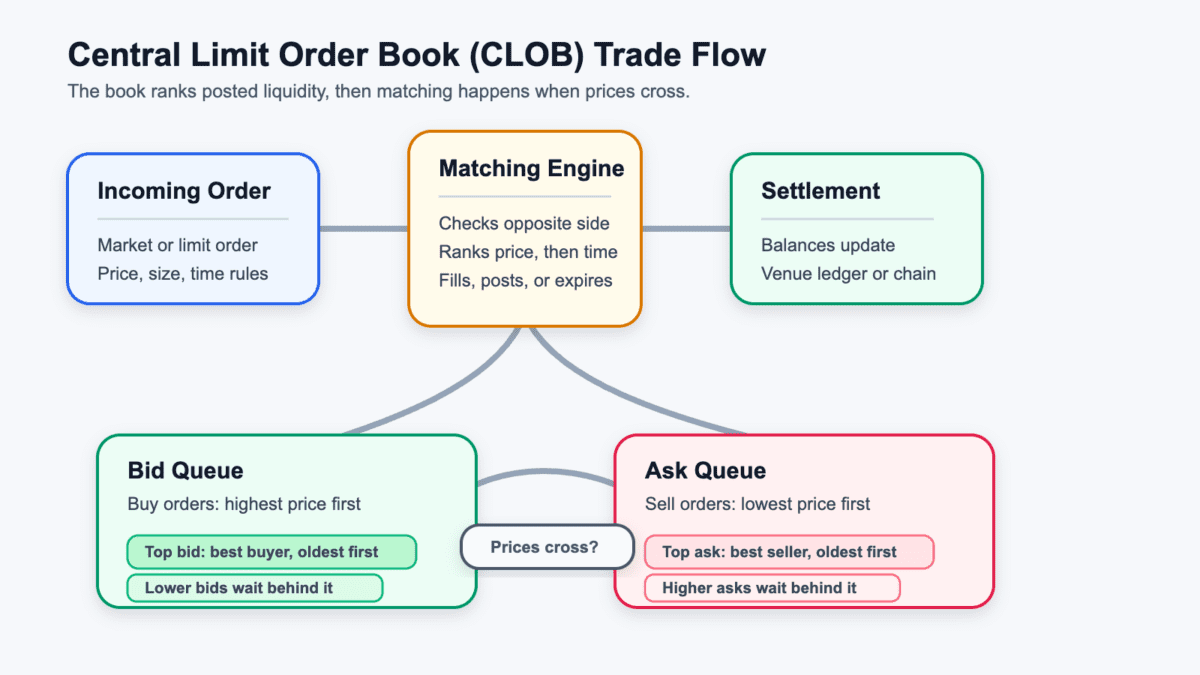
The trade path is clearer as a sequence:
| Action | What Happens In The CLOB |
|---|---|
| You place a limit buy below the best ask | The order usually posts to the bid side and waits. |
| You place a market buy | The order takes the lowest asks until it fills or runs out of size. |
| Your order size is larger than top-of-book liquidity | The trade may walk through several ask levels. |
| Your limit price crosses an ask | The matching engine executes the matching quantity. |
| Only part of your size is available | You get a partial fill and the remainder follows your time-in-force rule. |
| You cancel before a fill | The open part leaves the book if cancellation is accepted in time. |
Maker and taker roles come from this flow. A maker posts liquidity to the book. A taker removes liquidity by crossing the spread. Venues often price those roles differently, but the real cost is broader than the fee label. Spread, depth, queue position, and timing all matter.
Time-in-force settings decide how long an order may live. Good-till-canceled can sit until filled or canceled. Immediate-or-cancel tries to fill what it can right away and cancels the rest. Fill-or-kill demands the full order immediately or nothing. Those settings sound small until a fast market turns “mostly filled” into a position you did not plan.
Reading a central limit order book (CLOB) means checking the price levels your trade will actually touch, not just the best price on the screen. The top quote is only the first step. Your order size decides whether that quote is enough.
Start with the best bid, best ask, and spread. A tight spread usually means the market is more competitive. A wide spread tells you the two sides disagree, liquidity is thin, or market makers are demanding more compensation for risk.
Then check depth at your trade size. This small ladder shows why:
| Order Book Level | What It Means |
|---|---|
| Best ask: 2 ETH at $3,002 | A small market buy can fill near the displayed price. |
| Next ask: 5 ETH at $3,006 | A larger market buy starts paying more. |
| Next ask: 8 ETH at $3,014 | A very large market buy walks deeper into worse prices. |
If you buy 1 ETH at market, the best ask may be enough. If you buy 10 ETH at market, the order can consume several ask levels. Your average fill price may be much higher than the first number you saw.
That is CLOB slippage. It is not the same as AMM curve slippage, but the user feeling is familiar: the final fill can differ from the price you expected. A CLOB can make the path more visible, but it cannot promise that enough size will be waiting.
Depth also changes quickly. Market makers can cancel. Other traders can take the same liquidity first. A quote can look comfortable, then vanish when volatility rises. Before placing a larger order, compare top-of-book size with cumulative depth near your limit price.
Here is the check. If your trade is large compared with displayed depth, use a limit order, split the order, or wait for a better setup. A market order through a thin book is not bravery. It is a donation with extra steps.
CLOB vs AMM is a comparison between two ways crypto markets form prices and source liquidity. A CLOB matches posted bids and asks. An automated market maker prices trades against liquidity pools and a formula.
Neither model is automatically better. CLOBs can give traders precise limit orders, visible depth, and familiar exchange controls. AMMs can support long-tail tokens earlier because a pair can exist once liquidity providers deposit assets into a pool. A weak CLOB can be worse than a deep AMM.
The main changes sit in execution, cost, and control:
| Check | What Changes |
|---|---|
| Price formation | A CLOB uses posted bids and asks, while an AMM uses pool reserves and a pricing curve. |
| Liquidity source | A CLOB needs orders and market makers, while an AMM needs liquidity providers. |
| Order control | A CLOB supports limit orders, maker orders, and time rules more naturally. |
| All-in cost | A CLOB exposes spread and depth, while an AMM exposes fee, price impact, route, and minimum received. |
| MEV exposure | AMMs can expose visible swaps to sandwich pressure, while CLOBs can expose queue and latency games. |
| Long-tail tokens | AMMs often start faster, while CLOBs need enough active quoting to avoid empty books. |
User-reported cost comparisons often contrast AMM slippage with CLOB spreads, especially for larger trades. Those posts are useful pain signals, not proof of universal costs. One user’s route, chain, token, and size can make the numbers look wildly different.
For liquid pairs, a strong CLOB can give tighter execution and more control. For illiquid tokens, an AMM with concentrated liquidity can still beat a quiet order book. So the choice is not just “CLOB or AMM?” It is whether the venue has enough liquidity, clear costs, and a settlement model you understand.
RFQ sits near this comparison too. In a request-for-quote model, a trader asks one or more market makers for a specific price. That can work well for larger or less liquid trades, but it depends heavily on who sees the request and who provides the quote.
Centralized, decentralized, and hybrid CLOBs differ mainly in who controls custody, matching, settlement, and the trade record. The order-book shape may look similar, but the trust model can be completely different.
On a centralized exchange, the venue usually holds user balances, runs the matching engine, updates internal accounts, and manages withdrawals. The experience can be fast and familiar. The tradeoff is account risk, venue risk, and whatever restrictions apply to that platform.
A DEX CLOB changes part of that model. Some designs let users keep assets in wallets or smart contracts, then settle trades on-chain. That makes self-custody wallet setup more relevant, because a trading venue no longer hides key management behind a login screen.
Hybrid designs sit in the middle. They may match orders off-chain for speed, then settle the results on-chain. That can reduce gas and latency, but it also creates a question: who controls the off-chain matching process, and how can users verify fair treatment?
The dYdX Help Center gives a useful concrete limit: short-term orders on dYdX Chain last up to 20 blocks in validator memory, or about 30 seconds. The broader lesson is not that every DEX CLOB works the same way. It is that “on-chain settlement” and “on-chain matching” are different claims.
Fully on-chain CLOBs push more of the order life cycle onto the blockchain itself. Orders, cancellations, matching, and settlement can become more transparent. But that transparency has a price. The chain must handle frequent updates quickly enough for traders and market makers to care.
So when a venue calls itself a decentralized order book, separate the layers. Ask where the order lives, where matching happens, who can cancel or censor, how settlement finalizes, and what happens if the operator, sequencer, bridge, or smart contract fails.
On-chain CLOBs are hard to build because order books need constant updates, fast cancellations, and frequent matching. Blockchains are good at shared settlement. They are less comfortable with thousands of tiny order changes racing every second.
Each order action can create state. A trader places an order. Another trader cancels. A market maker refreshes quotes. A taker consumes part of the book. The system must rank, match, store, and settle those changes without becoming too slow or expensive.
The hard parts usually cluster around a few constraints:
That is one reason AMMs became common in DeFi. An AMM can price a swap from pool reserves without maintaining a live queue of every bid and ask. It is not always cheaper or safer, but it is simpler to run on many chains.
CLOB builders try to solve this with faster chains, appchains, rollups, off-chain order relay, batch settlement, shared liquidity layers, and specialized matching systems. Some newer designs also use zero-knowledge proofs to make parts of execution more verifiable.
> ZK can help verify parts of execution, but it does not create liquidity by itself.
That warning needs its own line. A clever proof system can improve transparency around a matching process. It cannot force market makers to quote tight spreads, prevent every bad order, or make a new venue deep on day one.
The useful user check is simple, which is often a good sign. Does the book stay liquid during volatility? Can you cancel quickly? Are fills and settlement rules understandable? If those answers are weak, the infrastructure story is just a nicer wrapper around a thin market.
A central limit order book (CLOB) helps when traders need control over price, order size, and timing. It works best when there is enough active liquidity for bids and asks to stay tight across meaningful size.
Good CLOB markets often involve liquid majors, perpetual futures, prediction markets, and pairs with active market makers. In those settings, the book can show where size is available, how tight the spread is, and whether your order is likely to fill without walking too far.
Good-fit cases usually look like this:
A CLOB does not help much when the book is empty, stale, or dominated by one-sided liquidity. Thin altcoin books can turn impatient buyers and sellers into exit liquidity for better-positioned traders. The order book may be transparent, but transparency does not make the other side generous.
Bad-fit cases look different:
AMMs can still work better for long-tail tokens, simple swaps, and early liquidity. A CLOB shines when active quoting exists. Without that, the book becomes a scoreboard for missing liquidity.
CLOB risks start with the false comfort of visible depth. A central limit order book (CLOB) can show you posted liquidity, but it cannot guarantee fair fills, stable quotes, or equal speed for every trader.
Wide spreads are the first warning. If the best bid and ask are far apart, crossing the spread costs you before any fee appears. Thin top-of-book size is the second warning. Your trade may fill the first level, then keep chewing into worse levels.
Retail traders also face speed and tooling gaps. API users, professional market makers, and latency-sensitive traders may react faster than a manual trader. That can make active markets feel like PVP trading even when the rulebook is public.
Check these risks before trading:
Spoofing-like behavior is another concern. Traders may post size that looks meaningful, then cancel before it trades. You do not need to prove intent to protect yourself. If depth keeps appearing and vanishing, reduce size or use stricter limits.
DEX CLOBs add extra layers. Smart contracts can fail. Bridges can fail. Sequencers can censor or delay. Wallet mistakes can be final. CEX CLOBs add different risks, including account freezes, withdrawal limits, operational failures, and opaque internal controls.
The takeaway is not to avoid CLOBs. It is to stop reading “visible order book” as “safe execution.” A CLOB gives you more information, but it also gives you more ways to ignore that information.
Before you trade on a CLOB, compare the full execution path with your order size and risk limit. The fee line is only one part of the cost. Spread, depth, fill type, custody, and settlement can matter more.
Use this checklist before placing anything larger than a casual test order:
Position size belongs in that checklist too. Sending your entire position through a thin book is how a trading plan turns into public comedy. Split size, use limits, and give the book time to show whether real demand is there.
For DEX CLOBs, test the full path with a small amount first. That includes deposit, order placement, cancellation, settlement, and withdrawal. A venue can have a clean interface and still hide friction in the last step.
For CEX CLOBs, check the account side. A great fill is less useful if withdrawal rules, regional restrictions, or verification friction trap the funds afterward. Trading mechanics and account access are separate risks, but your balance experiences them together.
Related CLOB concepts help you see where the order book ends and the rest of market structure begins. The most useful ones are AMM, RFQ, market maker, spread, market depth, matching engine, and MEV.
An AMM prices swaps from liquidity pools. It is common in DeFi because it can support simple token swaps without a live order queue. An RFQ system asks one or more liquidity providers for a quoted price on a specific trade.
A market maker posts bids and asks to earn spread, rebates, or strategy profit. The spread is the gap between the best bid and best ask. Market depth is the available size across price levels. A matching engine is the system that applies the venue’s rules.
MEV is the value that can be extracted from transaction ordering, routing, or settlement. It shows up more often in AMM and on-chain execution conversations, but CLOB users still face ordering, latency, and queue-position risk.
For the next practical checks, start with sizing and fake-looking liquidity. Full port explains why one oversized trade can turn a small execution mistake into an account-level problem. Volume spoofing helps you think about depth that appears convincing until it disappears.
The shared point is simple. A CLOB is not the whole market. It is one matching design inside a wider stack of liquidity, infrastructure, custody, fees, and trader behavior.
CLOB stands for central limit order book. In crypto, it usually means an exchange-style order book where buy and sell limit orders are ranked by price and time.
You will see the term around centralized exchanges, perp DEXs, prediction markets, and on-chain order-book projects. The acronym sounds more complicated than the idea. It is a live queue of orders plus a matching engine.
A central limit order book is a specific type of order book. It lists limit orders in one central market and matches them under a defined rule set, often price-time priority.
People often say “order book” casually when they mean CLOB. The distinction becomes important when comparing CEXs, DEXs, RFQ systems, AMMs, and hybrid venues.
A CLOB is better than an AMM when you need precise order control, visible depth, and enough active liquidity. It can be worse when the book is thin or market makers are absent.
An AMM can be better for simple swaps and long-tail tokens because liquidity can start from a pool. The best model depends on trade size, pair quality, fee, spread, gas, and settlement risk.
Yes, a DEX can use a central limit order book, but the design can vary a lot. Some DEX CLOBs match off-chain and settle on-chain. Others push more of the order life cycle onto the chain.
Do not assume “DEX” means every step is trustless. Check custody, matching, settlement, sequencer control, cancellation rules, and what users can verify.
On-chain CLOBs are hard to build because order books need fast placement, cancellation, matching, and storage. Each action can create blockchain state, cost gas, and wait for finality.
Traders and market makers also need speed. If cancellation is slow or expensive, quotes become risky. That is why many designs use faster chains, rollups, off-chain matching, or hybrid settlement.
A CLOB does not remove slippage. It can make the available depth more visible, but a market order can still walk through several price levels if your size is larger than available liquidity.
Limit orders help control price, but they can miss the trade or fill only partly. The real check is depth at your size, not the first quote on the screen.