Physical Address
304 North Cardinal St.
Dorchester Center, MA 02124
Physical Address
304 North Cardinal St.
Dorchester Center, MA 02124


Chain abstraction hides chain steps, but not route risk.
Chain abstraction is a crypto design approach that lets an app handle chain selection, routing, gas, and settlement behind one user action.
It can make crypto feel less like a routing exam. But the route still exists. So do liquidity, signer permissions, chain finality, support records, and the boring little fees that do not vanish just because the button got prettier.
A good product makes the cross-chain action easier while keeping the route inspectable. When it fails that test, it has only moved the confusion off-screen.
Chain abstraction in crypto means the app handles the chain work users normally manage by hand. Instead of choosing a source network, switching wallets, bridging assets, finding gas, and opening another app, the user asks for the outcome.
That outcome might be a swap, payment, DeFi deposit, NFT purchase, or stablecoin transfer. The interface can show one balance and one action while the system handles chain selection, routing, gas logic, bridging, settlement, and confirmation.
The underlying chains still process the work. Ethereum, Solana, Base, Arbitrum, BNB Chain, and other networks do not disappear. Chain abstraction just makes them less visible in the user flow.
That distinction keeps the term honest. Chain abstraction can hide:
It does not remove market risk, smart-contract risk, signer risk, bridge dependency, liquidity depth, or support friction. A cleaner screen is useful. A cleaner screen that hides the receipt is a problem wearing nicer shoes.
Most users meet chain abstraction inside wallets, cross-chain swap tools, stablecoin payment apps, DeFi interfaces, and apps that stop asking which network to use. The promise is simple: ask for the result, not the route.
Chain abstraction exists because normal cross-chain crypto still asks users to do too many infrastructure jobs. A trader may hold USDC on Arbitrum, want a Solana asset, need SOL for gas, and then discover the route has three interfaces and five chances to mistype something.
Manual flows also make support harder. If one step fails, the user may need several transaction hashes, a bridge receipt, an app support ticket, and a calm heart rate. Crypto often supplies the first three slowly and the last one never.
The difference shows up in the work the user no longer has to do.
| Manual Cross-Chain Flow | Chain-Abstracted Flow |
|---|---|
| User chooses the source and destination networks. | App chooses or suggests the route. |
| User finds and compares bridge options. | Route engine quotes the path. |
| User holds gas tokens on each chain. | Gas may be sponsored, bundled, or netted into the quote. |
| User checks bridge, swap, and app fees separately. | User sees fewer line items, sometimes too few. |
| User opens the destination app after bridging. | Destination action may execute in the same flow. |
| User tracks support across several tools. | App should expose hashes, status, and refund path. |
The tradeoff is visibility. Chain abstraction can reduce wallet switching and bridge hunting, but it can also compress details that serious users still need. A simpler screen does not automatically mean cheaper execution, safer custody, or better liquidity.
Good chain abstraction removes chores. Bad chain abstraction removes visibility.
Chain abstraction works by turning a user goal into an executable route across accounts, networks, and liquidity sources. The user sees one action. Behind it, the system still needs approvals, route pricing, execution, settlement, status updates, and recovery handling.
The exact stack varies by wallet or app. A common chain abstraction flow starts with an intent, checks wallet permissions, prices possible routes, chooses a solver or relayer, uses a bridge or liquidity layer, executes on the destination chain, then returns confirmation or a refund path.
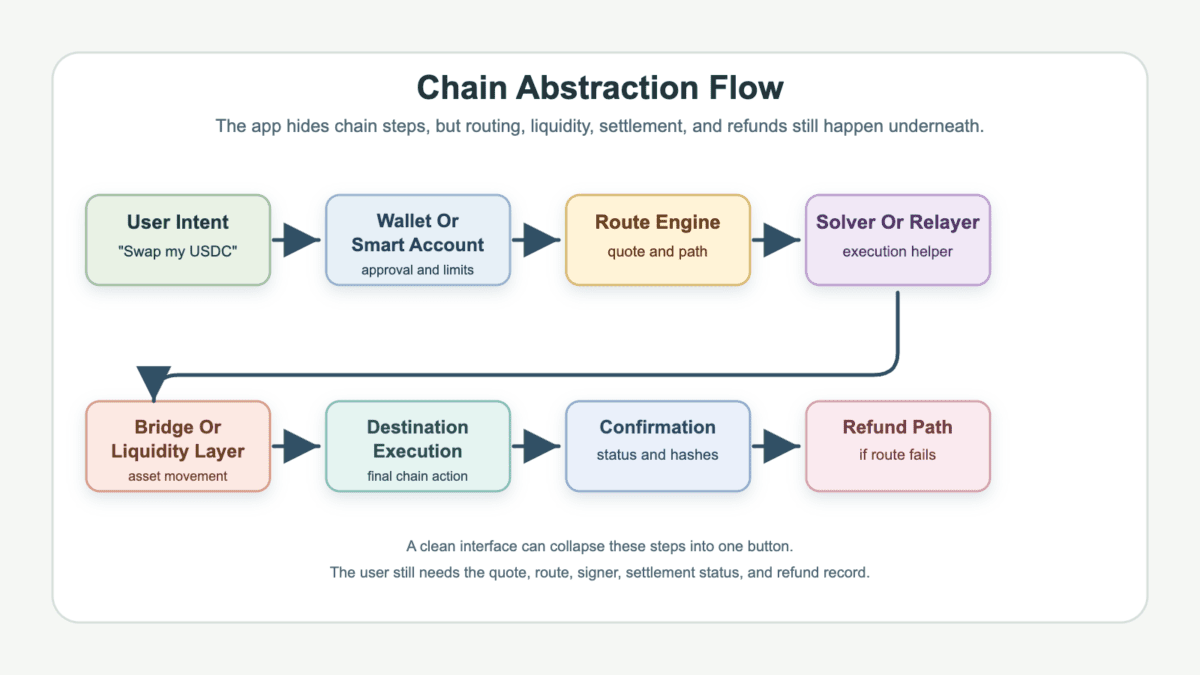
User intent is the requested outcome, such as “swap this USDC for that asset” or “pay this address.” The wallet or smart account then decides what the user is allowed to approve.
This is where chain abstraction can work with smart accounts, session keys, and limited permissions. The wallet may approve a narrow action instead of asking the user to sign a broad approval they barely understand.
The signer model still matters. A normal wallet signature, smart account rule, passkey flow, or delegated permission can all create different risk. If the wallet cannot show what it is approving, the smoother flow has already lost the plot.
Route selection turns the intent into a path. The system may compare bridges, liquidity pools, aggregators, messaging layers, and direct solver quotes before it shows a final amount.
A solver may fill the user’s desired outcome from its own inventory, then settle behind the scenes. A relayer may submit transactions or messages across chains. Both can make execution feel faster. Both add dependencies.
Pending states are normal in cross-chain flows. Quote expiry, source-chain finality, relayer queues, destination gas failure, and bridge delays can all pause the route. A good app shows the source transaction hash, destination transaction hash when available, quoted amount, current status, and refund address.
Liquidity decides whether the quoted route can deliver the asset at the expected price. Settlement decides when the destination action becomes final. Refund handling decides what happens when the route breaks.
These are not small details. A fast quote may use inventory instead of moving the same token through a slow bridge. That can be fine when the provider is sound and the price is clear.
But if a transaction fails, the user needs proof. Save the quote, transaction hashes, route ID, wallet address, destination address, and support ticket. Chain abstraction should reduce clicks, not erase the paper trail.
Chain abstraction changes a cross-chain trade by putting the desired result first. The user starts with the asset, amount, and destination outcome, not a bridge menu.
Take a trader with USDC on Arbitrum who wants exposure to a Solana asset. The old path may require choosing a bridge, moving USDC or a wrapped version, getting SOL for gas, waiting for settlement, opening a Solana trading app, and checking the final fill.
A chain-abstracted path can quote the whole route up front. The app may route Arbitrum USDC through a bridge or solver, handle the Solana-side execution, and show the final asset the trader receives.
The routing problem is already large enough to matter: DefiLlama’s bridge dashboard showed $18.835 billion in total bridge volume over the previous month as of June 5, 2026.
Before accepting the quote, check the parts the cleaner screen can hide:
This is where exit liquidity matters. A route can look elegant while the destination pool is thin, the spread is wide, or the final token version is hard to sell.
Chain abstraction can also speed up capital rotation between chains and narratives. That helps only if the route quality holds. Faster rotation with weak liquidity is just a cleaner way to arrive at a bad fill.
Chain abstraction differs from account abstraction, bridges, and multichain apps because it wraps cross-chain execution into a simpler user action. The terms can overlap inside one product, but they solve different parts of the problem.
Account abstraction changes how accounts validate actions, pay gas, recover access, and manage permissions. Ethereum’s account abstraction roadmap explains smart-account features that can support better wallet flows, but those features alone do not route a trade across chains.
The distinction helps when a product uses all four words at once.
| Term | What It Changes |
|---|---|
| Multichain app | Supports several chains, but may still make users choose and manage each one. |
| Cross-chain bridge | Moves assets or messages between chains. |
| Bridge aggregator | Compares routes across bridge or liquidity options. |
| Account abstraction | Changes wallet validation, permissions, recovery, and gas payment. |
| Chain abstraction | Wraps chain choice, route, gas handling, and settlement into one user-facing action. |
Account abstraction and chain abstraction can work together. A smart account can set spending limits, batch approvals, or sponsor gas while a chain abstraction layer handles route selection and settlement.
Bridges also remain part of many routes. Chain abstraction may hide bridge choice from the screen, but it still depends on bridging, messaging, liquidity inventory, or solver settlement. The bridge did not vanish. It moved backstage.
Chain abstraction can reduce fee friction, but cross-chain costs still land somewhere. A product may sponsor gas, bundle fees into a quote, or show a single total instead of several line items.
That can help beginners. It can also make a bad quote look suspiciously tidy. Users should ask what the quoted output includes before assuming the route is cheap.
Common costs can appear in different places.
| Cost Type | Where It Can Show Up |
|---|---|
| Source-chain gas | The first approval, transfer, or swap action. |
| Destination-chain gas | Final execution, claim, or app action. |
| Bridge or messaging cost | Cross-chain movement or communication. |
| Solver spread | Difference between market price and quoted fill. |
| Platform fee | App, wallet, or routing service charge. |
| Slippage | Price movement or thin liquidity during execution. |
| Priority fee | Faster source or destination execution. |
| Refund cost | Failed-route return or partial recovery. |
Sponsored gas is the easiest phrase to misunderstand. Someone still pays. The sponsor, app, wallet, solver, or user pays directly or indirectly through a wider quote.
Tiny remnants also add up. Cross-chain actions can leave dust in the form of small token balances, leftover gas tokens, or partial refunds. Dust is not always dangerous, but it can make wallet accounting messy.
The best interface shows the total expected output, the network path, any sponsored fee language, and the failure cost. If it only says “gasless” and smiles, keep the transfer small.
Chain abstraction risks sit in the layers that make the route feel simple. The user may approve one action, but execution can depend on a wallet signer, smart-account permissions, route engine, solver, relayer, bridge, liquidity venue, and destination app.
Use a route only when the boundaries are visible. Move meaningful size after you can inspect them.
Run these checks before a large route:
Wallet setup deserves extra care. If the flow relies on a smart wallet, embedded wallet, passkey, or delegated signer, review the wallets layer before the trade. Account control comes first.
Large trades need route transparency. A fast route may use solver inventory, market-maker liquidity, or a bridge-backed settlement promise. That can be useful. But the user should know whether they are waiting for final chain movement, receiving inventory-backed liquidity, or accepting a delayed refund path.
The worst failure pattern is not a failed transfer. It is a failed transfer with no status, no hashes, no refund logic, and a support page that acts like “pending” is a personality trait.
Assess a chain abstraction project by checking whether it makes one useful action easier without hiding risk. The product should reduce chain chores while keeping fees, permissions, liquidity, and support paths visible.
Start with the live user flow. A project with polished language but no clear quote, route status, supported-chain list, or refund behavior is still mostly a pitch.
Useful checks include:
Market attention can turn chain abstraction into a crypto meta. That may bring capital, integrations, and noise at the same time. A hot label does not prove the product can route real size.
Infrastructure claims need patience. If chain abstraction becomes a conviction play, usage, liquidity, security, and clear failure handling should earn it. Narrative heat alone is not a route map.
The strongest projects make one high-value action simpler. They also let users inspect enough of the plumbing to know what happens when the clean path breaks.
Chain abstraction examples work best when they start with user outcomes, not vendor slogans. The goal is not to crown one stack. The goal is to see which chain work disappears from the main flow.
Common examples include:
In each case, the user should still see the important constraints. One balance should not hide which asset version is held. One payment should not hide the route cost. One DeFi deposit should not hide the bridge dependency. One marketplace action should not hide failed-settlement handling.
Products may build around intents, smart accounts, solver networks, bridge aggregation, liquidity inventory, or cross-chain messaging. The labels differ, but the user’s checklist stays boring in a useful way: quote, permissions, route, settlement, refund.
That is the clean path through the vendor fog. Start with the action. Then ask which invisible steps carry risk.
Chain abstraction sits near several terms that often get blended together. Keeping them separate helps users avoid thinking every cross-chain product solves the same problem.
Account abstraction is about wallet behavior. It can change signing, recovery, spending limits, batching, and gas payment. Chain abstraction may use account abstraction, but its bigger job is hiding cross-chain routing from the user.
Gas abstraction means the user does not handle gas in the usual way. Gas can be sponsored, paid in another token, bundled into a quote, or handled by the app. It is a fee-handling feature, not a full cross-chain execution model.
Intents describe outcomes. Instead of signing every step, the user requests a result. Solvers are participants that try to satisfy that result, often by finding or providing the route.
Cross-chain bridges move assets or messages. Bridge aggregators compare routes. Liquidity fragmentation describes why the same asset may be split across chains, pools, and versions. Unified balances try to make that split easier to view.
Smart wallets, appchains, and multichain apps can all appear in chain abstraction products. The useful check is what each term changes: the account, the chain route, the liquidity source, or the app experience.
No. Chain abstraction can use bridges, but bridging is only one possible part of the route. Chain abstraction focuses on hiding chain selection, gas handling, routing, and settlement inside one user-facing action.
No. Account abstraction changes wallet and account behavior, while chain abstraction changes how cross-chain actions are routed and shown to the user. They can work together in the same wallet or app.
No. Chain abstraction may sponsor gas, bundle it into the quote, or hide separate line items. The cost still exists somewhere, so users should compare the final received amount.
Chain abstraction can be safe for larger trades only when the route is transparent, liquidity is deep, wallet permissions are narrow, and the refund path is clear. Test small before moving size.
Chain abstraction transactions can fail because quotes expire, relayers queue, bridges delay, destination gas is missing, liquidity shifts, or smart-account permissions reject the action. Save hashes and route IDs before opening support.
Chain abstraction works only across the chains a specific wallet, app, solver, bridge, or routing layer supports. Always check the supported-chain list and the actual route before assuming coverage.
Start with chain abstraction the same way you should start with any cross-chain tool: small, documented, and slightly skeptical. A good first test is a route you can follow from quote to confirmation.
Before approval, make sure the app shows enough detail to reconstruct the route. If support would need a transaction hash, route ID, wallet address, or refund address, you should have that information too.
Use these checks before you move meaningful funds:
If the first route works, increase size slowly and compare each quote against the previous one. Slippage, solver spread, and refund behavior can change when the amount grows.
Then decide whether the tool earned more trust. Chain abstraction should make cross-chain crypto less annoying without making the route impossible to inspect. If the product hides the chain and the risk, the abstraction is doing too much.