Physical Address
304 North Cardinal St.
Dorchester Center, MA 02124
Physical Address
304 North Cardinal St.
Dorchester Center, MA 02124


A plain-English guide to Chainflip, native swaps, FLIP, fees, and risk checks.
Chainflip is a cross-chain swap protocol that lets users exchange native crypto assets across supported chains without the usual wrapped-token bridge route.
That sounds simple, but the details decide whether a route is useful. A Chainflip swap is different from buying FLIP, staking FLIP, providing liquidity, using Boost, or chasing BTC yield. Each choice has its own risk stack.
Chainflip is a protocol for swapping native crypto between supported chains. The core promise is direct asset movement: send one asset from one chain and receive another asset on another chain. You avoid the usual “wrap it, bridge it, unwrap it, hope it matches” routine.
The phrase Chainflip crypto can also point users toward the FLIP token, price pages, staking, LP roles, or yield products. Those are related, but not identical. Using Chainflip to swap BTC into ETH does not mean you bought FLIP. Providing liquidity is not the same as sending one normal swap.
Keep these choices separate from the start:
The clean way to understand Chainflip is route-first. Start with the asset you hold, the asset you want, the chain where each one lives, and the wallet that will receive the output. Then ask what happens between those two wallets.
Chainflip uses protocol-controlled vaults, validators, a State Chain, and a Just-In-Time AMM to coordinate that movement. Those words are useful only when they explain where funds sit, who sees the deposit, who prices the trade, and who sends the final asset out.
Native swaps are useful. They are not a cheat code against slippage, bad addresses, thin liquidity, fake URLs, or token risk.
Chainflip moves native crypto by turning a source-chain deposit into a destination-chain send. A user might start with BTC and want ETH, or start with BTC and want SOL. The important part is that the user is not first minting a wrapped BTC token on another chain just to keep moving.
The route usually starts through a front end, wallet, broker, integration, SDK, or direct protocol path. The user provides the source asset, destination asset, destination address, and other route details. Chainflip’s Protocol Overview describes the State Chain, validator-controlled vaults, and JIT AMM as core pieces behind native cross-chain swaps. It also says up to 150 validators can participate in the protocol’s Authority Set at one time.
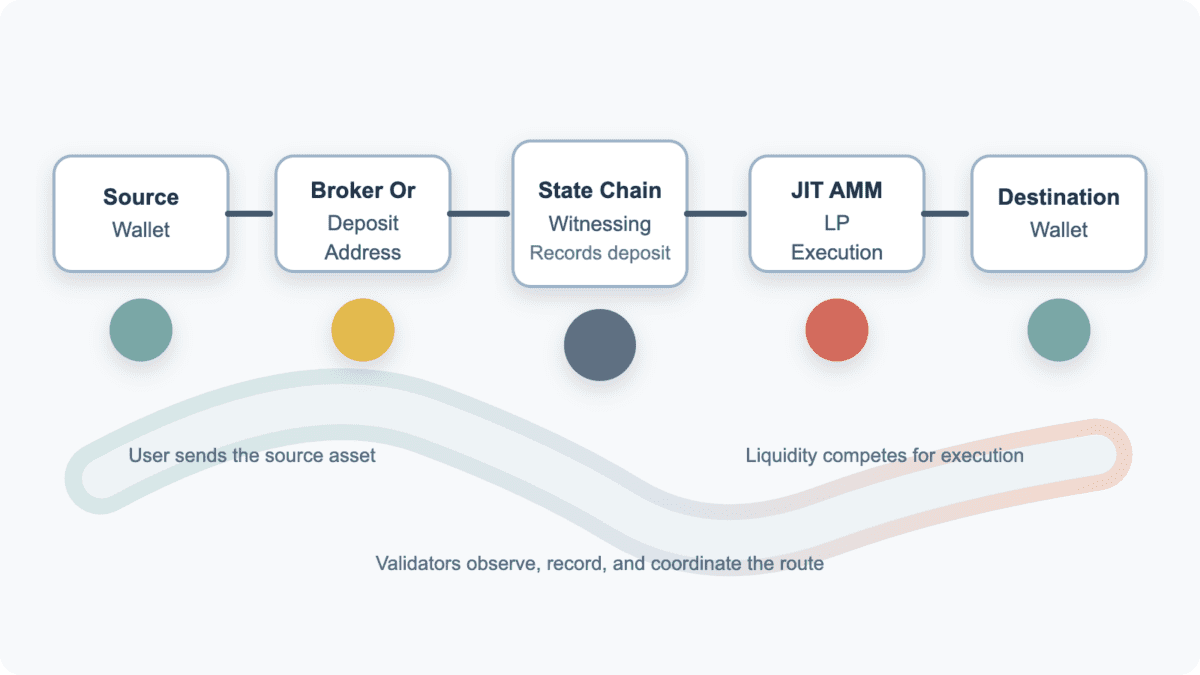
Once the user sends funds, validators watch supported chains for the deposit. That observed deposit is recorded on Chainflip’s State Chain. The State Chain is the protocol’s coordination layer, not the destination chain where the user wants to end up.
Execution then happens through the JIT AMM. Liquidity providers compete to price the swap when the order is ready, and routes can pass through more than one pool. A BTC-to-ETH route, for example, may use an intermediate stablecoin pool before the final ETH output is sent.
The moving pieces have distinct jobs:
Then comes egress. Validator-controlled vaults send the destination asset to the wallet address the user supplied. That final address is not decoration. If it is wrong, unsupported, or controlled by the wrong wallet, even a clean route can end badly.
For users, the takeaway is plain: Chainflip is not just a quote screen. It is a cross-chain route with a deposit, a witness period, AMM execution, liquidity competition, and a destination send. Each step can affect timing, final output, or recovery options.
Chainflip sits in the same decision set as bridges, centralized exchanges, THORChain-style native swaps, wallet swaps, wrapped-BTC paths, and aggregators. The right route depends on custody, account needs, asset support, liquidity, size, support expectations, and route visibility.
A centralized exchange can be simpler when you need fiat, account support, tax records, or a familiar order book. A native swap route can be useful when you already hold assets in self-custody and want to move directly between chains without depositing to an account first.
Compare route types by the checks they force, not by slogans.
| Route Type | What To Check Before Using It |
|---|---|
| Chainflip native swap | Supported assets, destination address, quote expiry, liquidity depth, route status, and refund path. |
| Bridge plus DEX | Wrapped asset version, bridge security, destination liquidity, gas on both chains, and unwrap path. |
| Centralized exchange | KYC status, deposit and withdrawal rules, withdrawal fees, account limits, and support access. |
| THORChain-style native swap | Asset support, quote quality, affiliate fees, inbound confirmation time, and final receive amount. |
| Wallet or aggregator swap | Underlying route, provider fee, slippage setting, refund logic, and who handles support. |
The table does not crown a permanent winner. A route that wins for a small SOL swap might lose for a large BTC move. A CEX might beat DeFi on support, while a native route might beat a bridge when wrapped assets create extra steps.
For serious size, compare outputs across more than one venue. Save the quote, route ID, and transaction hashes. If the tool cannot show those basics, it is asking you to provide both liquidity and faith.
Chainflip is not just a bridge with better branding. It solves the cross-chain movement problem, but its native swap model differs from lock-and-mint bridge routes that create wrapped assets on another chain.
It is also not a FLIP price page. The token has a role in network security and economics, but token exposure is a market decision. A user can care about a Chainflip route without wanting to buy FLIP.
Chainflip is also not a shortcut around basic route checks. The protocol may reduce wrapped-token friction, but the user still chooses a source asset, a destination asset, a receiving address, and a route surface. Any one of those choices can be wrong.
Several other assumptions deserve a quick cleanup:
The privacy point is especially easy to mangle. No account or no KYC can reduce one type of friction, but public-chain activity is still visible. Wallet history, destination address behavior, sanctions screening, and analytics are separate from account signup.
The custody point also needs care. Chainflip avoids the exchange-account route, but funds still move through protocol-controlled vaults and validator processes. That is different from holding assets in your own wallet the whole time.
The same goes for integrations. A wallet, broker, or aggregator may expose a Chainflip route inside its own interface. That can be convenient, but it also changes where you look for fees, support, route IDs, and recovery details.
Chainflip fees and final output depend on more than one line item. A user may see a quoted receive amount, but the final result can reflect protocol fees, broker fees, network costs, LP spread, price impact, liquidity depth, route size, and slippage controls.
So ask more than “what is the fee?” Ask what amount should land, which assumptions support the quote, and what breaks if the route moves before execution.
Several checks belong before you accept a meaningful route:
A Chainflip quote is a snapshot of a route. It can age quickly when markets move, liquidity changes, or the route uses more than one pool. Larger swaps can push price harder when exit liquidity is thinner near the size you actually need.
> For large Chainflip swaps, a small test proves the address and basic route. It does not prove that the large route will receive the same price quality.
Slippage protection helps, but it is not a magic guardrail. A minimum accepted price can prevent execution below a limit. A refund path can matter when a route cannot execute within its rules. But fees, timing, and partial execution details still need checking before the swap starts.
Audit the receive amount first. Fees are only one way the output changes. Spread, depth, route timing, network costs, and retries can all matter more than a tidy fee label.
The FLIP token is tied to Chainflip’s network security and token economics. It is separate from the act of using Chainflip to make a swap, even though token pages often blur that line for obvious reasons.
At a high level, FLIP connects to validator participation, collateral, staking, fees, and network incentives. Validators secure the State Chain and help control protocol vault operations.
For a normal user, the split is simple:
Those choices can overlap, but they should not be sold as the same decision. A strong swap route does not automatically make FLIP a good trade. A weak FLIP chart does not automatically mean the route is unusable.
That distinction helps when token pages start mixing network health with investment language. Swap volume, validator incentives, burns, emissions, and fee flows can all affect the FLIP story, but none of them guarantees a good entry price.
Avoid stale token numbers unless you are checking a live source at the moment you act. Supply, emissions, burns, revenue sharing, staking yield, and market price can all change.
Use one sentence to name your exposure before committing funds. “I used Chainflip to swap BTC to ETH” is route exposure. “I bought FLIP” is token exposure. “I supplied liquidity” is balance-sheet exposure.
Chainflip liquidity, Boost, and BTC yield language belongs in a separate bucket from simple swapping. A swap user wants output. A liquidity provider supplies assets to earn from activity. A yield user is asking where return comes from and what can go wrong.
That split protects users from the most expensive confusion. “Passive BTC yield” sounds calmer than “I am taking protocol, liquidity, pricing, and withdrawal risk,” but the second version is usually closer to the truth. Start with the source of yield, not the label.
| Product Or Role | What Risk To Verify First |
|---|---|
| Active liquidity provider | Inventory exposure, order behavior, rebalancing needs, and whether you can monitor positions. |
| Passive liquidity provider | Asset exposure, pool rules, withdrawal path, fees earned, and who manages execution. |
| Boost participant | Boost fee source, timing risk, refund treatment, and whether yield depends on swap flow. |
| Lending or borrowing feature | Collateral rules, liquidation path, oracle design, withdrawal terms, and current product status. |
| Stablecoin strategy | Issuer risk, chain risk, pool depth, and whether yield compensates the hidden fragility. |
Broader yield farming context helps here because Chainflip yield still needs a payer. Yield is not free money because the protocol likes you. It usually comes from fees, incentives, borrowing demand, price spreads, or someone paying for faster liquidity.
Before providing liquidity or using Boost, check the asset you deposit, the asset you may receive back, the withdrawal route, the current fee source, and the failure path. If any of those answers are fuzzy, the yield number is doing too much emotional labor.
BTC yield deserves extra suspicion because BTC holders often think in principal preservation terms. If a route changes your exposure, locks funds, adds protocol custody, or depends on changing market flow, you are no longer just holding BTC with a coupon attached.
Chainflip risk sits wherever value can be delayed, repriced, rejected, misrouted, or misunderstood. A native swap removes some bridge steps, but it does not remove the need to verify the route.
The first risk is user error. Wrong destination address, wrong chain, unsupported wallet behavior, stale quote, or a copied fake URL can turn a reasonable route into a support problem. Crypto will not ask whether you had enough coffee.
Use this checklist before moving size:
Then come route and protocol risks. A Chainflip swap depends on validators, vault control, State Chain processes, liquidity providers, AMM execution, and destination-chain broadcasting. Each layer has a job. Each layer can affect timing, output, or recovery.
Fake route risk deserves its own warning. A lookalike native-BTC swap page, fake support account, or too-good-to-be-true yield page can feel close to a hard rug even when the real protocol is not involved. The scammer borrows the brand. You supply the funds.
> No account does not mean invisible. It means you should separate KYC friction from onchain privacy, route screening, and wallet history.
No-KYC risk is another common misunderstanding. Not creating an account does not mean private, anonymous, or immune from chain-history review. Public wallets still leave public records. Compliance screening, analytics, and destination-chain traces can still affect the route or later account use.
FLIP holders, validators, LPs, Boost users, and lenders also face risks that a one-time swapper does not. Token price can move. Validator behavior can be penalized. Liquidity can become uneven. Withdrawal timing can matter. The more roles you take, the more risk surfaces you inherit.
Checking a Chainflip route means verifying the source, destination, quote, wallet, and recovery trail before you send a serious amount. The goal is not to eliminate risk. The goal is to avoid the dumb risks first.
Start with the source. Use the official Chainflip app or a trusted integration you reached from a known place. Avoid sponsored search results and random support links. If a route appears inside a wallet or aggregator, check which provider actually handles the swap.
Then run the route like a checklist:
The receiving wallet deserves more attention than most users give it. A route can succeed while the output lands somewhere awkward, unsupported, or controlled by a wallet setup you did not mean to use. Use basic wallet checks before sending size, especially on chains you do not use daily.
A small test is helpful, but it has limits. It confirms address control and basic route function. It does not guarantee large-swap liquidity, the same final price, or the same timing under heavier market movement.
For large BTC, ETH, SOL, USDC, or USDT routes, compare the final expected output across Chainflip, a CEX, a wallet route, and a THORChain-style route. The best choice can change by asset, size, time, and how much support you want if something stalls.
Chainflip is used for swapping native crypto assets across supported chains without first moving through a wrapped-token bridge path. Users often look at it for BTC-to-ETH, BTC-to-SOL, stablecoin, or other cross-chain routes where self-custody and direct chain-to-chain movement are important.
Chainflip solves a similar cross-chain movement problem, but it is not the same as a classic lock-and-mint bridge. A Chainflip swap uses protocol vaults, State Chain coordination, liquidity providers, and AMM execution to send a destination asset rather than simply minting a wrapped token.
Chainflip routes are generally discussed as no-account or no-KYC swap paths, but that does not make them private or risk-free. Public-chain activity is still visible, and route providers, wallets, aggregators, or later exchanges may apply their own checks.
Buying FLIP is not the same as using Chainflip. A swap user is trying to move between assets, while a FLIP buyer is taking token-price exposure tied to Chainflip’s network, incentives, and market narrative.
A Chainflip swap can fail, delay, retry, or refund depending on route rules, slippage settings, timing, and the way the swap was initiated. Before sending meaningful funds, check the current recovery path, refund address requirements, and route status tools.
Chainflip can be cheaper on some routes and worse on others. Compare the final receive amount, route fees, network costs, slippage, liquidity depth, timing, and support path before assuming Chainflip, THORChain, or a CEX is always best.
Start with a small, boring Chainflip route before treating it as infrastructure for serious size. Ignore the clever protocol pitch for a minute. The route should give you a clear quote, a clear destination, and a clear way to track what happened.
That first route should be boring on purpose. Use an asset and receiving wallet you understand, avoid rushed market conditions, and make sure you know where the route status will appear after the deposit leaves your wallet.
Use these steps before moving meaningful funds:
Then decide what problem you are solving. If you need direct native-asset movement, Chainflip may belong on the shortlist. If you need fiat access, formal account support, or the cleanest records, a CEX may still be simpler.
If the route is large, repeat the comparison after the quote refreshes. A small test can prove address control, but it does not prove deep liquidity, stable pricing, or the same timing when the amount changes.
Keep the product choices separate as you go. A swap is one decision. FLIP exposure is another. Boost, staking, lending, and LP participation add different assumptions about liquidity, timing, withdrawal paths, and token risk.
And if a yield page turns a complex route into three glowing words, slow down. The best Chainflip user is not the one who clicks fastest. It is the one who knows which risk they are taking before the wallet asks for a signature.