Physical Address
304 North Cardinal St.
Dorchester Center, MA 02124
Physical Address
304 North Cardinal St.
Dorchester Center, MA 02124


A plain guide to the challenge period, L2 withdrawal waits, and bridge risk.
A challenge period is the waiting window when an optimistic rollup or bridge lets participants dispute a withdrawal before it settles on Ethereum or another base chain.
For users, the challenge period usually shows up as a slow native L2 withdrawal. The transaction may look complete on the L2, but the funds may not be claimable on L1 until the dispute window ends and the final claim step is done.
That delay can feel broken if you expected a normal transfer. Most of the time, though, it is a security timer rather than a support hold, exchange review, or mystery wallet bug.
A challenge period in crypto is the time allowed for network participants to challenge a proposed rollup state, bridge message, or withdrawal before it settles on the base chain.
For users, it is the timer behind many slow native exits from optimistic L2 networks back to Ethereum mainnet.
“Confirmed” can mean different things during a bridge exit. A transaction may be accepted by an L2 app, shown by a bridge interface, or proven on L1, while still waiting for the challenge period to finish. The bridge is not necessarily broken because your wallet balance has not updated yet.
> If the route is native, the timer may be security plumbing, not a broken transfer.
If the interface shows wait, prove, finalize, or claim, read that label as a stage in the exit process. It is telling you whether the withdrawal is still inside the challenge period or waiting for a final action.
Here, the term points to rollup and bridge challenge periods. It does not cover exchange withdrawal reviews, staking unbonding, KYC holds, legal challenge windows, or a support agent taking a long lunch in a branded hoodie.
Optimistic rollups need a challenge period because Ethereum does not re-run every L2 transaction by default. The rollup posts commitments about what happened on the L2, then relies on watchers and challengers to dispute bad claims inside a set window.
The word “optimistic” is literal. The system assumes a proposed state is valid unless someone proves a problem. That keeps normal operation lighter, but it creates a need for time. If a sequencer, proposer, or other participant submits an invalid state root, honest participants need a fair chance to spot it and submit a fraud proof or fault proof.
Here is the core language without protocol-spec fog:
| Term | Plain Meaning |
|---|---|
| Challenge Period | The time allowed to dispute a proposed state |
| Fraud Proof | Evidence that a proposed state is invalid |
| Challenger | A participant trying to prove the state is wrong |
| State Root | A compact commitment to the rollup’s current state |
| L1 Finality | Settlement on the base chain after required checks |
The challenge period is a security tool, not just an inconvenience. It gives the system time to reject a bad state before users rely on the result as settled on L1.
For users, the lesson is simple: optimistic-rollup security trades some withdrawal speed for a dispute process. That tradeoff can be reasonable, but it should never surprise you after you already moved funds.
A challenge period affects L2 withdrawals by delaying when funds can be finalized or claimed on the base chain. The L2 transaction may succeed first, but a native L2-to-L1 exit can still need proof, waiting time, and a final L1 action.
The OP Stack specification describes withdrawals as cross-domain transactions that start on L2 and finish through an L1 transaction. In that flow, a withdrawal can be initiated, proven on L1, pass through the challenge period, and then be finalized.
After a withdrawal is proven, the OP Stack flow puts it through a 7-day challenge period before finalization. That is the delay many users see as a bridge timer.
A normal native withdrawal often feels like this:
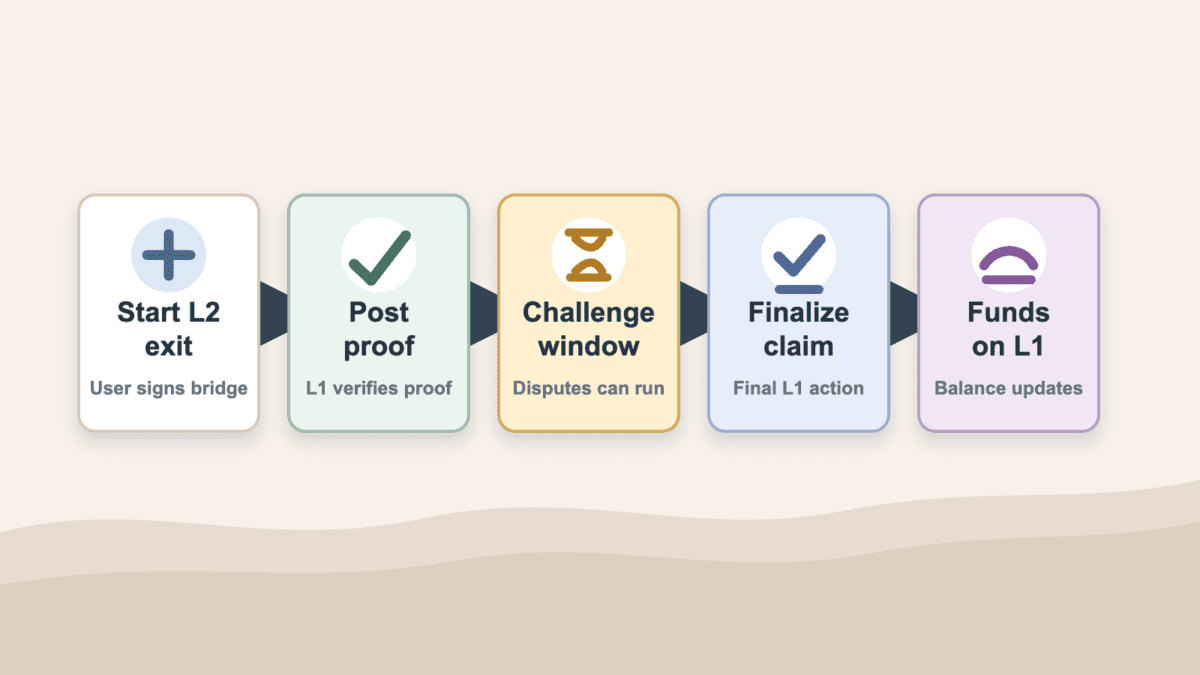
That is why a missing balance is not automatically a lost balance. First, find the stage the withdrawal has reached. A bridge page may show pending, prove, finalize, or claim states, and each label points to a different next step.
Network-specific waits are not universal, so use the OP Stack example as a route check, not a universal law. Different networks, proof systems, and bridge interfaces can use different windows or final-claim steps.
Use this split before assuming the worst:
Check the stage before opening random support links. If the route is native, boring patience may be the correct move.
A challenge period is a protocol waiting window, while bridge delays and exchange holds can come from many other causes. Mixing them up creates bad fixes, like using a risky bridge route for an exchange compliance review that had nothing to do with rollup security.
Start by identifying the route. L1-to-L2 deposits are often faster than L2-to-L1 native exits because the security flow is different. Third-party bridges may depend on liquidity. Exchanges may review withdrawals, enforce limits, or pause a network without using a rollup challenge period at all.
Use this split before blaming the wrong mechanism:
| Delay Type | What It Usually Means |
|---|---|
| Challenge Period | A rollup or bridge state is waiting through a dispute window |
| Bridge Liquidity Delay | A fast bridge route may lack available liquidity |
| Exchange Hold | A centralized platform is reviewing or limiting a withdrawal |
| Staking Unbonding | A staked asset must wait through a protocol exit period |
| Failed Transaction | The transfer did not complete and may need a retry |
Check the sequence before changing routes. Ask where the funds started, where they are going, whether the route is native or third-party, and whether a claim button appears after the timer ends.
Also check the wallet network. Many “missing funds” moments are really display problems, wrong-network views, or a claim step waiting on L1 gas. Not glamorous, but cheaper than panicking into a bad link.
A fast bridge usually does not delete the challenge period. It often gives you faster funds by fronting liquidity, routing through another pool, or settling the slower native path later behind the scenes.
That is useful, but it changes the risk. The native bridge is closer to protocol settlement. A fast bridge adds smart-contract risk, liquidity-provider risk, routing risk, and sometimes extra fees. The speed comes from someone or something else taking a position while the native process catches up.
Compare the routes in user terms:
| Route | Best Use And Main Tradeoff |
|---|---|
| Native Bridge | Best when security and direct settlement matter more than speed |
| Fast Bridge | Best when timing matters, but it adds bridge and liquidity risk |
| Exchange Route | Best when a trusted exchange supports both networks, but custody and limits apply |
The route choice depends on urgency, size, fees, and risk tolerance. A small test transfer may be fine through a fast bridge. A large treasury move may deserve the boring native route and a calendar reminder.
Bridge delays can also attract fake support pages, recovery DMs, and phone-number spam. A protocol delay is not the same as a hard rug, but scammers love confused users because a countdown timer makes people impatient.
Before using a fast bridge, confirm the key details:
Faster is only better when you understand what risk was added.
Challenge periods can lock capital at the exact moment a user wants to move, rebalance, repay, or exit. The problem is not just speed. It is whether funds are usable when timing matters.
Imagine a DeFi user moving ETH from an L2 back to mainnet before a collateral deadline. If the native exit takes days, the user may miss the window even though the withdrawal is working normally. The same problem appears when someone needs exchange funding, L1 gas, NFT liquidity, or capital for another chain.
> A slow exit belongs in the liquidity plan.
That delay links directly to exit liquidity and timing pressure. A slow route can leave a user waiting while a market thins, a price moves, or a better exit disappears. It can also interrupt crypto rotation when capital needs to move between chains, sectors, or risk levels.
Use these habits before routing meaningful funds:
Active users in the DeFi trenches feel this cost fastest because opportunities move before settlement windows end. The fix is not always a faster bridge. Sometimes it is better position sizing, spare liquidity, and knowing the native wait before clicking confirm.
A challenge period can get shorter, but only under the rules of a specific network and proof system. Do not assume every optimistic rollup has the same window, or that a social post about faster finality applies to your bridge route.
Several designs can change the waiting model. Fault proofs can improve how disputes are handled. Multiple proof systems can reduce reliance on one path. Validity proofs can shift the security model because they prove state transitions before acceptance rather than waiting for challenges after an optimistic claim.
> Do not assume a shorter window until the current bridge page confirms it.
The ZK comparison is useful, but easy to overstate. ethereum.org explains that ZK rollups use validity proofs to confirm off-chain state transitions without Ethereum re-executing each transaction. That is a different model from an optimistic challenge window, but actual withdrawal speed still depends on the network, bridge, proof generation, and exit design.
Before trusting a shorter-window claim, check the details that change the actual wait:
If a bridge or chain advertises shorter finality, verify it from official materials before moving size. Fast-finality claims age quickly, and crypto has never met a confident acronym it could not overuse by Friday.
A challenge period safety checklist helps you avoid turning a normal wait into a costly mistake. Know the route, the wait, the claim step, and the real URL before funds leave your control.
Run the checks before moving a meaningful amount:
Wallet setup is part of bridge safety, not an afterthought. The wrong network view can make funds look missing, while a sloppy recovery flow can expose seed phrases. Review wallet basics from a known source before trusting a random support DM.
If something looks wrong, slow down. Check the transaction on the relevant explorer, return to the official bridge page, and avoid anyone asking for private keys, seed phrases, remote access, or a “verification deposit.” Real finality does not arrive through Telegram pressure.
Challenge period language sits beside several other crypto concepts. Keep the terms separate, and bridge pages become easier to read. Not every delay comes from the same problem.
The useful split is security, liquidity, and access. A challenge period belongs mostly to security. Fast bridges and exit timing belong more to liquidity. Wallet setup and claim steps belong to access. These pages help with the next layer of the problem:
For broader background, the CryptoProcent crypto guides category is useful after you understand the specific withdrawal stage in front of you. Learn the timer first, then branch into the surrounding mechanics. That order keeps one slow withdrawal from turning into a dozen unrelated tabs.
Yes, a challenge period may be the reason if you used a native bridge from an optimistic L2 back to Ethereum mainnet. Some networks use a roughly week-long dispute window before the withdrawal can be finalized or claimed.
But do not assume every seven-day-looking delay has the same cause. Check the route, network, bridge status, and whether the withdrawal still needs a prove or final claim step.
Funds are usually still in the withdrawal process during a normal challenge period, not simply lost. Check whether the withdrawal was initiated on the official bridge, whether the transaction succeeded, and whether the bridge page shows the expected pending state.
If the timer ended and no claim path appears, check the official status page and transaction history before clicking any support link.
Often, yes. Some native withdrawal flows require a final L1 transaction after the challenge period ends. That action may be called finalize, claim, or complete, depending on the network and interface. You may also need L1 gas for that step. If the bridge page shows a claim button after the wait, the funds may not appear in your wallet until that transaction is submitted.
Usually, you should assume a native withdrawal cannot be casually canceled once the bridge transaction has entered the settlement flow. Exact behavior varies by network and bridge interface. If you made a mistake, use the official bridge support materials and transaction page first. Do not trust recovery DMs, phone numbers in search results, or anyone asking for a seed phrase.
A fast bridge can help you avoid waiting as a user, but it usually does not remove the protocol challenge period. The bridge may front liquidity, route through another pool, or settle the native exit later. That can be useful when timing matters. It also adds another trust surface, including bridge contracts, liquidity providers, routing logic, fees, and availability.
ZK rollups generally use validity proofs rather than the same optimistic challenge-period model. That means the security process is different, not automatically instant for every withdrawal.
Proof generation, bridge design, operator behavior, and L1 settlement still affect timing. Check the specific network’s current withdrawal flow instead of assuming “ZK” means no wait.