Physical Address
304 North Cardinal St.
Dorchester Center, MA 02124
Physical Address
304 North Cardinal St.
Dorchester Center, MA 02124


A plain-English guide to crypto dilution, token unlocks, FDV, and holder risk.
Dilution in crypto happens when new or newly liquid token supply reduces each holder’s relative share or raises the demand needed to support price.
That is why holders care about token unlocks, fully diluted valuation, emissions, staking rewards, and liquidity. A token can look cheap by current market cap while future supply is quietly lining up at the door.
Every unlock does not mean doom. Before panicking, ask whether new supply reaches people who may sell, and whether real demand can absorb it without turning late buyers into the payment plan.
Dilution in crypto means your share of the token base can shrink when more supply becomes tradable or when more demand is needed to support the same price. It is the crypto version of the stock-market idea that new shares can reduce existing owners’ percentage claim.
Tokens make the idea messier. A project may have a max supply that was visible from day one, but only a small part of that supply may trade at launch. When the rest unlocks, enters circulation, or gets paid out as rewards, circulating holders face a different market.
So dilution is not only “more tokens exist.” Holders care about three things:
Charts often hide the absorption problem. If new supply arrives while demand grows, the market may absorb it. If supply arrives into thin liquidity and weak bids, holders feel the dilution much faster.
Crypto dilution follows a supply-pressure chain: supply becomes liquid, recipients can sell, buyers must absorb it, and liquidity decides how sharp the price move can be. The event may be simple. The market reaction rarely is.
Start with the source. Tokens may be minted, unlocked from vesting, paid as staking rewards, released from a treasury, or distributed through incentives. Once those tokens can move, the recipient has a choice: hold, stake, sell slowly, sell fast, or use the tokens elsewhere.
Then buyers have to meet that supply. If normal demand is deep, the extra float may pass through the market with limited damage. If demand is weak, new sellers may need exit liquidity from late buyers who do not understand the supply schedule.
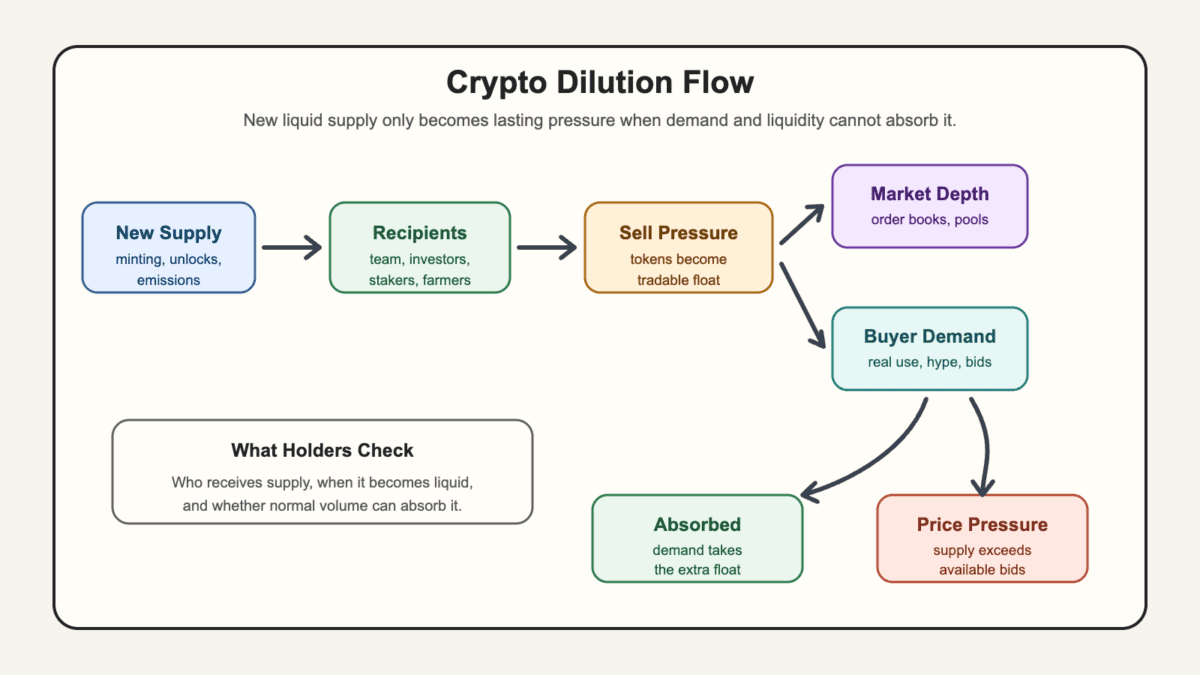
New supply only becomes lasting pressure when buyer demand and market depth cannot absorb the added float.
The same unlock can behave differently across tokens. A well-telegraphed release into deep markets may create brief volatility. A smaller release into a thin DEX pool can move price hard because there are fewer bids under the market. Dilution raises the bar. Demand decides whether the bar gets cleared.
Dilution, inflation, token unlocks, and FDV are related, but they answer different holder questions. Mixing them together creates bad decisions, usually with more confidence than math.
A token unlock can dilute circulating holders even if the supply cap was already public. The key change is liquidity. Tokens that were locked, vested, or unavailable did not compete for current buyer demand in the same way.
| Term | What It Means For Holders |
|---|---|
| Dilution | Holder share or price support can weaken when more supply becomes liquid or sellable. |
| Inflation | New supply is created over time, often through rewards or issuance. |
| Token unlock | Previously locked tokens become transferable, tradable, or available to recipients. |
| Circulating supply | The supply counted as available in the market today. |
| Market cap | Current price multiplied by circulating supply. |
| FDV | Current price multiplied by total or max supply, showing the implied full-supply valuation. |
This is why FDV sits close to dilution risk. Market cap tells you what the market values today. FDV asks what the valuation would look like if the whole supply were counted at the current price.
That does not mean a high FDV is automatically bad. It means future supply has to be paid for by future demand. If the float is tiny and the FDV is huge, the token may be less cheap than the market-cap headline suggests.
Token dilution comes from any event that adds new or newly liquid supply to the market. The source changes the risk because each recipient group has different reasons to hold, sell, stake, or farm.
Common sources include these supply paths:
Planned dilution is not the same as abuse. A transparent vesting schedule is different from hidden mint rights, surprise emissions, or insider-friendly changes after retail holders arrive.
Risk language gets sharper when control is unclear. Slow insider dumping, vague emissions, and poor tokenomics can leak value over time. Sudden mint authority abuse is worse because the supply control itself becomes the attack surface.
A useful check is simple: who receives the new supply, when can they sell, and what reason do they have to keep holding?
Dilution can hurt token price because extra sellable supply needs extra buyer demand. If demand does not grow, each new token competes for the same pool of capital.
Low float and high FDV make this risk easier to miss. A token can trade with a small circulating supply, so its market cap looks modest. But if most supply is still locked, FDV may reveal a much larger implied valuation waiting behind the current float.
Picture a token that launched with only a small public float. Early buyers push the chart up, social feeds heat up, and the market cap still looks “early.” Then the next unlock arrives. If insiders, market makers, or farmers sell into thin demand, late buyers can become the bagholder side of the trade.
Several signals make dilution sharper:
An unlock can be priced in, ignored, or overtraded. The danger comes when the chart gives a top signal while the supply schedule quietly says more tokens are on the way.
Dilution is less dangerous when supply growth is slow, transparent, and matched by real demand. Some useful networks issue rewards or release supply without crushing holders because the market has a reason to absorb it.
Lower-risk cases usually share a few traits:
Separate planned supply from surprise supply. Planned vesting gives the market time to price risk, size positions, and watch recipient behavior. Surprise supply changes remove that preparation and force holders to react after the damage starts.
This is where discipline beats slogans. Holding through dilution can work when you have a real thesis, position sizing, and a reason to believe demand grows with supply. That is a thesis-backed hold, not a hope trade.
Narratives can also absorb supply for a while. A strong sector story can keep attracting bids. But narrative demand can fade faster than vesting schedules. A loud story is not the same as durable demand.
Staking can offset some dilution for stakers, but it may not offset every source of supply growth or every cost. A headline APY is only the first line of the calculation.
If a protocol issues new tokens to validators or stakers, those rewards may help participants keep their relative share. Non-stakers may be diluted by the same issuance. Those rewards do not automatically protect against investor unlocks, treasury releases, farming emissions, or price pressure from sellers.
Use these checks before calling staking “anti-dilution”:
| Question | What To Check |
|---|---|
| What pays the reward? | Protocol issuance, fees, incentives, or another token. |
| Who does not stake? | Non-stakers may lose relative share faster. |
| What fees apply? | Validator fees and staking costs reduce the net return. |
| What risks remain? | Slashing, lockups, liquid staking risk, taxes, and price moves. |
| What else unlocks? | Investor, team, treasury, or farming supply may still hit the market. |
Focus on net impact. A staker can earn tokens and still lose purchasing power if price falls faster than rewards accrue. A non-staker can be diluted even if the chart rises for a while.
So staking is not a magic shield. It is one supply tool inside a larger tokenomics map.
Dilution in DeFi yield happens when rewards are paid with new token emissions instead of revenue or external demand. The APY can be real for the farmer and still costly for passive holders.
This shows up often in yield farming. A protocol may pay high rewards to attract liquidity. Early farmers earn tokens, sell some rewards, and move on when incentives drop. Later buyers may inherit a weaker chart and a larger supply.
Ask who pays the yield. Fee-backed rewards come from activity. Emission-backed rewards come from supply. Both can be useful, but they create different pressure.
Check the reward source before chasing APY:
High APY can be a user-acquisition budget with a token attached. That can work for a while. But if rewards create more sellers than buyers, the yield becomes dilution wearing a party hat.
Checking dilution risk before buying means mapping future supply against current demand, liquidity, and recipient incentives. You are not trying to predict every candle. Your job is to check whether the token can survive its own schedule.
Start with the supply page, tokenomics document, unlock calendar, market data page, contract permissions, and exchange liquidity. Then compare the story with what can actually trade.
| Check | What To Look For |
|---|---|
| Circulating supply percentage | How much of the total supply is already liquid. |
| FDV to market cap gap | Whether the current valuation hides a large future supply base. |
| Unlock schedule | Dates, cliffs, linear releases, and monthly drips. |
| Next unlock size | Size compared with normal volume and available liquidity. |
| Recipient class | Team, investors, treasury, users, stakers, or farmers. |
| Vesting type | Cliff unlocks can shock markets faster than gradual releases. |
| Daily volume | Whether trading activity can absorb added float. |
| DEX liquidity | Pool depth and slippage on likely sell sizes. |
| CEX depth | Order-book support near current price. |
| Treasury policy | When and why project-held tokens can move. |
| Emissions schedule | How staking, rewards, or farming supply enters circulation. |
| Burn mechanics | Whether burns are meaningful or mostly marketing. |
| Real demand | Usage, fees, users, or buyers beyond incentives. |
| Holder concentration | Whether a few wallets can add sudden sell pressure. |
There is no universal ratio where dilution becomes fatal. A large FDV gap and a near-term cliff deserve caution, but context still changes the risk. Deep liquidity, aligned recipients, and strong demand can soften the pressure.
Scale puts this check before the trade. Tokenomist’s review counted $97.43B of tokens released across major sectors in 2025, so an unlock schedule belongs beside liquidity and volume in your pre-buy work.
Position sizing is part of the answer. Going full port into a token with obvious supply overhang leaves no room for being early and wrong. In the small-cap trenches, thin liquidity can make even modest supply events feel brutal.
A token unlock calendar shows when locked tokens become liquid, who receives them, and how the release happens. Read it like a pressure schedule, not a prophecy.
First, separate cliff unlocks from linear releases. A cliff releases a chunk at once. Linear vesting drips supply over time. Monthly releases sit between those extremes and can create recurring pressure if recipients keep selling.
Then compare the unlock with normal market activity:
Recipient class changes the reading. A user airdrop, team unlock, VC allocation, and staking emission can all enter the market, but each group has different incentives. The calendar gives the date. You still need the motive and the market depth.
Burns and buybacks can offset dilution only when their size, funding source, and execution are meaningful. A tiny burn does not cancel a large unlock just because both words sound exciting.
A burn reduces supply by removing tokens from circulation or future availability. A buyback uses funds to purchase tokens, and those tokens may be burned, held, or redistributed. Both actions can support supply dynamics when they are transparent and material.
Check three details before giving either one credit:
Timing changes the risk here. A buyback announced before a major unlock may calm headlines without changing the future float. A recurring burn tied to real fees can carry more weight because the offset has a repeatable source.
After a burn, ask what actually changed. Did circulating supply fall in a meaningful way? Did buy pressure come from real activity? Did unlocks or emissions keep running in the background?
Related crypto concepts help explain what dilution can turn into when supply pressure meets bad timing, weak demand, or poor tokenomics. They are warning labels, not verdicts.
The terms around dilution are blunt because traders see the same pattern often. New sellable supply appears, buyers ignore the schedule, liquidity thins out, and the argument becomes less about valuation and more about who is left holding the chart.
These nearby ideas are useful when the supply story starts to look worse:
Dilution is the supply mechanism. These terms help you spot what happens when that mechanism meets hype, low liquidity, and bad incentives.
Dilution in crypto is the holder impact from new or newly liquid token supply. It can reduce each holder’s relative share or increase the demand needed to support price.
Dilution is not always bad in crypto. It becomes more dangerous when supply grows faster than real demand, liquidity, and user activity.
Token unlocks are not the same as dilution, but they can cause dilution for circulating holders. The risk appears when locked tokens become liquid and compete for buyer demand.
Staking can protect against some protocol issuance if you participate, but it does not protect against every dilution source. Investor unlocks, treasury releases, fees, taxes, and price moves still matter.
Fully diluted valuation is the token price multiplied by total or maximum supply. It helps show the valuation implied if future supply were already counted.
Yes, a token can rise while it is being diluted. Demand, liquidity, narrative strength, and timing can absorb new supply, at least for a while.
Start with the tokenomics, not the chart. A chart shows what traders did. The supply schedule shows what future buyers may have to absorb.
Before taking the trade, write down the supply event that would prove your risk view wrong. That can be a large cliff, a treasury move, weak post-incentive demand, or liquidity that disappears when sellers show up.
Use this order before taking a position:
Then size the position around the risk you actually found. Dilution does not make every token unbuyable. It just makes the bill clearer, and someone always gets it.
If the schedule is confusing, pause before buying. Good projects can explain supply in plain language. If the only answer is a chart, a slogan, or a promise that “the market knows,” the market may be about to teach a paid lesson.