Physical Address
304 North Cardinal St.
Dorchester Center, MA 02124
Physical Address
304 North Cardinal St.
Dorchester Center, MA 02124


A practical guide to FDV trap risk, token unlocks, and low-float supply.
An FDV trap happens when a token looks cheap by current market cap, but its full valuation already assumes much more supply will eventually enter the market.
The risk sits in the supply schedule. Low float, insider allocations, team tokens, airdrops, emissions, and cliff unlocks can all make a chart look early while the full-supply valuation is already heavy. The token may be real, the schedule may be public, and the trade can still be a mess if fresh supply meets weak demand.
An FDV trap means the visible market cap shows only a small tradable slice, while the fully diluted valuation shows a much larger implied value for the whole supply. The trap is the setup around the number, not the FDV metric itself.
FDV stands for fully diluted valuation. It is current token price multiplied by total or maximum supply. Market cap uses circulating supply instead, so a token can show a modest market cap and a demanding FDV at the same time.
A round-number example makes the gap obvious:
The token may look like a $10 million project at first glance. But the current price already implies a $100 million full-supply valuation if every token were counted.
That is the setup traders call “low float high FDV.” On CT, the phrase usually means “the public can buy only a small slice, while future supply may arrive later.” It is blunt language, but the math is not mysterious.
An FDV trap does not mean the token must fall. It means buyers need to ask who owns the missing supply, when it can move, and whether the market can absorb it without turning new buyers into someone else’s exit plan.
An FDV trap happens in low-float launches because only a small share of supply trades at first. Scarcity can push the price up, then that same price gets multiplied across the full supply to create a large FDV.
That structure can be intentional and disclosed. Projects may stagger supply to fund development, align contributors, reward users, avoid a day-one flood, or manage launch liquidity. Disclosure helps, but it does not remove the market risk.
Several supply groups often sit outside the first public float:
Binance Research described low-float, high-FDV launches as a market-structure concern in 2024, especially around private-market pricing and public listings. The concern was not that every token was fake. It was that public buyers could face supply terms set long before the listing.
In the trenches, the same pattern can be harsher. Small-cap markets often have thin liquidity, fast attention cycles, and little patience for complicated tokenomics. A tiny float can move fast upward, then move even faster once supply pressure appears.
The point is simple. Low float can make early price action look clean, but the future supply still exists. If most of the supply has not faced the market yet, the FDV trap is really a demand question: who pays for the rest of the bill?
FDV trap math compares market cap, FDV, and float ratio so you can see whether the token’s current valuation depends on a small supply slice. The math is not hard. The interpretation is where people get cooked.
Market cap answers, “What is the circulating supply worth now?” FDV answers, “What would the whole supply be worth at today’s price?” Float ratio answers, “How much of that full supply is already counted?”
| Metric | What It Tells You |
|---|---|
| Token price | The current price used in both market cap and FDV |
| Market cap | Current price multiplied by circulating supply |
| FDV | Current price multiplied by total or maximum supply |
| Float ratio | Circulating supply divided by total or maximum supply |
| FDV-to-market-cap ratio | How many times larger FDV is than current market cap |
| Unlock schedule | When missing supply may become sellable |
If 10% of supply is circulating, FDV will be about ten times market cap at the same price. If 5% is circulating, FDV will be about twenty times market cap. That does not create a sell signal by itself, but it does flag a supply overhang.
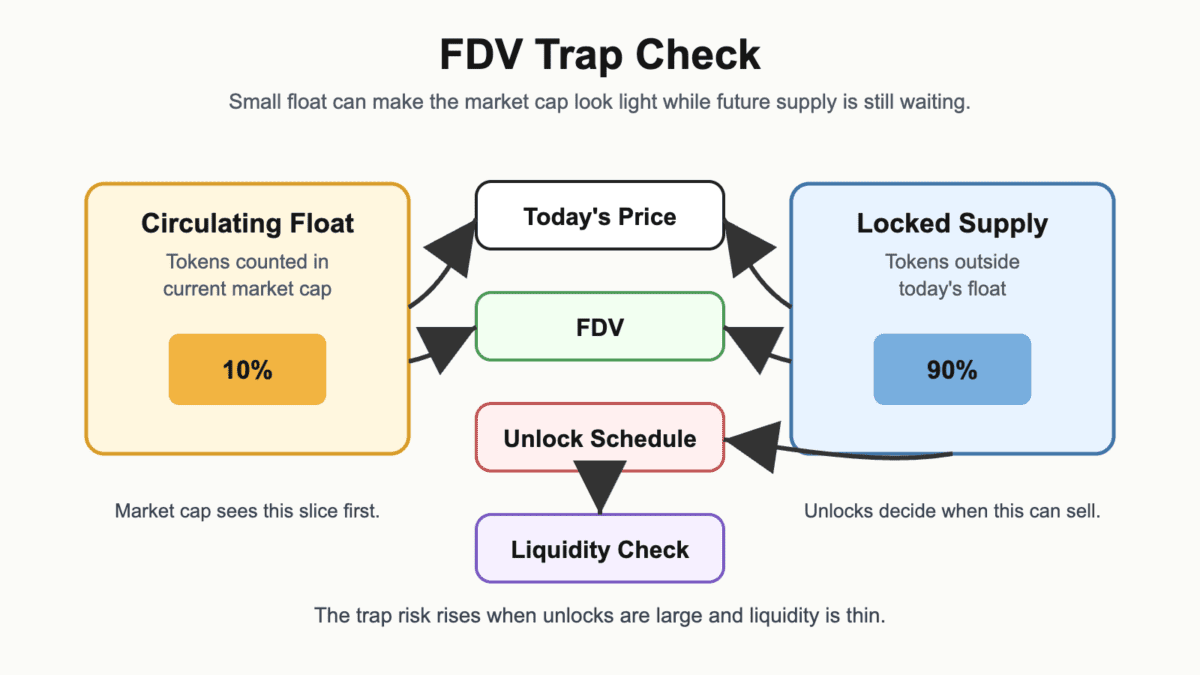
Ratio thresholds should start questions, not end them. A 2x FDV-to-market-cap gap can be normal for a mature token with slow vesting. A 20x gap near a cliff unlock deserves a colder look, especially when liquidity is thin and the token is moving mostly on launch attention.
Token unlocks turn an FDV trap into sell pressure when locked tokens become transferable and their recipients can sell. The FDV number warns about future supply. Unlocks decide when that supply can meet the market.
Not every unlock causes a dump. Some recipients hold, some sell slowly, and some supply was already expected. But the market still has to absorb any tokens that move from locked supply into tradable supply.
| Unlock Pattern | What to Check |
|---|---|
| Cliff unlock | Size of the release versus current float and volume |
| Linear vesting | Daily or monthly supply added over time |
| Team allocation | Whether contributors have long-term reasons to hold |
| Investor allocation | Cost basis, lock length, and release size |
| Airdrop claim | Whether recipients have a reason to keep the token |
| Incentive emissions | Whether rewards are funded by useful demand or new supply |
The dangerous version is not just “tokens unlock.” It is a large release into thin liquidity, weak demand, or crowded hype. In that moment, public buyers can become future exit liquidity for recipients with lower entry prices.
That is also how FDV trap risk can turn into bagholder risk. A buyer may enter because market cap looks early, then discover the token needs more demand every month just to absorb the schedule.
Read alongside the earlier Binance Research warning, CoinGecko Research keeps the same point current: low-float supply is a market-structure issue, not some dusty niche problem. The useful takeaway is not panic. It is timing. Check the next unlock before assuming a cheap-looking chart is actually cheap.
FDV trap warning signs are supply, liquidity, and demand clues that tell you the token may be priced on too little circulating supply. One weak signal means look closer. Several together are a warning.
Start with the gap between market cap and FDV. Then ask what happens when the missing supply becomes tradable. The goal is not a perfect forecast. The goal is to avoid obvious bad terms before your entry becomes the lesson.
Run these checks before buying:
A crowded launch can become a top signal when buyers chase scarcity right before supply terms matter. The chart may still go higher, but the margin for being late gets smaller.
Sizing is part of the check. Going full port into a token with clear FDV trap signals leaves no room for being early and wrong. Crypto will happily invoice that confidence.
The cleanest red flag is missing data. If you cannot find circulating supply, total supply, vesting, recipient groups, or unlock timing, the risk is not just high. It is poorly mapped.
A high FDV is not an FDV trap when supply terms are transparent, unlocks are manageable, and demand can plausibly absorb future tokens. High FDV raises the bar. It does not write the verdict.
Some tokens price future growth early because the market expects real usage, fee demand, strong distribution, or sector demand. That can be reasonable, but only when the supply schedule and liquidity support the story.
High FDV looks less dangerous when these conditions line up:
A strong token narrative can help absorb supply for a while. It cannot replace float math. Narrative demand can rotate away before vesting schedules finish.
The same goes for a conviction trade. Conviction is useful only when it includes the supply schedule, not when it refuses to read it. A high-FDV token can still rise, but it needs more proof than a small-cap chart and a loud feed.
An FDV trap is not automatically a rug pull. It is usually visible tokenomics risk: low float, high implied valuation, and future supply that may pressure public buyers.
Fraud needs separate evidence. A bad setup can hurt holders without proving theft, hidden controls, or illegal conduct. Keep the labels clean because sloppy labels create sloppy risk checks.
| Label | What It Means |
|---|---|
| FDV trap | A low-float, high-FDV setup with future supply risk |
| Bad tokenomics | Supply, allocation, or incentive rules that hurt holders |
| Soft rug | Slow confidence loss through poor delivery, insider selling, or weak incentives |
| Hard rug | Abrupt abuse such as liquidity removal, trapped selling, or malicious control |
| Dilution risk | More or newly liquid supply needs more buyer demand |
A hard rug is the abrupt danger zone. It may involve liquidity removal, blocked selling, hidden minting, or direct contract abuse.
A soft rug can overlap with FDV trap risk when supply keeps hitting public buyers while delivery, communication, or demand weakens. But overlap is not proof. A transparent high-FDV launch can still be ugly without being a rug.
This distinction helps you check the right thing. For FDV trap risk, inspect supply, unlocks, recipients, liquidity, and demand. For fraud risk, inspect contract permissions, wallet control, liquidity locks, transfer rules, and verified claims.
Checking an FDV trap in practice means moving from headline valuation to supply timing, recipient incentives, and market depth. Start with the market-data dashboard, then verify the parts that dashboards can simplify too much.
Market data pages can show market cap and FDV quickly. They are a starting point, not a full risk review. Your next job is to find what sits behind the gap.
Use this workflow:
Recipient groups change the reading. A team unlock, investor unlock, treasury grant, airdrop claim, and reward emission all create different incentives. The same unlock size can behave differently depending on who receives it.
Liquidity changes the damage. A large unlock into deep, steady markets may pass with limited impact. A smaller unlock into a thin pool can move price hard because there are fewer bids under the chart.
The final check is uncomfortable but useful: who benefits if you buy now? If the answer is mostly early holders with liquid or soon-to-liquid supply, the FDV trap may already be open.
Related terms help explain an FDV trap because the phrase sits between tokenomics, trading slang, and holder risk. No single term covers the whole setup.
Use these concepts to separate supply pressure from ordinary trading noise:
The useful habit is to translate every slogan back into a check. If someone says “low float high FDV,” ask how much supply trades now, how much unlocks next, who receives it, and whether buyers can absorb it.
Start an FDV trap check with supply, not the story. A strong pitch can explain why demand might grow, but only the supply schedule shows what demand must absorb.
Keep the first pass boring and mechanical. Boring is underrated when the chart is screaming.
Use these next actions:
If the supply map is missing, pause. Good tokenomics should be explainable in plain language. If the only clear thing is the hype, you may be looking at a valuation trap with better lighting.
An FDV trap is not a reason to hate every new token. It is a reason to slow the click when the market cap looks cheap but the full-supply math says the bill may arrive later.
An FDV trap in crypto is a low-float setup where a token looks cheap by current market cap while its full valuation already prices in much more future supply. The risk appears when locked or future tokens become sellable and demand cannot absorb them.
An FDV trap works by letting a small circulating supply set the visible market cap while today’s price is multiplied across the full supply for FDV. If the missing supply later unlocks into weak liquidity, public buyers may face sell pressure.
No, an FDV trap is not the same as a rug pull. It is usually visible supply and valuation risk, while a rug pull involves separate evidence of abuse, deception, liquidity removal, trapped selling, or malicious control.
No single FDV-to-market-cap ratio proves an FDV trap, but a wide gap deserves extra work. A 10x or 20x gap can be serious when the next unlock is close, liquidity is thin, and recipient groups have reasons to sell.
Yes, a high-FDV token can still go up if demand, liquidity, usage, and market timing absorb future supply. The higher the FDV gap, the more proof the token needs before it deserves normal position size.
Token unlocks affect an FDV trap by turning locked supply into potentially sellable supply. The key checks are unlock size, recipient group, timing, liquidity depth, and whether current demand can absorb the extra float.