Physical Address
304 North Cardinal St.
Dorchester Center, MA 02124
Physical Address
304 North Cardinal St.
Dorchester Center, MA 02124


Funding wallet meaning, transfers, and token-risk checks.
A funding wallet is either an exchange account bucket for holding and routing funds or an on-chain source wallet that funded another address.
The confusing part is that both meanings are real. On Binance, OKX, KuCoin, Bybit, Bitget, and similar exchanges, a funding wallet usually explains where funds sit before you trade, pay, withdraw, or move them. In token analysis, it can mean the upstream wallet that supplied a deployer, launch wallet, or early holder cluster.
Same words. Different headache.
A funding wallet in crypto is a routing point for funds, but the exact meaning depends on where you see the term. Inside an exchange, it usually means an account bucket for deposits, withdrawals, P2P, payments, cards, or internal transfers. On-chain, it usually means the wallet that sent money to another wallet before a token launch or trading event.
The split changes the next action. If your USDT appears in an exchange funding wallet, you may need to move it to Spot, Trading, Futures, or another product account before a trade works. If a token deployer was funded by a suspicious wallet, you are reading a source-of-funds clue, not moving your own balance.
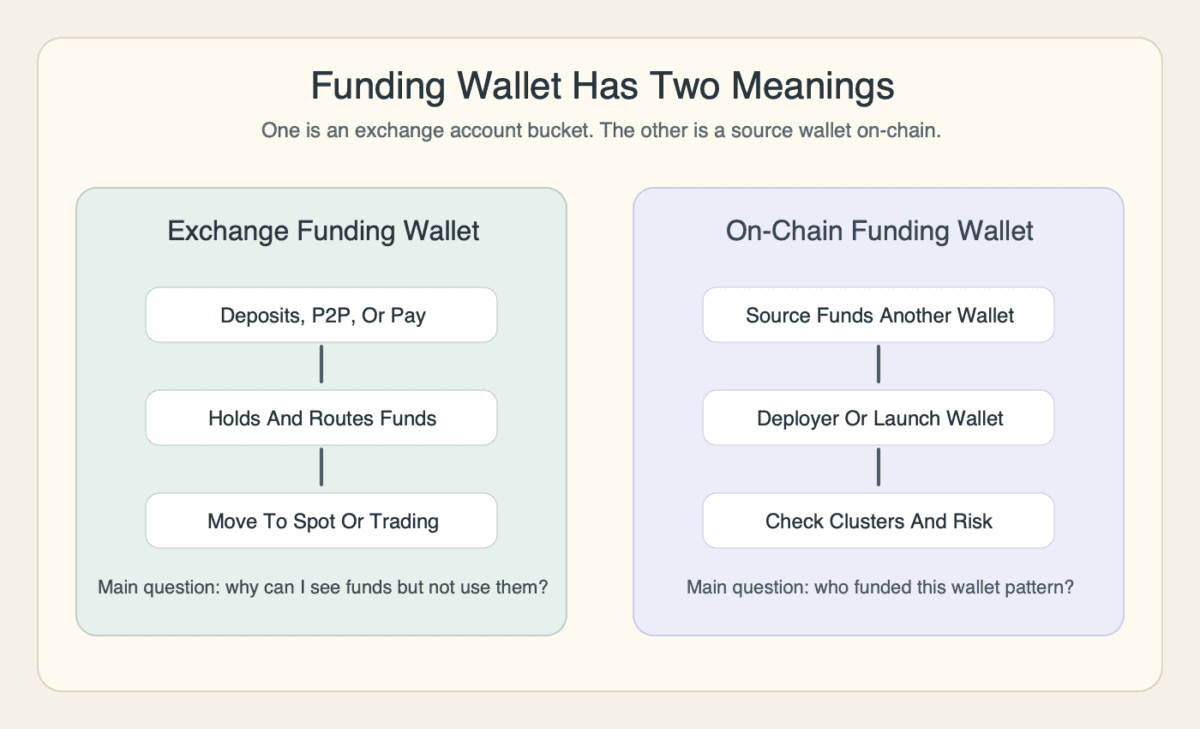
Think of the exchange version as an internal shelf. The money may be yours, but the shelf decides which product can use it. Think of the on-chain version as a trailhead. It shows where another wallet got its first usable funds, which can help explain whether multiple wallets may be linked.
The trap is assuming one meaning answers every problem. A Binance funding wallet question usually needs account routing. A meme coin funding wallet question usually needs wallet tracing. Put those in the same box, and the box starts smoking.
A funding wallet, spot wallet, trading account, and self-custody wallet answer different questions. On an exchange, these labels usually describe internal account buckets. In self-custody, the real dividing line is control of private keys.
Published on May 29, 2026, Binance’s account overview lists seven exchange-account categories in its simple breakdown: Spot & Funding, Earn, Margin, Futures, Trading Bots, Copy, and Alpha. Other exchanges use different names, but the logic is similar: a visible total balance is not always the same as spendable, tradable, or withdrawable balance.
| Account Or Wallet Type | What It Is Used For |
|---|---|
| Funding wallet | Receiving, holding, paying, withdrawing, P2P, card use, or routing funds between exchange products. |
| Spot wallet or spot account | Holding assets that can usually be traded on spot markets. |
| Trading account | A broader product bucket for spot, margin, derivatives, or unified trading features, depending on the exchange. |
| Earn, futures, or margin account | Product-specific areas where assets may be subscribed, pledged, borrowed against, or used as collateral. |
| Self-custody wallet | A wallet you control through private keys or a seed phrase, outside an exchange’s internal account system. |
The biggest beginner mistake is treating every exchange wallet label like a real crypto wallet. It is usually an account view inside a custodial platform. The exchange controls the private-key infrastructure, while you control the account login and permitted actions.
The funding wallet still has a job. It answers a routing question, not a custody question. If you want to understand wallet control, seed phrases, and device-based storage, start with CryptoProcent’s crypto wallets coverage before assuming an exchange tab gives the same control.
A funding wallet works on exchanges as a staging area for money entering, leaving, or moving between products. It often sits between deposits and the feature you actually want, such as spot trading, P2P selling, Pay, Convert, cards, Earn, margin, or futures.
The exact menu names vary by platform. Binance uses Funding Wallet language heavily. OKX may separate funding and trading accounts. KuCoin, Bybit, Bitget, WEEX, and others can add their own product buckets. Region rules can also change which buttons appear.
Common exchange use cases usually look like this:
The platform still decides what that balance can do. A funding wallet can hold the asset, but the product you want may require a different account. The same balance can look available in one screen and invisible in another.
So the first check is boring but useful. Open the asset page, confirm the account bucket, then look for transfer history before assuming funds vanished. Crypto apps love making five drawers look like one wallet. Naturally, the drawer you need is never the one already open.
Your funding wallet balance may not be tradable because it is in the wrong account bucket, locked by a product, restricted by account rules, or held in an asset the target market cannot use. A balance display is not the same as trading permission.
Start with account location. If the asset sits in Funding, the Spot page may show zero available balance until you move it. If the asset sits in Earn, Futures, Margin, or an open order, it may be reserved, pledged, or unavailable for a different flow.
Run through the practical checks before assuming the platform broke:
Some assets are visible but not tradable in the product you picked. For example, a token may be depositable but not listed on spot markets. A stablecoin may work for P2P but not for a local card flow. A futures account may need collateral transferred into that product first.
> A funding wallet does not override platform rules. KYC status, compliance review, regional restrictions, withdrawal holds, product activation, and maintenance can still block a trade, transfer, card payment, or cash-out.
Next, isolate the failure point. If Funding to Spot works, the issue was routing. If the transfer fails, the problem is probably restrictions, asset support, account status, or a product-specific rule.
Moving funds from a funding wallet to Spot or Trading usually means using the exchange’s internal transfer feature. The transfer is normally off-chain because it happens inside the platform’s account system, not through a blockchain transaction.
Keep the sequence generic, because each exchange changes button names and app layouts. Before you submit anything, confirm the source, destination, asset, and amount.
Use this flow as a platform-neutral checklist:
Do not confuse an internal transfer with a withdrawal. A withdrawal sends crypto to an external address and may involve network fees, chain choice, address checks, and holds. An internal transfer just moves the balance between exchange buckets.
Also check product eligibility before moving everything. A transfer to Futures, Margin, or Earn can change the risk profile. Collateral can be liquidated, borrowed assets can create debt, and subscribed funds may not exit instantly. That is not a wallet transfer. That is a product choice wearing a small transfer button.
A funding wallet in on-chain analysis is the wallet that supplied another address with the funds it needed to act. Traders use it to trace who funded a deployer, launch wallet, liquidity wallet, or early buyer cluster before a token starts trading.
This meaning is common around meme coins and new tokens. A deployer wallet may create the contract. A launch wallet may add liquidity or trigger the first actions. Early holder wallets may buy soon after launch. If the same source funded several of them, the pattern can suggest coordination.
| Wallet Role | What Traders Check |
|---|---|
| Funding wallet | The upstream source that supplied gas, SOL, ETH, USDT, or other starting funds. |
| Deployer wallet | The address that created the token contract or launch setup. |
| Launch wallet | The address used for initial liquidity, trading setup, or early operational actions. |
| Holder cluster | A group of wallets that may share timing, funding source, behavior, or later transfer paths. |
| Liquidity provider wallet | The wallet tied to pool creation, liquidity adds, removals, or lock status. |
A shared funder is especially relevant when the team is hidden. If an anon dev launches a token and several “independent” early wallets all trace back to the same source, the funding wallet adds context. It does not name the person. It does show the wallets may not be as separate as they look.
Exchange-tagged funding sources need extra caution. A wallet funded from Binance, Coinbase, OKX, or another centralized exchange may simply mean the owner withdrew from that venue. Many unrelated users can share the same exchange source label, so a CEX tag often hides identity instead of proving a link.
Bridge sources can also blur the picture. Funds may arrive from Ethereum, Solana, Base, Arbitrum, or another chain through a bridge. That route can be normal, but it can also break a clean trail. A useful funding wallet check always pairs the source with timing, wallet behavior, liquidity, and contract permissions.
Traders use funding wallets to spot risk by tracing whether supposedly separate wallets share a source, act in sync, or connect to weak liquidity and sell pressure. The goal is not to shout scam at the first shared address. The goal is to avoid buying blind.
Start with the most relevant wallet. For a new token, that may be the deployer, the first liquidity wallet, or the wallet that made early contract actions. Then trace inbound funding before launch and compare the source against other early wallets.
A practical workflow usually looks like this:
The signal becomes useful when the pattern tightens. If one funding wallet feeds several fresh wallets, those wallets buy early, and liquidity is thin, public buyers may become exit liquidity when insiders sell into demand. The funding wallet does not create the risk alone, but it can show the setup.
Good analysis also looks for innocent explanations. Market makers may route funds to many wallets. Teams may split operational wallets for security. Exchanges and bridges can make unrelated wallets look connected. One clue is a clue. A full pattern needs timing, behavior, and market structure.
Funding wallet red flags are strongest when they combine source links with suspicious timing, weak liquidity, and contract or trading risks. A shared funding wallet alone does not decide the case. It gives you a reason to slow down and check the rest of the map.
Ask what the wallet relationship can explain. If the answer is coordinated early buying, hidden team control, thin liquidity, or repeated low-trust launches, the signal deserves weight.
| Signal | What It Can And Cannot Tell You |
|---|---|
| Many early wallets funded by one source | Can suggest coordination, but cannot prove the same person controls every wallet. |
| Newly created wallets with synchronized buys | Can show planning, but may also reflect bots, launch tooling, or market-maker setup. |
| Same funder across low-trust launches | Can reveal repeated behavior, but still needs transaction context. |
| Liquidity wallet tied to the same source | Can increase rug risk, but lock status and permissions matter too. |
| CEX or bridge funding source | Can explain a broken trail, but often hides identity rather than proving innocence. |
The sharper warning signs appear when wallet links meet bad market structure. If the same source funds early wallets, liquidity is not locked, and the owner can remove the pool, the risk starts to look closer to a hard rug setup.
There are limits. Labels can be incomplete. Exchange withdrawals can make unrelated users look related. Bridge hops can hide useful context. Shared infrastructure can link wallets for boring reasons. False positives are common enough to humble anyone with a block explorer and too much coffee.
Still, ignoring repeated funding links can be expensive. If early wallets share a source, sell into thin liquidity, and leave late buyers holding a broken chart, the public side can end up as the bagholder. That is the real job of the funding wallet check: catch patterns before the chart explains them with red candles.
Start with context. If the funding wallet appears inside an exchange app, solve the account-routing problem first. If it appears in a token-risk tool or block explorer, solve the source-of-funds problem first.
For exchange users, the fastest path is to locate the asset, account bucket, and product you want. Then check transfer history, account restrictions, KYC status, and product eligibility before opening a support ticket. Most “missing funds” scares begin with a balance sitting in the wrong product bucket, not with coins leaving the platform.
For on-chain traders, the fastest path is to trace upstream funding, compare connected wallets, and pair the result with liquidity, sellability, contract permissions, and holder concentration. A shared funding wallet should push you into deeper checks. It should not make the whole decision for you.
Use these next actions:
Then decide what the evidence actually supports. An exchange funding wallet may only tell you to move USDT into Spot before placing an order. An on-chain funding wallet may tell you several early wallets share a source. Those are different findings, and they deserve different responses.
A funding wallet is a useful clue because it points to flow. It shows where funds sit, where they came from, or where they may need to move next. Once you know which meaning applies, the term becomes much less annoying. Almost friendly, if you squint.
A funding wallet in crypto is either an exchange account bucket for holding and routing funds or an on-chain source wallet that funded another address.
On exchanges, it is usually tied to deposits, withdrawals, P2P, payments, cards, and internal transfers. In token analysis, it helps traders trace where a deployer, launch wallet, or early wallet cluster got its starting funds.
A funding wallet on Binance is an account area commonly used for deposits, withdrawals, P2P, Pay, and transfers into other account areas.
If your funds are visible there but not available on the Spot screen, you may need to move them from Funding to Spot first. Also check asset support, KYC status, holds, and product restrictions.
No, a funding wallet is not the same as a spot wallet. A funding wallet usually routes funds, while a spot wallet or spot account is where assets are normally available for spot trading.
The exact labels depend on the exchange. The important check is whether the asset is in the account bucket required by the product you want to use.
Your funds may be in a funding wallet but unavailable to trade because they are in the wrong account bucket, locked in another product, or restricted by platform rules.
Check transfers, open orders, Earn subscriptions, futures or margin positions, KYC status, regional rules, withdrawal holds, and whether the exchange supports that asset for the trade you want.
You can often withdraw from a funding wallet when the exchange allows that asset, network, account status, and destination address.
But withdrawals can still be blocked by KYC checks, compliance review, cooldown periods, network maintenance, unsupported chains, or product-specific restrictions. Always confirm the chain before sending funds out.
A shared funding wallet cannot prove a token is a scam by itself. It is a risk signal that needs more context.
The signal becomes stronger when several early wallets share a source, buy in sync, connect to weak liquidity, and later sell into public demand. Even then, check labels, exchange withdrawals, bridges, market-maker routing, and contract permissions before making a call.