Physical Address
304 North Cardinal St.
Dorchester Center, MA 02124
Physical Address
304 North Cardinal St.
Dorchester Center, MA 02124


Fraud proofs challenge bad rollup updates before they finalize.
A fraud proof is a way to challenge an invalid blockchain state update, mainly used by optimistic rollups so bad transaction batches can be rejected before they become final.
That sounds like scam protection. It is not. A fraud proof is about whether a rollup posted a valid claim about balances, transactions, and withdrawals, not whether a token team is honest or a wallet popup is safe.
A fraud proof in crypto is a dispute mechanism for optimistic systems. A rollup posts a claim about its new state, and someone can challenge that claim if it is invalid.
The word “fraud” is easy to misread here. It does not mean a scam report, a legal finding, or a guarantee that a project is clean. It means the posted blockchain state can be proven wrong before the base layer accepts it as final.
Think of the fraud proof as a challenge receipt for the rollup. It does not judge your trade, your token, or the team behind an app. It asks whether the latest state transition followed the rollup’s rules.
Keep the boundary simple:
Optimistic rollups use this pattern because they do not ask Ethereum to recheck every transaction by default. They execute transactions offchain, publish data and a state root, then wait through a challenge window.
Two mechanism terms carry most of the load:
The user-facing promise is narrow but important. A fraud proof can stop an invalid rollup update from settling.
That distinction keeps the rest of the topic sane. Fraud proofs are rollup safety machinery. They are not a universal lie detector, tempting as that would be for crypto.
A fraud proof works by giving challengers time to dispute a rollup’s posted state before users rely on it for final withdrawals. The rollup moves quickly because it assumes batches are valid unless someone proves otherwise.
The flow starts with normal user activity. You trade, swap, bridge, or use an app on an optimistic rollup. A sequencer orders those transactions and sends a compressed batch, transaction data, and a proposed state root back to Ethereum.
From there, the clean version looks like this:
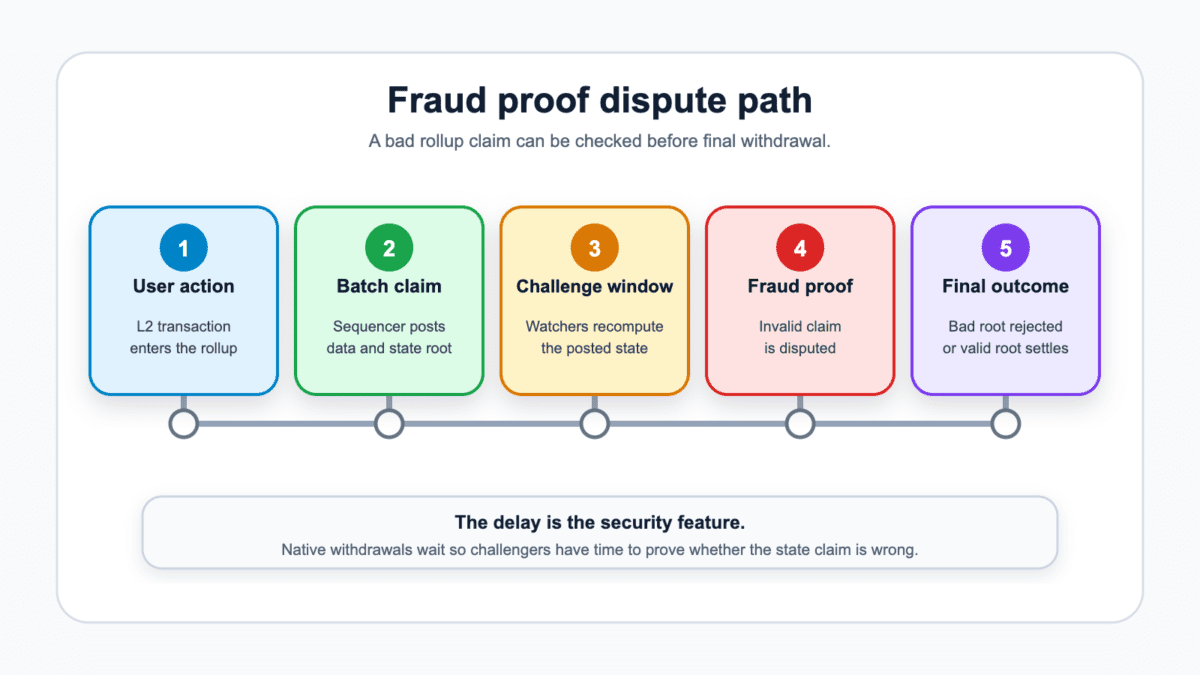
This is why data availability sits beside fraud proofs. A challenger needs the transaction data to recompute the state and spot the bad step. If the data is hidden, the challenge path becomes theory with a nice logo.
So keep the test concrete. A fraud proof system is only as useful as its live challengers, available data, dispute contract, and challenge period. Remove one piece, and “inherits Ethereum security” starts doing too much work.
A fraud proof creates withdrawal delays because native withdrawals must wait long enough for bad state claims to be challenged. The delay is not just slow plumbing. It is part of the security model.
Suppose you move ETH from Ethereum to an optimistic rollup, trade there, and later withdraw back to Ethereum. The rollup has to prove that your final L2 balance is valid. Because the system is optimistic, Ethereum waits through the challenge window before treating that withdrawal claim as settled.
From there, the exit path splits:
This is why optimistic rollups can feel fast while deposits, swaps, and app actions are happening on the L2, then suddenly feel slow when you want to exit natively. The cheap lane has a toll booth at final settlement.
Fast bridges make this feel different. They may give you funds quickly on another chain by fronting liquidity, then settle the native withdrawal later. That can be useful, but it moves some risk to liquidity providers, route design, and bridge assumptions.
None of those paths is automatically wrong. The mistake is assuming a fast bridge removed the fraud proof delay. Usually it just moved the delay somewhere less visible.
For small transfers, that tradeoff may be fine. For larger exits, the bridge route, liquidity depth, token version, and refund path deserve a real check before you sign.
Fraud proof vs validity proof is the core comparison between optimistic rollups and zero-knowledge-style rollups. One model assumes a state update is valid unless challenged. The other asks for proof of validity before accepting the update.
Fraud proofs are reactive. They need at least one capable challenger to notice and dispute a bad state within the window. Validity proofs are proactive. They make the rollup produce a cryptographic proof that the new state follows the rules.
The user-facing comparison is where the tradeoff gets clearer:
| Question | What Changes For The User |
|---|---|
| What is assumed first? | A fraud proof model assumes the batch is valid unless challenged. A validity proof model requires proof before acceptance. |
| Who checks the claim? | Fraud proofs rely on challengers and dispute contracts. Validity proofs rely on proof generation and verification. |
| How does finality feel? | Fraud proofs usually create a challenge-window delay. Validity proofs can make state finality faster once the proof is accepted. |
| What can fail? | Fraud proofs depend on available data and live challengers. Validity proofs depend on correct circuits, provers, and implementation quality. |
| What should users compare? | Check withdrawal timing, bridge assumptions, proof maturity, upgrade controls, and whether status claims are current. |
That does not make one design perfect and the other doomed. Fraud proofs can be cheaper to run and simpler in some execution environments. Validity proofs can offer faster finality for state validity, but they add prover costs and engineering complexity.
The real question is not which term sounds more advanced. It is what assumptions you are accepting when you bridge funds, hold assets, or use DeFi on that network.
A fraud proof can be strong when the dispute path is live, permissionless, and backed by public data. A validity proof can be strong when the proving system is mature, audited, and not hidden behind upgrade shortcuts. Either design can still carry governance, bridge, or app risk.
A fraud proof does not protect you from most everyday crypto mistakes. It checks rollup state validity. It does not check whether your wallet, token, app, team, or bridge frontend is safe.
The name invites overconfidence. A rollup may have a working fraud proof system while a user still signs a malicious approval, buys a scam token, or sends funds through a fake bridge site. The proof system is not sitting inside your wallet yelling at bad decisions.
Fraud proofs do not cover several common failure paths:
That is where normal risk checks still apply. Use separate wallets for testing, limit approvals, verify contract addresses, and keep seed phrases away from anything with a text box. Basic wallet security still does more for phishing risk than a rollup dispute game.
Project-level scams sit in a different bucket too. A hard rug can drain liquidity or user funds even if the underlying chain keeps posting valid state. The rollup can be honest while the project built on top of it is not.
So read “fraud proof” as a settlement-security term. It narrows one important risk. It does not turn crypto into a padded room.
Fraud proof systems, fault proofs, and rollup stages are related terms for checking how mature an optimistic rollup’s dispute path is. They are useful labels, but they are not magic safety stamps.
“Fault proof” is often used as a close synonym for fraud proof, especially around OP Stack chains. The naming can differ by project, but the basic idea is similar: a bad output, claim, or state transition can be challenged through a formal dispute process.
Here is the plain-English map:
| Label Or Term | Plain Meaning For A User |
|---|---|
| Fraud proof | A way to challenge an invalid optimistic rollup state update. |
| Fault proof | A similar term often used for the dispute system in OP Stack material. |
| Challenger | The actor that checks a posted claim and submits a dispute if it is wrong. |
| One honest challenger | The idea that one capable challenger can protect the system if data and access are available. |
| Challenge period | The time window before a claim becomes final for exits. |
| Stage 0 | Early rollup maturity with more operator or training-wheel trust. |
| Stage 1 | More proof-system protection, but usually still with some emergency or governance controls. |
| Stage 2 | Stronger decentralization and exit guarantees, with fewer override paths. |
Arbitrum’s BoLD is another useful example because it focuses on permissionless validation and bounded disputes. The beginner lesson is not to memorize every protocol name. It is to ask whether external actors can challenge bad claims without asking the operator for permission.
Stage labels add another shorthand. The L2BEAT Stages framework describes maturity levels for rollups, including proof-system and exit-protection requirements. One concrete threshold is an exit window of at least 7 days for upgrades outside Security Council control. Live status can change, so recheck the current project page before using a label as a trust shortcut.
The table should make one thing obvious: labels compress risk. They do not remove it. A rollup can improve its proof system while still having sequencer limits, upgrade controls, emergency councils, or app-level risk.
For users, the best habit is to separate three questions. Is the fraud proof system live? Can outside challengers use it? And can users exit if governance, operators, or sequencers behave badly?
You check whether a fraud proof system is live by verifying the dispute path, not by trusting the word “proof” in a marketing line. The useful check is whether a bad state can be challenged today.
Start with official project materials, rollup-risk dashboards, audits, and status pages. Then look for specific mechanics: who can propose outputs, who can challenge them, how long the challenge period lasts, what data is posted, and what powers can override the process.
The checklist should stay practical:
| Check | Why The Check Helps |
|---|---|
| Proof system is live on mainnet | Testnets and roadmap claims do not protect real funds. |
| Challengers are permissionless | A permissioned set adds trust in selected actors. |
| Transaction data is available | Challengers need data to recompute the disputed state. |
| Challenge period is clear | Users need to know when native exits become final. |
| Emergency roles are disclosed | Guardians or councils may pause, upgrade, or override parts of the system. |
| Upgrade delays exist | Fast upgrades can fix bugs but also add governance trust. |
| Bonds and costs are realistic | Challengers need incentives that make disputes economically possible. |
| Audits and code are public | Hidden systems are harder for outsiders to inspect. |
The goal is not to become a protocol auditor before moving $50. The goal is to avoid treating every “fraud proof” claim as equal.
Also keep team and governance risk in view. A live dispute system does not prevent soft rug risk in apps, tokens, or projects around the rollup. It also does not remove the need to understand who controls upgrades.
If you cannot find the challenge period, challenger rules, data-availability path, or emergency controls, reduce size or wait. Missing details do not always mean danger, but they do mean you are guessing.
For L2 investors, fraud proofs shape bridge confidence, withdrawal assumptions, and the credibility of decentralization milestones. They are one input, not a buy signal.
For ARB, OP, Base-related activity, and other optimistic-rollup exposure, proof maturity can shape user trust. A rollup with a clearer dispute path may feel safer for deposits, DeFi use, and long-term app activity. But markets also price fees, growth, liquidity, token supply, governance, and narrative heat.
Use fraud proofs as part of a wider review:
The investor mistake is turning proof language into a green light. A project can talk about fraud proofs while still depending on an upgrade council, centralized sequencing, limited challengers, or weak app security.
Team identity can matter, but it is not a substitute for protocol checks. A doxxed team may be easier to evaluate, yet public names do not replace permissionless challengers, public data, or clear exit rights.
The best use of fraud-proof research is sizing and route selection. It helps you decide how much to bridge, how long you can wait to exit, and whether a chain’s security story matches the risk you are taking.
Fraud proofs are not only for Ethereum rollups, but Ethereum optimistic rollups are the main user-facing place most crypto users meet the term. The broader pattern can apply anywhere offchain computation is posted onchain and challenged.
The idea is simple: do work somewhere cheaper or faster, publish a claim to a base layer, and let challengers prove that claim wrong if it breaks the rules. That pattern can show up in rollups, app-specific chains, data systems, and some Bitcoin L2 discussions.
Outside Ethereum, the phrase often needs extra translation. One system may challenge execution. Another may challenge data, withdrawals, bridge messages, or a small app-specific state. Some projects may use the language before the full dispute path is live for normal users.
When the term appears outside Ethereum, ask the same questions:
That is why Ethereum rollups dominate beginner explanations. They give the clearest everyday example: cheaper L2 execution, Ethereum settlement, a challenge window, and a withdrawal path that depends on finality.
But the details change fast by design. The useful comparison is procedural: find the claim, the challenger, the data source, and the final judge. If those pieces are vague, the pitch is asking you to trust a phrase instead of a system.
No. A fraud proof is not general fraud detection. It is a way to challenge an invalid blockchain state update, usually in an optimistic rollup.
Fraud detection looks for scams, suspicious behavior, stolen funds, or identity abuse. A fraud proof checks whether a posted rollup state follows the protocol rules.
Optimistic rollups need a fraud proof challenge period because they accept state updates optimistically first. The waiting window gives challengers time to find and dispute an invalid claim.
Without that window, a bad batch could become final before anyone has a fair chance to challenge it. That is why native withdrawals can take longer than normal L2 activity.
A fraud proof is submitted by a challenger, validator, watcher, or other actor allowed by the rollup’s rules. The stronger setup lets outside actors challenge without special permission.
The exact role name changes by project. The important part is whether capable challengers can access the data, afford the process, and reach the dispute contract in time.
A sequencer should not be able to finalize an invalid state if the fraud proof system is live, data is available, and a challenger disputes the bad claim in time. That is the clean model.
Real systems still have caveats. Sequencers can affect ordering, liveness, and user experience. Upgrade controls, emergency roles, bridges, and app contracts can add risks beyond the fraud proof path.
If nobody submits a fraud proof during the challenge period, the rollup’s posted state can become final under that system’s rules. That is why the one-honest-challenger assumption is central.
The model needs at least one capable actor to watch, recompute, and challenge bad claims. If watchers cannot get data or cannot use the dispute system, the protection weakens.
Fraud proofs are not simply worse than validity proofs. They make different tradeoffs around finality, costs, complexity, and who must verify state updates.
Validity proofs can reduce the need for watchers to catch invalid state after the fact. Fraud proofs can still be useful when the challenge path is live, permissionless, and supported by available data.
Start with the actual rollup or bridge you plan to use. A fraud proof is only useful if its dispute path is live, documented, and reachable when something goes wrong.
Use the docs for the route you will actually touch. A clean fraud proof explainer does not help much if your transfer uses a fast bridge, wrapped token, exchange withdrawal, or app-specific bridge with different assumptions.
Before you bridge meaningful funds, run a quick check:
Then size the move around the weakest part you find. If the proof system is unclear, use less capital. If the fast bridge hides liquidity or refund details, slow down.
Keep the check current, too. Fraud proof systems, challenge rules, and emergency controls can change after upgrades. A note from last cycle is useful background, not a fresh safety check.
For first use, send a test amount and follow the exit path on purpose. Check how the claim moves, when it becomes final, and where support docs send you if something stalls. That boring rehearsal is cheaper than learning the challenge window during a market panic.
Crypto rarely punishes patience. It punishes the signature you did not read.