Physical Address
304 North Cardinal St.
Dorchester Center, MA 02124
Physical Address
304 North Cardinal St.
Dorchester Center, MA 02124

Governance attack risks, explained for DeFi users.
A governance attack is when someone uses a crypto protocol’s own voting or control process to push through a harmful change.
That harm can look like a treasury drain, a hostile contract upgrade, a risky collateral change, or a vote that hands control to one group. The awkward part is that the attack may travel through approved governance rails, which makes it harder to spot than a simple contract bug.
A governance attack in crypto is a takeover or abuse of protocol decision-making. The attacker does not always break the smart contract. They may win enough votes, borrow enough voting power, bribe delegates, or hide a dangerous payload inside a proposal.
The term feels slippery because a DAO can follow its rules and still approve a bad outcome. If the rules let governance move treasury funds, upgrade contracts, whitelist collateral, or change fee recipients, those controls become valuable attack surfaces.
For users, the label matters less than the control path. If a vote can change deposits, rewards, permissions, or code after people commit capital, governance is part of the security model. It is not just a community sidebar.
The phrase covers fast attacks and slow capture. A flash loan can help when voting power is measured too late. A patient bloc can also win if delegates sleep, quorum stays low, or review windows stay short.
A simple example helps. Imagine a lending protocol where token holders can vote to add collateral. A malicious proposal adds a weak token as accepted collateral, then the attacker uses that token to borrow stronger assets. The governance process did the work. The market pays for the mistake.
So a governance attack comes down to control. Who can propose? Who can vote? How is power measured? Who can execute the result? Those questions decide whether governance is a safety layer or a loaded lever.
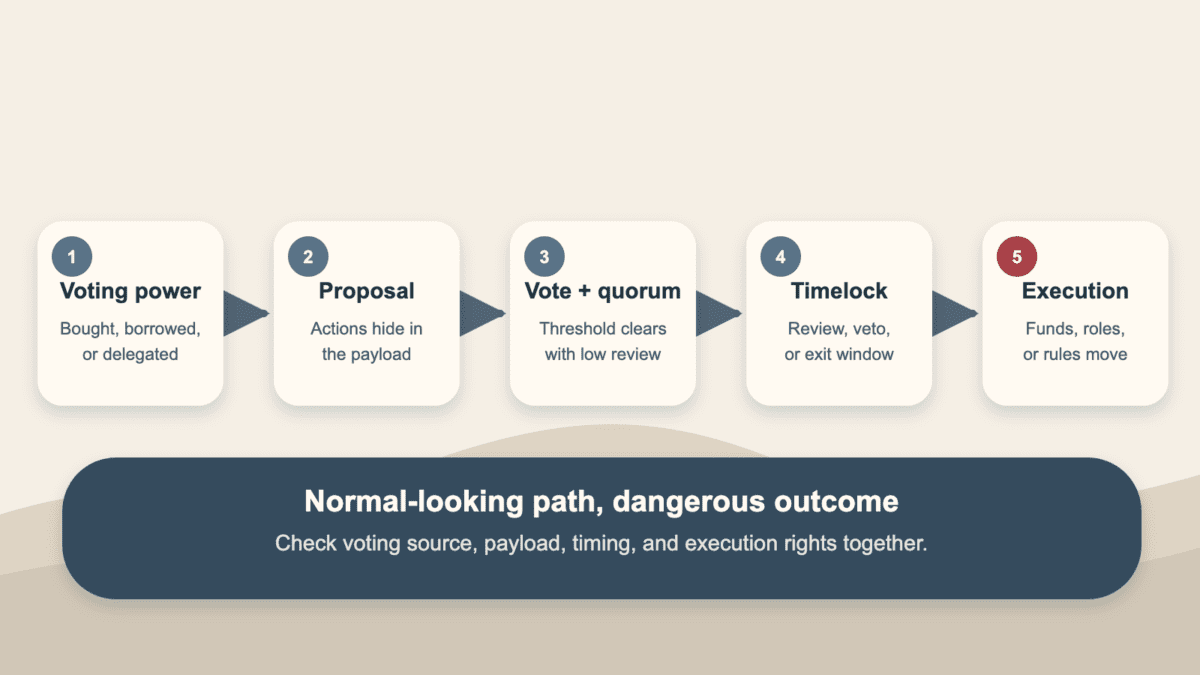
A governance attack works by turning voting influence into executable protocol control. The path moves from acquiring power, to passing a proposal, to executing the change on-chain.
The attack may look ordinary at first. A proposal appears, delegates vote, quorum is reached, and the transaction waits in a queue.
Voting power is the raw material of a governance attack. It can come from bought tokens, delegated votes, borrowed assets, staking rights, or a thin voter base.
Some systems reduce temporary voting games with historical snapshots. A standard Governor setup can use past vote balances. That helps, but it does not solve concentration or delegate capture.
The proposal payload is where the real change lives. The title may sound boring, while the encoded actions move funds, alter parameters, or upgrade contracts.
Good governance review asks what the proposal will actually execute. Calldata, target contracts, permissions, and post-execution effects matter more than vibes.
The vote decides whether the proposal clears the protocol’s thresholds. Quorum measures participation, while majority rules decide the winner.
Low turnout makes this step cheaper. A hostile bloc does not need every token if most holders are asleep or too small to pay attention.
A timelock creates a delay between a successful vote and execution. That delay gives delegates, users, and guardians time to inspect the queued action.
But a timelock only helps if people monitor it and can act. Veto roles and multisigs can stop danger, yet they add trust.
Execution is the moment governance becomes code. The queued transaction runs, permissions change, funds move, or contracts point to new logic.
Extraction comes after that. The attacker may drain a treasury, borrow against bad collateral, redirect emissions, or block future proposals. The vote was the door.
Governance attack risk depends on what governance can actually control. A token vote that only changes forum rules is annoying. A token vote that can upgrade contracts, move funds, or change collateral rules can put real capital at risk.
The control map is the first thing to inspect. It shows whether governance is mostly symbolic, operational, or powerful enough to rewrite the protocol.
| Governance control | Why an attacker cares |
|---|---|
| Treasury transfers | Funds can be redirected to attacker-controlled contracts or grants |
| Contract upgrades | Logic can be changed without exploiting the old code |
| Collateral listings | Weak assets can be used to borrow stronger assets |
| Liquidation parameters | Risk settings can favor one side of a market |
| Fee recipients | Revenue can be redirected quietly over time |
| Emissions | Token rewards can be aimed at friendly pools or wallets |
| Pause powers | Withdrawals, borrowing, or markets can be frozen |
| Bridge routes | Cross-chain messages can move risk across networks |
| Emergency roles | A council or multisig can bypass slow voting in a crisis |
This is also where team accountability enters the picture. Anonymous operators are not automatically unsafe, and public teams are not automatically safe. Still, anonymous control over emergency powers changes how much trust users must place in off-chain judgment.
The key question is simple: what can governance touch before users can react? The wider that surface, the more a governance attack can feel like a normal admin update until it is too late.
A governance attack is different because the attacker abuses decision rights rather than only breaking code. The transaction may be authorized, signed, and executed by the protocol’s own governance system.
The boundary keeps the next check clear. Some incidents mix categories, but clear labels help users know what failed and what to check next. A hard rug usually centers on direct value extraction by insiders, while a soft rug is slower neglect, abandonment, or decay. A governance attack can overlap with both, but the failure point is different.
| Risk | How It Differs |
|---|---|
| Governance attack | Uses proposal, voting, delegation, timelock, or execution rights |
| Smart contract exploit | Abuses a code bug or faulty logic without needing a vote |
| Bridge exploit | Targets cross-chain messaging, custody, verification, or liquidity |
| Oracle manipulation | Moves a price input so the protocol makes bad calculations |
| Admin-key compromise | Uses stolen privileged keys rather than public voting power |
| 51 percent network attack | Targets block production or chain history, not app governance |
| Rug pull | Often depends on insiders, hidden permissions, or abandonment |
The messy cases are the useful ones. A bridge exploit can trigger emergency governance. A bad governance vote can change an oracle setting. A compromised multisig can execute what looks like a governance action.
So do not stop at the headline. Ask what authority changed hands, which system executed the change, and whether users had a real exit window.
Common governance attack types include temporary voting-power attacks, delegate capture, malicious payloads, vote buying, low-turnout abuse, cross-chain timing games, and emergency-power misuse. They all aim at the same thing: make governance approve something the broader protocol would reject.
The warning signs are usually visible before execution. The challenge is that they are scattered across forums, vote dashboards, delegate comments, and contract calls.
Flash-loan voting uses borrowed capital to gain voting power for a short window. It is most dangerous when voting power can be acquired and used quickly.
Snapshots and voting delays can reduce this risk. They do not help if the attacker accumulated power earlier or captured delegation.
Whale capture happens when one holder or coalition can swing the result. Delegate capture happens when voting power sits with persuadable, inactive, or aligned delegates.
A protocol can drift into this risk when retail holders stop voting and delegates become the real control layer.
A malicious payload hides damage inside executable actions. The title may mention maintenance or incentives, while the transaction grants a role or moves assets.
Watch for proposals that change many contracts, use unfamiliar targets, or lack readable simulations. The boring proposal is sometimes where the bodies are buried.
Vote buying turns governance into a market for influence. Bribes and reward promises can make a harmful proposal look popular.
Proposal spam floods reviewers with noise and forces rushed votes. A small team can miss danger when every week becomes governance whack-a-mole.
Low turnout lowers the cost of control. Weekend votes, short review windows, and quiet forums can all matter.
Cross-chain governance adds timing risk. A vote or bridge message may clear in one place before another system can react.
These signals deserve extra scrutiny:
| Attack type | Warning sign |
|---|---|
| Flash-loan voting | Voting power appears suddenly around the proposal window |
| Delegate capture | A small bloc controls the outcome despite broad opposition |
| Malicious payload | The proposal text is vague, but calldata is powerful |
| Vote buying | Support appears tied to side payments or promised rewards |
| Proposal spam | Many proposals reduce review quality and delegate attention |
| Low-turnout abuse | Vote timing makes normal participation less likely |
| Cross-chain timing | Execution depends on bridge messages or delayed finality |
| Emergency-power misuse | A guardian, council, or multisig can override normal checks |
The best early signal is a cluster: sudden voting power, weak explanation, short review time, and a payload that touches money or permissions.
Governance attack examples are useful only when the facts are clean. Loss totals, attribution, and proposal intent can get messy fast, so examples should teach the pattern.
Beanstalk is the clearest cited example. Beanstalk disclosures state that the protocol was attacked via on-chain governance on April 17, 2022, with a flash loan used to compromise governance and steal about $77 million in non-BEAN assets.
That case shows the classic pattern. Temporary voting power affected governance, the approved path executed, and the protocol later changed its governance structure.
Compound’s 2024 Proposal 289 debate is a more recent example of why wording changes the claim. Delegates argued over whether a concentrated voting bloc could push an investment arrangement through quorum while decentralization concerns were still unresolved before execution.
That does not make every contentious vote a hack. It shows why delegates use “governance attack” when voting power appears to overpower broad opposition.
Use examples for the pattern, not the scoreboard:
| Example pattern | What It Teaches |
|---|---|
| Flash-loan governance | Temporary capital can become temporary control |
| Treasury-directed proposal | A vote can move assets without a contract bug |
| Delegate concentration | A few voting blocs can outweigh broad but inactive holders |
| Emergency veto response | Defense tools can stop harm, but add trust assumptions |
Careful examples keep the article honest. If exact losses, dates, or responsibility are not verified, use the pattern and skip the drama.
Governance attack risk can hit price, liquidity, collateral safety, and withdrawal confidence at the same time. The vote may target protocol controls, but the market response lands in your portfolio.
Governance tokens carry two risks. They are market assets, and they may also be control assets. If voting power is concentrated or borrowable, the token can become both the thing being attacked and the tool used to attack.
The first market effect is confidence. A suspected governance attack can push holders to sell before official analysis arrives. Late sellers can become exit liquidity for faster wallets, while smaller holders may become bagholders after liquidity thins.
The second effect is protocol exposure. A lending market can suffer if governance changes collateral rules. A liquidity pool can suffer if emissions shift. A treasury can lose value if funds move to a weak strategy. Integrations can inherit the problem if they accept the affected token or vault share.
The third effect is timing. Markets move on rumors, forum posts, vote dashboards, and wallet flows. Users who wait for a perfect post-mortem may get clearer facts, but fewer exit options.
Practical risk often shows up in three places:
None of this means every tense vote is an attack. It means governance risk is portfolio risk when a protocol can change what your position depends on.
Governance attack checks start with who can change the system and how much time you get before execution. High yield means less if governance can rewrite the risk.
Start with the control layer, not the slogan. You need the proposal threshold, voting-power distribution, quorum, timelock, veto roles, upgrade authority, and withdrawal path.
| Question to ask | Risk signal |
|---|---|
| Who can submit proposals? | A low threshold can invite spam or hostile payloads |
| How concentrated is voting power? | A small bloc may control outcomes |
| Is voting based on snapshots? | Snapshots can reduce short-term borrowing games |
| What quorum is required? | Low turnout can make attacks cheaper |
| How long is the timelock? | Users need time to inspect and exit |
| Who can veto or pause? | Emergency powers protect users but add trust |
| Can governance upgrade contracts? | Upgrades can change the rules after you deposit |
| What collateral can governance add? | Weak collateral can infect lending markets |
| Are bridge routes governed? | Cross-chain control can spread risk slowly |
| Are delegates active? | Silent delegates reduce review quality |
| Are simulations published? | Users need readable effects, not only summaries |
| Can you withdraw quickly? | Exit rights matter when proposal risk appears |
Then check your own exposure. Do not go full port into one governance token, one vault, or one DAO-controlled lending loop just because the proposal page looks quiet.
Operator identity is another trust signal. Public teams can still make bad choices, but accountability changes how users evaluate emergency roles, multisigs, and off-chain governance promises.
The best check is boring: assume governance can change more than the page admits. Then decide whether the yield, liquidity, and exit window still work.
A governance attack can be made harder, but no single defense makes governance safe by magic. Each control blocks one path while adding a tradeoff in speed, trust, or participation.
Timelocks give users and delegates time. Snapshots make temporary voting power harder to use. Quorum design can raise attack cost. Simulations can expose dangerous calldata.
Prevention works best when it matches the power being protected. A spelling fix in a forum post does not need the same guardrails as a contract upgrade. A proposal that can move treasury funds or change collateral should face more review, better simulation, and more time.
Useful defenses usually combine several layers:
The tradeoff is real. A guardian can stop a malicious proposal, but it can also become a central point of trust. A multisig can react quickly, but it can freeze users or override token-holder preferences. Higher quorum can raise attack cost, but it can also make normal upgrades harder.
Prevention is strongest when dangerous controls require the most review. Moving a treasury, upgrading core contracts, changing collateral, or assigning emergency roles should never feel routine.
If a governance attack is suspected, verify the proposal state before making irreversible moves. Panic helps scammers and faster wallets.
First, find the proposal. Check whether it is discussed, voting, queued, executed, or canceled. Those states demand different responses.
That state check changes your options. A proposal under discussion gives users time to read, ask, and trim risk. A queued proposal may leave less time. An executed proposal means the next move is usually verifying balances and permissions before signing anything else.
Use this order before acting:
Social channels can help you notice a problem, but they can also turn one proposal into six rumors. If the first alert comes from crypto Twitter, use it as a signal to verify, not as an instruction to sign.
Custody needs its own check during a live scare. If you withdraw to self-custody, confirm the address, network, and token before moving size. CryptoProcent’s wallets section can help with wallet research, but a wallet cannot fix a bad approval.
The safest useful move is often small. Reduce avoidable exposure, revoke stale approvals when appropriate, and wait for a clean proposal-state update.
Related governance attack concepts help separate control risk from market slang. If the suspected harm comes from insiders, compare it with a hard rug or softer soft-rug risk before calling every ugly vote the same thing.
Team identity has its own lane. Public names can add accountability, but they do not remove upgrade risk, delegate capture, or weak emergency controls.
Social language helps with market reaction. Governance rumors often spread before proposal details are decoded, so separate the rumor from the actual authority, payload, and execution window.
A governance attack in crypto abuses a protocol’s voting, delegation, proposal, or execution process to push through a harmful change. The change may be valid under the rules.
No. A governance attack targets decision rights, while a smart contract hack usually targets a code flaw. Some incidents involve both.
Yes, if borrowed or temporary capital can count as voting power at the wrong time. Snapshots, voting delays, and timelocks can reduce that path.
Yes. A DAO can approve a harmful proposal through valid voting mechanics. The flaw may be economic, social, or procedural.
Timelocks help, but they do not stop governance attacks alone. They create time for review, exits, vetoes, or emergency action.
Check the proposal state first, then verify whether it is discussed, voting, queued, executed, or canceled. Reduce exposure if needed, and avoid recovery links.
Start with the protocol’s real controls. A governance attack is much easier to understand once you know what a successful vote can change.
Then connect those controls to your own position. A small governance-token holding is one kind of risk. A vault funded with borrowed assets, a bridged asset, or collateral inside a DAO-controlled lending market is another. The same proposal can be trivia for one user and a serious exit problem for another.
Do not try to audit every DAO like a security firm. Start with the controls that touch your own capital. If you only hold the token, price and voting concentration come first. If you use a vault or lending market, upgrade rights, pause powers, and withdrawal timing deserve the attention.
Use these checks this week:
If those checks are hard to answer, that is useful information. Governance risk does not need to be dramatic to be expensive. It just needs enough power, enough confusion, and a vote that clears before users understand what changed.
Keep the bar simple. If you cannot tell who can change the rules, how long execution takes, or whether you can leave cleanly, size the position like governance can surprise you. Because sometimes it can, and it rarely sends a polite calendar invite first.