Physical Address
304 North Cardinal St.
Dorchester Center, MA 02124
Physical Address
304 North Cardinal St.
Dorchester Center, MA 02124


Honeypot crypto traps explained without recovery hype.
A honeypot in crypto is a trap where entry works and the exit does not: you can buy, deposit, or add gas, but selling, withdrawing, or moving value back out fails.
The term usually appears after everything looks fine and the transaction refuses to cooperate. A token balance may look valuable, a chart may look active, or a wallet may look tempting, but the exit path is blocked. For DEX traders and wallet users, the lesson is blunt: a displayed balance is not the same as money you can sell.
A honeypot in crypto is a one-way trap. Entry feels normal, then the action that should get value back out stops working.
In token trading, that usually means a token you can buy but cannot sell. The approval may succeed. Your wallet may show a balance. The chart may print green candles. Then the sell fails, reverts, or gets taxed until the exit is useless.
The same word can also describe wallet seed-phrase bait or fake platforms. In those cases, the lure changes, but the pattern stays the same. You are shown a route in. The route out belongs to someone else.
That differs from the older cybersecurity use of “honeypot,” where a system is built to attract attackers and study them. In crypto trader language, the victim is usually not being studied. They are being baited.
That split changes the response. If the trap is a token contract, raising slippage may only donate more gas. If the trap is wallet bait, adding gas to the shown wallet can feed a sweeper bot. If the trap is a fake platform, the dashboard balance may be the prop, not the asset.
The simplest way to read the term is this:
So a honeypot is more than a bad trade. A normal bad trade can still be sold. A honeypot attacks the exit itself.
Crypto users often use “honeypot” for several traps that feel similar. The shortcut is understandable, but it can lead to the wrong response.
A token honeypot traps a trade. You buy through a DEX and receive the token. Later, you discover that your wallet cannot sell under normal conditions. The contract may block transfers to the pool, blacklist buyers, allow only approved wallets to sell, or apply a sell tax so large that the output is meaningless.
A wallet honeypot works almost backward. The scammer shows a wallet that appears to hold valuable tokens, often with a seed phrase or private key. The victim adds native gas to move the tokens. A sweeper bot instantly removes that gas before the victim can do anything useful.
Fake platforms and bridge traps are broader. They may allow deposits, show a dashboard balance, and then block withdrawal with fake fees, identity checks, or endless support excuses.
| Honeypot Type | What The User Should Check |
|---|---|
| Token sell trap | Can normal wallets sell through the pool, or only insiders? |
| Wallet seed-phrase bait | Does the wallet need fresh gas that could be swept instantly? |
| Fake platform or bridge | Can independent users withdraw, or only deposit and watch numbers? |
The defense changes by type. Token honeypots need contract, trade, liquidity, and authority checks. Wallet bait needs a clean-wallet mindset and a refusal to add gas to someone else’s wallet. Fake platforms need withdrawal proof, not dashboard screenshots.
When in doubt, ask what action is blocked. If buying works but selling fails, think token honeypot. If added gas gets stolen, think wallet bait. If deposits work but withdrawals never clear, assume the platform is hostile.
Buying and selling are not always mirror-image actions inside a token contract. A honeypot keeps the path in open, then routes the path out through a hidden rule.
On a normal DEX trade, your wallet routes a swap through a router and liquidity pool. You send one asset in, receive the token, and later reverse the route when you sell. A scam token can allow the first transfer and reject the second.
That is why a honeypot can look liquid. New buyers may keep entering, and the chart may keep moving. The trap can turn buyers into exit liquidity for insiders who can sell while everyone else is stuck.
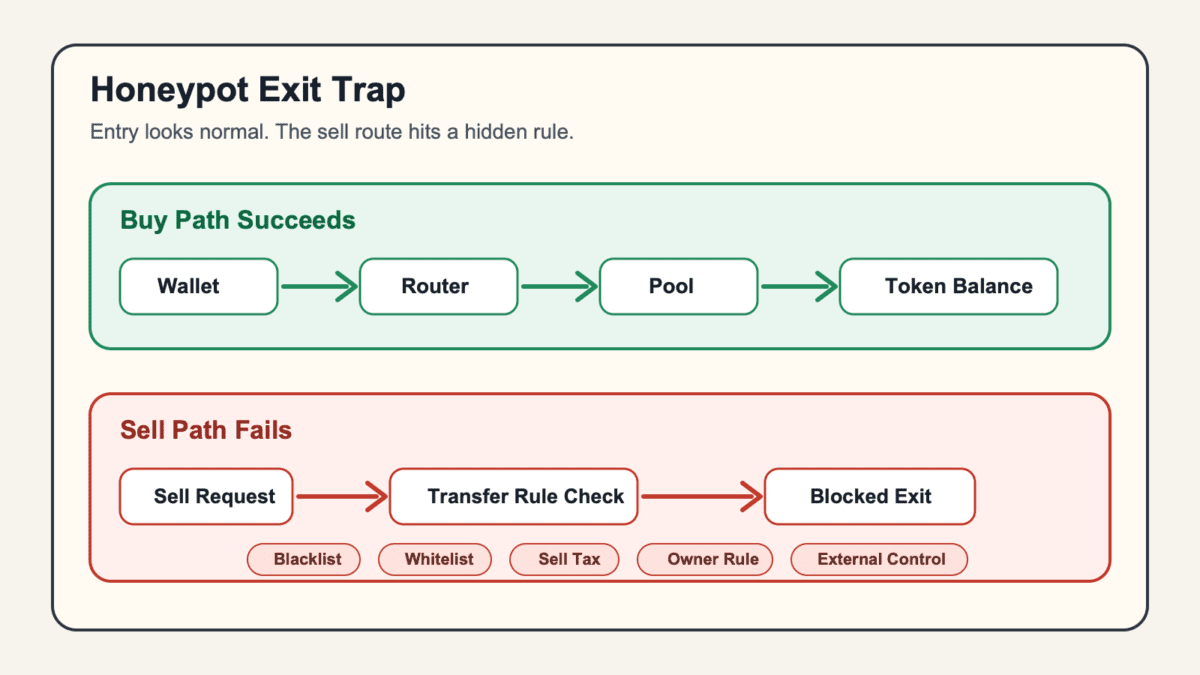
The buy path often looks simple:
The sell path is where the checkpoint appears. The contract may check whether your wallet is blacklisted, whether selling is enabled, or whether your wallet is whitelisted. It may also block amounts above a limit or ask an external controller to approve the transfer.
Common sell-blocking controls include:
Approvals can mislead users here. A token approval only lets the router try a transfer from your wallet. It does not guarantee the token contract will allow the later sell transfer.
That distinction stings, but it helps. If approval succeeds and selling still fails, the problem may sit inside the token’s transfer rules, not your wallet app, slippage setting, or internet connection.
A honeypot balance can look valuable because wallets and charts often display ownership, last traded price, or estimated value. Those signals do not prove that your specific wallet can sell.
Token ownership is only one layer. You may hold units of the token on-chain. Realized value needs a working transfer path, real buyers, pool depth, and a sell route that does not fail or destroy the output.
That is why a wallet can show a big number while the market value is effectively zero for you. The app may multiply your token balance by a recent pool price. It may not know that selling from your address hits a blacklist, transfer hook, tax rule, or frozen token account.
| Displayed Signal | What It Does Not Prove |
|---|---|
| Wallet token balance | That the token can be transferred or sold |
| Chart price | That your sell order can reach that price |
| Market cap estimate | That enough real liquidity exists for exits |
| Green candles | That ordinary buyers are selling successfully |
Pool depth can create the same illusion. A token with thin liquidity can show a price that collapses when anyone tries to sell size. That may not be a honeypot by itself, but it can feel similar when the displayed number cannot be realized.
A displayed value is an unproven claim, not cash. The useful question is not “What does my wallet show?” It is “Can a normal wallet sell a real amount through the actual route right now?”
A honeypot blocks the holder’s exit. A rug pull usually removes or drains value. No liquidity means there may be no buyer, or not enough depth, to buy from you.
Those labels overlap in casual chat, but they point to different problems. A hard rug is usually more direct. Liquidity may be pulled, funds may be drained, or a contract function may be abused to destroy holders quickly.
A soft rug is slower. The team may keep dumping, abandon promises, hide bad news, or let trust bleed out until the token becomes a sad souvenir with a ticker.
| Problem | How To Tell It Apart From A Honeypot |
|---|---|
| Honeypot | Buyers receive tokens, but normal selling fails or gets blocked |
| Hard rug | Liquidity or funds disappear through a direct drain or abuse |
| Soft rug | Value fades through dumping, neglect, or broken promises |
| No liquidity | Selling may be technically possible, but there is no real depth |
| High sell tax | Selling works, but the tax consumes most of the output |
Use the label to choose the next move. A no-liquidity token will not be fixed by changing slippage forever. A true honeypot will not become safe because the chart has buys. A hard rug may already be over before you diagnose it.
For a quick first pass, inspect actual sell transactions. If normal wallets are selling meaningful amounts, the issue may be liquidity, tax, or market depth. If only privileged wallets sell while buyers fail, honeypot risk rises fast.
Honeypot red flags usually appear before the failed sell. They are easy to ignore because the social feed is loud and the chart is moving.
One warning sign rarely proves the case. New tokens are messy, and some legitimate launches have rough settings. But several red flags together are enough to skip the trade. You do not need courtroom proof to avoid a bad contract.
Check these signals before you buy:
Solana tokens need their own checks. Freeze authority, update authority, mutable token data, transfer hooks, and suspicious token accounts can change the risk picture. A token can look tradable in a wallet while control settings still make exits fragile.
EVM tokens have different tells. Look for custom transfer logic, owner exclusions, external controller calls, hidden taxes, blacklist mappings, and trading flags. If every answer depends on trusting the deployer, the risk is not subtle.
The cleanest red flag is a sell-history problem. If you cannot find ordinary wallets selling through the same pool, slow down. A fast chart is not evidence. It is often the bait.
Checking honeypot risk means testing the exit, not admiring the chart. The goal is to catch obvious traps before you send meaningful money.
Start with the exact contract address. Scam tokens often copy names, tickers, logos, and social accounts. A clean-looking chart for the wrong contract is decoration with a gas fee.
That risk is not theoretical. The 2024 ACM CCS paper TokenScout labeled 22,800 ERC-20 marketplace tokens as honeypots in its research dataset. One scanner pass should lead to transaction-history checks, not replace them.
Then run a layered check:
Honeypot scanners are useful because they simulate whether a token can be bought and sold at the time of the check. A tool such as Honeypot.is can help catch obvious sell traps before you trade.
But a scanner result is not a safety stamp. Contract behavior can change after the scan. Owner controls, external controllers, liquidity changes, upgradeable code, and wallet-specific rules can all make a later trade behave differently.
Use scanner output as one signal. If a scanner fails the token, walk away. If a scanner passes the token, keep checking.
Solana honeypot checks focus less on Solidity transfer code and more on token authorities, account behavior, liquidity, and wallet display quirks. The names are different, but the exit question stays the same.
Look at freeze authority, mint authority, update authority, transfer hooks, mutable metadata, and whether the pool has real sell activity. Also be careful with burn tools. Burning a token may tidy wallet clutter, but it usually does not recover lost trade value.
Solana wallets can also show tokens that have no practical market. Do not confuse a displayed value, a token account, or rent recovery with a working sale.
EVM honeypot checks often start with transfer and transferFrom behavior. The dangerous part is usually not the token balance. It is the rule that decides whether your wallet can send tokens back to the pool.
Look for blacklists, fee switches, owner exemptions, max transaction rules, trading flags, external contract calls, and odd conditions around the DEX pair. If the code treats buys and sells differently, that difference deserves attention.
Non-technical users can still learn from public trades. If normal wallets buy but never sell, the code may be doing exactly what the scammers need.
If you bought a honeypot token, stop trying random fixes. More transactions can waste gas, reveal more intent, or expose you to recovery scams.
Recovery is usually unlikely when the token is a true sell trap. There are exceptions, such as a tax setting that changes, a temporary pool issue, or a narrow contract bug. But paying strangers to “free” the token is usually how the second scam starts.
Use a containment checklist instead:
Wallet hygiene helps after any suspicious token interaction. A clean setup for unrelated assets, careful approvals, and separate hot wallets can limit damage next time. CryptoProcent’s wallet hygiene category is useful when the problem expands from one bad token to broader custody cleanup.
Do not burn tokens expecting a refund. Burning may remove clutter or close some token accounts in specific cases, but it does not make a scam contract pay you. If the sell route is blocked, burning only changes what sits in your wallet.
The main goal is containment. Protect what is not affected, document what happened, and assume unsolicited recovery help is hostile until proven otherwise.
Social hype gives a honeypot its timing. The contract is the lock. Promotion gets users to walk through the door before they check the exit.
The pitch often starts with urgency. A Telegram group pushes an early entry. An X account posts a chart with only green candles. A fake helper drops a contract address. A copied token name rides a real trend. Someone claims the liquidity is burned, the owner is gone, or the team has “alpha.”
Watch for these pressure patterns:
The cruel part is that some signals can look good at a glance. A new pool, rising volume, and fast buys can appear exciting. But if nobody can sell except privileged wallets, the chart is not a market. It is a staged room.
The social layer also explains why victims often keep signing. After the first failed sell, helpers appear with a fix, a private bot, or a paid recovery route. That second pitch can be more dangerous than the token because the user is already stressed.
There is no shame in slowing down. Scammers build around impulse and embarrassment. A five-minute contract and sell-history check ruins many of their best moves.
Honeypot risk sits near several other crypto terms, but each one answers a different question. Exit liquidity explains who may be used as the buyer of last resort. A hard rug explains direct drains or liquidity removal. A soft rug explains slower value decay after trust breaks.
Wallet hygiene belongs nearby too. Some honeypot losses start as token trades, while others start with seed phrases, approvals, or poor wallet separation. The controls are different, but the habit is similar: reduce the number of ways one mistake can reach the rest of your funds.
It also helps to understand trading “in the trenches.” New-token markets move fast, use informal language, and reward speed. That environment makes honeypot checks harder, not optional.
Keep the concepts separate before choosing a response. A honeypot blocks exit. A rug removes value. A weak market may simply have no real buyers. Naming the problem correctly keeps you from wasting gas on the wrong fix.
Start with the exit path. Before buying a new token, look for proof that ordinary wallets can sell through the same pool under normal conditions.
That single habit beats most slogans. It forces you to check the actual market instead of trusting a chart, a group chat, or a stranger’s confidence.
The point is not to become a full-time contract auditor before every small trade. It is to make the obvious trap fail before your wallet does. A token with no normal sell history, live owner controls, and urgent promotion does not need a heroic investigation. It needs a pass.
Use this simple order:
Then size the trade as if the checks could still miss something. New-token markets are not polite. Some risks only appear after you are inside, especially when owner controls or authorities can change later.
If the token is already stuck, shift from trading mode to containment mode:
That order is boring by design. Boring is useful after a scam because panic creates the next opening.
The win is not perfect detection. It is refusing the obvious traps, limiting damage when a token fails, and keeping the rest of your wallet out of the blast zone.
A honeypot in crypto is a trap where you can buy, deposit, or add gas, but you cannot sell, withdraw, or move value back out normally. In token trading, it usually means a token that lets buyers enter while blocking their sell path.
No. A honeypot blocks the holder’s exit, while a rug pull usually removes liquidity, drains funds, or destroys value through insider action. They can overlap, but the first check is different: ask whether normal wallets can sell.
Usually not if it is a true honeypot. Some failed sells are caused by high taxes, bad routing, thin liquidity, or temporary settings, but a real sell trap is designed to stop ordinary holders from exiting.
Yes. A honeypot checker can miss behavior that changes later, depends on your wallet, uses an external controller, or appears only after the first trade. Use scanners as useful warnings, not guarantees.
Your wallet may show token ownership and an estimated price, but that does not prove a working sell route. A honeypot token can display a balance while transfer rules, taxes, liquidity, or authorities stop you from realizing the value.
“Honey pot token” is a common spaced spelling of honeypot token. It means the same thing in crypto slang: a token that looks buyable or valuable, then traps users when they try to sell.