Physical Address
304 North Cardinal St.
Dorchester Center, MA 02124
Physical Address
304 North Cardinal St.
Dorchester Center, MA 02124


Hyperliquid points explained without airdrop fog.
Hyperliquid points were a reward score tied to activity on Hyperliquid, used historically to recognize users who contributed to the protocol before the HYPE genesis distribution.
That made the score important, but not magical. It was not HYPE, not a wallet balance, not a transferable asset, and not a standing promise that every future trader gets paid. The useful question is narrower: what did the points mean, what changed after the original program, and how can you avoid getting farmed while trying to farm?
They were a score used to recognize activity on Hyperliquid. They belonged to a rewards program, not to a tradable market.
That distinction protects users from mixing several different ideas into one claim. In crypto, “points” can mean a scoreboard, a campaign metric, an eligibility signal, or a marketing hook. For Hyperliquid, points became famous because users connected them to the later HYPE genesis distribution, but that history was not a public formula for a fixed payout.
You may see the term mentioned in several places:
Those are not the same source of truth. An old dashboard can show history, while a farming page can show speculation. The simplest filter is this: the points were a record of activity, not something you could send to another wallet. They answer “what did this account do?” more than “what is this claim worth today?” That is the safer way to read every dashboard.
That also explains why late users feel pulled in two directions. The old program was real enough to shape a major token story, yet vague enough that copycat pages can stretch it into almost anything. A user may be checking an old score, reading a current HyperEVM campaign, and seeing a “Season 2” thread in the same hour. Those are separate signals.
That does not make the topic useless. It makes precision expensive. Users who understand the difference can read old points history, HYPE discussions, and new farming claims without mixing them into one very confident mistake.
The points worked as a recurring reward score for eligible platform activity. The public rules gave users a timeline, but not every scoring detail was fully open. The Hyperliquid Docs page gives the narrow public timeline: the first program began on November 1, 2023, and ran for six months, with 1,000,000 points distributed weekly. The same page says the later L1 phase distributed 700,000 points weekly.
That setup explains why the Hyperliquid points program attracted serious farmers. It gave users a visible score, a weekly cadence, and a reason to keep activity on the platform. It also left enough ambiguity to reduce simple gaming.
Here is the clean timeline to keep in mind.
| Period | What Users Should Understand |
|---|---|
| Closed alpha through October 31, 2023 | Early activity received points treatment before the public program began. |
| November 1, 2023, to May 1, 2024 | The original program distributed 1,000,000 points weekly for six months. |
| Weekly distribution cycle | Activity counted through Wednesdays at 00:00 UTC, with distributions on Thursdays. |
| Affiliate activity | Affiliates earned 1 point for every 4 points earned by referred users. |
| May 29, 2024, to November 2024 | The L1 points phase distributed 700,000 points weekly. |
The table gives the history, not a live recipe. If you are looking for today’s farming instructions, do not read old weekly numbers as a promise that a new campaign uses the same cadence. The most important detail is opacity, because criteria changed and some scoring choices were not fully disclosed.
Opacity can be reasonable, but it still creates risk for users. You can spend real money on fees, spread, and time without knowing whether your activity qualifies. So the system was not just “trade more, get paid.” Anyone selling it as a clean conversion formula is making the tidy version up.
The points connected to HYPE because they helped explain who had contributed before the HYPE genesis event. They were part of the historical participation trail.
That is why the phrase “Hyperliquid points to tokens” still appears in farming chatter. Users saw points before HYPE, then HYPE arrived, and the market built a story around that sequence. Points did not become a public, transferable receipt that late users could buy afterward.
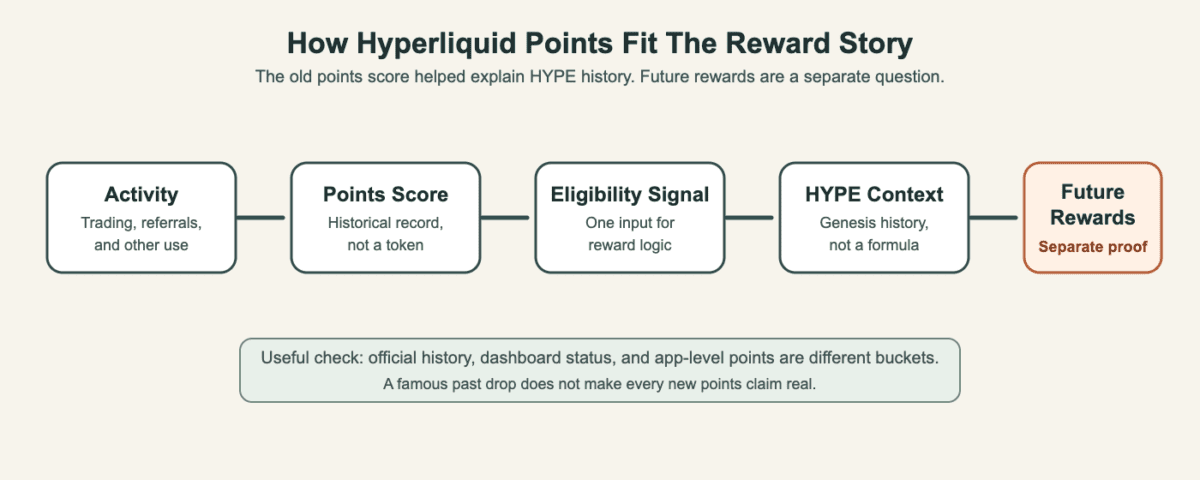
The HYPE connection is still worth understanding because it shaped behavior. Once a reward score is linked to a major token event, every later points campaign gets compared with it. Some comparisons are useful. Some are pure airdrop karaoke.
There is also a portfolio lesson after rewards arrive. A points win can turn into token exposure, tax records, and sale timing. If a user keeps a large token position only because the original reward felt free, bagholder risk can creep in quietly.
Read the history with both sides in view. The points helped users understand past participation, and they helped make HYPE famous. They did not create a standing right to future tokens, a fixed point value, or a repeatable claim path.
The original program is historical. Official timing for a new Hyperliquid points Season 2 is not disclosed. That answer can feel unsatisfying, especially if you found a recent farming guide.
Season chatter often moves through CT rumors before it reaches an official source. That is useful for finding questions, but it is a poor foundation for wallet permissions.
Read common claims like this.
| Claim | How To Read It |
|---|---|
| Original points are active again | Check official status first. The old program belongs to history. |
| Future community rewards may happen | Possible does not mean confirmed, funded, or eligible for you. |
| HyperEVM app points are live | App-level points can be real but separate from the old score. |
| A third-party page has Season 2 steps | Read it as a pitch until official channels confirm the program. |
| Referral pages promise guaranteed HYPE | Guaranteed conversion language is a red flag. |
The table is not anti-farming. It is anti-confusion. A user can trade on Hyperliquid or explore HyperEVM apps without pretending every action is part of the original points program.
Latecomers also need a clear answer to “too late?” For the original high-profile points opportunity, yes, that window has passed. Farming a possible future reward is a cost-benefit bet with its own rules and smart contract exposure. If a page skips those distinctions, it is asking you to bring money to a fog machine.
The old reward story still pulls in traders because it became a benchmark. It showed how activity, product use, and a token event can turn into a powerful incentive loop. That does not mean the only reason users cared was rewards.
Hyperliquid also attracted traders because the product felt close to a centralized exchange flow while keeping onchain settlement in the conversation. Then airdrop farming around Hyperliquid became a reference point for other campaigns.
The current FOMO usually comes from three places:
That last group deserves extra skepticism. Referral-led guides can still contain useful steps, but their incentive is not neutral. A guide can be helpful and still be trying to make your activity someone else’s points.
There is a cleaner way to think about it. A visible score made activity feel measurable, and a later token event made that score feel consequential. The danger is replay bias, where every new points campaign starts to look like a delayed paycheck. That is why referral pages hit so hard after a famous drop: they sell a memory, not just a tactic. Memory gets expensive when it becomes automatic.
Before farming the old score again, check the cost of the activity before you imagine the reward. The risk is real even when the reward is not confirmed. The first cost is trading cost, including fees, spread, funding, slippage, and liquidation risk.
Then check what you are actually using. A Hyperliquid trade, a HyperEVM app, a bridge, a staking route, and a vault are different risk surfaces. They may sit near the same brand story, but they do not carry the same rules.
Use this checklist before adding size.
The hardest line item is opportunity cost. Money and time used to chase uncertain points cannot be used elsewhere. Crowding also changes the game, because late users can become exit liquidity after earlier users already captured the major upside.
None of this means every future Hyperliquid-related reward is bad. It means you need a plan that survives zero payout. Record-keeping belongs in this checklist too, because future rewards may require claim dates, wallet addresses, market values, transfers, and sale records.
Set a hard line: farm only when the product or route makes sense without the reward. If the only reason to act is a rumor, you are trading certainty for a scoreboard.
The main risks start with fake certainty. Any page that promises an instant claim, fixed conversion, or guaranteed Season 2 payout is asking you to skip verification. Scammers like points campaigns because users expect a claim page.
The strongest red flags are usually plain.
Wallet hygiene belongs with the risk check, not after it. If you are comparing storage, approvals, and claim safety, CryptoProcent’s crypto wallets category is the more relevant internal starting point than a random claim link.
The second risk is bad guide quality. Some pages describe points like airline miles or store credit, which is wrong for this program. The third risk is activity theater, where a guide pushes trades, bridges, swaps, or app interactions without proving the activity will matter.
Use a blunt test before signing anything: would you still do this action if no reward appears? If the answer is no, the risk deserves more attention than the points estimate. And if a page tells you not to verify the source, close it.
The old score differs from many crypto points programs because it is now a famous historical case. New campaigns borrow the language, but they do not inherit the outcome. That is the trap.
Most point systems try to make users do something before a reward is public. That can be useful when the activity is real product use. It becomes weaker when the activity is only there to imitate a past airdrop. Hyperliquid points sit on the famous side of that divide, so they attract comparisons that are often too neat.
Compare the buckets before you compare the upside.
| Points Type | What To Verify |
|---|---|
| Official protocol points | Who runs the program, what activity counts, and whether dates are public. |
| App-level points | Whether the app has its own rules, risks, and reward budget. |
| Referral points | Whether the guide benefits from your activity more than you do. |
| Quest points | Whether tasks are meaningful or just wallet-interaction theater. |
| Vague loyalty scores | Whether any credible reward path exists at all. |
This comparison also explains why opacity cuts both ways. Some projects hide parts of the formula to reduce sybil farming. Others hide details because there is not much there. Late-stage points campaigns can also become PVP incentives, where users compete over a reward pool that may not expand just because more users arrive.
The difference is control. With official protocol points, you at least know who can clarify the rules. With app-level or referral points, you may be dealing with a smaller reward budget, different smart contracts, and stronger marketing incentives. That does not make them fake. It means the burden of proof is higher before you add size or sign approvals.
That is why the old program should not become a universal farming template. It is a useful case study, but it does not prove that every new points system deserves your capital, wallet permissions, or weekend. Fine for a case study. Dangerous as a playbook.
Real information about the points should come from official sources before social posts or farming pages. Start with the source hierarchy, then decide whether the action is worth doing. Use official Hyperliquid materials for the historical points program and the app dashboard for what your own account can see. If those sources are silent, a louder farming guide does not fill the gap.
That hierarchy keeps each source in its lane.
This order is especially important when a claim asks for a wallet connection. A real-looking screenshot can still point to the wrong domain, the wrong chain, or an old campaign. If the action involves a signature, bridge, deposit, claim, or approval, slow down until the official source and the app flow agree.
Do not let screenshots outrank official pages. A cropped dashboard can be old, edited, or from another app. Also separate “Hyperliquid” from “HyperEVM app,” because a third-party app can run points on HyperEVM without restarting the original program. That distinction changes who sets rules, who holds risk, and who may owe nothing. Do the boring check before the exciting click, and check the sequence before you sign.
If the sources disagree, do not average them into a hopeful answer. Give more weight to the source that can actually run the program, publish the claim window, or show your account state. Community posts can explain what users are confused about. They do not turn a rumor into eligibility.
The safest workflow is boring: verify the domain, read the current official status, inspect permissions, and assume no reward until the rules are public. Boring is underrated when wallets are involved.
Start with the historical answer, then decide whether there is any current action worth taking. Do not begin with a claim link. If you arrived from a Season 2 post, pause long enough to separate old official points, app-level campaigns, and pure referral bait. That pause can save fees, signatures, and a very annoying afternoon of wallet cleanup.
Use these steps if the topic is on your radar.
If you already use Hyperliquid, points history can help you understand why the platform became such a large airdrop story. If you do not use it, the old points story is not a reason to rush into risk. A future reward can be interesting and still be too vague for your capital, especially when the cost is paid today and the reward is only imagined.
The calm answer wins here. The points were real, important, and historical. The next claim still has to prove itself with clear rules, official timing, and a wallet flow that does not ask for blind trust. If that proof arrives, you can read it then. Until then, keep the wallet cooler than the timeline.
No. They were a historical reward score, while HYPE is the token connected to the later genesis event. Points helped explain past participation, but they were not HYPE tokens in a wallet.
The original program is historical. Official timing for a new points season is not disclosed, so any current earning claim needs official verification before you spend money or connect a wallet.
The points were part of the historical participation context before the HYPE genesis distribution. That does not mean there was a public fixed conversion ratio from points to tokens.
No. They were not a transferable token or wallet asset. If a page says you can buy, sell, or transfer the points, that is a major red flag.
Official timing for a new Season 2 is not disclosed. Community posts and farming guides may use Season 2 language, but timing and eligibility still need official confirmation.
No. They did not have a fixed dollar price. Any value estimate is speculative unless an official reward rule gives the score a defined outcome.