Physical Address
304 North Cardinal St.
Dorchester Center, MA 02124
Physical Address
304 North Cardinal St.
Dorchester Center, MA 02124


A practical guide to crypto points farming, airdrop odds, and hidden costs.
Points farming in crypto means using a protocol, wallet, bridge, exchange, game, or DeFi app to earn points that may affect a future token airdrop or allocation.
The important word is “may.” A points balance can look precise on a dashboard, but it is usually scorekeeping, not money in your wallet. The project still decides what counts, when the campaign ends, whether points convert, and who survives the filters.
That makes points farming useful only when the cost stays controlled. If the activity is something you would do anyway, points can be extra upside. If it requires risky approvals, expensive gas, borrowed exposure, or endless referral grinding, the dashboard may be farming you back.
Points farming is the deliberate effort to earn protocol points before a token, airdrop, or reward event is confirmed. You do the actions a project wants. The project records the score.
That score can sit on a public dashboard, inside an app account, or attached to a wallet address. It may reflect swaps, deposits, trades, referrals, bridge use, quests, or repeat product activity. But the point itself is usually not a token, not a claim ticket, and not something you can send from one wallet to another.
The trap is reading a dashboard like a bank balance. A points page may show 12,000 points, a rank, a multiplier, and a season badge. None of that gives the score a fixed dollar value. It only means the project has recorded activity under its current rules.
For example, a bridge campaign may award points for moving a small amount across chains each week. The dashboard can show progress, but the campaign can still cap wallets, filter suspicious activity, or convert points under a later formula.
Points farming sits close to airdrop farming because both chase future eligibility. The difference is visibility. In older airdrop farming, users often guessed which actions might count. In a points program, the project shows at least part of the score while the campaign runs.
That visibility can help. It can also make weak rewards feel more certain than they are. A good points campaign gives useful signals and clear limits. A poor one turns real user cost into a scoreboard with fog around the prize.
Before a token launch, points farming usually starts with activity the project can measure. A user connects a wallet, swaps, bridges, deposits liquidity, trades volume, holds an asset, refers friends, or completes app tasks.
The project then turns those actions into protocol points. Galaxy frames crypto points programs as gamified airdrop farming, while token conversion stays uncertain until later terms are set. Its July 2024 report examined five points programs launched from 2022 to 2024, showing that the mechanic had already become a repeatable growth playbook rather than a one-off airdrop trick.
That is the model in one line: the activity can be real, while the payout math stays private.
Most campaigns add layers. A season can run for a fixed period. A dashboard can update daily or weekly. Multipliers can reward early users, larger deposits, specific assets, referrals, partner apps, social actions, or repeated use. A snapshot can freeze eligibility at a time the user may not know in advance.
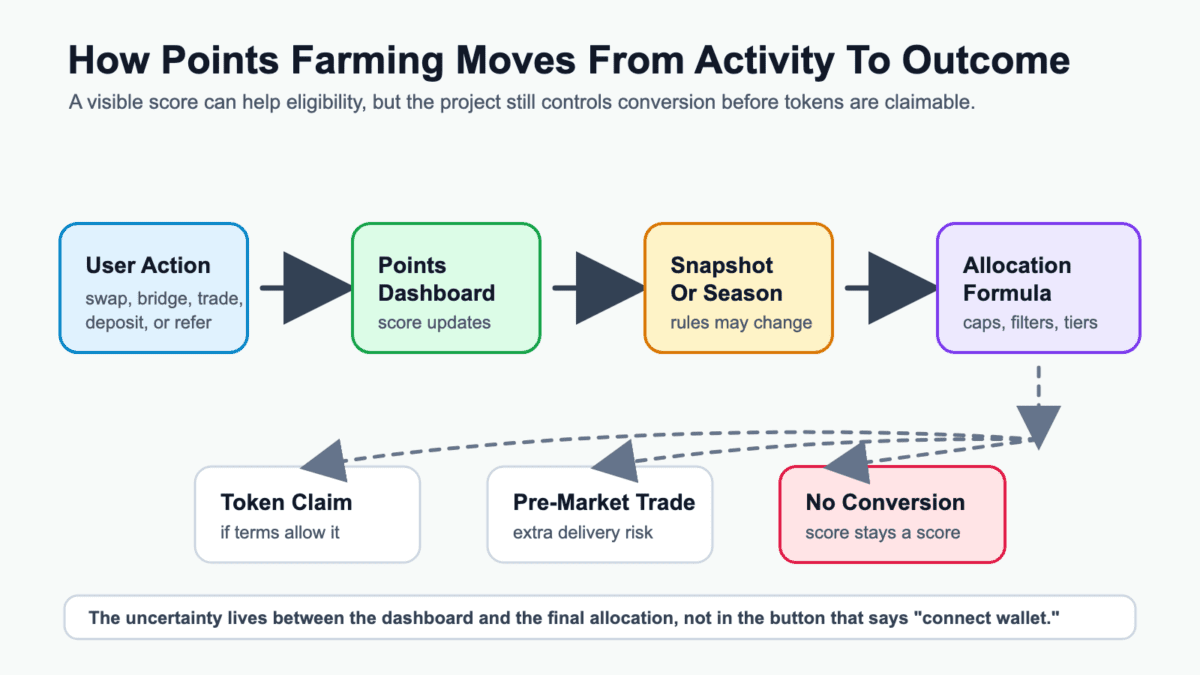
That gap is why points farming can feel more exact than it is. The dashboard makes the chase measurable. The final allocation can still depend on caps, Sybil filters, account status, regional rules, token supply, or a later formula.
Points also reward attention, not just capital. A campaign can pull users back into an app, push referrals, and keep a project visible across the attention economy before a token exists. That does not make the campaign bad. It means you should notice who gets value before the airdrop.
Points farming is part of the airdrop-farming family, but it is not the same as yield, staking, or normal reward income. The difference is the source of value.
In farming in crypto, the word can cover several strategies. Some produce fees or staking rewards. Others build activity history for a possible future token. Points farming belongs in the second camp unless the project clearly defines a separate redemption benefit.
Use this comparison to keep the labels clean.
| Strategy | How It Differs From Points Farming |
|---|---|
| Airdrop Farming | Broader eligibility chasing. Points farming is the version where a dashboard tracks part of the score. |
| Yield Farming | Seeks yield from fees, incentives, or lending rates. Points may be extra, but they are not the yield itself. |
| Staking | Locks or delegates assets to support a network or protocol. Rewards usually follow published rules. |
| Liquidity Mining | Provides liquidity for fees or tokens. Points may track usage, but the pool risk is still separate. |
| Pre-Market Points Trading | Speculates on a future claim. It adds counterparty and delivery risk after farming. |
The table does not mean one strategy is always safer. Staking can carry slashing, lockups, or validator risk. Yield farming can face smart-contract loss and reward-token dumps. Airdrop farming can waste time and gas.
The useful distinction is certainty. Points farming usually has the least certain payout because the issuer controls the final mapping from points to rewards. If the reward rules are vague, read the points as optional upside, not income.
Crypto projects use points farming programs because points let them shape user behavior before making hard token promises. That flexibility helps teams. It also creates risk for users.
A token launch creates commitments around supply, price discovery, liquidity, holders, and market pressure. Points delay that moment. They let the project gather usage, deposits, feedback, and attention before deciding how rewards should work.
Projects often use points to push specific behaviors:
Those goals can be reasonable. A points program can help a real product find users and reward early risk. It can also create a busy dashboard that flatters the project more than it rewards users.
The tradeoff is control. A team may need private criteria to block obvious Sybil farms, but that same privacy makes the user’s expected reward harder to price. The more a program depends on vague hints, the more carefully you should cap cost.
That project side is part of the definition. Points are an incentive tool, not just a gift. If the product is useful, the points may sweeten activity you already wanted. If the product is weak, points can turn you into unpaid growth work with gas fees.
Points farming is worth considering only when the possible reward can justify the costs you can control. The reward is uncertain, so the cost side deserves more attention than the headline upside.
The upside can be real. Some users have received valuable airdrops after early activity. But that history also creates copycat behavior. A famous drop can turn the next dashboard into a lottery-ticket trade, where the small chance of a large payoff hides a pile of small costs.
Count these costs before you farm.
| Cost To Count | Risk To Price In |
|---|---|
| Gas And Bridge Fees | Small transactions can become expensive across chains or repeated tasks. |
| Spreads And Slippage | Swaps and trades can lose value even before any reward exists. |
| Borrowed Capital | Borrowed positions can liquidate while points are still only points. |
| Lockups | Deposits may be hard to exit when market conditions change. |
| Attention Cost | Checking dashboards and tasks can consume hours with no payout. |
| Token Price Risk | A good allocation can still drop after listing or unlocks. |
Clean points farming starts with activity you would do anyway. Testing a credible app with a small amount, keeping records, and stopping at a written cost limit is different from looping borrowed funds because a dashboard rewards size.
Small wallets need to think in proportions. More points do not always mean a proportional token allocation. A fixed reward pool, whale activity, referral boosts, Sybil filters, caps, and tiers can flatten the result. If the campaign needs large capital to compete, a small user may be buying hope at institutional prices.
The biggest points farming risks usually arrive before the reward does. Wallet safety, approvals, fake claim pages, bridge exposure, and market losses can hit while the points still have no defined value.
Start with wallet hygiene. Use a separate wallet for unfamiliar campaigns, and avoid connecting the wallet that holds your main funds. If you need a refresher on wallet types and custody habits, the crypto wallets category is a better starting point than a referral thread.
Then check what you are signing. A fake claim page can copy a real brand, create urgency, and ask for an approval that drains tokens. A real-looking dashboard can still route you into a malicious contract if you arrived through the wrong link.
Use this checklist before touching a campaign.
Smart-contract and bridge risk need attention too. A points campaign can route users through young contracts, new chains, thin liquidity, or wrapped assets. The airdrop may be hypothetical, but the contract risk is live.
Market risk is just as real. If a campaign rewards deposits, liquidity, or perp volume, the underlying position can lose money. If it rewards borrowed loops, liquidation can arrive long before any token. And if rewards later become claimable, keep records for tax review instead of trying to reconstruct the story from screenshots and panic.
The best points farming opportunity is one where the product, cost, and risk still make sense without the airdrop. That filter removes most of the noise.
Start with the official source. The campaign should be visible from the project’s real website, app, documentation, or verified social account. Referral posts and influencer lists can help you discover campaigns, but they should not be the final source for wallet actions.
Team transparency is another useful signal. A doxxed team does not remove risk, but it can make accountability easier than a campaign run by anonymous accounts with no public track record. For newer teams, the burden shifts to audits, product quality, partner credibility, and conservative position size.
Use a quick filter before committing time or capital.
A campaign does not need to disclose everything. Many pre-token campaigns keep some criteria private to reduce gaming. But if every important detail is vague, you are not evaluating a strategy. You are donating activity to a scoreboard and hoping the scoreboard remembers you fondly.
Points farming usually looks like ordinary crypto activity with a scoreboard attached. The user does tasks, the dashboard updates, and everyone tries not to say “guaranteed” too loudly.
Common versions show up across DeFi, wallets, trading apps, games, and new networks. The exact tasks vary, but the pattern is similar: the project wants activity before a token or reward event, and users want a place in the final allocation.
Typical examples include:
None of those examples is an endorsement. Each has its own risk surface. A bridge task is not the same as a perp trade. A testnet quest is not the same as depositing real USDC. A social task may cost little money but a lot of attention.
A healthier pattern is modest and repeatable. Use one campaign at a time, understand the action, cap the cost, and keep the wallet clean. If a task list keeps pushing you toward larger size, borrowed funds, or stranger approvals, the points are no longer the main risk.
After points farming ends, the project may publish eligibility, run a snapshot, open a claim page, launch a token, extend the season, change criteria, or do nothing visible. The end of farming is not automatically the start of money.
The first job is verification. Use official links for any claim page, check the contract or claim route, and avoid signing under time pressure. Scammers love the gap between “season ended” and “claim live” because users are already waiting for a reward.
Then check the allocation math. A points total may become a tier, a capped allocation, a multiplier, or only one factor among many. A wallet can have plenty of points and still lose eligibility because of Sybil filters, regional rules, minimum activity, suspicious behavior, or account issues.
If a token arrives, the next risk is market structure. Selling pressure, vesting releases, thin liquidity, and crowded claims can turn a successful airdrop into exit liquidity for late sellers. A free token still needs a buyer, and “free” gets complicated once fees, tax records, and missed exits enter the chat.
Pre-market point trades add another layer. If someone bought or sold a future claim before launch, the trade can involve delivery risk, counterparty trust, escrow rules, and unclear final allocation. A point price in a side market is not proof that every point will convert at that value.
After the event, ask the dull but useful question: would you still use the product? If the answer is yes, the points may have introduced you to something valuable. If the answer is no, close approvals, record the outcome, and resist turning a finished campaign into a permanent habit.
Start points farming with a small test, not a grand theory. Pick one credible campaign where the task is clear, the official source is easy to verify, and the downside fits your budget.
Write the limits before connecting your wallet. Set a maximum gas spend, maximum capital at risk, and maximum time commitment. Also set a stop condition, such as “stop after this season” or “stop if rules stay vague after one month.”
Keep the first run boring. A low-risk test teaches more than ten open tabs full of projected allocations. You want to learn how the app behaves, what approvals appear, how quickly the dashboard updates, and whether the task still feels sensible after the novelty wears off.
A simple starting plan works better than a crowded spreadsheet.
Review the position after each meaningful change. If the campaign adds new tasks, changes multipliers, asks for larger deposits, or starts pushing referral pressure, make a fresh decision. The old cost limit should not automatically cover the new version.
That last point is the quiet test. Good points farming should feel like careful product exploration with extra upside. Bad points farming feels like expensive dashboard maintenance. If you cannot explain the cost, risk, and exit, the best farm may be the one you skip.
Points farming is worth it when the activity has capped costs, clear rules, and a credible product you would use anyway. It is less attractive when the campaign needs high gas spend, borrowed exposure, risky deposits, or constant attention for an undefined reward.
Points farming rewards are not real money until the program gives them a defined use, claim, token allocation, discount, or other benefit. A dashboard score can be real inside the app and still have no fixed market value.
Yes, points farming can lose money through gas, bridge fees, spreads, slippage, smart-contract risk, wallet drainers, lockups, borrowed exposure, or falling asset prices. The points may never convert, but the costs happen immediately.
No, points farming is not the same as yield farming. Yield farming usually seeks fees, incentives, or lending returns from a position, while points farming builds a score that may or may not affect a future reward.
Small wallets can have a chance with points farming, especially when the project rewards organic use, early activity, or capped participation. The odds get worse when rewards heavily favor volume, referrals, large deposits, or many-wallet farming.
No, you should not use your main wallet for points farming on unfamiliar campaigns. Use a separate wallet with limited funds, verify official links, and review approvals after each interaction.


