Physical Address
304 North Cardinal St.
Dorchester Center, MA 02124
Physical Address
304 North Cardinal St.
Dorchester Center, MA 02124


Learn what Pre-TGE really means before a token launch.
Pre-TGE is the phase before a token generation event when early access, points, or locked allocations exist before normal trading.
That early phase can feel like the starting line. It is often closer to the waiting room. You may have a dashboard balance, campaign score, subscription receipt, claim key, or allocation promise.
But you still may not have a freely transferable token. This is where hype, eligibility rules, lockups, wallet risk, points, pre-market prices, and no-liquidity assumptions all meet at the same tiny table.
Pre-TGE in crypto means the period before a token generation event, when a project may run campaigns, track points, sell early allocations, or prepare launch mechanics before the token trades normally.
The phrase expands to pre-token generation event. The key word is “before.” Before the official launch, a user may have exposure to a future token without having one they can freely move, sell, or value in a normal market.
Pre-TGE can show up in several forms:
Each form gives the user a different kind of control. A points balance may only prove activity. An allocation may only prove eligibility. A locked token may exist on paper while still sitting outside a tradable market.
A typical platform-style Pre-TGE offer gives early access before the main token generation event. But allocated tokens may remain locked instead of trading immediately. That example captures the broader market meaning well: early access does not automatically mean liquid ownership.
Every path leads back to the same check. Know what you have now, what you may receive later, and what must happen before transfer or trading becomes possible.
Pre-TGE is a pre-launch state. It can be useful. It can also be vague. If the rules do not explain transferability, claim timing, lockup length, and refund treatment, the user is mostly holding a promise with better branding.
Pre-TGE works by moving users through campaign rules before the token reaches full launch, claim, transfer, and trading status.
A project usually starts by announcing a campaign. It may ask users to connect a wallet, hold a required asset, complete tasks, trade, refer others, subscribe with funds, or earn points.
In some cases, users receive a proof of eligibility, claim key, or future allocation instead of a liquid token. This overlaps with pre-TGE farming when users repeat actions because they hope the activity leads to rewards.
The common sequence usually looks like this:
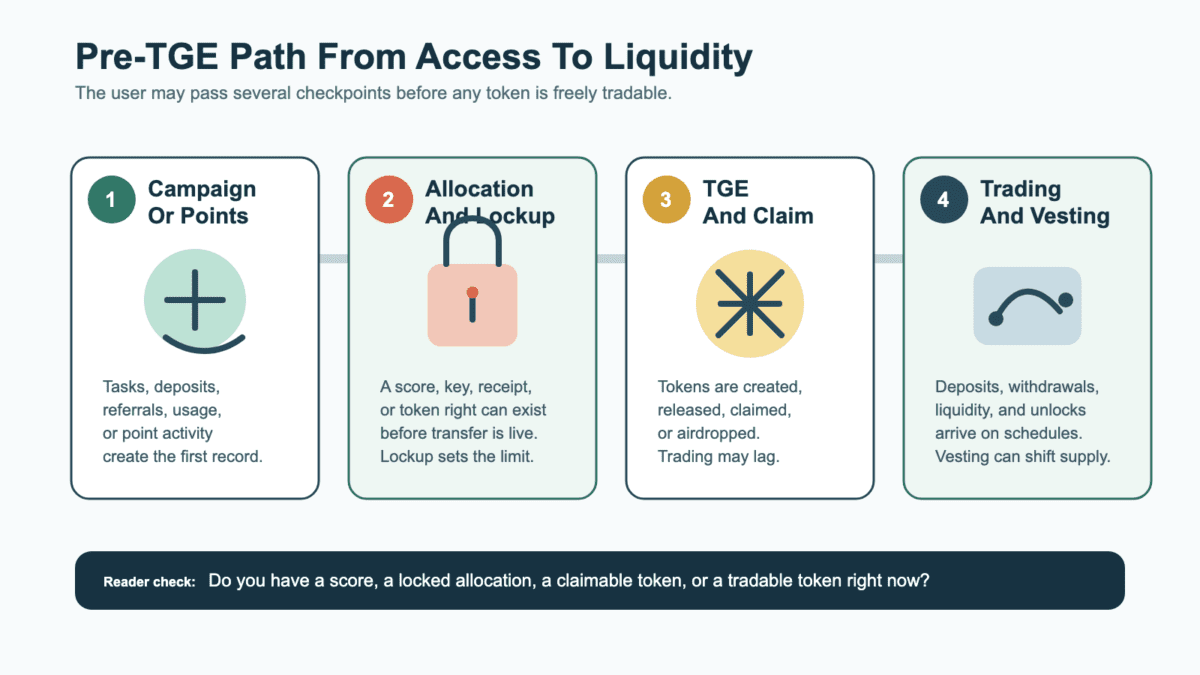
Those steps do not always arrive in a neat line. A project can announce a TGE date, then delay claims. A token can be claimable but still locked. An exchange listing can open before liquidity is deep. Vesting can continue long after launch-day excitement fades.
Track the right milestone. “I joined the campaign” is not the same as “I can sell the token.” “TGE announced” is not the same as “transfers are live.”
That distinction saves users from reading a countdown clock like a cash register.
Pre-TGE differs from TGE, presales, airdrops, points, and pre-market trading because each label gives users a different right.
This vocabulary gets messy because one campaign can combine several labels. A user might farm points, win an allocation, wait through a lockup, claim after TGE, and see a separate pre-market price before spot trading opens. The table separates each label from the right it gives.
| Term | What It Means For Users |
|---|---|
| Pre-TGE | The phase before the official token generation event, often with early access, locked rights, or uncertain rewards. |
| TGE | The token generation event, when tokens are created, distributed, claimable, or formally launched. |
| Presale | A token sale before public launch, usually with price, allocation, and vesting terms. |
| IDO | A token launch through a decentralized exchange or launchpad. |
| IEO | A token launch handled through an exchange platform. |
| Airdrop | A distribution to eligible wallets, often based on activity, points, or snapshots. |
| Offchain Points | A project-controlled score that may affect future rewards but is not a wallet balance. |
| Claim Page | The official flow where eligible users claim tokens or rewards. |
| Pre-Market Futures | A speculative market for future token exposure before normal spot listing. |
| OTC Allocation | A private or peer-to-peer trade of future allocation rights, often with delivery risk. |
| Lockup | A period when tokens cannot be traded, transferred, or used normally. |
| Vesting | A release schedule that lets tokens become transferable over time. |
| Exchange Listing | A venue adds trading, deposits, withdrawals, or some mix of those. |
| Liquidity Pool | Onchain liquidity that lets users trade, if depth and routing are usable. |
The key difference is enforceability. A liquid token in your wallet gives you more control than a dashboard score. A locked allocation gives you more detail than a rumor, but less freedom than a transferable balance.
Pre-market trading adds another layer. It can create a visible price before launch, but that price may reflect thin liquidity, collateral rules, delivery terms, and speculative demand. It is a clue, not a contract with the future.
So read Pre-TGE labels through rights, not vibes. What can you verify, claim, transfer, sell, or lose today? If the answer is fuzzy, size the risk like the answer is fuzzy too.
Crypto projects run Pre-TGE campaigns to build early demand, test users, distribute future tokens, and create launch momentum before normal trading begins.
A project can use a Pre-TGE phase for legitimate work. It can reward early users, test a product, gather liquidity, stress an app, and find wallets that actually participated before launch. A staged campaign can also give teams time to finish tokenomics, run audits, coordinate exchange support, test claim flows, or filter duplicate wallets.
The strongest campaigns usually have a few visible traits:
But the skeptical read deserves space. A Pre-TGE campaign can turn user activity into cheap marketing. Users complete tasks, bridge funds, post referral links, trade volume, or hold balances because they hope the future reward will justify the work.
Launch attention can become its own market force. That is why a Pre-TGE phase often blends with a launch hype narrative before anyone knows the final float, listing depth, or post-launch demand.
That does not make every campaign cynical. It means users should ask what the project gets before TGE. If the answer is deposits, volume, social reach, and wallet connections, users should demand clearer rules in return.
Pre-TGE usually means the token does not yet have a normal spot market, so value signals are incomplete and easy to overread.
An allocation can look valuable because the future sounds close. But value needs more than a launch date. It needs transferable tokens, buyers, sellers, usable liquidity, known circulating supply, and enough depth that one trade does not turn the chart into abstract art.
FDV adds another trap. It estimates what a project would be worth if all tokens were counted at a given price.
Use these signals with caution.
| Signal | What To Check |
|---|---|
| Pre-Market Price | Is the market deep, collateralized, deliverable, and close to final token terms? |
| Points Balance | Does the project promise conversion, or only hint at future eligibility? |
| Allocation Size | Is it confirmed, capped, locked, and tied to a clear claim process? |
| Circulating Supply | How much can actually trade near launch? |
| FDV | Does the implied valuation make sense once locked supply is counted? |
| Listing Venue | Are deposits, withdrawals, and trading all enabled, or only one part? |
| Liquidity Depth | Can normal users enter and exit without heavy slippage? |
| Vesting Schedule | Are large unlocks close enough to create sell pressure? |
Pre-TGE exposure often behaves like an early-token speculation bet. The upside can be real, but the ticket can expire, reprice, or become smaller once final rules arrive.
Launch-day liquidity is where neat math gets messy fast. A pre-market quote may imply a clean valuation. Then the token opens into thin books, airdrop selling, bots, market-maker spreads, and users trying to exit at once.
Start with what is liquid, when it becomes liquid, and who may sell first. That gives a better risk picture than a single exciting price screenshot.
Pre-TGE risks cluster around timing, transfer limits, fake claim flows, weak liquidity, and the gap between promised access and actual ownership.
The first risk is lockup. A user may receive tokens, but still be unable to trade, transfer, or use them. The project may control when the lockup ends. Past campaigns do not prove future lockup length, and exact timing may change.
Delays and fake claims feed on that waiting period because users have already spent time, gas, attention, or funds.
Watch for these risk signals before you act:
The scam backdrop is not small. The FBI reported more than $11 billion in losses tied to cryptocurrency-related complaints in 2025. That does not make every Pre-TGE claim malicious, but it explains why fake claim pages, pressure tactics, and mystery contract addresses deserve boring verification.
Exit risk is not only a meme. If early recipients, private buyers, market makers, or insiders can sell into fresh public demand, late buyers may absorb the sell pressure from people who got better terms.
There is also slow-fade risk. A project can avoid a dramatic collapse and still drift into vague updates, changing rules, delayed claims, and weaker demand. That pattern deserves caution without pretending every bad launch is the same thing.
Plenty of Pre-TGE campaigns are legitimate. Still, users are early enough that many protections are unproven. Early can mean opportunity. It can also mean you are helping test the floorboards.
Checking a Pre-TGE project means verifying what you can receive, when it becomes usable, and what risk you take before that happens.
Start with the official campaign page. Confirm it through the project’s website, verified social channels, wallet app, exchange page, or launchpad. Do not trust a claim link because it arrived in a reply, direct message, Discord thread, or boosted post.
Then read what you are actually doing. You might be earning points, buying tokens, subscribing for allocation, receiving a key, or qualifying for a future claim.
Use this checklist before spending funds, connecting a wallet, or farming activity:
Wallet hygiene deserves its own pause. If a campaign asks for signatures, approvals, claims, or repeated actions, use a wallet-risk plan. Separate active campaign wallets from long-term storage, and keep wallet setup boring enough that a fake claim page cannot ruin your week.
Also check whether you would use the product without the reward. If the answer is no, the campaign needs a clearer payoff and lower risk before it deserves meaningful capital.
The final check is exit planning. Decide before launch whether you are farming for possible upside, buying future exposure, or waiting for liquid trading. Mixing those plans is how users end up surprised by the exact rules they clicked through.
Pre-TGE examples appear across wallets, exchanges, launchpads, DeFi communities, points campaigns, and private allocation markets.
Think in categories, not endorsements. The label tells you what kind of right might exist before TGE. It does not tell you whether the project is good, liquid, fair, or worth your time. Common examples include:
The same user can see several of these at once. A project might run points, then a subscription round, then a claim, then an exchange listing, then later vesting. Each step changes what the user can actually do.
The useful question stays consistent. What do I have right now? A score, a receipt, a key, a claim, a locked token, or a tradable token?
If the answer changes by screen, slow down until the project explains the flow clearly.
Related Pre-TGE terms help users separate launch timing, ownership rights, and market risk before a token trades normally. This section is not a glossary dump. It is a short map of the ideas that change what a user can claim, move, sell, or lose.
Token generation event is the anchor term. It usually marks the formal creation, distribution, or launch moment for a token. Pre-TGE describes what happens before that moment, when users may be earning eligibility, buying allocation, or waiting for claim rights. Lockup and vesting sit beside it because they decide when an allocation becomes usable, not just when it appears on a screen.
Points and claims explain why a Pre-TGE campaign can look valuable before it becomes liquid. Points are project-controlled scores. Claims are the later steps that may deliver tokens or rewards. FDV and circulating supply then explain why a shiny launch price can still hide weak float, thin books, or heavy future supply.
Two risk terms help after that. Exit liquidity explains what can happen when late buyers absorb selling from earlier holders. Soft rug describes the slower failure pattern: vague delivery, changing promises, weak demand, and updates that keep arriving just late enough to keep hope alive.
None of these terms proves a Pre-TGE campaign is good or bad on its own. Together, they lead to better questions. What exists now? What is locked? What can move? Who can sell first? And how much of the story depends on future rules?
Pre-TGE means the phase before a token generation event, when users may join campaigns, earn points, buy allocation, or wait for future token claims before normal trading starts.
It usually signals early access with restrictions. The user may not have transferable tokens yet.
Pre-TGE is the period before launch. TGE is the token generation event itself, when tokens are created, distributed, claimed, or formally launched.
The difference is control. Pre-TGE users may hold a future right or locked allocation, while TGE may start the path toward claim, transfer, and trading.
Pre-TGE tokens are often not tradable right away. Many are locked until the project enables transfer, finishes the lockup, or reaches the official launch schedule.
Some pre-market products may let users speculate before launch, but that is not the same as selling normal spot tokens.
You usually cannot sell Pre-TGE tokens before launch unless the campaign or a separate pre-market venue allows a specific kind of transfer or exposure.
Even then, check delivery rules, fees, counterparty risk, and lockups. A pre-market trade can fail to match the final launch terms.
Pre-TGE points are not guaranteed to become tokens unless the project publishes clear conversion or reward rules.
A points dashboard can show activity, rank, or eligibility. It still may lead to tokens, perks, lower fees, status, or nothing fixed.
A TGE can be delayed after a Pre-TGE campaign if the project changes launch timing, tokenomics, technical readiness, listings, or claim plans.
That delay can affect lockups, refunds, pre-market exposure, and user expectations. Join only after reading what happens if dates move.
Start with Pre-TGE by separating the opportunity from the rights you actually receive.
If the project cannot explain claim timing, transfer rules, lockup length, and eligibility, wait. Being early is not useful when the rules are still foggy.
The next step depends on what the campaign is asking from you. A points campaign costs time, gas, attention, and wallet exposure. A subscription or allocation round may also tie up funds. A pre-market trade adds price, delivery, collateral, and counterparty risk.
Write those costs down before the campaign gets noisy. Include gas, spreads, deposits, bridged assets, lockup time, and the chance that the reward changes. If the expected upside only works when every rule lands perfectly, the setup needs a smaller size or a pass.
Use these next actions:
Then keep the pre-market number in its lane. It can signal interest, but it cannot promise launch-day value.
That is the final filter. If you understand the rules, can afford the cost, and know what happens if the date moves, participation may make sense. If you are guessing on all three, waiting for a tradable token is not cowardice.
It is just refusing to buy fog with extra steps.