Physical Address
304 North Cardinal St.
Dorchester Center, MA 02124
Physical Address
304 North Cardinal St.
Dorchester Center, MA 02124


Synthetic dollar meaning, yield, and risks.
A synthetic dollar is a crypto asset or position built to track the U.S. dollar without simple bank-reserve backing.
That design can look calm from the outside. Under the hood, it may depend on collateral, hedges, derivatives, funding rates, liquidity, and several venues doing their jobs at once.
The big lesson is simple: a synthetic dollar can be useful, but it is not cash in a hoodie. To understand one, you need to know what creates the dollar exposure, where any yield comes from, and which parts can break under stress.
A synthetic dollar in crypto is a dollar-tracking asset or position built from financial engineering instead of a simple one-token-for-one-bank-dollar reserve. It aims to behave like a dollar token, but the support behind it can be very different from USDC or USDT.
The word “synthetic” does not mean fake in the usual scammy sense. It means the dollar exposure is constructed. A protocol may combine collateral, derivatives, hedges, minting rules, redemption routes, or other controls to make the token track $1.
That distinction gets lost fast because the token may still trade like a stablecoin. You see a dollar price. You use it in DeFi. You may even pair it with USDC or USDT. But the engine behind that dollar target is doing more work than a standard reserve-backed token.
USDe is the example most people have in mind today. Ethena popularized the term by packaging a hedged crypto position into a dollar-tracking token. That does not make the whole category Ethena-only. USDe is the main case study because it made the category visible.
Think of the category as a risk stack:
That is why a synthetic dollar deserves its own bucket. It can sit beside stablecoins in your wallet, but it does not always fail in the same way. If you only ask, “Is it worth about $1 right now?”, you are only checking the surface.
Trace what creates that $1 behavior. The collateral, hedge, liquidity, redemption path, and venues tell you which risks matter first.
A synthetic dollar keeps dollar exposure by balancing one market position against another. The common version is simple at the concept level: hold crypto exposure on one side, then use a short futures or perpetual position to offset price moves on the other side.
Suppose a protocol holds $1,000 of ETH exposure and opens a matching short ETH perpetual. If ETH rises, the spot side gains value while the short loses. If ETH falls, the spot side loses while the short gains. The goal is not to win on ETH direction. The goal is to keep the net dollar value close to stable.
That is what traders mean by delta-neutral. Delta is the exposure to price movement. Neutral means the long and short sides are meant to cancel most of it. In normal markets, that can turn volatile crypto collateral into a position that behaves more like dollar exposure.
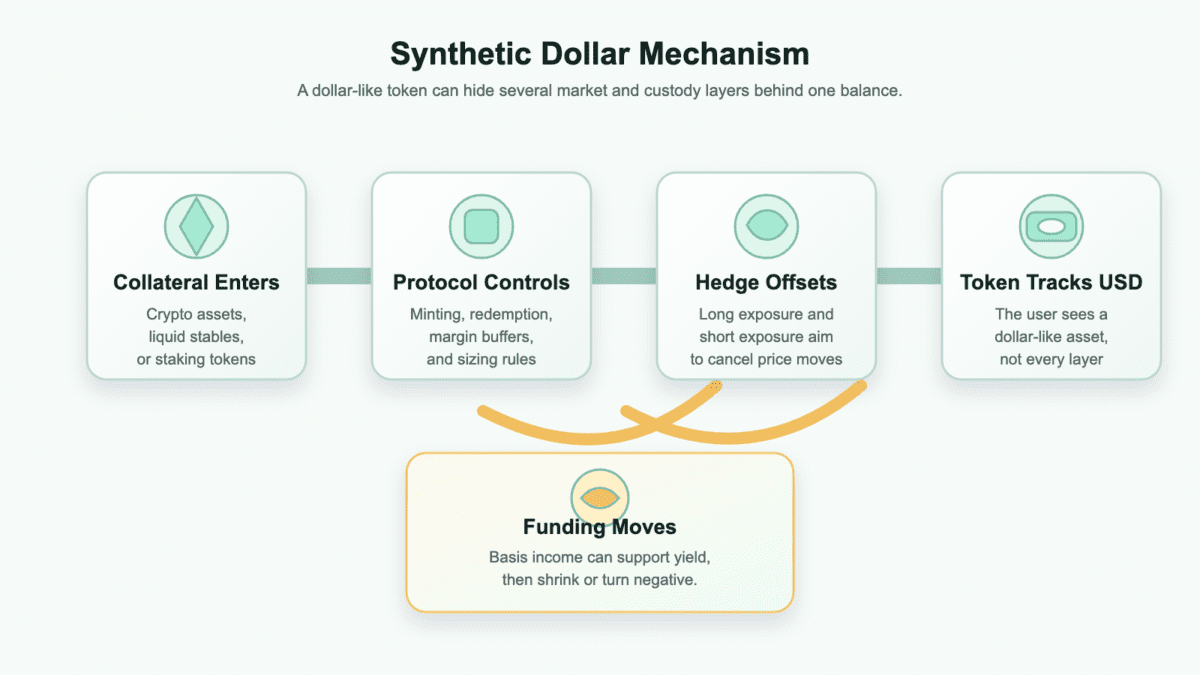
The hedge is only as useful as the rails around it. The protocol needs margin, venue access, collateral controls, liquidation buffers, and pricing systems. It may also need approved minting and redemption routes so supply can adjust when demand changes.
Now add funding rates. Perpetual futures markets often require one side of the trade to pay the other. When long traders are eager, shorts may receive funding. That can create income for a hedged design. When the market flips, the same funding flow can shrink or turn negative.
This is why a synthetic dollar can hold its target in quiet markets but still deserve a stress test. The peg is not defended by vibes. It depends on the hedge staying open, the collateral staying accessible, and users trusting the exit path when everyone checks the door at once.
A synthetic dollar and a stablecoin can both trade near $1, but they can rely on very different support systems. The real comparison is what supports the price label when markets get messy.
Fiat-backed stablecoins usually depend on reserves, banks, short-term assets, redemptions, and issuer controls. Crypto-collateralized stablecoins depend on onchain collateral, liquidation systems, or governance parameters. Synthetic dollars depend on constructed exposure, often with hedges and derivatives.
Algorithmic stablecoins add another bucket. Terra UST is the obvious ghost in the room, but it should be a contrast, not a lazy synonym. UST relied on a reflexive mint-burn relationship with another token. A hedged synthetic dollar can use a very different design and still carry real risk.
Here is what each model asks the user to trust:
| Model | What The User Is Really Trusting |
|---|---|
| Fiat-backed stablecoin | Reserves, banking access, issuer operations, redemption confidence, and market depth. |
| Crypto-collateralized stablecoin | Collateral value, liquidation rules, oracle pricing, and governance controls. |
| Synthetic dollar | Collateral, hedge execution, funding markets, counterparties, liquidity, and redemption routes. |
| Algorithmic stablecoin | Market incentives, confidence in a support token, and reflexive supply rules. |
The names can overlap in messy ways. A market page may call USDe a stablecoin because it trades around $1. A DeFi dashboard may place it near USDC or DAI because users deploy it for dollar exposure. That interface choice does not make the backing model identical.
So when someone asks whether a synthetic dollar is “safe like a stablecoin,” the only honest answer starts with which stablecoin model they mean. USDC risk is not DAI risk. DAI risk is not USDe risk. USDe risk is not Terra UST risk.
Compare failure modes, not branding. Ask what has to keep working for the token to stay near $1, then ask what route you have if that support weakens.
Synthetic dollar yield exists because the underlying structure can earn income from markets, collateral, incentives, or DeFi routing. It is not a magic interest rate. Someone, somewhere, is paying for risk, liquidity, demand, or complexity.
Funding rates are the first place to look. If a protocol holds spot crypto and shorts perps, it may receive payments from longs when demand for long exposure is high. That payment can support protocol revenue, reserves, or yield passed to staked tokens.
Basis income is another version of the same idea. Futures may trade above spot when traders pay for future exposure. A hedged position can try to capture that spread. That strategy is related to cash-and-carry trading, only packaged into a token system instead of left as a manual two-leg trade.
Collateral may also earn return. Liquid staking tokens, liquid stables, lending positions, or other assets can add income. Protocol incentives and points campaigns can add another layer. That is where yield farming habits creep in: users chase a number, while the risk stack grows behind the screen.
Plain USDe and sUSDe are not the same position. USDe is the dollar-tracking token. sUSDe is a staked or yield-bearing version that may pass through protocol revenue over time. Pendle positions can split that exposure again into principal and yield components.
The layers are easier to see in a simple table:
| Position | What Changes For The User |
|---|---|
| USDe | Dollar-tracking exposure, usually without the full yield layer. |
| sUSDe | Staked exposure that may receive variable protocol revenue. |
| PT-sUSDe | A fixed-maturity principal token that can trade at a discount or premium. |
| YT-sUSDe | A yield token that isolates future yield and can be highly sensitive to rate changes. |
The headline APY can compress when funding cools, incentives end, or demand shifts. It can also look smoother than the risks underneath. A lower APY does not prove the position became simple. It may only mean the market is paying less for the same moving parts.
So before chasing a synthetic dollar yield, separate the token from the wrapper. Then ask whether the yield comes from funding, collateral, points, lending, Pendle structure, or borrowed loops. Different source, different trouble.
The main synthetic dollar risks come from the parts that make the design work: hedges, venues, collateral, liquidity, and user confidence. The token can trade near $1 right up until one of those parts becomes the weak point.
Funding-rate risk sits near the top. If shorts stop getting paid, yield can fall. If shorts must pay, protocol revenue can turn into a cost. A reserve fund or buffer may help, but buffers are finite and depend on how stress is managed.
Venue and custodian exposure is another core risk. A hedge may involve centralized exchanges, off-exchange settlement, custodians, or other infrastructure. If access pauses, margin moves fast, or a venue fails, the protocol may struggle to adjust the hedge in time.
Peg and liquidity risk show up where users actually trade. A synthetic dollar may have a target near $1, but your exit depends on pools, order books, redemptions, bridges, and market makers. If too many holders leave together, exit liquidity becomes the polite name for a very rude queue.
Other risk layers deserve a direct check:
The slow version can be harder to spot than the dramatic depeg. Risk disclosures get thinner. Incentives carry usage after organic demand fades. Governance changes quietly favor insiders. Reserves look vague. That kind of drift can resemble a soft rug even when no single switch gets flipped.
Bridge exposure also changes the picture. A token on one chain may depend on wrapped supply, bridge liquidity, and chain-specific market depth. A deep mainnet pool does not guarantee a clean exit on a smaller chain.
Integration risk is the part non-holders can miss. If a synthetic dollar becomes collateral in lending markets, vaults, or liquidity strategies, stress can move through borrow caps, liquidation settings, and oracle rules. You may not hold the token directly, yet still face its risk through a vault or loan.
None of this means every synthetic dollar is doomed. It means the risk is structural, not only price-based. If the design gives you extra yield, ask which layer is paying and which layer can hand you the bill.
USDe is the synthetic dollar most users mean when the term appears in DeFi conversations. Ethena built the token around crypto collateral and hedging rather than a simple fiat-reserve stablecoin model.
USDe aims to track the dollar. sUSDe is the staked version that may receive yield from protocol revenue. ENA is the governance token tied to the protocol, but ENA price is a separate market bet. Do not mash the three together and call it research.
In the USDe example, Ethena’s USDe documentation describes a design using spot assets, liquid stables, and delta-hedged futures positions. It also reports that sUSDe APY averaged 19% in 2024. That is a useful reminder that yield is historical and market-dependent, not a standing promise. The mechanics page is the cleanest reference point for this specific design.
Authorized minting and redemption also deserve attention. In many synthetic dollar systems, not every wallet has the same direct access to mint or redeem at the protocol layer. Ordinary holders may rely more on secondary-market liquidity, exchange markets, or DeFi pools.
For holders, the next question is blunt: are you holding the base token, a staked receipt, a fixed-yield token, a yield token, or collateral inside another protocol? Each version has a different exit, yield path, and risk surface.
USDe can be useful as dollar exposure inside crypto rails. sUSDe can be useful for users who understand variable yield and withdrawal timing. Pendle-style positions can be useful for those who know exactly which side of yield they are buying.
But useful is not the same as boring. The more layers you add, the less your position behaves like “just a dollar token.” The label may stay tidy while the risk map gets busy.
Synthetic dollars can fit in a crypto portfolio as trading collateral, DeFi liquidity, yield exposure, or a temporary dollar-like parking spot. They work best when users size them as structured crypto positions, not as bank cash.
Traders may use them to stay inside crypto rails while reducing exposure to BTC or ETH direction. DeFi users may supply liquidity, borrow against them, or route through vaults. Yield seekers may stake, split, or loop them for returns that appear steadier than volatile token farming.
Those uses can be legitimate. They can also blur the line between cash management and structured risk. A position can look stable because the token target is $1, while the actual risk comes from funding markets, venues, bridges, or wrappers.
Chain launches add another wrinkle. A synthetic dollar on a new chain can improve liquidity and give users a local dollar asset. It does not automatically make that chain’s token more valuable. Supply on a chain is infrastructure, not a guaranteed demand engine.
Position size is the boring control that saves the most pain. If a synthetic dollar position is meant to be dry powder, it should not be so large that a peg wobble forces bad choices. If it is meant to earn yield, size it like yield risk.
Before sizing it, ask less about beating USDC and more about exit reliance. What needs to work if you want out this week? If the answer has five moving parts and you understand only two, reduce the size until the risk fits your actual knowledge.
Before using a synthetic dollar, check the exact token, wrapper, chain, yield source, and exit route. Most mistakes start when users see a dollar label and skip the machinery.
Start with the peg and market depth. Look at where the token trades, how deep the pools are, and whether the price is consistent across venues. A token can look fine on one dashboard while your chosen chain or pool is thin.
Then check the yield. Ask whether it comes from funding, basis, collateral return, lending, incentives, points, Pendle structure, or borrowed loops. If the explanation needs six tabs and a prayer, size the position like you are taking six-tab risk.
Use this checklist before you hold, stake, bridge, or borrow against a synthetic dollar:
Custody is not a side quest. If you bridge, stake, or hold a yield-bearing wrapper, your wallet setup and chain support become part of the position. For basic self-custody hygiene, the CryptoProcent wallets hub is a better place to start than a random link under a farm tweet.
Also check whether the yield route changes your exit. A staked token may have a cooldown. A Pendle token may have maturity risk. A looped position may depend on lending rates staying favorable. A bridge token may depend on liquidity outside the main venue.
The final check is personal: do you understand what would make the position lose money or lose liquidity? If the answer is vague, the position is too complex for cash-sized allocation.
Start with the exact position you hold. A synthetic dollar risk check is useless if you mix up USDe, sUSDe, PT-sUSDe, YT-sUSDe, or a vault receipt. The wrapper decides the exit.
Then keep the checklist small enough to use. You do not need to become a derivatives desk before touching a dollar-tracking token. You do need to know which market is paying the yield and which route gets you out.
Take these steps before you make the position meaningful:
Set one threshold before you enter. Decide what discount, cooldown, APY drop, bridge issue, or funding turn would make you reduce exposure. That sounds fussy until the market is moving and everyone is trying to read the same dashboard at once.
Leave yourself an exit. That means holding some plain liquid funds, avoiding all-in staking, and not assuming a small discount will heal before you need to sell. Becoming a bagholder is not more dignified because the asset was marketed as stable.
A synthetic dollar can be a useful DeFi tool. It can also be a tidy wrapper around several market risks. Respect both facts, and the category is much easier to use without pretending the busy parts are boring.
No, a synthetic dollar is not the same as every stablecoin, even if both can trade near $1. A fiat-backed stablecoin usually relies on reserves and redemption confidence, while a synthetic dollar may rely on collateral, hedges, derivatives, liquidity, and protocol controls.
A synthetic dollar usually keeps its peg through hedged exposure, market liquidity, minting or redemption routes, and arbitrage. In a USDe-style design, long spot exposure can be balanced by short futures or perps so price moves mostly offset.
Synthetic dollar yield can come from funding rates, basis spreads, collateral returns, protocol incentives, lending markets, or wrappers such as sUSDe and Pendle tokens. The rate can shrink, rise, or turn costly when market conditions change.
Yes, a synthetic dollar can depeg if liquidity weakens, hedges fail, redemptions slow, funding turns painful, venues pause, or confidence breaks. The risk is not identical to every stablecoin model, but the visible result can still be a price below $1.
No, USDe and sUSDe are related but not the same position. USDe is the base dollar-tracking token, while sUSDe is a staked version that may receive variable protocol revenue and can have different withdrawal or yield behavior.
A synthetic dollar is not automatically like Terra UST. Terra relied on a reflexive algorithmic model tied to another token, while a hedged synthetic dollar may use collateral and derivatives. That difference does not remove peg, liquidity, venue, or funding risk.