Physical Address
304 North Cardinal St.
Dorchester Center, MA 02124
Physical Address
304 North Cardinal St.
Dorchester Center, MA 02124


A clear guide to Sybil scores, airdrop filters, and wallet safety.
A Sybil score is a crypto signal that estimates whether a wallet, account, or identity looks like one real participant or one actor faking activity across many identities.
You will usually run into a Sybil score around airdrops, quests, proof-of-personhood tools, wallet reputation systems, and claim checkers. The awkward part is that score direction changes by tool. A high score can mean “more human” in one product and “more suspicious” in another, so read what the score measures before chasing it.
A Sybil score in crypto is a tool-specific estimate of whether a wallet, account, or identity looks unique, reputable, human, suspicious, or linked to repeated fake activity. It answers a narrow question: does this activity look like one genuine participant, or one actor split across many identities?
The word “Sybil” comes from Sybil attacks. In crypto, that usually means one person, bot, or group creates many wallets or accounts to gain rewards, votes, influence, whitelist spots, or campaign access.
A Sybil score is the scoring layer around that problem. It may look at on-chain behavior, account history, wallet links, identity attestations, social proof, or project-specific rules. Then it turns those signals into a number, label, pass/fail result, or review flag.
That output can affect real outcomes, but it is still a probability signal. A wallet can look clean in one campaign and weak in another because the scoring model, threshold, and accepted proof all changed. The score’s context carries more weight than the number alone.
You may see the output in a few forms:
That does not make the score universal. One tool may score human reputation. Another may score fraud risk. Another may hide the exact scoring rules to stop farms from gaming them. Same phrase, different dashboard, different headache.
For a normal user, the useful question is simple: what does this score mean in this exact tool? If the answer is unclear, do not assume a bigger number is better.
A Sybil score shapes airdrops and token launches by influencing who gets rewards, who enters review, and how clean the early user data looks. If a campaign rewards many repeated wallets, the distribution can look broad while control is still concentrated.
In practice, the score can influence several outcomes:
Projects use Sybil checks to protect allocations, quests, grants, voting, and early access. Airdrop farmers may repeat tasks across many wallets, profiles, and referral paths to look like a crowd. That overlaps with airdrop farming, but the score is not a farming guide. It is an anti-abuse signal.
A token launch can look healthier when dashboards show many participants, high quest completion, or a loud community. But if much of that activity came from linked wallets chasing rewards, the launch may face noisier selling and weaker real demand.
Investors should watch that gap. A farmed drop can scatter tokens into hands that planned to sell from the beginning. Early buyers can become exit liquidity if they mistake reward extraction for durable demand.
A Sybil score cannot clean up every launch. Projects still choose snapshots, regions, caps, vesting, manual review, and final allocation logic. But scoring can reduce the obvious mess: one actor pretending to be an entire crowd with matching wallets and matching timing.
A Sybil score usually works by comparing wallet or account behavior against patterns that may show uniqueness, reputation, coordination, or abuse. The model looks for clues, not courtroom evidence.
Most systems combine several signals because any single signal can mislead. Wallet age can help, but old wallets can be bought or compromised. Funding source can help, but friends, teams, and family wallets may share paths. Transaction timing can help, but power users often move fast.
Common inputs include these patterns:
| Signal | What It Can Suggest |
|---|---|
| Funding source | Many wallets funded from the same place may be linked. |
| Wallet age | Older activity can suggest history, but age alone is weak. |
| Transaction timing | Repeated timing can suggest scripts, farms, or batch behavior. |
| Contract diversity | Real users often touch varied apps, not one repeated path. |
| Counterparties | Shared counterparties can reveal clusters or normal team activity. |
| Cross-chain links | Bridges and shared routes can connect wallets across networks. |
| Identity attestations | Passport, credential, or account proofs can add uniqueness signals. |
| Contribution quality | Real support, governance, testing, or community work can add context. |
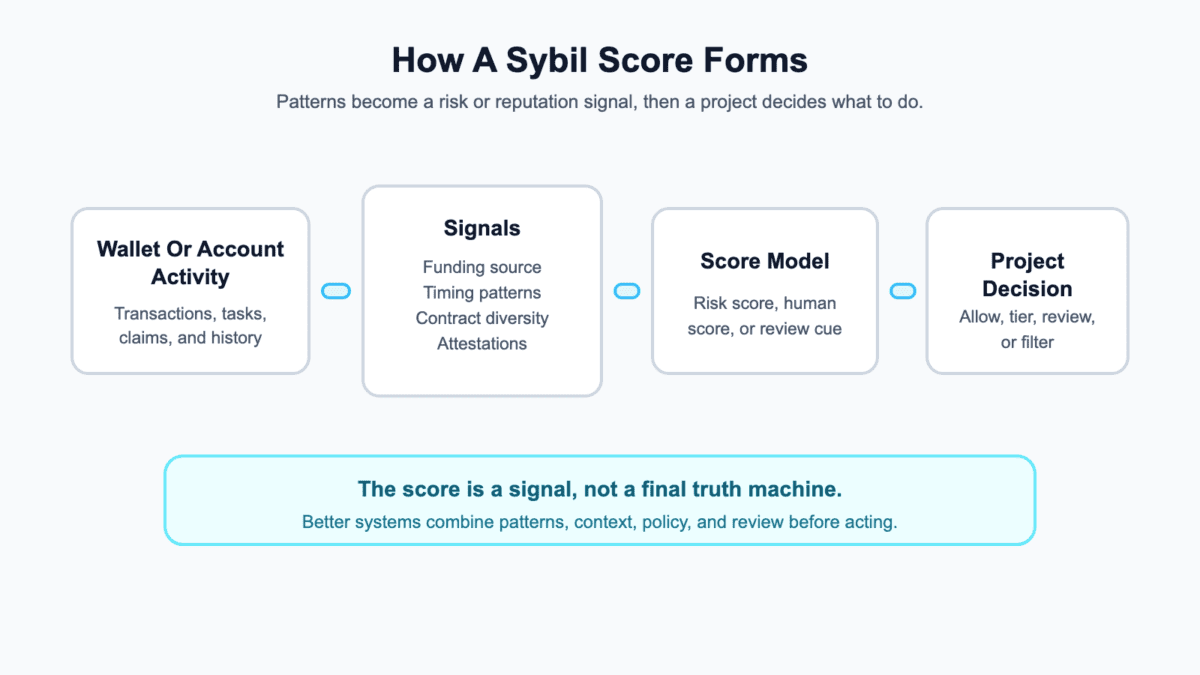
_A Sybil score turns wallet patterns into a risk or reputation signal. The project still decides how to use it._
The best systems use scoring as one layer. They combine behavior, context, review, and published policy where possible. Weak systems turn one blunt rule into an automatic punishment machine, then act surprised when real users complain.
That is why “how is a Sybil score calculated?” rarely has one clean answer. Each tool weighs signals differently, and projects may keep some details private so the filter does not become an instruction manual for farms.
A good Sybil score depends on the tool because score direction is not standardized. Some products reward human reputation with higher scores. Other products score Sybil risk, where a higher number can mean more suspicion.
This is the trap that catches many users. A dashboard may say “score,” “risk,” “reputation,” “passport,” or “credential,” but those words do not all point the same way. Before acting, read the tool’s own definition and threshold.
For example, Galxe Help Center lists quest participation requirements that can combine external Sybil-prevention options, including Passport-style thresholds, TrustScan settings, Nomis credentials, and proof-of-personhood checks. Its TrustScan example uses a Sybil Score threshold of 60 or below for enhanced protection.
Use this table before assuming the number is good or bad:
| Tool Or Score Type | How To Read It |
|---|---|
| Passport-style human score | Higher usually points toward more human or unique signals. |
| Wallet reputation score | Higher may mean stronger account history, depending on the product. |
| TrustScan-style threshold | The campaign may accept scores under or over a set line. |
| Cred-style risk score | Higher can mean the wallet looks more suspicious. |
| Project-specific airdrop filter | The score may be hidden, combined, or only one input. |
That means a “good” Sybil score is not a universal number. It is a match between the tool’s direction, the campaign threshold, and the action you want to take.
If a page hides the meaning completely, slow down. A vague score tied to a wallet connection, mint, or claim link deserves more caution than a transparent read-only dashboard.
Sybil score false positives happen when real users look coordinated, repetitive, or low-trust to a scoring system. That can happen without fraud, especially in crypto, where people often use several wallets for reasonable reasons.
A privacy-focused user may keep separate wallets for trading, NFTs, governance, and long-term storage. A new user may have little wallet history. A tester may repeat similar actions across apps. A team wallet may share funding sources with several contributors.
Common false-positive patterns include:
Multiple wallets do not automatically mean Sybil farming. But repeated timing, identical paths, shared funding, copied behavior, and low-effort task loops can make a cluster look manufactured.
Better systems leave room for context. They may combine a Sybil score with appeal paths, manual review, contributor records, social proof, or clearer eligibility language. Worse systems make real users feel like they failed a secret exam written by a bot with a clipboard.
The safe takeaway is boring but useful: do not buy wallet history, sell old wallets, or expose private keys for a score shortcut. That can create security, tax, attribution, and recovery problems that are worse than missing one campaign.
Sybil score, privacy, KYC, and proof of personhood all deal with identity, but each answers a different question. A Sybil score may use identity signals, yet it can also rely only on wallet behavior and attestations.
Behavior-heavy scoring looks at what wallets do. It may use funding paths, transactions, contract use, timing, and on-chain links. Identity-heavy systems may ask for account links, credentials, social graph signals, proof-of-personhood checks, or KYC.
The tradeoff usually appears in a few places:
The tradeoff is real. Stronger uniqueness checks can reduce bots and reward farming. They can also add privacy risk, exclude users without the right accounts, and create pressure to reveal more than a campaign deserves.
Proof of personhood sits in the middle. It tries to show that one user is one human without always publishing that person’s name. That can help with grants, airdrops, voting, and quadratic funding. But users still need to know what data is collected, who stores it, and whether the proof links back to wallets.
KYC is narrower and heavier. It usually means legal identity checks. A Sybil score can include KYC data, but many scoring systems use wallet reputation instead. Public identity also differs from doxxed identity, where a person or team is openly linked to a real-world identity.
There is no perfect privacy answer. A fully anonymous system can be farmed. A strict identity system can feel invasive. Match the scoring method to the stakes. A tiny quest should not demand the same proof as a regulated exchange account.
Check a Sybil score safely by separating curiosity from wallet power. Reading a public address is one thing. Connecting a wallet, signing a message, approving tokens, or minting a credential is another.
Start from official project links, not replies, DMs, sponsored search results, or random claim posts. Many users first meet Sybil scoring through an airdrop checker or quest gate, which is exactly where fake pages like to dress up as helpful tools.
Use this checklist before connecting:
If the checker asks for a transaction, it is a real wallet action. A score mint can cost gas, create a public credential, or link behavior across accounts. That may be fine, but it should be intentional.
Basic wallet safety belongs before any score chase. Keep long-term funds away from experimental claim flows, and do not let a possible airdrop push you into signing something you cannot explain.
A legitimate checker should make the requested action clear. If a page mixes urgent rewards, vague prompts, seed-phrase language, or fake support DMs, close it. No score is worth turning your wallet into a lesson plan.
A Sybil score cannot tell you everything about a wallet, a user, or an airdrop. It cannot prove intent, certify a token as safe, guarantee a reward, or identify a real-world person by itself.
It cannot answer questions like these:
That limit deserves attention because scoring language can sound more certain than it is. A wallet may look suspicious because of repeated activity, shared funding, or thin history. It may also belong to a careful user, a tester, a team member, or someone who migrated funds after a wallet scare.
A Sybil score also cannot explain hidden project rules. A campaign may include legal filters, regional limits, minimum balances, snapshot timing, social contribution, manual review, vesting, or allocation caps. Passing one score does not mean passing the full campaign.
For investors, a score cannot turn launch metrics into truth. It can reduce some fake activity, but it cannot prove that token demand is durable, that recipients will hold, or that the community is active after rewards end.
Use the score as a signal inside a larger picture. It is useful when it clarifies risk, eligibility, or reputation. It becomes dangerous when a dashboard makes a probability look like a verdict.
Sybil score terms are easy to blur because airdrop threads, quest pages, and wallet tools use them casually. Keeping them separate makes the score easier to read.
The main split is between the attack, the score, and the defense. A Sybil attack is the behavior. A Sybil score is one way to estimate that behavior. Sybil resistance is the broader design work used to make fake identities harder or less useful.
| Term | Plain Meaning |
|---|---|
| Sybil attack | One actor creates many identities to gain rewards, votes, access, or control. |
| Sybil score | A product-specific signal about uniqueness, reputation, humanity, or suspicion. |
| Sybil filter | A rule or model that removes likely fake or linked accounts. |
| Sybil resistance | Design choices that make fake identities costly or less useful. |
| Wallet reputation score | A broader score based on wallet history, behavior, or credentials. |
| Proof of personhood | A way to show one human behind one account or credential. |
| KYC | Legal identity verification, often with documents or personal data. |
| Sybil farming | Repeated multi-wallet activity meant to capture rewards or access. |
This vocabulary also helps with farming language. A farm in crypto can mean yield activity, points chasing, hardware mining, or reward-seeking behavior. Sybil farming is the identity-abuse version, not every farm.
When a project says it uses Sybil resistance, ask what kind. It may mean wallet clustering, proof-of-personhood, manual contributor review, credential scoring, hidden filters, or a mix. The label alone does not tell you the tradeoff.
It depends on the tool. Some Sybil score systems use higher numbers for stronger human reputation, while risk-score systems may use higher numbers for more Sybil suspicion.
Check the tool’s definition before acting. If the page gives a threshold, read whether users need to be above it, below it, or simply hold a matching credential.
Yes, a Sybil score can affect an airdrop when a project uses it for eligibility, tiers, review, or filtering. It may be public, hidden, or combined with other rules.
That does not mean a score guarantees tokens. Snapshots, legal filters, caps, manual review, vesting, and final allocation choices can still decide the result.
A wallet can look like a Sybil wallet when it shares repeated patterns with many other wallets. Common clues include shared funding, similar timing, copied contract paths, low-quality task loops, or thin history.
Those clues are not proof by themselves. Real users can share exchange funding paths, migrate wallets, test apps, or use several wallets for privacy and custody.
Yes, a real user can get a bad Sybil score. False positives happen when scoring systems miss context or rely too heavily on blunt patterns.
Fresh wallets, shared funding sources, cross-chain activity, wallet migrations, and privacy habits can all create confusing signals. Better systems allow review or use several signals before filtering.
No, a Sybil score is not the same as proof of personhood. Proof of personhood is one possible signal a score may use, but scoring can also rely on wallet behavior, attestations, or reputation.
Proof of personhood tries to show uniqueness. A Sybil score tries to interpret risk, reputation, or uniqueness inside a specific product or campaign.
You can reduce risk when a checker supports public address lookup or a clearly read-only flow. Risk rises when the page asks for wallet connection, signatures, approvals, transactions, or score minting.
Start from official links, use a low-balance wallet, read prompts carefully, and never enter a seed phrase. If the action is unclear, close the page.
Start with the tool’s definition, then work outward to wallet safety and campaign context. A Sybil score only helps if you know what it is measuring.
That order keeps you from reacting to a number before you know its direction. A reputation score may reward deeper history. A risk score may punish repeated patterns. A campaign threshold may only decide whether a wallet enters a review queue.
Use these checks before you act:
If the score is tied to an airdrop, separate eligibility hopes from wallet safety. A possible claim is not a reason to sign blind messages, mint surprise credentials, or link every wallet you own to one checker.
If the score is tied to a token launch, read it as one clue about distribution quality. It can help explain why a project filtered wallets, but it cannot prove demand or predict what recipients will do after the claim.
Finally, keep the score in its lane. It is one signal about identity, reputation, or suspicion. It cannot grade someone’s character, guarantee rewards, or prove that a token launch is clean.


