Physical Address
304 North Cardinal St.
Dorchester Center, MA 02124
Physical Address
304 North Cardinal St.
Dorchester Center, MA 02124


Hybrid rollups explained without the sales pitch.
A hybrid rollup is a Layer 2 design that mixes optimistic assumptions with zero-knowledge proofs to make verification faster or stronger.
That simple answer has a catch. In crypto, “hybrid” can mean several things. Most people use hybrid rollup for an optimistic rollup that adds ZK proof mechanics. Some projects use similar wording for public and private execution inside a ZK system.
So do not stop at the technical label. Ask what changes for withdrawals, bridges, proof risk, project maturity, and token hype.
A hybrid rollup in crypto is a Layer 2 network design that combines parts of optimistic rollups and zero-knowledge rollups. The usual goal is to keep the lower cost and EVM friendliness of optimistic execution while adding proofs that can verify disputed or important state changes faster.
That sounds tidy. Real designs get messier. Some hybrid rollups run like optimistic rollups during normal use, then call on ZK proofs when a dispute, withdrawal, or verification shortcut needs stronger evidence. Others market “hybrid ZK” around public and private execution, where some activity is visible while other parts stay private.
The label touches real money because Layer 2 networks handle deposits, trades, withdrawals, and sometimes tokens tied to the project. The rollup design can affect those experiences, but it rarely explains all of them.
It also does not tell you which base layer secures the chain, who orders transactions, where data is posted, or which bridge route people must use. Those details decide whether the design works in a wallet, not just in a diagram.
Keep the term narrow: a hybrid rollup is a design label, not a quality badge. It tells you the project is mixing proof assumptions. It does not prove the bridge is deep, the sequencer is decentralized, the contracts are safe, or the token captures value.
A narrow definition makes project claims easier to test. If a project says it is a hybrid ZK rollup, ask whether it means ZK-assisted fraud proofs, validity proofs on demand, a phased migration toward ZK, or public plus private execution. Those are not interchangeable.
That distinction keeps the term useful. It leads to the next question: which parts are actually hybrid, and which parts are ordinary rollup risk wearing a shiny new jacket?
Hybrid rollups exist because optimistic rollups and ZK rollups solve different problems well. Optimistic rollups can be cheaper and easier to make EVM-compatible. But they often rely on a challenge period before some withdrawals become final.
ZK rollups take a different route. They use validity proofs to show that a batch of transactions followed the rules. That can support faster finality, but proof generation and proving infrastructure can be expensive, complex, or slower to develop.
The Ethereum Research discussion around hybrid rollups frames the idea as optimistic performance meeting ZK verification. The thesis is straightforward: run cheaply when nothing is disputed, then bring in proofs when stronger verification is needed.
The tradeoff is easier to scan this way:
| Design Choice | What Users Feel |
|---|---|
| Optimistic rollup | Lower normal operating cost and broad EVM support, but exits can wait on challenge windows. |
| ZK rollup | Stronger proof-based verification, but proving cost and EVM compatibility can be harder. |
| Hybrid rollup | A mixed path that may reduce some delays while keeping optimistic-style execution. |
The table leaves out one messy detail. “Hybrid” does not specify the exact proof schedule. One project might generate validity proofs on demand. Another might use ZK fraud proofs during disputes. Another might move from optimistic architecture toward full ZK over time.
Use the label as a prompt for questions. Ask when proofs are generated, who pays for them, whether withdrawals really shorten, and how users can verify the system is live rather than promised for later.
A hybrid rollup works by processing transactions on a Layer 2 network, posting data or commitments to a base layer, and using either challenges, ZK proofs, or both to support settlement. The exact path varies by project.
Start with the user. You make a swap, bridge funds, mint an asset, or use an app on the L2. A sequencer orders the transaction and includes it in a batch. That batch updates the L2 state, so your wallet may show the result quickly.
Then the rollup has to anchor that activity to the base chain. Usually that means posting transaction data, state roots, commitments, or related proof material to Ethereum or another settlement layer. This is where data availability and finality begin to bite.
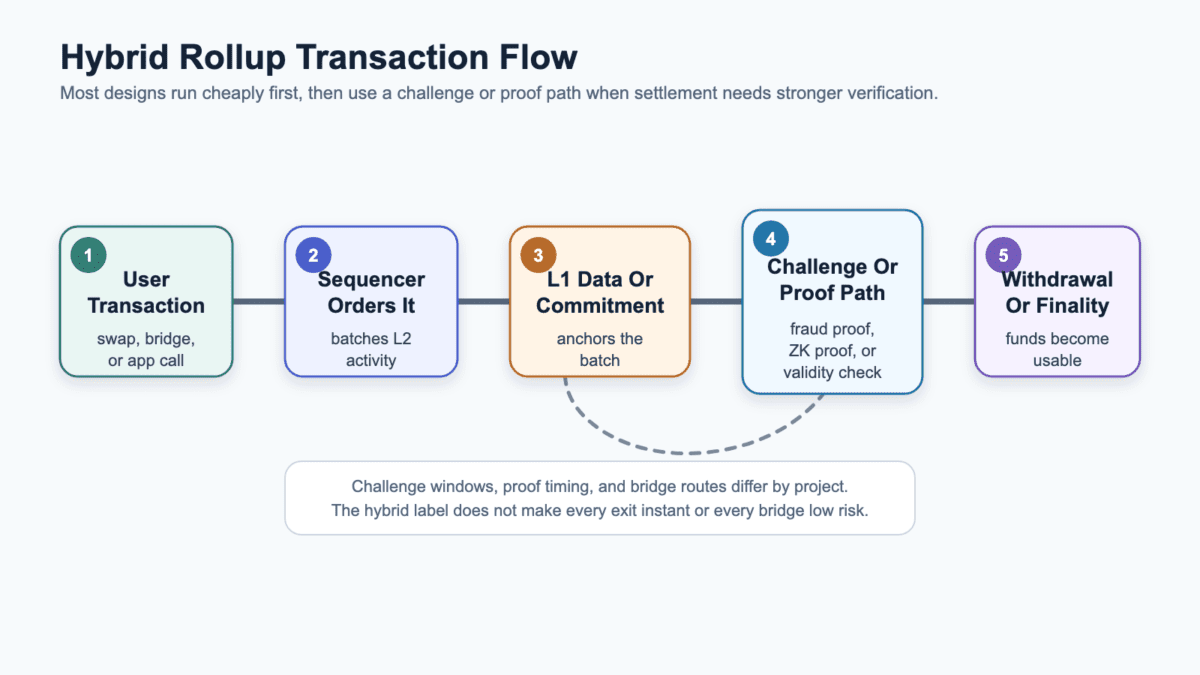
The proof path is the hybrid part. A normal optimistic rollup assumes the batch is valid unless someone challenges it. A hybrid design may add a ZK proof during that challenge, or generate a validity proof when a faster verification path is needed.
That can sound like a shortcut. It is still infrastructure, not a spell. The system needs working contracts, available data, reliable proof generation, and a bridge path that honors the result.
The moving parts usually look like this:
The key issue is timing. Your transaction can feel final inside the L2 before it is fully settled on the base layer. Hybrid rollups try to narrow that gap in some cases. They do not remove the need to understand where your funds are and which step has actually completed.
A hybrid rollup can change withdrawals by adding proof-based shortcuts to a system that might otherwise wait through an optimistic challenge window. But faster exits are not automatic. They depend on the specific bridge, proof system, liquidity, and project settings.
Canonical withdrawals are the first route to understand. They follow the rollup’s official settlement path back to the base chain. On optimistic systems, that path can include a waiting period so invalid batches can be challenged before funds leave.
Fast bridges solve a different problem. They may front liquidity on the destination chain before the canonical route finishes. That can be useful, but it adds liquidity-provider, solver, route, and refund assumptions. Speed has a source. Always find it.
| Path | What To Check Before Using It |
|---|---|
| Canonical withdrawal | Challenge window, proof status, claim step, and destination gas. |
| Fast bridge | Available liquidity, route contracts, fees, refund path, and token version. |
| Validity proof shortcut | Whether the proof path is live, automated, audited, and supported for this asset. |
| Exchange route | Deposit network, withdrawal network, account limits, fees, and custody risk. |
Hybrid rollups may help when a proof can verify the disputed or withdrawal-related state faster than waiting for a full challenge period. That’s the promise users care about. Less idle capital. Less bridge anxiety. Fewer “is my money stuck?” tabs.
Still, a bridge can be slow even when the rollup design is smart. Liquidity can dry up. A claim step can require L1 gas. A wallet can show the wrong token version. If you are moving funds into or out of an L2, basic wallet checks still belong in the flow.
Before bridging size, check the exact withdrawal route, the expected wait, the token contract that lands, and whether a fast path is replacing finality with liquidity.
Hybrid rollup examples help because the term is used unevenly. Some examples describe a live proof mechanism. Some describe a roadmap. Some use “hybrid” for a related, but different, ZK design.
BOB is often discussed as a hybrid ZK rollup because it adds ZK fraud proofs and proof infrastructure to an OP Stack-style design. Metis has used hybrid rollup language around combining optimistic and ZK ideas. Morph describes an optimistic zkEVM approach with responsive validity proofs.
Kroma has been discussed as a project moving from optimistic design toward stronger ZK architecture. Fraxchain appeared in older coverage as a hybrid rollup concept tied to Frax’s broader L2 plan. Aztec is the clean disambiguation example: its hybrid ZK language is more about public and private execution than the same optimistic-plus-ZK path.
| Example | What The Hybrid Label Means Here |
|---|---|
| BOB | OP Stack roots with ZK fraud proof and proof-network mechanics. |
| Metis | Optimistic and ZK hybrid positioning from earlier project announcements. |
| Morph | Optimistic zkEVM framing with responsive validity proof ideas. |
| Kroma | A rollup project associated with a gradual move toward ZK architecture. |
| Fraxchain | Older investor-facing L2 plan using hybrid rollup language. |
| Aztec | Public plus private ZK execution, not the same category as every OP-plus-ZK hybrid. |
This table is a translation layer, not a ranking. A project can use the same label while meaning a different architecture, maturity level, or roadmap phase.
Hybrid rollup can also become a crypto meta. A real technical phrase turns into a market story, then traders start pricing the story before the live system proves much. That is not new in crypto. It is just wearing better cryptography now.
When you see a project claim the hybrid label, ask what is live today. Then ask what is still a roadmap item, what is only in docs, and what depends on external proof markets or bridge support.
A hybrid rollup could improve the parts of Layer 2 use that feel slow, uncertain, or expensive. The strongest possible gains sit around verification, withdrawal timing, and compatibility with existing Ethereum-style apps.
For users, the upside is not “more cryptography.” It is a better experience when proofs help settle disputes or withdrawals sooner. If the system works, capital may spend less time waiting in a challenge window.
The improvements usually fall into a few buckets:
Each benefit depends on implementation. A hybrid rollup with weak proof availability may not feel better than a plain optimistic rollup. A design with great proofs and poor bridge liquidity can still punish users at the exit.
There is also a cost balance. Full-time validity proving can be expensive, especially when the system needs broad EVM compatibility. A hybrid design may reserve heavier proving for moments where it adds the most value, such as disputes or faster verification paths.
The best version narrows the gap between cheap execution and strong verification. Users only feel that value when the proof path, bridge path, apps, liquidity, and wallet experience all work together.
For builders, that can mean fewer compromises during a migration from optimistic architecture toward stronger ZK verification. For users, it should mean clearer exits, more reliable disputes, and fewer long waits when something needs to be proven.
The upside is conditional. If proofs are live, fast, audited, and connected to the withdrawal path, users may see a real improvement. If proofs are mostly a roadmap slide, the benefit is future tense with a logo.
A hybrid rollup still does not solve every risk around Layer 2 networks. It can improve verification while leaving smart-contract bugs, bridges, sequencers, upgrade controls, and liquidity problems untouched.
The biggest mistake is reading the design as a safety stamp. A ZK proof can verify that a computation followed specific rules. It cannot prove the rules were wise, the contracts were bug-free, the admin keys are safe, or the bridge has enough liquidity for stressed exits.
> A hybrid rollup can improve verification, but it cannot make bridges, admin controls, or liquidity safe by itself.
The unresolved risks are familiar:
Those risks do not make hybrid rollups useless. They make them normal crypto infrastructure. The proof system is one layer in the stack, not a full warranty.
Sequencer risk deserves its own pause. If one operator controls ordering, users may still face downtime, censorship, or unfair ordering even when the proof path works. A rollup can verify the batch later while still giving one party a lot of control before settlement.
Data availability is another quiet dependency. If users cannot access the data needed to verify or reconstruct state, the proof model becomes harder to trust. Hybrid rollups still need a clear answer for where data lives and who can retrieve it under stress.
Token markets add another trap. A project can have a real technical roadmap and still become a crowded trade. If buyers chase the hybrid rollup story without checking liquidity, emissions, or token value capture, they can become exit liquidity for earlier holders.
Keep the warning simple: a valid proof can verify execution while the wider system can still be risky. Keep those ideas separate. Otherwise “ZK” becomes a stamp on the box instead of a mechanism you understand.
Evaluate a hybrid rollup by checking what is live, what is verified, and what touches your funds. The label is only a starting point. The actual risk sits in contracts, bridges, sequencers, data availability, liquidity, and token design.
For users, start with the money path. Can you deposit through a known route? Can you withdraw through the canonical path? How long does it take? Does a fast bridge have enough liquidity? What token version lands in your wallet?
Then look at failure paths. If a withdrawal stalls, do you need to prove, finalize, claim, wait for liquidity, or contact support? If the answer is vague, the route may be fine for a test but wrong for a large transfer.
For investors, separate the technology from the token. A project can build useful rollup infrastructure without giving the token a strong role in fees, staking, governance, sequencer revenue, or demand. Good tech does not automatically mean good token economics.
Use this checklist before you move funds or buy the story:
The token point deserves extra care. Hybrid rollup can become a narrative coin angle if the market prices the phrase before users show up. That can create fast upside, fast disappointment, or both in the same week.
Roadmap wording is where discipline pays. “Planned,” “testing,” “phased,” and “coming soon” are not the same as live withdrawals protected by the promised proof path. A serious check separates current network behavior from future architecture.
The cleaner approach is slower. Check the live network, then the bridge, then the proof path, then the token role. If any layer is vague, reduce size or wait for clearer evidence.
For actual use, test small first. Confirm the route, token contract, destination gas, withdrawal method, and support path. The fancy architecture can wait. Your approval signature cannot.
Related hybrid rollup concepts make the label easier to parse. The job is to keep proof terms, bridge terms, and execution terms separate.
An optimistic rollup assumes transactions are valid unless challenged. A ZK rollup uses validity proofs to verify state changes. A fraud proof tries to show that an invalid state transition happened. A validity proof shows that a claimed computation followed the rules.
Data availability describes whether transaction data can be accessed when the system needs to verify or reconstruct state. A sequencer orders L2 transactions before they settle more deeply. A bridge moves assets or messages between chains, often with its own risk model.
A zkEVM is a ZK-friendly execution environment designed to support Ethereum-style contracts. A zkVM is broader: it proves computation inside a virtual machine. Both can appear in hybrid rollup discussions, but neither word tells you how withdrawals work.
Challenge windows belong in the same map. They describe the time allowed for someone to dispute a batch before a withdrawal becomes final. A hybrid design may shorten or change that path, but only if the proof process is connected to the actual bridge route.
Validity proof on demand is another phrase to separate. It usually means the system does not prove every batch upfront. Instead, it can generate a proof when a dispute or fast verification path needs one.
For the investment side, keep two nearby ideas in view. A soft rug helps explain why vague roadmaps can hurt users without a clean collapse. A conviction play helps frame how traders size a technical thesis without pretending the thesis is proof.
Keep the map simple. Proofs answer “was this computation valid?” Bridges answer “can my assets move safely?” Sequencers answer “who orders activity?” Token design answers “does this architecture create value for this asset?” Mixing those questions is how technical explanations turn into marketing fog.
No, a hybrid rollup is not always the same as a ZK rollup. Most hybrid rollups mix optimistic rollup assumptions with ZK proof mechanics, while a full ZK rollup relies more directly on validity proofs for state verification.
Some projects use “hybrid ZK rollup” for public and private execution. That is related language, but it is not the same design as every optimistic-plus-ZK hybrid.
Yes, a hybrid rollup can make withdrawals faster when its proof path shortens the normal challenge or verification process. That benefit depends on the live design.
Users still need to check the bridge route, liquidity, claim step, destination gas, and supported assets. A faster proof path does not make every exit instant.
A hybrid rollup can reduce some verification weaknesses, but it is not automatically safer than an optimistic rollup. Safety depends on the whole system.
Check contracts, audits, sequencer control, data availability, bridge design, admin keys, and proof availability. The proof layer is important, but it is not the whole risk stack.
Projects associated with hybrid rollup language include BOB, Metis, Morph, Kroma, Fraxchain, and Aztec. They do not all use the term in the same way.
Some examples describe live proof mechanics. Others describe roadmaps, historical announcements, or public/private ZK execution. Compare the architecture and status before comparing the names.
No, Aztec is not usually the same kind of hybrid rollup as Metis or Morph. Aztec-style hybrid ZK language points more toward public plus private execution.
Metis or Morph-style hybrid rollup discussion usually points toward optimistic execution plus ZK proof mechanics. The shared word “hybrid” hides two different ideas.
You should only use or invest in a hybrid rollup project after checking the live network, bridge route, withdrawal timing, audits, liquidity, sequencer setup, and token role.
The design can be promising without being ready for your funds. Move small first, verify the exit path, and avoid buying a token only because the architecture sounds expensive.