Physical Address
304 North Cardinal St.
Dorchester Center, MA 02124
Physical Address
304 North Cardinal St.
Dorchester Center, MA 02124


A practical guide to points meta, airdrop odds, and wallet risk.
Points meta in crypto is the trend where projects give users points for activity before a possible token or airdrop. Users farm the score because it might later turn into value.
The phrase shows up when a wallet, DeFi app, Layer 2, trading venue, or social app gives users a visible score before clear reward terms exist. That score can be useful, but it can also turn real gas, capital, time, referrals, and wallet exposure into a very official-looking maybe.
Points meta in crypto means the market habit of chasing project-issued points before a possible airdrop, token launch, or reward event. The “meta” part means the behavior itself becomes the game.
A crypto meta is a pattern traders and users start following because it seems to work. With points meta, the loop is simple: projects publish a score, users chase the score, social channels speculate on future value, and the project keeps final reward control.
Beginners often miss who controls the score. A points balance can rank activity, measure loyalty, or track eligibility. It does not automatically create a token, a fixed exchange rate, a claim on treasury funds, or a promise that every active wallet gets paid.
The phrase usually covers three groups at once:
Each group carries a different risk. A project may gain users, data, liquidity, and attention even if no token arrives. A farmer may pay costs before knowing the reward. A later buyer may see strong usage numbers without knowing how much of that activity was rented by points.
So the clean answer is blunt: points meta is speculation wrapped around a scoreboard. It can reward useful early activity, but it is not money until a project defines an actual reward and lets eligible users claim it.
Points meta works by turning user actions into a score before anyone knows the final reward. The user connects a wallet, does tasks, watches a dashboard, and waits to see whether the project later maps the score to tokens, perks, status, or nothing.
A current official example is MetaMask Rewards, whose May 6, 2026 update says Season 1 awarded 8 points for every $10 swapped on or across supported networks. That does not make every campaign the same. It simply shows the pattern in a mainstream form.
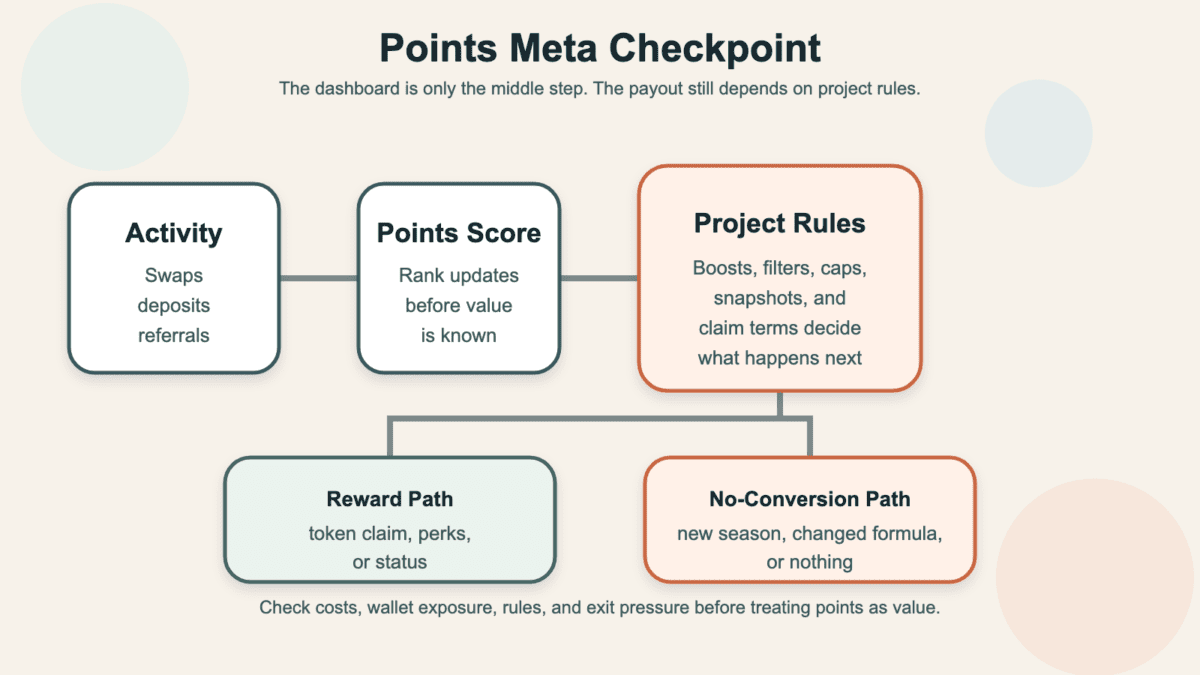
The activity can be cheap, or it can get expensive fast. Common actions include swaps, perpetual trades, deposits, borrowing, liquidity provision, bridge use, quests, referrals, app logins, NFT listings, or repeat wallet actions. The points program may then add seasons, boosts, multipliers, partner points, and leaderboards.
The dashboard can feel more exact than it is. A score may update every day, but the final formula can still depend on hidden caps, Sybil filters, country restrictions, snapshots, account status, and later campaign changes.
Possible endings include:
The order is the risk. Points can come before airdrop points, pre-TGE points, and a claim page, but they are not the claim page. The gap between the dashboard and the payout is where most of the risk hides.
Crypto projects use points meta because points give them flexible incentives before they commit to a token formula. That flexibility can help a real product grow, but it can also make user rewards harder to price.
A simple airdrop usually rewards past actions after a snapshot. A points campaign turns the waiting period into an active loop. Users keep returning, trying features, referring friends, depositing assets, and comparing ranks while the project keeps control over final terms.
Projects often want these outcomes:
Some ambiguity is rational. If every scoring rule is public, industrial farmers can script the exact actions and crowd out normal users. Hidden filters can protect the campaign from obvious abuse.
But ambiguity also pushes risk onto users. The project may learn which features people use, grow visible metrics, and build launch demand. The farmer still has to guess whether the eventual reward beats gas, spreads, time, funding costs, and wallet exposure.
Points meta is user acquisition with optional upside. Sometimes the user wins. Sometimes the scoreboard just gets excellent attendance.
Points meta, airdrops, tokens, and loyalty rewards sound similar because they all use reward language. They differ in control, transferability, known value, and user risk.
The cleanest distinction is ownership. A token can often be held in a wallet and priced by a market. A points balance is usually a project-controlled score. It may lead to something valuable, but the issuer still decides what happens next.
Use this table to keep the labels separate.
| Term | What The User Should Understand |
|---|---|
| Points Meta | The broader market loop where projects issue points and users farm possible future rewards. |
| Points Farming | The deliberate act of earning points through repeated campaign activity. |
| Airdrop | A token or reward distribution to eligible users, usually after rules or snapshots are applied. |
| Token | A crypto asset with contract rules, wallet visibility, and possible market pricing. |
| Loyalty Reward | A perk, discount, rank, or benefit that may never become a tradable token. |
| Pre-Market Point Exposure | A speculative bet on future conversion terms before a token exists. |
The table is not a safety ranking. Tokens can dump. Airdrops can be phished. Loyalty rewards can expire. Points can change. Each label only tells you where control sits and how much of the value is known.
The mistake is treating points vs tokens as a technical detail. It is a risk detail. If you cannot transfer the score, price it, claim against public terms, or verify the conversion, the score belongs in the “possible upside” bucket.
Traders farm points meta because the upside can be lopsided. A small amount of early activity might qualify for a reward that later trades for much more than the cost.
That logic is close to points farming, but points meta adds the social layer. When everyone sees the dashboard, rank, season, boost, and referral code, the campaign starts feeling like a live market before any token exists.
Count the costs before you chase the rank:
The lottery-ticket comparison fits here. A farmer accepts small certain costs for uncertain upside. That can be reasonable when the costs are capped, the product is useful, and the wallet risk is isolated.
It backfires when the campaign turns into a scoreboard with no budget. A user can loop volume, bridge repeatedly, deposit into young contracts, or invite people into a vague campaign, then learn later that the formula capped rewards, excluded regions, filtered wallets, or never produced a token.
Beginners should be especially careful with size. Whales, bots, referral networks, and multi-wallet farms can dilute normal users. If a small wallet has to act like a full-time desk to compete, the expected value may already be broken.
A points meta campaign should be checked before wallet connection, not after the first signature. The reward may be uncertain, but the wallet risk starts immediately.
Start with the official path. Use the project site, verified app, known documentation, or verified social account to reach the campaign. Referral posts, screenshots, Telegram links, and “easy airdrop” threads can point you toward a campaign, but they should not be trusted for the final wallet action.
Use this checklist before committing funds or attention.
| Check | Reason To Check |
|---|---|
| Official Link | Fake dashboards and claim pages often copy real branding. |
| Separate Wallet | A campaign wallet limits damage if approvals or contracts are risky. |
| Seed Phrase Prompt | Any campaign asking for a seed phrase should be skipped. |
| Approval Size | Unlimited approvals increase loss if a contract is abused. |
| Country Rules | Region limits can block points, claims, or rewards. |
| Referral Incentives | Heavy referral rewards can turn discovery into spam. |
| Cost Record | Gas, bridges, spreads, and time should be tracked from day one. |
| Exit Path | Deposits should be removable without surprise lockups or thin liquidity. |
The table is a filter, not a guarantee. A campaign can pass basic checks and still disappoint. But it should stop the worst version of the trade: risking a main wallet because a referral thread made the dashboard look urgent.
Good wallet setup habits are boring until they save the day.
Use a separate wallet for unfamiliar campaigns, keep only the funds needed for tasks, review approvals, and avoid signing anything you cannot explain in plain English.
Also watch the social layer. If most promotion comes from referral bonuses, leaderboards, and vague “you are early” posts, slow down. Hype can be useful for finding a campaign. It is terrible at verifying one.
Investors should read points meta activity as incentivized usage until proven otherwise. High volume, TVL, wallet counts, or referral growth may show interest, but the points program can be paying users to look interested.
That does not make the project fake. Many useful products need incentives to start a network effect. The problem is interpretation. If points disappear and users leave, the pre-launch numbers were renting behavior, not proving demand.
Use a two-step check on any points-heavy project.
| Signal | What To Check |
|---|---|
| Volume | Does trading continue after rewards slow down? |
| TVL | Is capital sticky, or does it leave when points end? |
| Active Wallets | Are wallets repeat users, or one-task farmers? |
| Fees | Does the product earn real fees without subsidy? |
| Liquidity | Is depth usable, or only present during campaigns? |
| Community | Are people discussing product use, or only allocation math? |
| Token Design | Do float, FDV, vesting, and supply releases support buyers? |
That table leads to the real test: retention. A campaign can create a beautiful chart before TGE. The harder question is whether users still trade, borrow, bridge, or hold positions when the next points season is gone.
Post-campaign token analysis needs the same skepticism. Check circulating float, market maker depth, vesting release timing, airdrop allocation, and early seller pressure. A large points crowd can become a large sell queue if the token finally lists. The best signal is boring: repeat usage without constant rewards.
If a project still earns fees, keeps liquidity, and retains active users after incentives fade, the points campaign may have introduced real demand. If activity vanishes, the score did its job for the project, not for the buyer.
When a points meta campaign becomes a token, the work moves from scorekeeping to allocation, claims, trading, and sell pressure. Vague hope becomes exact math, and exact math is rarely kind to everyone.
The project may publish eligibility rules, snapshot results, claim pages, vesting schedules, or a token generation event. Users then learn whether points affected allocation directly, only helped with tiers, or mattered less than expected after filters and caps.
Watch the post-token steps:
The farmer and the buyer face different risks. A farmer may decide whether to claim, hold, or sell. A buyer must decide whether the post-airdrop market already absorbed months of expected reward value.
That is where exit liquidity risk enters. If many farmers receive tokens and rush to sell, late buyers can end up funding the exit. A busy campaign does not protect against weak float, thin books, low retention, or release-heavy tokenomics. A good token can still emerge from a points campaign.
Read it narrowly: the points campaign helped distribute attention and maybe supply. The token still has to earn demand after the scoreboard goes quiet.
Points meta sits near several crypto terms, but each one solves a different confusion. Keeping them separate helps users avoid turning every reward dashboard into the same story.
Use these pages when the language starts blending together:
Together, those terms show why points meta is bigger than “do tasks, get paid.” It is a full attention loop with project incentives, farmer costs, and investor risk packed into one tidy dashboard.
No, points meta does not mean a guaranteed airdrop. A project can track points without promising a token, fixed conversion rate, claim date, or reward pool. Points may help with eligibility, but final allocation can depend on snapshots, filters, region rules, campaign changes, and later token decisions.
No, points meta rewards are not the same as tokens unless the project actually issues a token or defines a claim. A points balance is usually a project-controlled score. A token is a crypto asset with contract rules, wallet visibility, and possible market pricing. That difference changes both value and risk.
Projects use points meta because flexible scoring lets them shape behavior before final token terms are public. They can encourage deposits, trades, referrals, testing, and repeat use while keeping room for Sybil filters or later allocation choices. The tradeoff is that users cannot price the expected reward cleanly.
Sometimes users trade exposure to points meta rewards through OTC deals, pre-market contracts, or special platforms, but that exposure is not the same as a liquid token. The final conversion may change, fail, or exclude the wallet. Delivery risk, thin markets, and unclear legal terms can make pre-launch trading fragile.
Points meta farming can be worth it for beginners only when the product is useful, costs are tiny, and wallet risk is isolated. It is usually a bad fit when it requires large deposits, borrowed funds, constant referrals, confusing signatures, or repeated gas spending for a reward that may never arrive.
Investors can separate real usage from points meta farming by watching what happens after incentives fade. Durable demand shows up in repeat users, real fees, retained liquidity, organic discussion, and post-campaign activity. Weak demand often disappears after snapshots, claims, or season changes remove the reward chase.