Physical Address
304 North Cardinal St.
Dorchester Center, MA 02124
Physical Address
304 North Cardinal St.
Dorchester Center, MA 02124


A practical guide to moonbag strategy, partial exits, and leftover crypto risk.
A moonbag strategy is a planned leftover crypto position after profit-taking. It keeps some upside open without forcing you to hold the whole bag.
The idea sounds simple because it is. Sell enough to reduce pressure, then leave a smaller amount in case the coin keeps running. The hard part is deciding whether that leftover still has a reason to exist, or whether it has turned into hope with a wallet address.
Crypto traders use the phrase most often around meme coins, low-cap altcoins, and fast-moving market cycles. It can also describe slower scale-outs in larger assets. The point is not to predict the next moonshot. The point is to make the next decision before the chart starts yelling.
A moonbag strategy is a crypto profit-taking plan where you sell part of a position and keep a smaller remainder for possible upside. The leftover position is the moonbag.
That separates it from simply refusing to sell. A real moonbag strategy has a trigger, a sale, and a reason for the remaining tokens. If none of those exist, the word “moonbag” is doing more work than the plan.
The phrase can also collide with token names. MoonBag, MBAG, and BAG may refer to specific assets, price pages, or presales. Here, moonbag strategy means the trading phrase, not coverage of a branded token.
The emotional appeal is obvious. Nobody wants to sell everything, watch the coin run, and spend the next week pretending to be happy for everyone else. A moonbag reduces the pain of being wrong in both directions.
But the smaller bag still carries risk. It can drop to zero, become illiquid, or sit there for months while better opportunities pass. The strategy works only when that leftover is planned exposure.
The useful test is plain:
That last point is the sanity check. A moonbag strategy should lower emotional pressure. If the leftover still controls your mood, the bag may be too large.
A moonbag strategy works by splitting a winning position into two jobs: realized profit now and optional upside later. The sale comes first. The moonbag is what remains after that sale.
A common example is a trader who buys a speculative coin, watches it rise, then sells enough to recover the original stake or lock in profit. The rest stays open in case the next leg arrives. That is where the phrase “take profit and leave a moonbag” comes from.
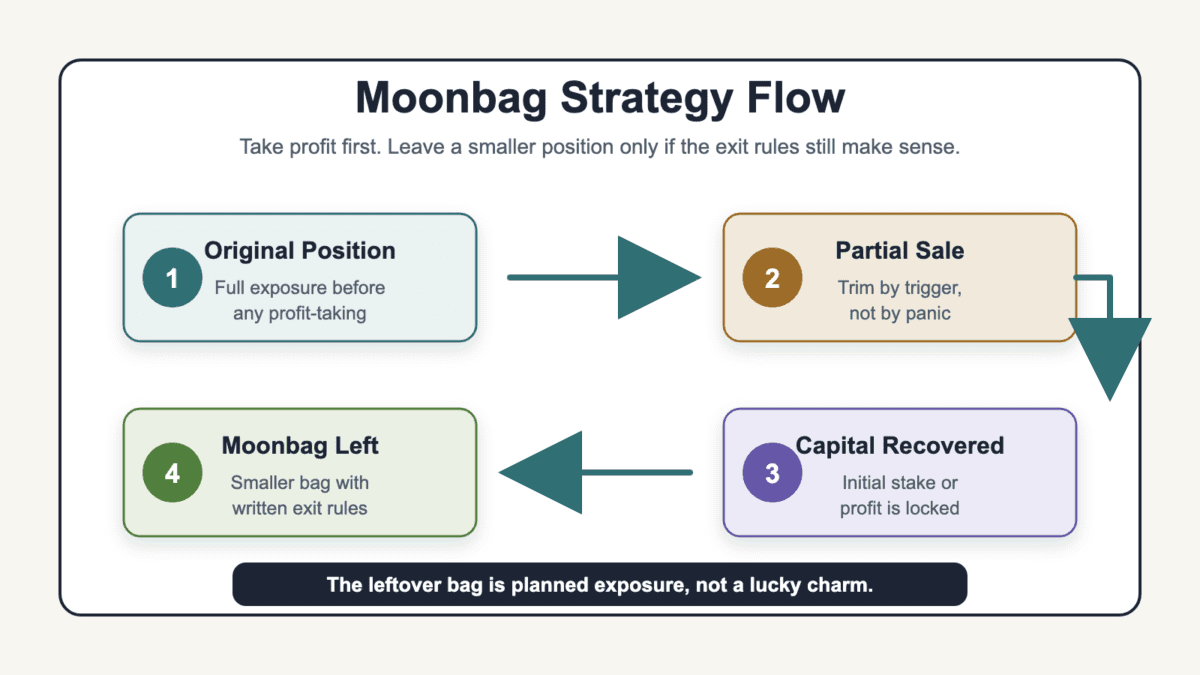
The flow is simple, but the details decide whether it works. Some traders sell half after a double. Others sell smaller pieces into strength. Some recover only the starting capital, while others lock a profit buffer before leaving anything to ride.
Those examples are examples, not laws.
> A clean moonbag plan might say: “If the position doubles, I sell enough to recover my stake, move the proceeds aside, and keep a smaller bag only while liquidity and momentum remain usable.”
That sentence has three parts many casual posts skip. It names the trigger, the sale, and the conditions for the leftover. Without those parts, “leave a moonbag” can become a nicer phrase for winging it.
Plan the future exit before you trust the leftover. A moonbag is useful only if someone can buy it later at a price you can actually receive. Thin markets can make wallet value look better than executable value, so exit liquidity belongs in the plan before the leftover feels safe.
So the mechanics are not about finding the perfect percentage. They are about turning paper profit into a real sale, then making the smaller position easier to manage.
A moonbag strategy changes with the asset because crypto risk does not behave the same way everywhere. A meme coin moonbag, a low-cap altcoin moonbag, and a Bitcoin or Ethereum scale-out do not deserve identical rules.
Meme coins often move quickly and depend heavily on attention. That can make early profit-taking useful, because liquidity and hype may fade faster than the chart suggests. In that setting, the moonbag is usually small and brutally conditional.
Larger assets usually move with deeper liquidity and broader market cycles. A holder may scale out more slowly, especially when the original thesis is not just a short hype trade. Even then, a moonbag strategy still needs an exit plan. “Blue chip” is not a sleep aid.
| Asset situation | How the moonbag strategy changes |
|---|---|
| Meme coin or microcap | Take profits earlier, keep the remainder smaller, and watch liquidity closely. |
| Low-cap altcoin | Scale out around catalysts, then keep a moonbag only while the thesis still holds. |
| Major coin such as Bitcoin or Ethereum | Use slower trims if the position fits a broader portfolio plan. |
| Branded MoonBag-style token | Verify the exact contract, liquidity, and sellability before assuming the term means strategy. |
The table is not a rulebook. It is a reminder that the same phrase can hide very different market conditions.
When a coin runs because everyone is suddenly posting the same chart, exits need extra discipline. A market top signal does not prove the move is over, but it can warn that the easy part may already be crowded.
That is where moonbag strategy helps most. It lets you stay exposed without pretending every runner deserves your whole position forever.
A moonbag strategy should be sized around what you can afford to leave exposed, not around what would feel amazing if the coin moons. Upside fantasies are cheap. Position size is where the receipt arrives.
Start with the original reason for the trade. If it was a fast meme coin rotation, the leftover should probably be smaller and reviewed more often. If it was a long thesis with clear milestones, the moonbag may be larger, but it still needs an invalidation point.
The phrase “risk-free moonbag” often appears after someone recovers their starting capital. That can reduce financial and emotional pressure. But it does not remove risk, because the leftover still carries liquidity, tax, security, and opportunity costs.
Use these checks before deciding how much to keep:
The best moonbag size is often the one that stops you from staring at the chart every five minutes. If the leftover keeps dragging you into panic-refresh mode, it is probably not small enough.
A leftover bag is not the same as a conviction play. A conviction play has a thesis you can explain before the price moves. A moonbag is often the remnant of a trade that already paid you.
That distinction protects you from retrofitting a thesis after the fact. Crypto is full of people who discover “long-term conviction” right after missing an exit. Funny timing, that.
A moonbag strategy helps when it turns a stressful winner into a managed leftover position. It turns into bagholding when the leftover survives only because selling feels painful.
That difference is not philosophical. It shows up in behavior. A planned moonbag has a size, a reason, and a sell rule. A bagholder story usually has excuses, old screenshots, and a group chat that gets quieter every week.
A good moonbag lets you stop arguing with every candle. You have already taken something off the table, so the smaller position can work as optional upside. You are no longer risking the full trade on one more leg.
Bagholding starts when the plan disappears. Maybe the token loses liquidity. Maybe the original catalyst passes. Maybe the team vanishes from public channels. If the only reason to hold is “it might come back,” the moonbag strategy has probably run out of road.
> A moonbag is planned optionality. A bag is an unpaid emotional subscription.
That is why bagholder risk belongs in any honest moonbag discussion. The same leftover position can be disciplined one week and delusional the next if the facts change.
The fix is to write the exit before you need it. Decide what breaks the thesis, what level or event triggers another sale, and how long you are willing to let the leftover sit. A moonbag should buy flexibility, not a lifetime membership in the comments section.
A moonbag strategy reduces some pressure, but it does not make a crypto position safe. The biggest mistake is taking “risk-free moonbag” literally.
Recovering your starting capital can make the trade feel cleaner. It may also protect you from turning a full win into a full loss. But the leftover bag is still exposed to bad contracts, thin liquidity, taxes, and old-fashioned price collapse.
Scam risk deserves special attention because “moonbag” also appears in branded token names and presale pages. A token using moon language can still have dangerous permissions, concentrated holders, blocked sells, or liquidity that disappears when buyers arrive late.
The broader scam backdrop is not theoretical. The FBI reported in April 2026 that cryptocurrency-related complaints from Americans totaled more than $11 billion in reported losses for 2025.
That does not mean every microcap is a scam. It means the moonbag strategy should never skip basic checks because the position is “only profit.” A malicious token can still drain attention, trap funds, or make the leftover impossible to sell.
Watch for these risk points before calling anything comfortable:
A hard rug risk is especially ugly for moonbags because it attacks the assumption that the leftover can wait. Sometimes there is no graceful later exit. There is just a chart, a contract, and a lesson with no refund desk.
The answer is boring on purpose. Check liquidity, holder concentration, contract permissions, and your tax reserve before you decide the remaining bag is harmless.
A moonbag strategy works better when the checklist is written before the pump gets loud. The goal is to keep major decisions out of the worst possible moment.
You do not need a complex trading system. You need a few rules that stop a winning position from becoming improvisation theater. If the plan fits on one screen, even better.
Before leaving tokens to ride, check these points:
That checklist also helps with social pressure. Meme coin communities can praise holders and mock early sellers. The word jeets often gets thrown at people who sell early, even when they are simply protecting profit.
Do not let slang write your exit plan. If a partial sale fits your rules, it fits your rules. The market will not send you a certificate for pleasing strangers.
The final check is attention. If the moonbag is small but still consumes your day, something is off. Either the position is too large, the thesis is too weak, or the token has turned into entertainment with a balance attached.
Moonbag strategy sits next to several crypto slang terms, and mixing them up can make a bad plan sound smarter than it is. The words help only when they sharpen the decision.
A moonbag is the leftover position after profit-taking. A bagholder is someone stuck holding after the trade or thesis breaks. The word jeets describes early sellers in meme coin slang, often as an insult from people who wanted more coordinated holding.
Exit liquidity is the buyer-side reality behind every later sale. If new buyers or usable liquidity are missing, your wallet balance may not become a clean exit. A top signal can warn that the move is crowded, euphoric, or late-stage.
A conviction play is different again. It starts with a thesis and a planned hold. A moonbag often starts after a winning trade has already been trimmed. One is thesis-first. The other is profit-first.
Hard rug belongs in the same mental folder because some leftovers fail for reasons that have nothing to do with normal price action. If the contract, deployer, or liquidity setup breaks trust, the moonbag may become unsellable long before your next target.
The clean version is simple. Use the term that matches the behavior. A planned leftover is a moonbag. A stubborn leftover is a bag. A token that cannot be sold is not a strategy problem. It is a risk problem with teeth.
A moonbag strategy in crypto means selling part of a position after it rises, then keeping a smaller leftover bag for possible further upside. The key word is planned. A leftover position is not automatically a moonbag strategy unless you took profit and know why the remainder still exists.
No. A moonbag strategy can feel risk-free after you recover your starting capital, but the leftover position can still lose value, become illiquid, trigger tax records, or sit in a risky contract. “Risk-free moonbag” is community shorthand. It is not a legal, tax, or market guarantee.
There is no universal moonbag strategy size. Keep only an amount that fits your original thesis, liquidity, time horizon, tax reserve, and risk tolerance. If the leftover would still hurt badly if it went to zero, the moonbag may be too large.
No. Moonbag strategy language appears most often around meme coins and low-cap altcoins, but the same logic can apply to larger coins after a strong move. The sizing changes. Meme coin moonbags usually need tighter rules because liquidity and attention can disappear quickly.
A moonbag strategy keeps a planned leftover position after profit-taking. Becoming a bagholder usually means staying in after the reason to hold has weakened or disappeared. The difference is the plan. A moonbag has exit rules. A bagholder often has memories.
Yes, it can. Selling part of a position may create a taxable gain or loss depending on your jurisdiction, cost basis, and local rules. The leftover moonbag does not erase the earlier sale. Keep records and set aside cash before calling the rest “free.”
Start a moonbag strategy by deciding the sale before the trade becomes emotional. The plan should be boring enough to follow while everyone else is posting rocket metaphors at unhealthy volume.
Use a small written plan:
Keep the plan somewhere you will actually see it. A note in your trading journal, wallet tracker, or exchange notes is better than a perfect plan buried in a chat thread. The point is to make the next step visible before price action makes you creative.
Then follow it. If the trigger arrives and you ignore the sale, you are not running a moonbag strategy. You are negotiating with FOMO in real time.
The best version leaves you calmer, not more trapped. You took profit, kept a measured upside ticket, and wrote the conditions for the next exit. That is the job.
Review the leftover on a schedule, not only during candles. If liquidity thins, the thesis breaks, or the remaining position keeps hijacking your attention, the plan should tell you what to do next.
If the leftover position needs constant excuses, cut the romance. A moonbag strategy should protect you from turning a winner into a personality test.