Physical Address
304 North Cardinal St.
Dorchester Center, MA 02124
Physical Address
304 North Cardinal St.
Dorchester Center, MA 02124


A practical prediction market explainer for odds, rules, and risk.
A prediction market is a market where people trade contracts tied to future event outcomes, so the price reflects the market’s current estimate of the outcome’s probability.
That sounds clean until real money enters the chat. A prediction market can look like trading, betting, forecasting, hedging, or all four. The label depends on the venue, contract, country, and user behavior.
Crypto users usually meet prediction markets through Polymarket-style yes/no markets, wallet integrations, or Kalshi headlines. Platform names matter less than the mechanics. Price, liquidity, rules, and resolution decide whether the market is a useful signal or just a confident crowd with wallets.
A prediction market lets users trade contracts based on whether a future event happens. The event could be an election result, an interest-rate decision, a sports outcome, a crypto listing, or a company milestone.
Most beginner examples use binary contracts. One side represents “yes” and the other represents “no.” The yes side pays if the event happens. It expires worthless if the answer is no.
That simple structure creates a market price. If a yes contract trades near 63 cents and pays $1 if correct, users often read it as roughly a 63% market-implied chance. The shortcut is useful, but it depends on fees, liquidity, rules, and whether enough informed traders care.
Prediction markets are sometimes called event markets, event contracts, information markets, or betting markets. Those labels are not interchangeable in every country. The legal label can change what products are allowed, who can access them, and what protections apply. That is why the market wording and payout rule matter as much as the headline event.
The beginner version is simple:
So a prediction market is more than a poll. It is a money-backed opinion market where being wrong can cost you. Even being right depends on the market resolving the way you expected.
Prediction market odds come from the contract price. In a simple yes/no market with a $1 payout, a yes contract priced at $0.63 is commonly read as a 63% implied probability.
That reading works because the contract has a fixed payoff. If the event happens, the winning side is worth $1. If it does not, that side is worth $0. Traders buy and sell between those endpoints as news, rumors, public data, and positioning change.
But the displayed price is not magic. It is the price someone can trade at now. A deep order book can make that price more meaningful. A thin one can make it noisy, jumpy, or easy to distort.
Use this table as a quick translation layer:
| Price Signal | What It Usually Means |
|---|---|
| $0.10 yes price | The market is pricing a low chance, not impossibility. |
| $0.50 yes price | The market is close to split, or liquidity is uncertain. |
| $0.80 yes price | The market strongly favors yes, but late reversals can still hurt. |
| Wide bid/ask spread | The displayed odds may be expensive to enter or exit. |
| Fast price move | New information, thin liquidity, or aggressive trading may be driving it. |
Fees also matter. A contract that looks profitable before fees may be less attractive after trading costs, withdrawal costs, or funding friction. This is where the “63% equals 63 cents” shortcut stops being enough.
Build the habit before you trade. Read the price as a live market estimate. Then check the bid, ask, depth, volume, close date, and settlement rule before believing the odds.
Prediction market trading starts with a listed event question and ends with settlement. Each step can change your risk, even when the price looks clean on screen.
A good market question is specific. It names the event, deadline, source, and resolution condition. A weak market question sounds obvious at first, then turns messy when real-world details arrive.
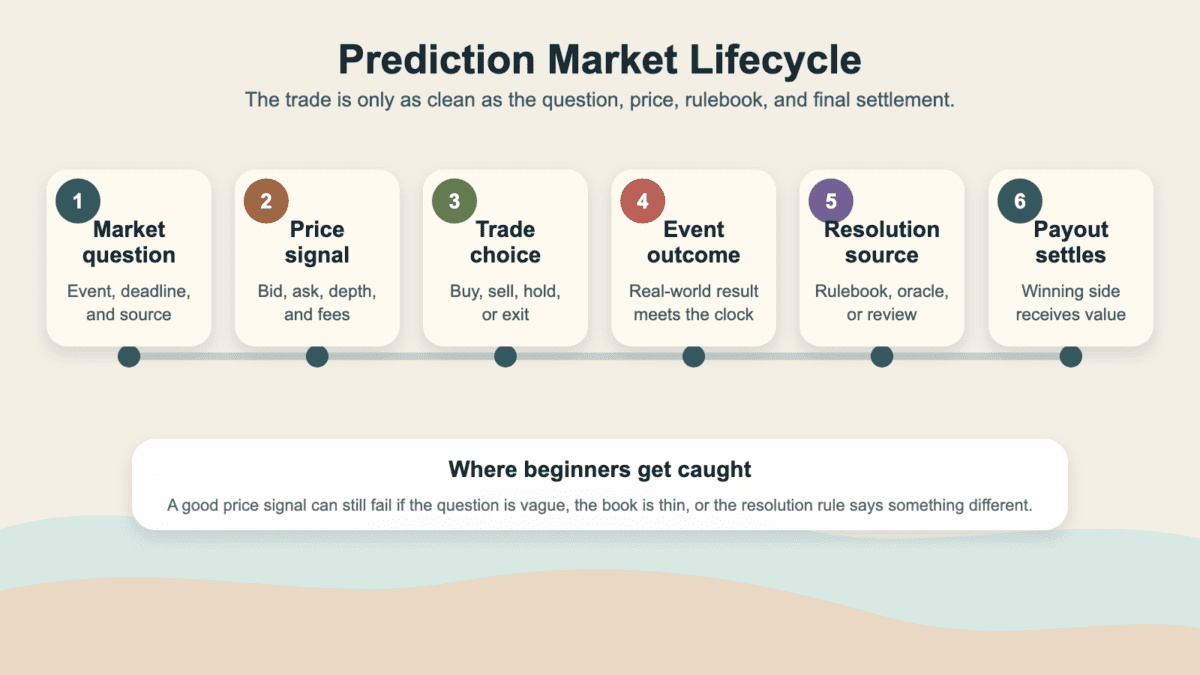
The normal lifecycle looks like this:
Crypto-native platforms may add wallet steps. You might connect a wallet, fund with USDC, and trade through smart contracts or platform-managed interfaces. That makes a basic wallets check part of the trading flow, not a cosmetic setup step.
Before placing a trade, read the rule like it is the product. If the market says “official announcement by a named source before midnight UTC,” your personal interpretation does not matter much. The contract pays on the rule, not on vibes.
Settlement is part of the trade too. You can be directionally right and still lose if the wording excludes your scenario, uses a different data source, or resolves later than you expected.
Prediction market prices show what traders are willing to risk on an outcome. That can beat a poll, a loud timeline, or a comment section.
Money changes behavior. When users can profit from being right, they have a reason to research, update, hedge, and correct bad prices. That is the forecasting case for prediction markets.
But market odds are not truth. They can reflect crowd attention, stale information, one-sided positioning, or a thin order book. A sports market with sharp traders and deep liquidity may carry better signal than a niche crypto market with three active accounts and a heroic spreadsheet.
Crypto adds another wrinkle. Some markets become part of the broader crypto meta because traders start quoting the odds as social proof. Once that happens, the price can reflect attention as much as probability.
Prediction market prices are most useful when these conditions line up:
They are least useful when the market is emotional, thin, vague, or easy to manipulate. In those cases, the price can become a weather vane in a wind tunnel.
Use the odds as one input. Then compare them with primary information, market depth, and your reason for thinking the crowd is wrong.
Prediction market liquidity decides how easily you can enter, resize, or exit a position. It also decides whether the displayed odds are real enough to trade.
In a liquid market, there are enough buyers and sellers near the current price. You can usually trade without moving the market much. In a thin market, your order may push the price, fill badly, or sit there like a lonely limit order.
The bid/ask spread is the first warning light. If yes is bid at $0.58 and offered at $0.70, the market may show a midpoint near 64%. You cannot trade that midpoint. You pay the spread to get in or accept it to get out.
This is where event markets can create their own form of exit liquidity. A position can look profitable on screen, yet be hard to close if few traders want the other side.
Check liquidity before checking your ego:
Liquidity also affects accuracy. A market with deep two-sided interest can adjust quickly after new information. A niche market can lag, overreact, or get pinned by one aggressive participant.
The takeaway is blunt. A prediction market price is only useful if you can trade near that price when it matters.
Prediction market outcomes get resolved by the market’s rulebook. That rulebook should name the event, deadline, data source, and process used to decide the winner.
Resolution is where many beginners get surprised. The market does not pay because your argument was clever. It pays because the final outcome matches the contract wording.
Centralized platforms may use an internal resolution team, official records, exchange rules, or listed data sources. Crypto-native markets may use decentralized oracles, dispute windows, token votes, or a mix of off-chain review and on-chain settlement.
Polymarket-style markets often involve oracle resolution, where the final result may depend on a designated source and a dispute process. That does not make the outcome automatic. It makes the rule and dispute path part of the risk.
Good resolution language usually has these traits:
Bad resolution language hides traps in plain sight. “Will Team X win?” sounds easy until the game is postponed, abandoned, appealed, or settled by a source using a category you did not expect.
Oracle risk is the crypto-specific version of this problem. If the oracle, source, or dispute process fails, the market can settle in a way that feels wrong to traders. That risk is separate from being wrong about the event itself.
So read the resolution rule before reading the odds. The payout follows the rule.
Prediction market trading and betting overlap because both involve risking money on uncertain events. The difference depends on product design, legal treatment, market structure, and user behavior.
An event contract can be framed as forecasting, hedging, speculation, or gambling. A business might hedge weather or policy exposure. A trader might speculate on an election. A bored user might chase sports markets for dopamine. Same building, different rooms.
The confusion is not just semantic. Legal and consumer-protection rules can change by country, state, product, and venue. Age limits, KYC, tax treatment, advertising rules, and prohibited markets can all differ.
This table shows why the label gets messy:
| Prediction Market Feature | Why It Feels Like Trading Or Betting |
|---|---|
| Yes/no event contract | Looks like a binary trade, but the payoff resembles a wager. |
| Order book pricing | Feels like trading because users buy, sell, and exit. |
| Sports or political events | Feels like betting because the underlying event is familiar. |
| Hedging use case | Feels like finance when exposure offsets a real-world risk. |
| Fast mobile access | Can encourage the same habits as high-frequency betting apps. |
Crypto prediction markets can intensify the blur. Wallet access, public trades, social sharing, and volatile narratives can make event markets feel like token trading with shorter timers.
Skip the vocabulary debate and ask sharper questions. What does the product allow? What law applies where you live? How does the platform protect users? Does your behavior look like analysis or impulse?
If the trade is mostly a rush, that is useful information. The market may be clever. Your use of it may not be.
Prediction market platforms differ by regulation, funding method, market selection, fees, resolution process, and country access. Two platforms can ask similar event questions while exposing users to very different risks.
Kalshi is usually discussed as a regulated U.S. event-contract venue. Polymarket is usually discussed as a crypto-native prediction market with wallet and stablecoin context. That distinction helps, but it is not enough to pick a venue.
Availability can change quickly. A platform may limit countries, states, sports markets, funding methods, or specific event categories. Do not rely on an old social post when real money is involved.
Check these points before choosing a prediction market platform:
| Check | Reason To Check |
|---|---|
| Legal access | Your country or state may restrict the product. |
| Funding method | Fiat, card, bank, wallet, and stablecoin flows carry different risks. |
| KYC requirements | Identity checks affect access, privacy, and withdrawals. |
| Market rules | The contract wording decides settlement. |
| Resolution process | You need to know who decides the result. |
| Liquidity and spreads | A listed market is not always a tradeable market. |
| Fees and withdrawals | Costs can erase small expected edges. |
Once the mechanism is clear, comparison pages become more useful. If you are comparing venues, CryptoProcent’s prediction market platforms page is the more natural next step.
For an explainer, the platform lesson is narrower. The best-looking interface does not fix weak rules, poor liquidity, or unclear availability.
Prediction market rules, taxes, and availability depend on where you live, what product you trade, and which venue lists the market. Global crypto access does not equal global legal access.
In the U.S., many regulated prediction-market products are discussed as event contracts. The CFTC says prediction markets have existed in regulated U.S. markets for more than two decades and have been under CFTC regulation since 2004, which is why availability is a legal and venue-specific question instead of just a platform toggle.
That does not make every market available to every user. Some products may be limited by country, state, age, KYC status, category, or platform policy. Sports, elections, politics, commodities, weather, and crypto events may not be treated the same way.
Tax treatment can also vary. A trade may create gains, losses, reporting duties, or gambling-style tax questions depending on the venue and jurisdiction. The awkward answer is still the honest one: check platform terms and local rules before trading.
Use this practical filter:
Do not read a prediction market guide as legal permission. Read it as a map of questions to ask before you click.
Prediction market risks go beyond being wrong about the event. You can also lose money through bad pricing, thin liquidity, fees, ambiguous rules, disputes, account limits, wallet mistakes, and emotional overtrading.
The obvious risk is total loss. If you buy yes and no wins, your yes contract can expire at zero. The quieter risk is losing while thinking you were careful.
Thin markets can trap users. Wide spreads can punish exits. Rules can settle against your interpretation. A platform can restrict access. A wallet-funded trade can add signing, phishing, bridge, or stablecoin risk.
Prediction markets can also become intensely user-versus-user. When a market is mostly speculation, the trade can feel close to PVP trading: one side’s gain comes from someone else mispricing, mistiming, or refusing to update.
Watch for these beginner traps:
Manipulation risk also deserves plain language. A thin market can be moved by a determined trader. A public market can attract narrative campaigns. Nonpublic information can create unfair edges and legal problems.
None of this means every prediction market is reckless. It means clever design does not remove basic trading discipline.
A prediction market is useful when the event is clear, the market is liquid, the rules are objective, and your stake is sized like risk capital. It is weak when the event is vague, emotional, illiquid, or legally uncertain.
Good prediction markets help users compare expectations. They show how prices move after new information. They can also expose gaps between public commentary and money-backed views.
But some markets deserve a pass. If the wording is loose, the spread is wide, the deadline is fuzzy, or the platform cannot clearly explain access and settlement, skipping is not cowardice. It is cost control.
Use this checklist before trading or trusting a prediction market:
A researched event thesis can be a conviction play when you understand the facts, price, and risk. A random click on a hot market is just a coin flip wearing a suit.
The cleanest next step is boring and useful. Track a few markets without trading. Watch how prices react to news, and study how they settle. Then decide whether your edge is real or just enthusiasm with a refresh button.
A prediction market can feel like gambling because users risk money on uncertain events. The label depends on the product, venue, law, and behavior. A regulated event contract, a hedge, a sports-style wager, and a crypto speculation market can look similar on the surface but be treated differently.
Prediction market odds usually come from contract prices. If a yes contract costs $0.63 and pays $1 if correct, users often read that as about a 63% implied probability. The shortcut becomes weaker when spreads, fees, thin liquidity, or unclear rules are involved.
Some prediction markets are available through regulated U.S. venues, but availability depends on the platform, state, product category, and current rules. Users should check the venue’s terms, local restrictions, and whether the product is offered through a regulated market.
Polymarket is commonly discussed as crypto-native, with wallet and stablecoin context. Kalshi is commonly discussed as a regulated U.S. event-contract venue. The practical differences include funding, KYC, available markets, public visibility, resolution process, and jurisdiction limits.
Prediction markets can be manipulated, especially when liquidity is thin or public attention is high. A trader with enough size can move a weak order book, and coordinated narratives can affect emotional markets. Better liquidity and clear rules reduce the risk, but they do not remove it.
Prediction market arbitrage is possible in theory, but it is not beginner-friendly. Fees, slow settlement, withdrawal limits, KYC delays, liquidity gaps, and rule differences can turn a neat spreadsheet edge into a messy real trade.