Physical Address
304 North Cardinal St.
Dorchester Center, MA 02124
Physical Address
304 North Cardinal St.
Dorchester Center, MA 02124


A plain guide to proto-danksharding, EIP-4844, Ethereum blobs, and L2 fee risk.
Proto-danksharding is Ethereum’s EIP-4844 upgrade that gives rollups a cheaper temporary data lane called blobs, so Layer 2 networks can post transaction data without using permanent calldata for every byte.
That definition is the clean part. The confusing part is everything the name drags behind it: EIP numbers, blobs, data availability, Dencun, full danksharding, and ETH fee-burn arguments that can turn one chart into a market sermon.
Proto-danksharding is not a token, wallet app, or meme phrase. It is a shipped Ethereum scaling step that mostly affects the data costs behind rollups. If you use L2s, trade ETH narratives, or compare rollup fees, this is the blob lane you need to understand before the acronyms start forming a pile.
Proto-danksharding in Ethereum is the first shipped version of Ethereum’s rollup data-scaling plan. It introduced blob-carrying transactions, which let rollups publish temporary transaction data more cheaply than using permanent calldata for every batch.
The name sounds like someone lost a bet in a protocol meeting. It actually combines two researcher names. “Proto” points to Diederik Loerakker, known as Protolambda, and “dank” points to Dankrad Feist.
The naming history helps. The user-facing checklist comes first:
The upgrade went live as part of Dencun, the Ethereum network upgrade that activated EIP-4844. Before that, rollups often used calldata to post the data needed for verification. Calldata works, but it is expensive for bulk rollup data because Ethereum keeps it in a more permanent execution-layer path.
Blobs gave rollups a purpose-built route. They keep transaction data available long enough for verification, then let normal Ethereum nodes prune that data later. The rollup still anchors activity to Ethereum. It just does not ask every node to store every byte forever. So the plain version is this: proto-danksharding made Ethereum better at serving rollups.
That narrow scope is the point. When a wallet quote falls on an L2, proto-danksharding may be part of the reason. When a bridge is risky or a mainnet swap is expensive, the upgrade is not the whole story.
Proto-danksharding works by separating rollup data availability from normal Ethereum execution. A rollup batches many Layer 2 actions, posts the batch data through blobs, and includes commitments that let Ethereum track and verify the data path.
Start at the wallet. You swap, transfer, mint, bridge, or use an app on an L2. The rollup’s sequencer orders that activity and groups it with other transactions. Then the rollup sends a blob-carrying transaction to Ethereum.
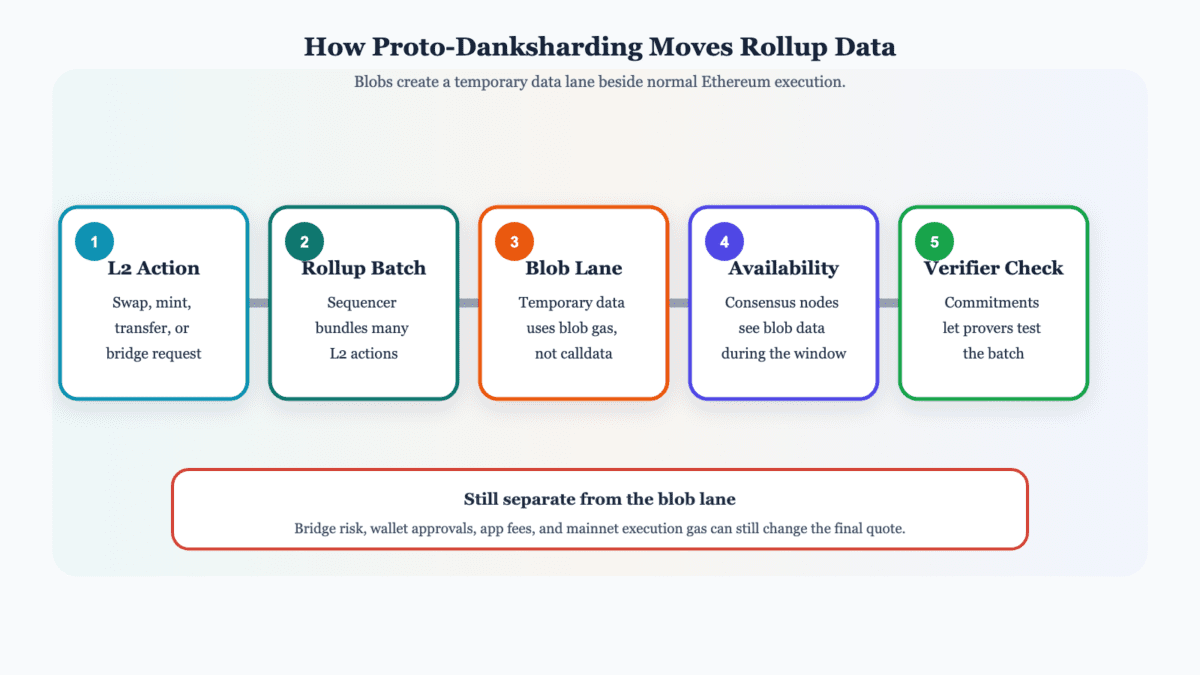
The Ethereum roadmap describes proto-danksharding as EIP-4844, a way for rollups to add cheaper data to blocks through blobs. It also frames the scale difference clearly: proto-danksharding uses six blobs attached to blocks, while full danksharding would expand that to 64.
The same roadmap notes that blob data is not accessible to the EVM. It can also be deleted after a fixed period, listed as 4096 epochs, or about 18 days.
That design creates two useful separations. The consensus layer handles blob data availability. The execution layer can reference commitments or versioned hashes, but smart contracts do not open the raw blob like ordinary calldata.
The core terms fit together like this:
| Term | Plain Meaning |
|---|---|
| Blob | Temporary rollup data attached to Ethereum blocks for availability checks. |
| Commitment | A compact cryptographic reference that ties the blob data to the on-chain record. |
| Blob gas | The separate fee unit used to price blob data space. |
| Calldata | The older execution-layer data path that rollups used more heavily before blobs. |
| Consensus client | The Ethereum software layer that sees and propagates blob data. |
| Prover | A party that can check whether a rollup state update follows the data. |
KZG commitments are the small cryptographic bridge in this story. They let Ethereum and verifiers refer to blob data without making every contract read the full blob. You do not need to do polynomial math before using an L2. For users, the result is enough: Ethereum can support rollup data checks without turning blob contents into normal app storage.
The temporary part is intentional. Rollups need the data available during the period when someone can reconstruct, prove, or challenge the batch. They do not need every normal node to preserve that data forever. Rollup operators, archive services, indexers, or other infrastructure can keep copies for longer when history is needed.
Proto-danksharding made Layer 2 fees cheaper by reducing one of the biggest costs rollups had to recover from users: posting transaction data back to Ethereum. Before blobs, many rollups relied more on calldata, which was a costly place for large batches of data.
After EIP-4844, rollups could use blobs for the data-availability part of the batch. That gave them a cheaper data lane with its own fee market. When blob capacity is not crowded, the rollup’s cost to publish data can fall, and users can see lower fees.
That does not mean every wallet quote becomes tiny. A final L2 fee can still include several moving parts:
The difference shows up clearly in high-frequency activity. A game, social app, NFT mint, or stream of simple transfers can produce many small actions. When those actions settle through an L2, cheaper rollup data helps the economics behind the screen. That is one reason on-chain games and other transaction-heavy apps care about low-cost rollup paths.
But blob costs can still rise. If many rollups compete for blobspace at the same time, blob gas can move higher. An L2 can also charge more because of congestion, bridge demand, app settings, or a route that has little to do with blobs. So read fee claims in pieces.
Proto-danksharding lowered a major rollup data cost. It did not abolish app fees, bridge fees, sequencer choices, or the ancient crypto tradition of making the simple quote suspiciously complicated.
Proto-danksharding, full danksharding, old sharding, and data availability all belong to the Ethereum scaling conversation, but they do different jobs. Keep them separate with two questions: what has shipped, and what does each term actually control?
Proto-danksharding is the live EIP-4844 step. It added blobs so rollups could post data more cheaply. Full danksharding is the broader roadmap direction for much more rollup data capacity and more advanced data availability techniques.
The split looks like this:
| Term | What To Remember |
|---|---|
| Proto-danksharding | The shipped EIP-4844 upgrade that introduced blob-carrying transactions. |
| Full danksharding | The larger Ethereum data-scaling goal beyond the first blob lane. |
| Old-style sharding | The older idea of splitting execution across many shard chains. |
| Blobspace | The temporary data capacity rollups compete for after EIP-4844. |
| Data availability | The guarantee that transaction data was available long enough to verify a rollup batch. |
| PeerDAS | Later roadmap work that aims to make blob data checks more efficient through sampling. |
The comparison prevents stale roadmap language from creating bad fee assumptions. Some old explainers still talk about proto-danksharding as upcoming. Some market posts talk about full danksharding as if it already arrived. Both readings can point users at the wrong cost layer.
Data availability is the shared concept underneath the blob lane. A rollup can claim a state update, but other parties need the underlying data to check it. If the data is missing, verification becomes a trust exercise. Nobody needs more trust exercises with bridge-sized balances attached.
Use this quick label check:
PeerDAS belongs in the later-roadmap bucket. It is about making data availability more scalable by letting nodes sample pieces of blob data instead of each node downloading everything in full. That is related to proto-danksharding, but it is not the same shipped upgrade.
Proto-danksharding does not fix every Ethereum or L2 problem. It improves one infrastructure cost in the rollup path: temporary data availability for rollup batches.
That is useful, but users still face the usual crypto hazards. A cheaper data lane does not make a bridge contract safer, a sequencer decentralized, a wallet approval harmless, or a withdrawal instantly liquid.
Before using an L2 because fees look better, still check the parts blobs do not solve:
Wallet safety is the dull line item that saves money. Proto-danksharding can lower rollup data costs while a fake app still asks for a bad approval. A quick check of wallet safety and signing behavior remains separate from blob economics.
There is also no guarantee that an L2 passes every cost saving to users in the same way. Rollups have different batching policies, compression methods, fee models, sequencers, and app mixes. Two networks can both use blobs and still quote different fees for the same-looking action.
Keep these boundaries plain:
Use the upgrade for what it is. It is a real improvement to rollup infrastructure, not a permission slip to stop checking routes, contracts, bridges, or approvals.
Proto-danksharding gives ETH holders and traders a real scaling signal, but not a clean price signal. It made Ethereum-aligned rollups cheaper to operate in one important area, which can support more L2 usage over time.
The bullish reading is simple. If rollups become cheaper and more usable, Ethereum remains central to settlement and data availability for a large L2 economy. More activity can strengthen Ethereum’s role, even when users spend most of their time on rollups rather than mainnet.
The cautious reading is just as important:
That is why ETH holder debates around blob fees can get loud. Some holders want rollups to become cheap enough for mass use. Others worry that cheap blobspace weakens the simple “more fees, more burn” story. Both sides can have a point.
Proto-danksharding can also become a market meta. That means traders may chase L2, data-availability, or Ethereum scaling names because the theme is hot, not because the fee economics are already proven. Blob activity is one signal. Compare it with L2 usage, rollup margins, ETH demand, liquidity, staking, issuance, and broader risk appetite.
You can check proto-danksharding signals by comparing blob usage, blob base fees, rollup cost dashboards, and the final wallet quote. A single screenshot rarely explains the whole fee stack.
Start with the category of data, not the loudest chart. Blob usage tells you whether rollups are filling the data lane. Blob fees tell you whether that lane is expensive right now. Rollup cost dashboards show how much networks spend posting data to Ethereum. Your wallet quote shows what you actually pay.
Use this quick check before reacting:
This is where crypto social channels can distort the signal. Blob fee screenshots, ETH burn takes, and rollup claims often spread before anyone checks what the chart measured. The first post wins attention. The second post usually has the boring correction and fewer likes.
For normal users, the wallet quote is still the final check. If an L2 is cheap because blob costs fell, good. If a route is expensive because a bridge is congested or an app adds a fee, blobs are not the suspect. For traders, a sustained pattern in rollup data costs is more useful than one spike.
Related proto-danksharding terms help keep the blob story from turning into one large Ethereum soup. The words overlap, but each one points to a different piece of the data path.
Two social terms can help too. Crypto meta explains how a real scaling upgrade can become a tradable theme. CT is where blob fee screenshots and ETH burn takes often spread before the details catch up.
Keep these definitions close when reading fee or roadmap claims:
| Term | How It Fits Proto-Danksharding |
|---|---|
| Blob | Temporary Ethereum data used mainly by rollups after EIP-4844. |
| Blobspace | The limited room available for blobs in Ethereum blocks. |
| Blob fee | The price rollups pay for blob data space. |
| Calldata | Execution-layer transaction data that rollups used more heavily before blobs. |
| Data availability | The data exists long enough for others to verify the rollup batch. |
| Rollup | The L2 system executes transactions, then anchors results and data to Ethereum. |
| Sequencer | The party that orders L2 transactions before they are batched and posted. |
| Prover | A party that checks whether a rollup update follows from available data. |
| KZG commitment | A compact cryptographic reference to blob data. |
| PeerDAS | Later roadmap work for more efficient blob data sampling. |
| Full danksharding | The larger data-scaling goal beyond proto-danksharding. |
Ask which layer a claim touches. If the claim is about wallet approvals, blobs probably are not the answer. If the claim is about rollup data posting, proto-danksharding is likely central.
That small separation prevents a lot of bad analysis. Crypto loves turning one term into an answer for every fee. Proto-danksharding is not that. It is a specific Ethereum upgrade with a specific job.
Start with proto-danksharding as a rollup data-cost upgrade. That one sentence keeps the rest of the topic from drifting into price predictions, bridge assumptions, or full-roadmap claims.
When you see a fee claim, run these checks:
For a live transaction, start with the quote details. If the wallet collapses everything into one “network fee,” compare the route with the app screen, bridge screen, or rollup status page before blaming blob costs.
Also check the tense. A claim about Dencun or EIP-4844 should describe proto-danksharding as live. A claim about PeerDAS or full danksharding should sound like later capacity work, not something your wallet already uses today.
Then ask whether the claim is practical or tradable. A practical claim says an L2 action became cheaper because rollup data posting improved. A tradable claim says ETH, an L2 token, or a data-availability token must move because blobs are cheap or expensive.
The practical claim is easier to verify. The tradable one needs more evidence: demand, liquidity, positioning, token design, timing, and some humility. Crypto rarely includes humility in the gas estimate, so you have to bring your own. For users, proto-danksharding is useful context before bridging or blaming fees.
Proto-danksharding is Ethereum’s EIP-4844 upgrade that gives rollups a cheaper temporary data lane called blobs. It helps Layer 2 networks post transaction data without relying as much on permanent calldata.
The simple version is “cheaper rollup data.” It does not mean every Ethereum fee is cheaper, and it does not make L2 apps risk-free.
Yes, proto-danksharding is the common name for EIP-4844, the Ethereum upgrade that introduced blob-carrying transactions. It went live through the Dencun upgrade.
The terms are often used together because EIP-4844 is the formal proposal, while proto-danksharding is the roadmap name people use in explainers, debates, and fee discussions.
Proto-danksharding does not directly lower normal Ethereum mainnet execution gas. A mainnet swap, mint, or contract call still pays regular L1 gas.
The upgrade mainly helps rollups lower the cost of posting transaction data to Ethereum. Users may feel that through cheaper Layer 2 activity, not through every mainnet transaction.
Proto-danksharding blobs work by carrying temporary rollup data alongside Ethereum blocks. Rollups post blob data and commitments so other parties can verify the rollup batch during the availability window.
The EVM does not read raw blob contents like calldata. It can reference commitments or hashes, while the consensus layer handles blob data availability.
Proto-danksharding is the live first step that introduced blobs through EIP-4844. Danksharding is the broader Ethereum roadmap goal for much larger rollup data capacity.
Think of proto-danksharding as the first blob lane. Full danksharding is the expanded system Ethereum is still working toward through later data-availability upgrades.
Proto-danksharding can support the bullish Ethereum case by making rollups cheaper to use. More affordable L2 activity can strengthen Ethereum’s role as a settlement and data-availability layer.
But it is not a price forecast. Cheap blobs can also mean less direct fee burn from blob activity, and ETH price still depends on demand, liquidity, staking, issuance, macro risk, and market positioning.