Physical Address
304 North Cardinal St.
Dorchester Center, MA 02124
Physical Address
304 North Cardinal St.
Dorchester Center, MA 02124


Raydium graduation explained without the stale migration fog.
Raydium graduation is the point where a bonding-curve launch reaches its threshold and moves into a Raydium pool, shifting trading to AMM-style liquidity.
That sounds neat until the chart starts moving. Graduation can make a token easier to trade, route, and track, but it does not make the creator honest, the holders patient, or the next candle friendly.
The confusing part is history. Older Solana meme-coin threads often used Raydium migration language for Pump.fun tokens, while Raydium LaunchLab now gives the phrase its own Raydium-native meaning. Same word, different plumbing.
Raydium graduation means a launchpad token has crossed the condition that moves it out of early curve trading and into a Raydium pool. In plain English, the token leaves the launchpad pricing phase and starts trading through normal pool liquidity.
That is the useful definition. It is also where many traders get sloppy. Graduation does not mean a centralized exchange listed the token, Raydium audited the project, or demand suddenly became real.
The phrase usually appears in fast Solana token markets. You may see a progress bar, a bonded label, a migration message, or a pool address. The exact wording depends on the launchpad and the data tool.
Raydium-specific graduation is about the Raydium launch flow. A token moves through a bonding curve, reaches a configured target, then migrates into a Raydium pool. After that, Raydium Swap and aggregators may be able to route trades through that pool.
The old phrase “token graduation to Raydium” also shows up because earlier Pump.fun discussions often described tokens moving from Pump.fun to Raydium after the bonding curve filled. That history matters, but it should not be pasted onto every current token screen.
Use Raydium graduation as a state change. It tells you where price discovery may happen next. It does not tell you whether the chart has another leg, whether liquidity is deep, or whether early wallets are about to sell into the fresh attention.
Raydium graduation on LaunchLab starts with a token launch, moves through bonding-curve trading, then reaches a platform condition that can create or migrate liquidity into a Raydium pool. The exact settings depend on the launch mode and configuration.
Raydium’s LaunchLab overview describes a five-step launch flow: creator configuration, bonding-curve trading, price movement, graduation, and post-graduation routing through Raydium pools. For this topic, official mechanics beat a half-cropped screenshot on social media.
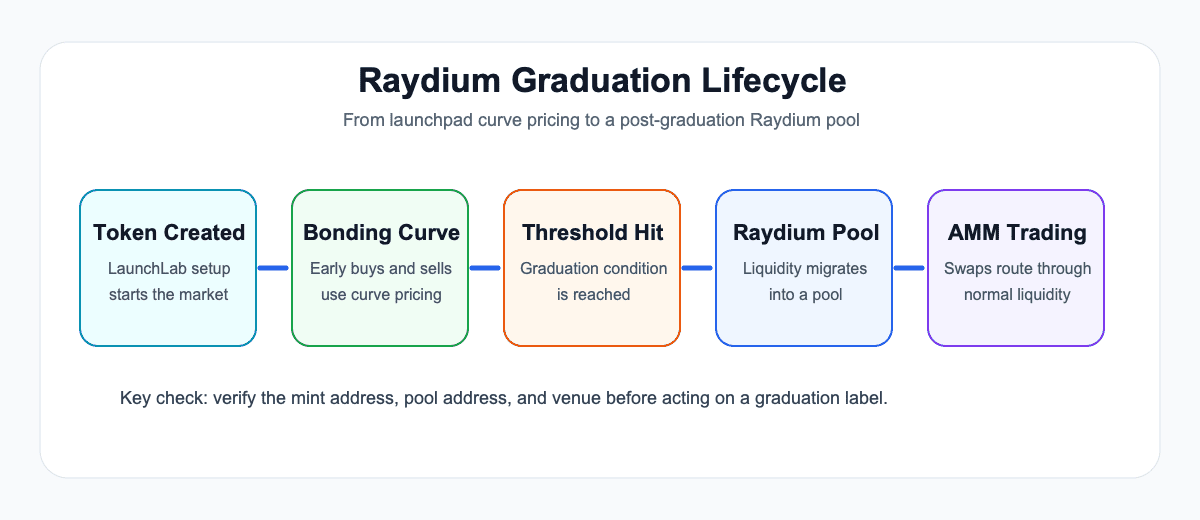
The basic lifecycle is easier to follow when each step has a job:
| Step | What changes |
|---|---|
| Token creation | The creator sets up the token and launch parameters. |
| Bonding curve trading | Buyers and sellers trade against the launch curve. |
| Graduation threshold | The launch reaches the condition needed to leave the curve phase. |
| Raydium pool creation | Liquidity moves into a Raydium pool based on platform settings. |
| Post-graduation AMM trading | Swaps can route through pool liquidity instead of the launch curve. |
The table is the clean version. Real tokens can still feel messy because charts, screeners, wallets, and aggregators may update at different speeds.
The bonding curve phase is the early market for the token. Instead of trading against a normal liquidity pool, buyers and sellers interact with a curve that changes price as trading happens.
This phase is why graduation can become a visible event. Traders watch progress, bots watch state changes, and creators watch whether the launch reaches the condition that can move it into a later market.
LaunchLab can support faster no-code style creation and more configurable launches. In user terms, the important point is simple: the creator’s chosen mode and settings can affect the graduation target, fee behavior, and post-graduation pool treatment.
So avoid universal numbers. A fixed target repeated from one token, one screenshot, or one old tutorial can be wrong for the launch you are checking.
The graduation trigger is the condition that ends the active curve phase and starts the move into Raydium pool trading. It is a program and platform event, not a vote of confidence from the market.
When that trigger fires, traders often see a status change before every tool agrees on the details. One page may show graduated. Another may show a new pool. A chart may need time to stitch the curve phase and pool phase together.
This is where precision helps. Ask whether the token reached the LaunchLab condition, whether a Raydium pool exists, and whether the pool address matches the mint you are tracking.
The trigger can be automatic from the user’s point of view, but that does not mean the next trade is safe. It only means the launch crossed the rule that moves it forward.
The Raydium pool after graduation becomes the new place where liquidity does the heavy lifting. Trades no longer depend only on the launch curve. They depend on pool depth, routing, slippage, and the behavior of people holding the token.
Depending on configuration, the post-graduation pool path can involve CPMM-style liquidity or other Raydium pool treatment. Creator-fee settings, Fee Key NFTs, LP token handling, and liquidity-lock behavior can all change what the creator controls after migration.
That sounds technical, but the trader lesson is basic. Do not stop at the word graduated. Confirm the pool, check whether liquidity is usable, and make sure the token you are viewing is the same mint that graduated.
Raydium graduation and Pump.fun Raydium migration are related phrases, but they should not be merged into one rule. Raydium graduation is the Raydium LaunchLab context. Pump.fun Raydium migration is older wording tied to a different launchpad history.
This confusion is common in crypto trenches, where traders jump between token pages, Telegram alerts, X posts, DEX tools, and screenshots. One stale phrase can travel faster than the correction.
Old Pump.fun pages mention Raydium because many early explanations described a token filling its bonding curve and moving to a Raydium pool. That language became shorthand for a fresh Solana token leaving the launchpad phase.
The problem is that shorthand ages badly. A guide, script, or comment can still rank, circulate, or get copy-pasted after the platform flow changes. Then a beginner sees Raydium, Pump.fun, PumpSwap, and Jupiter in the same thread and thinks they are interchangeable.
They are not. Pump.fun is the launchpad context. Raydium is a DEX and liquidity venue. PumpSwap can appear in Pump.fun-specific post-graduation context. Jupiter is usually a routing layer, not the graduation venue itself.
That distinction can save you from checking the wrong pool. If the page is about Raydium LaunchLab, read it as a Raydium launch. If the page is about Pump.fun, confirm the current Pump.fun venue instead of assuming the older Raydium route still applies.
Current venue claims need a date check because launchpads change faster than evergreen explainers. A screenshot from one year, a bot tutorial from another, and a live token page from today can describe different routes.
> Do not copy old thresholds, venue claims, or migration steps without checking the live launchpad page, mint, and pool address.
That warning is not pedantry. It decides which pool you inspect, which chart you trust, and whether you are looking at the same token state as everyone else.
The safest wording is specific. Say Raydium LaunchLab graduation when you mean a LaunchLab token moving into a Raydium pool. Say Pump.fun migration only when the token actually belongs to that flow and the current platform page backs it up.
After Raydium graduation, the market moves from launchpad curve pricing into pool-based trading. The token may be the same mint, but the pricing engine, route, chart source, and execution risk can change.
That shift can feel bullish because visibility improves. Screeners may show a fresh pool. Aggregators may discover routes. More traders may notice the token because it no longer looks trapped inside the launch phase.
Here is the broad before-and-after picture:
| Before graduation | After graduation |
|---|---|
| Trades use the launchpad bonding curve. | Trades use Raydium pool liquidity. |
| Progress and curve state dominate attention. | Pool depth, routing, and slippage become central. |
| The token may be harder for tools to route. | Raydium Swap and aggregators may route through the pool. |
| The main question is whether it can graduate. | The main question is whether demand can absorb sellers. |
The key shift is not only where trades happen. It is what information becomes useful.
The token does not become safer by default after Raydium graduation. The same token can still have concentrated holders, aggressive sellers, weak social traction, bad permissions, or a creator who disappears after the milestone.
Graduation removes one uncertainty: whether the token reached the next market state. It does not remove the normal risks around fresh Solana tokens.
That is why a graduated Raydium pool should start a new check, not end the old one. Look at liquidity depth, holder concentration, recent sells, and whether the first AMM trades show real demand or only a thin burst of attention.
The price source can change because a curve price and a pool price are not the same market. During the handoff, a chart may show gaps, jumps, or a short period where different tools disagree.
That does not always mean manipulation. The tool may be switching from curve state to pool trades, or liquidity may be thin enough for small orders to move the quote.
Still, do not hand-wave it away. If the curve price, Raydium pool quote, and aggregator quote look meaningfully different, wait until the route and pool data settle.
Confirm the Raydium pool address because a ticker and logo are easy to imitate. A pool address anchors the trading venue you are actually using.
Always match the mint address to the graduated pool. Then check whether the pool is the one linked by the launchpad or a reliable data tool. A fake or unrelated pool can look convincing when social hype is doing the marketing for free.
Once the pool is confirmed, watch execution. If a tiny buy causes ugly slippage, the pool may be too thin for the size you want to trade.
Raydium graduation can still be risky because the milestone improves tradability before it proves durable demand. A token can graduate, get attention, and then dump as early wallets finally get a cleaner exit.
That is the uncomfortable part. Graduation can be a real technical success and a terrible trade at the same time.
> A graduation label answers where the market moved. It does not answer who can still sell.
A milestone can become exit liquidity when late buyers read Raydium graduation as a green light. Early holders may be waiting for that exact attention spike.
The first post-graduation candles can attract traders who missed the curve phase. If those traders buy because the token “made it,” they may be buying into the first serious sell window.
That is why graduation can act like a top signal in weak launches. The label draws eyes right when the easy part of the narrative is already visible.
Watch for these danger signs before you chase:
The cleanest launch can still correct. The ugly one can do it faster, with fewer warnings.
Early wallets can still sell after Raydium graduation unless the token’s design or lockups stop them. Graduation changes the venue. It does not erase token balances.
That creates bagholder risk for late buyers. They arrive after the milestone, buy the visible pool, and then discover that early wallets used the better liquidity first.
Fast sellers, often called jeets, are part of that pressure. The word is crude, but the behavior is simple: holders sell quickly when the market gives them a good exit.
Check whether selling is broad or concentrated. One creator-linked wallet dumping is different from normal churn across many small holders. Both can hurt price, but one tells you more about trust.
LP treatment is not the whole risk because liquidity controls only part of the market. A burned, locked, or assigned LP position may reduce one removal path, but it does not stop token holders from selling tokens they already own.
Raydium LaunchLab settings can affect post-graduation pool treatment, creator fees, and fee-rights assets. Those details are worth checking because they shape incentives after the move.
But do not let one good setting blind you. A token can have cleaner LP treatment and still fail because demand dries up, holders rotate out, or bots own the early flow.
The risk checklist stays wider than the pool. You need liquidity, holder behavior, route quality, creator behavior, and a reason buyers still care after the graduation headline fades.
Checking Raydium graduation before trading means verifying the state change, then testing whether the new pool can handle real orders. Start with facts, not the candle.
The workflow is not complicated. It just feels slow when everyone else is yelling that the token already graduated.
Verify the mint and pool first because symbols lie. A ticker can be copied, a logo can be stolen, and a chart can point at the wrong route.
Start from the launchpad page or a trusted data screen. Match the token mint, the graduated Raydium pool, and the route you plan to use. If those do not line up, you are not ready to trade.
Use this checklist before you act:
| Check | What It Confirms |
|---|---|
| Launchpad page | Confirms the token belongs to the flow you are reading. |
| Mint address | Separates the real token from ticker clones. |
| Pool address | Confirms the post-graduation trading venue. |
| Graduation status | Shows whether the token actually crossed the milestone. |
| Route quote | Tests whether your wallet or aggregator sees usable execution. |
| Holder distribution | Shows whether a few wallets can dominate sell pressure. |
| Recent buys and sells | Reveals whether demand is absorbing the move. |
| Creator wallet behavior | Flags whether the launch owner is selling into attention. |
The table is not a ritual. It is a way to avoid paying real money for a label you did not verify.
Check liquidity and slippage because a graduated Raydium pool can still be thin. A pool exists, but it may not have enough depth for your trade size.
Run a small quote before you size anything meaningful. If the quoted output changes badly with a modest order, the market is telling you the pool is fragile.
This is where position sizing does real work. Going full port into a fresh graduation is not conviction. It is letting the pool teach arithmetic with money attached.
If you still trade, scale the entry to the pool. A trade that looks fine at one size can become a donation at another.
Read wallet behavior after the move because the first pool trades show who wants out. The post-graduation phase often reveals sellers that were quiet during the curve phase.
Look for creator-linked wallets, early clusters, repeated sells, and wallets that funded each other before launch. You do not need perfect forensics, but you do need enough context to know whether the pool is being used as an exit lane.
Then compare wallet behavior with social hype. If every post screams graduation while the chain shows steady selling, believe the chain first.
The best signal is not one green candle. It is a pool that keeps functioning after sellers test it.
Raydium graduation data deserves attention because the event is easy to automate. Indexers, trading tools, and bots can watch curve progress, completed status, mint addresses, migrated pool addresses, and the first AMM trades.
Manual traders often see the same signal later. By the time a public alert reaches a crowded chat, bots may have already reacted to the program event or pool creation.
Data tools track the pieces needed to connect the launch phase to the pool phase. That usually means the mint, curve state, graduation status, pool address, liquidity, and trade stream.
Names like Bitquery, CoinGecko API, Shyft, and Solana Tracker show up in this context because developers and dashboard builders need reliable state changes. Normal traders do not need to build a listener, but they should understand why these fields exist.
The useful takeaway is continuity. If the mint, curve, and pool cannot be connected clearly, the chart may be less trustworthy than it looks.
Alerts can create crowded trades because everyone is watching the same milestone. When graduation becomes the trigger, the trigger itself attracts competition.
That competition can make entries worse. Snipers may buy early, fast sellers may hit the first pool, and late manual buyers may see a cleaner-looking label after the best move already happened.
So use alerts as prompts, not orders. A Raydium graduation alert should make you check the pool, not blindly click the swap button.
If the route is unclear, liquidity is thin, or wallet behavior looks ugly, being late may be the best trade you make that day.
Raydium graduation gets easier once the surrounding terms stop blending together. The words are close, but each one points to a different part of the launch.
The useful split is timeline versus control. Bonding curve, graduation threshold, and migration describe where the token sits in the launch. LP token, Fee Key NFT, and Burn & Earn describe who may control fees or liquidity treatment after the pool exists.
Use this as a translation layer, not a glossary dump:
| Term | Plain-English Meaning |
|---|---|
| Bonding curve | The early pricing model used before graduation. |
| Graduation threshold | The condition a launch must hit to move forward. |
| Migration | The move from the launch phase into the pool phase. |
| CPMM | A constant-product market maker pool type used for normal AMM trading. |
| AMM v4 | An older or alternate Raydium pool path in some contexts. |
| LP token | A claim or representation tied to liquidity provided to a pool. |
| Fee Key NFT | A Raydium fee-rights asset linked to certain creator-fee setups. |
| Burn & Earn | A Raydium liquidity-lock mechanism used in some liquidity contexts. |
| Slippage | The difference between the expected quote and the final executed price. |
| Mint address | The token’s on-chain identifier. |
| Pool address | The on-chain identifier for the trading pool. |
Those terms help you ask better questions. Is the token still on the curve? Did it graduate? Which pool exists? Who controls the fee rights or liquidity treatment?
The goal is sharper inspection. If someone says the token is graduating, ask whether they mean the curve threshold, the migration event, the Raydium pool, or the first trades after the move.
Once you can separate those states, Raydium graduation stops looking like a magic badge. It becomes a market transition you can inspect before the chart starts barking.
Start with verification. A Raydium graduation label is useful only if you can prove what graduated, where it moved, and whether the new pool is tradable.
The goal is not to build a forty-step ritual. It is to slow down the exact moment when hype wants you fast.
First separate identity from execution. Identity is the mint, launchpad page, and graduated pool. Execution is the route, quote, slippage, and pool depth you will actually trade against.
If identity fails, stop. If execution fails, the token may have graduated correctly while your trade still lands badly.
Use this quick order before you trade:
Then decide if the setup still deserves attention. If the pool is unclear, the route is stale, or the chain shows heavy selling, skipping is not cowardice. It is just refusing to be the tutorial.
That order also protects you from stale Pump.fun Raydium migration claims. A current Raydium graduation check should prove the live venue, not repeat old wording because a screenshot sounded confident.
Raydium graduation in crypto is when a launchpad token reaches its bonding-curve threshold and moves into a Raydium pool for AMM-style trading.
It is a lifecycle event. It does not mean the token is audited, safe, fairly distributed, or guaranteed to keep rising after the move.
During Raydium graduation, the token leaves the active bonding-curve phase and liquidity moves into a Raydium pool, depending on the launch settings.
After that, trades may route through Raydium Swap or aggregators that use Raydium pools. Traders should verify the mint, pool address, and route before acting.
No, Raydium graduation is not automatically the same as Pump.fun migration. Raydium graduation usually refers to Raydium LaunchLab context, while Pump.fun migration belongs to Pump.fun’s own launch flow.
Older Pump.fun material may mention Raydium, which is why the terms get mixed together. Check the current launchpad page instead of relying on old migration wording.
No, Raydium graduation does not mean a token is safe. It only means the token crossed the launch condition needed to move into the next trading phase.
The token can still have concentrated holders, weak liquidity, creator selling, bot activity, or poor demand after graduation.
Yes, a token can dump after Raydium graduation. The milestone can attract late buyers while early wallets use the new liquidity to sell.
That risk is highest when hype is loud, pool depth is thin, and wallet behavior shows repeated selling into every bounce.
Before buying after Raydium graduation, check the mint address, pool address, graduation status, liquidity depth, slippage, recent trades, holder distribution, and creator-wallet behavior.
If those checks do not line up, wait. A missed trade is cheaper than buying the wrong pool or becoming someone’s exit.


