Physical Address
304 North Cardinal St.
Dorchester Center, MA 02124
Physical Address
304 North Cardinal St.
Dorchester Center, MA 02124


A plain-English guide to RollApps, Dymension, IROs, and setup risks.
A RollApp is an application-specific blockchain in the Dymension ecosystem that focuses on one app or project while Dymension handles settlement, access, liquidity, and cross-chain coordination.
That makes a RollApp more than a normal crypto app with a fresh token. It can come with its own execution environment, launch mechanics, bridge routes, wallet quirks, and token risks.
So do not stop at the definition. Before buying a RollApp token, chasing an airdrop, or moving funds through one, know how the token, bridge route, and live status hold up.
A RollApp in crypto is a blockchain built around one app, project, or use case. It gets its own execution environment instead of sharing one general-purpose chain with many unrelated apps. Then it connects back to Dymension for heavier shared functions.
Dymension’s RollApps overview describes chains that may start as tokens and later evolve into full blockchains. That detail is easy to skip. A RollApp can be a launch path, not only a live chain you already use in a wallet.
The quick split looks like this:
That last point carries the risk. “Built on Dymension” does not mean every RollApp has deep liquidity, active users, working bridge routes, or a clean token design. It tells you which launch and settlement model the project is using.
In plain English, a RollApp gives one app its own chain-like space. In the market, each RollApp can become its own token, wallet path, gas setup, bridge route, liquidity pocket, and builder track record.
A RollApp works by handling app activity in its own execution layer, then using Dymension for settlement, access, liquidity, and coordination. Users may only see a wallet, a bridge, a portal listing, or a token. Under the hood, several moving parts decide whether that experience feels clean or painfully crypto.
Start with execution. The RollApp runs the app-specific logic, such as trades, games, mints, or protocol actions. That lets the project tune its chain environment around one use case instead of competing for blockspace with unrelated apps.
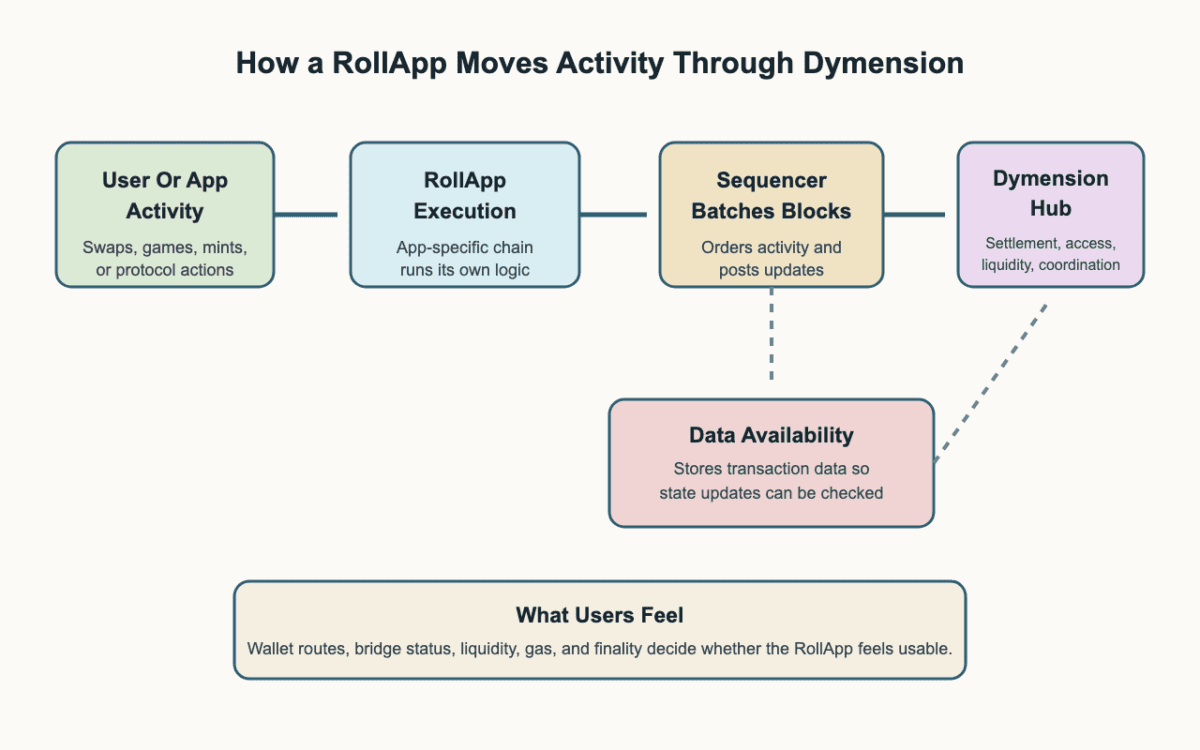
Then the sequencer orders transactions and batches blocks. It decides transaction order and helps move RollApp state forward. If the sequencer setup is fragile, centralized, or offline, users may feel that as delays, failed transactions, or stale app activity.
Dymension Hub is the shared coordination layer. It helps with settlement, access, liquidity, and communication between RollApps and the wider crypto stack. Data availability sits beside that flow, because transaction data must be stored somewhere users and verifiers can check.
The stack is easier to read in layers:
This is why RollApps are often described through modular crypto language. Different jobs sit in different places. That can lower launch friction for builders, but users still have to check more than one layer when something breaks.
For a normal user, the important part is the money path. Which wallet connects? Which asset pays gas? Which route moves funds in or out? Which token lands on the other side? The architecture only helps when those answers are clear.
RollApp, rollup, and appchain are related terms, but they are not identical. The confusion is fair. All three can involve a chain-like environment built for an app, lower costs, or more control than a crowded base chain.
The difference is where the system settles, how much shared infrastructure it uses, and which technical stack defines the model. A RollApp is Dymension’s term. A rollup is a broader scaling design. An appchain is the broadest label for a chain built around one app or project.
| Term | What to Understand |
|---|---|
| RollApp | Dymension’s app-specific chain model, often tied to token-to-chain launches and Dymension Hub coordination. |
| Rollup | A scaling network that executes transactions elsewhere and settles proofs, data, or commitments back to a base layer. |
| Appchain | A chain built for one app, protocol, or community, with more freedom but more operating responsibility. |
| Normal dApp | An app running on an existing general-purpose chain without its own chain environment. |
The user impact is straightforward. A rollup question often leads to proof systems, withdrawal timing, and base-layer security. An appchain question leads to validator sets, sovereignty, and chain operations. A RollApp question leads to Dymension, token launches, sequencers, wallet setup, liquidity, and bridge routes.
That does not make one label better. It makes the check different. If someone pitches a RollApp as “just like a rollup,” ask what Dymension handles, what the RollApp handles, and what users must do themselves. Every RollApp can be app-specific, but not every app-specific chain is a RollApp.
Dymension uses RollApps because a single shared chain is not always the best home for every app. Some projects want their own execution environment, token model, and launch path while still relying on shared settlement and user access. That is the chain-launchpad pitch: start with a token, bootstrap attention and liquidity, then aim to graduate into a fuller chain without building every chain component from scratch.
RollApps also fit the broader modular meta in crypto. Instead of one chain doing every job, the work gets split across execution, settlement, data availability, and interoperability. The upside is specialization. The downside is more places where users need clear routes and reliable status.
Dymension’s model tries to solve several builder problems at once:
But launch ease is not adoption. A RollApp still needs users, useful activity, visible liquidity, supported wallets, working bridges, and builders who keep shipping after the first wave of attention fades.
Users should stay grounded here. Dymension may make the chain lane easier to create. It cannot make every RollApp useful, liquid, safe, or fairly priced by default.
RollApp tokens matter because Dymension’s model can let a project trade before the full chain is mature. That can create early liquidity and price discovery. It can also create confusion, because a tradable token is not the same thing as a healthy live RollApp.
An Initial RollApp Offering, or IRO, is the launch mechanism tied to that token-before-chain idea. At a high level, it lets a project bootstrap liquidity and market interest before the RollApp reaches its fuller chain stage. The token may later connect to the live RollApp, but users still need to verify the terms.
The split is simple:
| Token Stage | What to Check |
|---|---|
| Pre-launch RollApp token | IRO terms, bonding curve design, liquidity depth, conversion terms, release schedule, and whether the chain is actually live. |
| Live RollApp token | Gas role, app utility, bridge support, exchange access, liquidity depth, sequencer or staking role, and real user activity. |
Bonding curves deserve a calm read. A curve can set token pricing as demand changes, but it does not guarantee fair exits. If liquidity is thin, a small sell can move price hard. If early buyers, creators, or airdrop farmers can exit into public demand, late buyers can become exit liquidity before they understand the chain.
That does not make IROs bad. It means they are launch markets, not safety stamps. The project still needs a live product, working routes, clear token rules, and enough demand after the launch excitement cools.
Do not stop at “does the RollApp have a token?” Ask what the token does after launch. A token can trade well on pre-launch hype and still leave users with weak utility, weak liquidity, or a route nobody wants to use.
Before buying a RollApp token, separate three things:
RollApps can matter for DYM holders because they may create more activity around Dymension Hub, staking, incentives, sequencer operations, and token launches. But “may” is doing real work there. A RollApp is not a guaranteed airdrop machine or a guaranteed demand engine for DYM.
DYM can show up in several places. It may be used around staking, network fees, hub activity, governance, sequencer-related roles, or project incentives. Some RollApp teams may also choose to reward DYM stakers, but that is a project decision, not a standing rule users should assume.
DYM holders should check these items before building expectations:
The airdrop angle is the easiest one to overprice. A forum post, social rumor, or old community thread is not enough. If the RollApp team has not published eligibility rules through official channels, assume there is no guarantee.
The same applies to value capture. More RollApps can mean more chances for activity, but activity needs users. A RollApp with no usage does not magically help DYM holders because the label exists.
RollApps are possible demand paths. Each path still needs proof. Fees, staking, incentives, bridge usage, sequencer economics, and token demand all need actual activity behind them.
Wallet and bridge setup is where RollApp theory meets user pain. You can understand the concept perfectly and still get stuck if you use the wrong network, send to an unsupported deposit path, forget gas, or rely on a bridge route that is not live.
RollApps can involve Cosmos-style routes, Dymension Portal flows, IBC paths, Keplr, MetaMask, or EVM-style networks depending on the app. That mix is powerful, but wallets can show balances, networks, and token versions differently.
Before moving funds, use a basic wallet setup check rather than trusting the first button that appears. Confirm the network name, token version, gas asset, bridge route, destination address, and whether the destination supports deposits from that route.
The common failure points are boring, which is exactly why they bite:
Funds can feel stuck even when they are not lost. A transfer may wait on a relayer, require a claim step, need gas on another network, or land as a token version your wallet does not display by default. Annoying, yes. Catastrophic, not always.
Still, test routes before size. Send a small amount first, confirm the asset lands, confirm you can move it again, then decide whether the full route deserves more trust. The chain-launchpad pitch is not a substitute for a test transaction.
The main RollApp risks come from liquidity, operations, wallet routes, project activity, and token expectations. None of these are unique to Dymension. A RollApp token may trade before the chain has enough users or demand, which can make price look active while exits remain thin.
Operational risk comes next. A RollApp needs reliable sequencing, current docs, working routes, visible status, and a team that keeps maintaining the app. If activity fades after launch, the result can look like a slow bleed rather than a dramatic rug. That slow-fade pattern is close to soft rug risk: weaker delivery, thinner liquidity, and users left holding a story with less support.
Watch for these risk signals:
Security risk also sits in the stack. Smart contracts can fail. Sequencers can go down. Bridge routes can stall. Data availability assumptions can change. Slippage is not a side detail either. It is the bill that arrives when everyone reaches for the same door.
The right stance is neutral, not cynical. A RollApp can be useful infrastructure. It can also be a thin token launch with better vocabulary. Learn the difference before the market asks you to pay for it.
Check a RollApp by proving that the project is live, usable, liquid, and officially supported before you move meaningful funds. You do not need to become a protocol engineer. You need to avoid obvious mistakes, starting with status.
Is the RollApp live on mainnet, testnet-only, in IRO, or just announced? A live token is not enough. You want a live app, working explorer, current docs, visible bridge route, and a wallet path ordinary users can repeat.
Then check the money route. Find the exact asset, network, gas token, bridge route, and destination. If you cannot explain how funds enter and leave, you are not ready to size up.
Use this checklist before using a RollApp:
Project activity matters too. Recent commits, updates, governance posts, support answers, and route fixes are useful signals. Empty channels and recycled launch posts are not. Crypto projects do not need to tweet hourly, but silence plus technical friction deserves caution.
Finally, check whether the RollApp has a reason to exist. If the app could run fine as a normal dApp, ask what the RollApp model improves. Better execution, custom fees, dedicated throughput, app-specific logic, or stronger routing can be real answers. “Because launchpad” is not enough.
RollApps sit in a cluster of modular-chain ideas. You do not need to master all of them, but the basic vocabulary helps you read a RollApp pitch without getting buried under infrastructure terms.
The core terms are modular blockchain, rollup, appchain, data availability, sequencer, IBC, and Dymension Hub. Together, they explain why a RollApp has more moving parts than a normal dApp. Execution happens in one place, settlement and coordination lean on Dymension, and data still needs to be available for verification.
Two risk terms are useful when the token story gets louder than the product:
The key distinction is control versus convenience. A RollApp can give a project more control over its own chain environment. In return, users must check more app-specific details than they would with a mature general-purpose chain.
That is the trade. More custom space can mean better fit. It can also create more places to make a mistake.
A RollApp is an app-specific blockchain model tied to Dymension. It focuses execution around one app or project while Dymension helps with settlement, access, liquidity, and cross-chain coordination. For users, the practical meaning is that each RollApp can have its own token, wallet route, bridge path, and risk profile.
No. A RollApp can share ideas with rollups, but the term is Dymension-specific. A rollup is a broader scaling design that settles data, proofs, or commitments back to a base chain. A RollApp is Dymension’s app-specific chain model, with token-to-chain launch mechanics and Dymension Hub coordination.
RollApp is Dymension’s branded term, so the precise meaning belongs to Dymension. Other projects may use appchains, rollups, sovereign rollups, or modular chains for similar ideas. If a project uses RollApp language outside Dymension, check whether it means the Dymension model or a looser marketing label.
Many RollApps can have their own tokens, and Dymension’s model supports token-first launches through mechanisms such as IROs. But a RollApp token should not be read as proof that the chain is mature. Check whether the RollApp is live, what the token does, and whether liquidity is deep enough to exit.
An Initial RollApp Offering is a RollApp launch mechanism where a token can begin trading before the full chain stage is complete. It can help bootstrap liquidity and attention. It can also create early pricing risk, slippage, and expectation gaps if buyers assume the token already represents a healthy live RollApp.
Funds can feel stuck if a bridge route is delayed, a relayer is slow, gas is missing, the destination wallet does not show the token, or the user picked the wrong network. That does not always mean permanent loss, but it is enough reason to test small transfers first and keep transaction records.
Start with the concept, then move to the route. A RollApp is not hard to define, but it can be hard to use safely if the wallet, bridge, token, and live status are unclear.
The order matters. If you begin with the token chart, every warning looks like friction. If you begin with live status, route support, gas, and liquidity, the chart becomes one input instead of the whole decision.
Use these steps before you touch a RollApp with meaningful funds:
After that, run a small rehearsal. Connect the intended wallet, confirm the gas asset, check the entry route, and make sure there is a way back out. Save transaction hashes and route records before you need them.
Then ask the simplest question: what does this RollApp make easier for real users? If the answer is clear, the next check is execution. If the answer is mostly token hype, keep your wallet bored. Bored wallets tend to survive longer.
That stance is not anti-RollApp. It is basic survival math. New chain paths can be useful, but they ask users to verify more details. Let the project earn trust with live routes, clear token rules, and steady activity before you send meaningful funds.