Physical Address
304 North Cardinal St.
Dorchester Center, MA 02124
Physical Address
304 North Cardinal St.
Dorchester Center, MA 02124


Understand a rollup bridge before moving funds across L2s.
A rollup bridge is a set of contracts and messages that moves assets or data between Ethereum and a rollup, or between rollups.
That bridge is the doorway into cheaper Layer 2 activity. It is also where wait times, token versions, liquidity gaps, and user errors show up. If Ethereum mainnet is the settlement layer, a rollup bridge is how your wallet enters and exits the cheaper neighborhood without pretending every route is equally safe.
A rollup bridge in crypto is the route that lets funds or messages move between Ethereum and a Layer 2 rollup. It connects the base chain, where settlement happens, with a rollup such as Arbitrum, OP Mainnet, Base, Scroll, zkSync, or Starknet.
The word “bridge” can hide several different jobs. A rollup bridge can handle a deposit from Ethereum to a rollup. It can process a withdrawal back to Ethereum. It can also carry a message that tells a contract on one chain what happened on another chain.
The simple user version is this:
For example, you might move ETH from Ethereum mainnet to a rollup so you can use cheaper swaps or lending apps. The ETH does not fly across the internet in a tiny armored truck. The bridge records the source-side action and creates or releases the matching result on the rollup.
That result may be native ETH on the rollup, a bridged token representation, or another token version with its own contract address. This is why two assets can share the same ticker while behaving differently in wallets, exchanges, and apps.
The main labels answer different route questions:
So the real question is not only “Can this bridge move my funds?” It is also “Which route, token version, and wait time am I accepting?”
A rollup bridge moves assets and messages by coordinating records across chains. One side records the source action, then the other side mints, releases, burns, or executes the matching action.
Most rollup bridge flows use a few shared pieces. There is a bridge contract on Ethereum. There is a bridge or gateway on the rollup. There is a message path between them. And there is a proof or verification process that tells the destination side the source-side action is real.
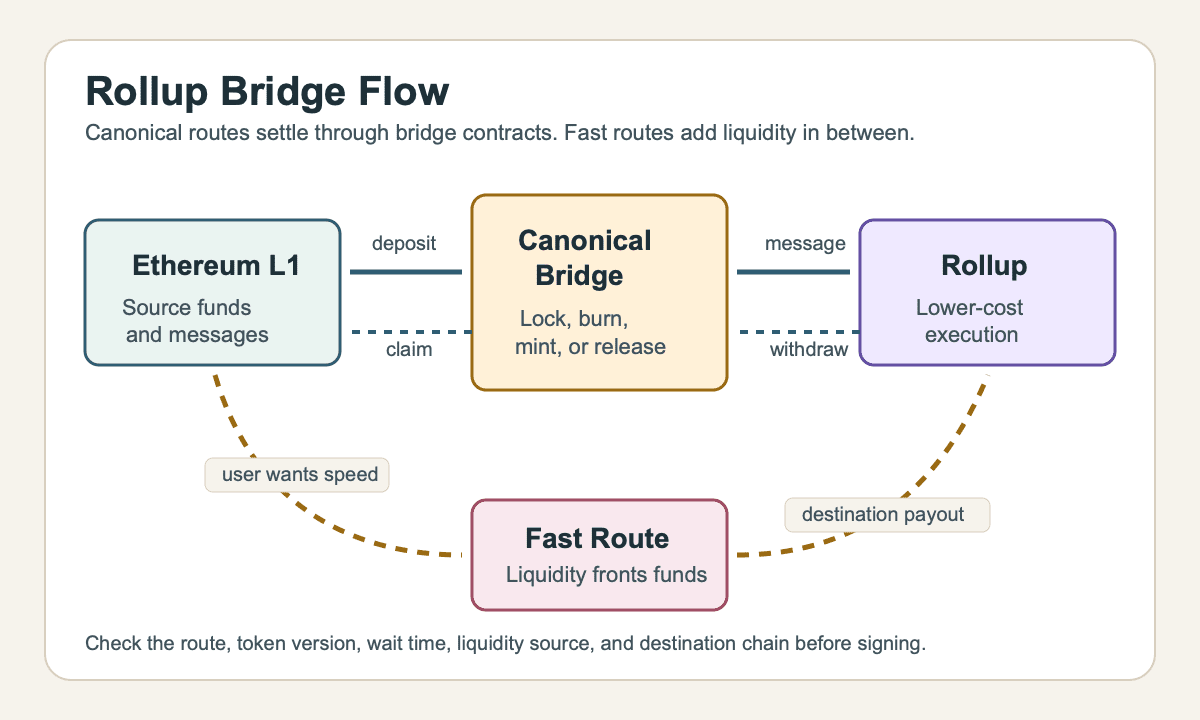
For a basic deposit, the common flow looks like this:
Withdrawals can reverse that process. A bridged representation may be burned on the rollup, then the original asset may be released on Ethereum after the exit process finishes.
Messages matter because bridges are not only token pipes. A rollup bridge can also carry instructions between contracts. That is how a rollup app may prove a withdrawal, finalize a claim, or tell Ethereum that a rollup-side event happened.
Two details decide much of the timing:
An optimistic rollup assumes transactions are valid unless challenged, so exits may wait through a dispute window. A ZK rollup relies on validity proofs, so the exit path depends on proof generation and verification instead.
For users, the lesson is plain. A rollup bridge transfer is a chain-to-chain accounting process. The interface may look like one button, but the risk lives in the route underneath.
A native rollup bridge and a fast rollup bridge can both get value to another chain, but they solve different problems. The native route focuses on the rollup’s official settlement path. The fast route focuses on reducing the user’s visible wait.
That tradeoff is where many bridge mistakes start. Users see a faster estimate and assume it is simply a better version of the same bridge. Usually, it is a different route with different assumptions.
Here is the clean comparison:
| Route Type | What It Means and When It Fits |
|---|---|
| Native or canonical rollup bridge | The official route tied to the rollup’s bridge contracts and settlement path. It can fit larger or patient transfers where token representation and final withdrawal clarity matter more than speed. |
| Fast rollup bridge | A liquidity-based or third-party route that may pay you on the destination chain before slower settlement completes. It can fit smaller or urgent moves when the quote, route, and liquidity source are clear. |
| Bridge aggregator | A route finder that compares bridge paths, swaps, fees, and wait times. It helps with discovery, but the chosen route still carries its own contracts, liquidity, and failure path. |
| Exchange withdrawal to L2 | A custodial route where an exchange sends funds directly to a supported rollup. It can be simple for onboarding, but it adds account limits, withdrawal policy, and custody risk. |
The native rollup bridge is often the cleaner route for knowing what token version should land. It is also the route most closely tied to the rollup’s own message system. That does not make it instant or risk-free. It only tells you which trust path you are using.
A fast rollup bridge can be reasonable when timing matters. The route may use a liquidity provider that sends funds on the destination side, then gets reimbursed later. In plain English, someone else is taking the slow bridge wait so you do not have to.
That convenience has a price. Fees may be higher. Liquidity can run thin. Some assets may not be supported. A route can fail, refund, or deliver a token version you did not expect if you click through too quickly.
Use this split as a routing check:
And never let a polished progress bar do your risk thinking for you.
Rollup bridge withdrawals can take longer than deposits because the return path may need stronger proof before Ethereum releases funds. The delay is most famous on optimistic rollups, where withdrawals can wait through a challenge period.
Deposits often feel faster because Ethereum can send a message into the rollup. The rollup can then credit the destination side once the deposit message is processed. Withdrawals move in the harder direction. Ethereum needs confidence that the rollup-side withdrawal is valid before assets are released on mainnet.
On OP Stack chains, the Optimism Standard Bridge gives a useful official example: Ethereum-to-OP Mainnet transfers usually complete within 1-3 minutes, while OP Mainnet-to-Ethereum transfers complete in seven days because of the withdrawal challenge period.
That seven-day example does not apply to every rollup bridge. It is an optimistic rollup pattern, not a universal bridge law. Arbitrum has similar optimistic withdrawal dynamics. ZK rollups use validity proofs, so their exit timing depends on proof production, verification, and the network’s own bridge design.
Fast exits work differently. A fast bridge may give you destination-side funds quickly because another party fronts liquidity. Behind the scenes, that party still needs to settle, rebalance, or get reimbursed later.
Before withdrawing, check the parts that change your next move:
A slow route is manageable when you know it in advance. A slow route discovered after signing is where the problem gets expensive.
Cross-rollup bridge routes move assets or messages between rollups, rather than only between Ethereum and one rollup. They exist because Layer 2 growth has split users, apps, and liquidity across many networks.
This is the part that feels silly the first time you meet it. You may have ETH on Arbitrum, USDC on Base, a lending position on OP Mainnet, and the app you want on Scroll. All of it is “Ethereum-adjacent,” but your wallet still has separate balances on separate chains.
Rollup bridges usually start with a hub-and-spoke pattern:
Cross-rollup routes try to shorten that path. They may use bridge aggregators, liquidity networks, intent systems, or app-specific messaging. Some routes also combine a bridge and a swap, so the asset you send is not always the asset you receive.
A cross-rollup quote should make three things plain:
Active traders feel this during market rotations. If capital moves from one chain or sector to another, waiting through a full exit to Ethereum can change the trade. A cross-rollup route can be useful, but the speed still depends on route depth, token support, and the bridge design.
There is also a simpler option. Some exchanges let users withdraw directly to a supported rollup. That can reduce steps when onboarding from cash or a centralized venue. But it is not the same as understanding the bridge route, and it will not help if the exchange does not support your exact destination chain or token.
L2 fragmentation is not only a nuisance. It changes how you manage balances. A good route can move funds where they are useful. A bad route can strand funds on a chain where the app, gas token, or token version is wrong.
Rollup bridge safety is not a yes-or-no label. A rollup bridge can inherit strong security from Ethereum and still expose users to contract bugs, admin changes, liquidity problems, phishing, and wrong-token mistakes.
The phrase “secured by Ethereum” needs care. A rollup may settle to Ethereum, but the bridge route can still include upgrade keys, sequencer assumptions, proof delays, token wrappers, relayers, or third-party liquidity. That is a lot of plumbing for one friendly button.
The main risk buckets are worth separating:
Liquidity risk deserves its own note. A fast bridge may depend on a liquidity provider having enough funds on the destination side. That is route liquidity, not the same thing as exit liquidity in trading slang. Both involve the other side of a transaction, but bridge liquidity is operational and exit liquidity is market-side.
Token representation is the quiet hazard. A wallet may show ETH, USDC, or another familiar ticker, while the contract address points to a bridged version. Some apps support that version. Others do not. The wrong version can turn a normal transfer into a support problem that is hard to unwind.
Canonical routes are not immune. They can still have long waits, claim steps, paused withdrawals, or smart contract risk. Fast routes are not automatically reckless either. Some are battle-tested and useful for smaller moves. The point is to know which assumptions you accept.
For larger balances, slow down and run the boring checks:
Anything that would ruin your day deserves a slower click.
Use a rollup bridge when the destination rollup gives you a clear benefit: lower fees, access to a specific app, better execution, or a supported withdrawal path. Do not bridge just because a route exists.
Small active balances are the cleanest use case. If you want to swap, lend, mint, vote, or use an app on a rollup, bridging can make sense. A cheaper chain can turn a costly Ethereum transaction into a normal wallet action.
Common scenarios include:
A DeFi farm is one reason users bridge to rollups. The app may run on a cheaper L2, and the gas savings can matter for deposits, claims, rebalances, and exits. Still, the bridge route is part of the cost, not a side quest.
Use this rough split before signing:
The quoted fee alone is not enough. The final received amount, token version, and exit path matter more.
An exchange withdrawal to L2 can be simplest when you are starting from a centralized account. It is not better or worse by default. It is a custodial route with its own limits, supported networks, and withdrawal policies.
Keep funds on mainnet when you do not need rollup activity, when the route is unclear, or when the bridge wait would create more risk than the fee savings are worth.
A rollup bridge checklist should catch the obvious mistakes before the transaction is signed. The goal is not to make bridging scary. The goal is to make the route visible.
Start with the source. Open the bridge from the rollup project’s official site or documentation, not from a random search result or social post. Fake bridge pages exist because bridge users are already in signing mode.
Run these checks before moving funds:
Good wallet setup helps here. You want a wallet where network switching, token approvals, transaction history, and contract prompts are clear enough that you can spot a wrong-chain mistake before it costs money.
Test transfers also help. Send a small amount first, then confirm it arrives as the correct token on the correct chain. That small test can leave crypto dust across networks, but dust is cheaper than discovering the wrong bridge route with your full balance.
After the transfer, do two follow-up checks:
Rollup bridge terms help you decode wallet screens, route summaries, and risk dashboards before you sign. The same transfer can be described with different labels depending on the network, token, and app.
Start with the label attached to the route. It usually tells you whether you are using the rollup’s own settlement path, a faster liquidity route, or a tool that found a route for you.
These terms come up most often:
These terms are useful because they point to different risk questions. “Canonical” points to route authority. “Fast” points to liquidity and provider risk. “Bridged token” points to the exact asset contract.
When a bridge interface hides these details, inspect the route summary before signing. The label is not decoration. It tells you what can slow down, break, or require an extra transaction later.
If the route summary only shows speed and fees, look for the missing pieces. You still need the destination chain, the token contract, the withdrawal path, and whether a third party is fronting liquidity. Those details decide what happens if the transfer stalls.
A rollup bridge is used to move assets or messages between Ethereum and a rollup, or between rollups. Users commonly use one to reach cheaper L2 apps, withdraw back to mainnet, move capital between rollups, or send a contract message across chains.
The exact use depends on the route. A native bridge may fit a patient deposit or withdrawal. A fast bridge may fit a smaller time-sensitive transfer.
A rollup bridge is a type of blockchain bridge, but it is more specific. It connects Ethereum and rollups, or connects rollups through routes designed around L2 settlement, messages, and token representations.
A general blockchain bridge may connect unrelated L1s, sidechains, appchains, or other networks. The risk model can be very different, so do not assume every bridge works like a rollup bridge.
A native rollup bridge can be safer for some transfers because it usually follows the rollup’s official bridge contracts and token mapping. That can make the route clearer for larger or patient moves.
But safer is not automatic. A native route can still have contract, upgrade, delay, or user-error risk. A fast bridge adds liquidity and provider assumptions, so it needs extra checks around route depth, token version, quote, and refund path.
Some optimistic rollup bridge withdrawals take seven days because Ethereum needs time for invalid withdrawal claims to be challenged. That waiting period is part of the optimistic design, not just a slow website.
The exact wait depends on the rollup and route. A fast bridge can shorten the user-facing wait by using liquidity, but that adds a separate route and provider risk.
Yes, a rollup bridge can be hacked or exploited if a bridge contract, token contract, message path, admin control, or related route has a serious weakness. Rollup bridges reduce some risks compared with weaker cross-chain designs, but they do not remove all bridge risk.
Users can reduce personal risk by verifying URLs, testing small transfers, checking token contracts, limiting approvals, and avoiding unfamiliar routes for large balances.
Using the wrong rollup bridge can send funds to the wrong chain, create an unsupported token version, trigger a long withdrawal path, or leave you waiting for a route that has poor liquidity. Sometimes funds are recoverable. Sometimes recovery depends on the wallet, bridge, exchange, or token issuer.
Stop before trying a second rushed fix. Save transaction hashes, confirm the destination chain and token contract, then use the official support path for the bridge or wallet involved.
Start with the route, not the button. A rollup bridge is only as useful as the source chain, destination chain, token version, wait time, and liquidity path behind it.
For a first transfer, keep the process boring. That means fewer assumptions, smaller amounts, and a route you can explain before your wallet opens the signing screen:
Choose a native bridge when you can wait and want the clearest settlement path. That is often the cleaner choice for larger transfers, withdrawals back to Ethereum, or any move where the exact token version matters more than speed.
Choose a fast bridge only when speed matters enough to justify the extra route checks. It can be a practical tool for smaller active balances, but the quote should show the route, received amount, token, and refund path clearly.
The best rollup bridge choice is rarely the flashiest route. It is the route you can explain before signing: where funds start, where they land, what backs the token, how long it can take, and what happens if the path stalls.
If any of those answers are fuzzy, pause. The fee you save is not worth much if the asset lands on the wrong rollup, arrives as an unsupported version, or needs a withdrawal path you did not plan for.


