Physical Address
304 North Cardinal St.
Dorchester Center, MA 02124
Physical Address
304 North Cardinal St.
Dorchester Center, MA 02124

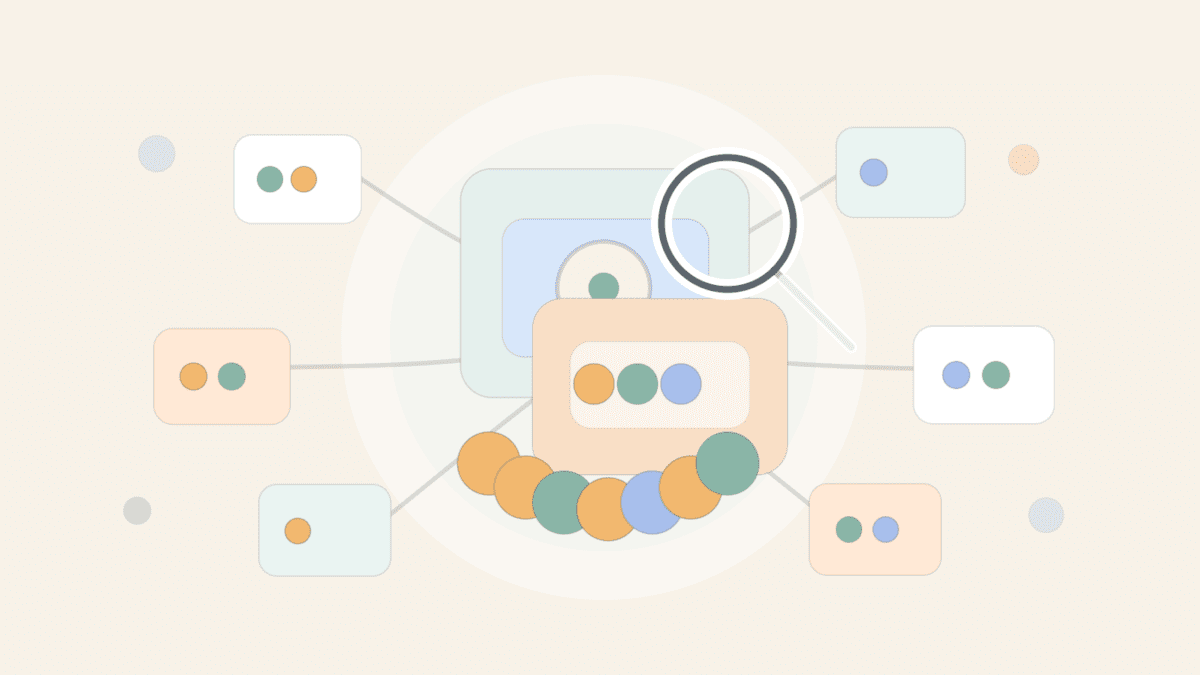
Holder concentration shows who may control supply before you buy.
Holder concentration is the share of a crypto token’s supply or voting power controlled by a small group of wallets or entities.
The number is only the start. The real risk is what those holders can do with it: sell into thin demand, shape governance votes, hide related wallets, or make a token look safer than it is.
Holder concentration in crypto means a large part of a token’s supply sits with a small number of wallets or owners. It is one of the simplest tokenomics checks because it asks a blunt question: who can move this market if they sell, vote, or transfer?
The hard part: blockchains show wallets, not always people. Before reading the raw list, keep three caveats in view:
A simple example helps. Imagine a token has 100 million units:
That token has 42 percent of supply in the top five wallets. That does not prove a scam. It does mean the top five deserve labels before you trust the chart.
Supply concentration can also differ from voting concentration. Some tokens give votes to staked balances, delegated balances, or governance contracts, so the normal holder screen may not show who can actually steer a vote.
Check how the token handles votes. If token balances vote directly, the holder list is closer to the governance map. If delegation, staking, or multisig rules sit between balances and votes, you need that second layer before making a clean call.
So holder concentration is best read as a control signal. It tells you where to look next, not what verdict to copy into a group chat with seven alarm emojis.
Holder concentration creates risk when large holders can change the market faster than ordinary buyers can react. A top wallet with a big balance can sell, move tokens to an exchange, vote through a proposal, or scare the market just by becoming active.
The risk gets sharper in small tokens. A whale in a deep market may sell without wrecking the chart. A whale in a thin pool can push price down hard because there are not enough buyers, or enough pool liquidity, to absorb the sale.
The main risk types are easy to separate:
Confidence risk is real too. Markets price stories as much as spreadsheets. If users believe insiders control too much supply, they may stop buying, cut size, or skip the trade.
That does not make every whale a villain. Some large wallets are exchanges, custody accounts, treasuries, vesting contracts, bridges, or long-term holders. First ask what kind of wallet it is. Then ask what it can actually do.
Holder concentration and holder count answer different questions. Holder count tells you how many wallets or token accounts hold at least some amount. Holder concentration tells you how much supply the biggest wallets control.
That distinction changes the read because a token can have thousands of holders and still be controlled by a small group. Dust wallets, airdrop farming, bot wallets, and split insider wallets can inflate the count while the real supply sits near the top.
Address count adds one more wrinkle:
The basic contrast is simple:
| Metric | What It Actually Tells You |
|---|---|
| Holder count | How many wallets or token accounts currently hold the token. |
| Holder concentration | How much supply the largest wallets or entities may control. |
| Top 10 holders | A quick view of visible supply concentration, before labels. |
| Holder distribution | The shape of balances across small, medium, and large holders. |
| Entity ownership | An estimate of who controls wallets, after labels and clustering. |
A clean holder count can still hide ugly ownership. Ten thousand wallets sounds broad. It is not broad if the top ten hold most tradable supply and the rest hold tiny dust.
The fix is simple: read counts and balances together, then look for wallet relationships. A broad holder base with organic balances feels different from a spreadsheet of fresh wallets funded by the same source.
Balance quality is the missing piece. A token with 20,000 holders where most wallets own dust can still be fragile, while a token with fewer holders but clear vesting, deep liquidity, and disclosed treasury controls may be easier to interpret.
So do not celebrate holder count by itself. It is a participation clue. Holder concentration is the control clue.
High holder concentration means different things across token types. A new memecoin, a governance token, a stablecoin, and Bitcoin can all show concentrated wallets, but the risk is not the same.
The key is to ask what the large wallet represents: a sellable whale, a public treasury, a liquidity pool, a custody address, a locked contract, or a known infrastructure wallet.
Here is how the same signal can change by context:
| Scenario | How To Read The Concentration |
|---|---|
| New memecoin | High top-wallet supply can mean insider control, bundled buys, or a thin exit. |
| DAO governance token | Concentration may affect voting power, proposal outcomes, and treasury control. |
| DeFi protocol token | Team, investor, emissions, and staking wallets need separate labels. |
| Stablecoin or wrapped asset | Large wallets may be bridges, issuers, pools, or exchange custody. |
| Bitcoin | Address concentration does not equal human ownership because custodians and lost coins distort the view. |
| Project treasury | A large balance can be normal if disclosed, governed, and not freely dumpable. |
This is why a single screenshot can mislead. A top wallet holding tokens for exchange customers is not the same as a founder wallet waiting to sell. A burn wallet cannot dump. A bridge wallet may hold large balances because users moved assets across chains.
Large-cap assets also need a calmer read. Bitcoin concentration claims often confuse addresses with owners because a wallet is only a visible container. Ownership can sit behind exchanges, custodians, funds, or old addresses nobody can move.
Small tokens deserve less patience. If a new token has high concentration, thin liquidity, unclear labels, and active top-wallet transfers, the burden of proof rises quickly.
You check holder concentration by starting with the official contract or mint address, then reading holders on a block explorer or token tool before you swap. Avoid starting from a random chart link. The wrong contract makes every later check theater.
For Ethereum and BNB Chain tokens, that often means Etherscan or BscScan. For Solana, it may mean Solscan plus a market tool or risk scanner. A recent DEXTools holder-distribution workflow is useful because it pairs the holder list with visual checks instead of treating one percentage as the whole answer.
Use this sequence before you give the token your money:
This workflow counts most in fast small-token markets. In trench trading, a few minutes can separate a fair launch from a chart built for someone else’s exit. Top-holder checks help you spot obvious problems before the crowd starts chanting.
Holder concentration also belongs beside rug checks. A hard rug usually needs more than a high top-holder number, but concentration can show who has the supply, access, or liquidity position to extract value fast.
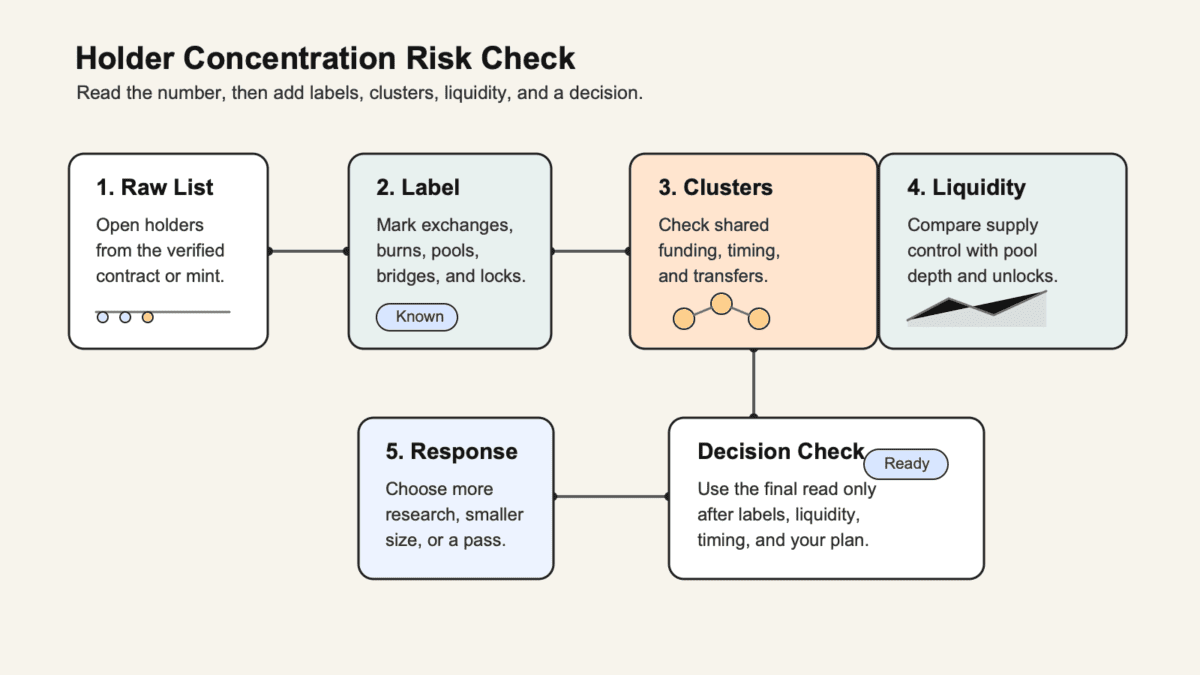
_A useful holder concentration check moves from raw balances to labels, clusters, liquidity, and action._
No tool sees everything. Labels can be stale, maps can overstate relationships, and off-chain ownership may remain hidden. Use the workflow to reduce obvious risk, not to certify safety.
The first job is labeling, not panicking. Raw holder concentration can look terrifying until you separate active market wallets from contracts, custody accounts, and dead addresses.
Start with the biggest wallets, then ask what each one is likely to be. A labeled wallet is not automatically safe, but it changes the question.
Common wallet labels deserve different treatment:
The order matters. Label the obvious wallets first, then recalculate the real question in your head. If the top address is a burn wallet and the second is a pool, the scary headline percentage may shrink. If the top address is unlabeled and recently received supply from the deployer, the risk gets louder.
Custody labels can be messy. If exchange custody versus self-custody is the confusing part, start with wallets basics. The holder list still needs chain-specific labels and context.
Two labels deserve extra care:
When labels are missing, leave the result unresolved. Unknown is not the same as dangerous. It is also not the same as safe.
If a token depends on “trust me” explanations for every large holder, step back. Clean projects usually make treasury, vesting, pool, and team wallets easier to explain, even if not every label is perfect.
Hidden holder concentration happens when related wallets split supply so the holder list looks cleaner than it really is. The top 10 may look acceptable while the top 40 quietly share funding, timing, transfer paths, or launch behavior.
This is common in small-token markets because visible concentration scares buyers. A group can spread tokens across fresh wallets, buy in the same early window, or use bundled launch transactions to make ownership look wider.
Picture a token where no single wallet holds more than 3 percent. That sounds calm until 18 wallets appear to share funding, buy seconds apart, and send tokens through the same routes. The visible list says “many holders.” The cluster says “maybe one group.”
Cluster tools can help, but they are not court records. Shared funding can mean coordination, a trading bot, a launchpad route, or users moving through the same funding path.
The right response is a follow-up check:
This is where holder concentration overlaps with soft rug risk. Slow insider selling, abandoned communication, and related-wallet control can hurt buyers without one dramatic drain.
The useful habit is restraint. A cluster is a risk signal, not proof. But if the cluster sits beside thin liquidity, vague team answers, and sudden wallet movement, you do not need a courtroom standard to step back.
Holder concentration becomes more dangerous when liquidity is thin. A top holder can only damage price through a sale if the market cannot absorb it, and small pools often cannot absorb much.
This is why a 15 percent wallet can mean different things in different markets. In a deep large-cap market, that balance may move slowly through OTC, custody, or exchange flows. In a tiny pool, one sell can turn the chart into a staircase with missing steps.
Pair concentration with these next checks:
| Signal | What To Check Next |
|---|---|
| Big top wallets | Are they labeled, active, locked, or moving toward exchanges? |
| Thin liquidity | How much sell size can the pool absorb before slippage gets ugly? |
| Locked liquidity | Who locked it, how long, and can other supply still dump? |
| Heavy recent volume | Is volume coming from real users or repeated bot-like churn? |
| Upcoming unlocks | How much supply becomes movable, and who receives it? |
| Governance control | Can large holders pass proposals or change key settings? |
This combination explains many ugly outcomes. Concentrated sellers do not need to sell everything. They only need enough size to overwhelm current demand and leave smaller holders facing bagholder risk.
Locked liquidity does not solve every problem. It may stop a pool pull, but it does not stop a large holder from selling into that pool. It also does not fix mint authority, freeze authority, vesting cliffs, or fake volume.
So read concentration as part of sellability. Ask who can sell, how much can be sold, where it can be sold, and how much demand exists on the other side.
There is no universal safe holder concentration percentage. A high number can be normal, risky, or meaningless depending on labels, token age, liquidity, vesting, governance rules, and how the supply got there.
For a new token, high concentration deserves more suspicion because the market has less history. For an older protocol, large treasury, staking, exchange, or bridge balances may be normal if they are disclosed and behave predictably.
Use clearer checks instead of a magic threshold:
Thresholds can still be useful as review triggers, not permission slips. A token can clear a neat top-holder line and still hide related wallets. A disclosed treasury or vesting contract can push the raw number higher without creating the same dump risk.
These checks also help you avoid false comfort. A top 10 number can look lower after insiders split wallets, or higher because a public pool, exchange, or burn address sits near the top.
Time changes the read too. Early concentration can improve as tokens distribute through trading, grants, rewards, or vesting releases. It can also get worse if early buyers consolidate supply or insiders keep feeding related wallets.
The answer can still be “pass.” You do not owe every token a full investigation. If concentration is high, labels are unclear, liquidity is thin, and the pitch relies on urgency, doing nothing may be the cheapest lesson.
Holder concentration mistakes usually come from overtrusting one screen. A holder tab is useful, but it is a snapshot, not a full ownership map.
New traders often make the same avoidable errors. Slow the read before acting.
Watch for these traps:
Another mistake is ignoring how the position fits your own plan. A concentration setup that is too risky for a long hold may still be visible to a short-term trader who sizes tiny and accepts the chance of a fast loss. That does not make the token safer. It changes the exposure.
Screenshots and tools can also blur the read:
When tools conflict, slow down instead of averaging them into a comforting answer. The boring habit works: confirm the contract, label obvious wallets, inspect clusters, check liquidity, and decide whether the risk fits the position.
No, high holder concentration is not always bad. It can reflect exchange custody, a burn wallet, a bridge, a treasury, a vesting contract, or a staking contract. It becomes more concerning when large wallets are unlabeled, active, related, or able to sell into thin liquidity.
To check holder concentration on Solana, start with the official mint address and open it in a Solana explorer such as Solscan. Review top holders, token accounts, creator activity, and recent transfers. Then compare the list with risk tools or wallet maps, especially for fresh tokens.
Yes, high holder concentration can let top holders crash a token when liquidity and demand are too weak to absorb their sales. The risk is higher when top wallets are unlabeled, recently active, moving tokens toward venues, or linked to the launch.
Holder concentration measures how much supply the biggest wallets or entities control. Whale wallets are individual large wallets. A token can have one obvious whale, several whales, or a hidden cluster that creates concentration without any single wallet looking huge.
Holder concentration does not automatically make Bitcoin centralized. Address-level concentration can be distorted by exchanges, custodians, old wallets, lost coins, and entities using multiple addresses. Bitcoin network control depends on more than wallet balances, though large holders can still affect market sentiment and liquidity.
You do not need to avoid every token with high holder concentration. You do need to investigate harder. Check wallet labels, transfer history, liquidity depth, vesting timing, governance power, and whether the top wallets appear related. If those checks stay unclear, passing is a valid decision.
Start with the contract, not the chart. A clean token symbol can point to the wrong asset, and a viral screenshot can hide the part of the holder list that actually matters.
Set a simple rule before you open the holder tab. You are not looking for a perfect token. You are looking for enough clarity to decide whether more research, smaller size, or a pass makes sense.
Then move through a short routine:
If one step fails hard, you do not have to finish the checklist. An unlabeled top wallet moving supply into a thin pool is enough to pause. A clean label set with deep liquidity may justify the next layer of research.
After that, decide what the risk deserves. More research is fine. Smaller size is fine. Walking away is also fine, and often cheaper than learning tokenomics through a red candle.
Holder concentration is not a magic scam detector. It is a practical question about control. Answer that question before you trust the next token story.