Physical Address
304 North Cardinal St.
Dorchester Center, MA 02124
Physical Address
304 North Cardinal St.
Dorchester Center, MA 02124


A plain-English guide to local tops, timeframe risk, and FOMO traps.
A local top is a temporary price peak on a chosen timeframe that can lead to a pullback without ending the larger trend.
Crypto traders use the phrase when a coin rallies hard, stalls, and starts to look tired. Sometimes it is serious chart talk. Sometimes it is a dry CT way of saying, “Nice, I bought the exact candle that punished me.” The joke is optional. The useful part is knowing when a local top points to real risk and when it is just noise with a louder username.
A local top in crypto is the point where price peaks relative to nearby candles, then cools off through a pullback, sideways chop, or failed breakout. The word “local” means the top belongs to a specific chart window, not the entire market cycle.
Context does most of the work. Bitcoin can form a local top on a four-hour chart while the daily trend still points higher. A meme coin can form one after a vertical candle and fall hard because liquidity was thin. The same phrase covers both, but the risk is not the same.
That split shows up in three quick checks:
People also use local top as slang after a bad entry. If someone buys a green candle and price immediately reverses, the replies may say “local top confirmed.” That does not mean a professional signal appeared. It may just be the crowd turning pain into a meme before the chart finishes loading.
A local top also avoids a false choice. Price does not have to crash for the signal to matter. It may simply stop rising long enough for late buyers to feel trapped, short-term traders to take profit, and patient buyers to wait for a cleaner retest.
So the clean meaning is simple. A local top is a temporary high inside a larger price path. It can warn that buyers are tired, but it cannot prove the final high in advance.
A local top is a smaller peak inside a larger market. A cycle top is the major high of a broader bull phase. An all-time high is only a record price, and it may or may not become either kind of top.
That distinction saves users from overreacting to every top call. A coin can make a local top below its record high, bounce from support, and continue higher. It can also make a new all-time high, pull back for days, then break higher again. The label only becomes useful after you know the scale.
| Top Phrase | What It Means In Practice |
|---|---|
| Local top | A short-term or medium-term peak on a chosen timeframe. |
| Local high | A formal chart term for a nearby high over a lookback window. |
| Swing high | A tradable peak with lower highs around it on the chart. |
| Cycle top | The major high of a broader market cycle. |
| Blow-off top | A fast, euphoric final-looking surge that often reverses violently. |
| All-time high | The highest price the asset has ever traded at. |
The opposite setup helps too. A strong reversal after a decline may be discussed as a bottom signal, but bottoms and tops share the same trap: they are easier to label after price has already moved.
A local top also differs from a double top. A double top needs two failed pushes near the same area and a break below support to carry more weight. A local top can be one peak, one rejection, or one exhausted move inside a broader uptrend.
So when someone says “top,” ask for the missing noun. Local top, cycle top, blow-off top, and all-time high all point to different risks. Crypto slang loves compressing them into one dramatic word. Unpack it before your order screen gets involved.
Timeframe changes every local top call because “local” only means something inside a chart window. A top on a 15-minute chart may matter to a scalper and mean almost nothing to a long-term Bitcoin holder.
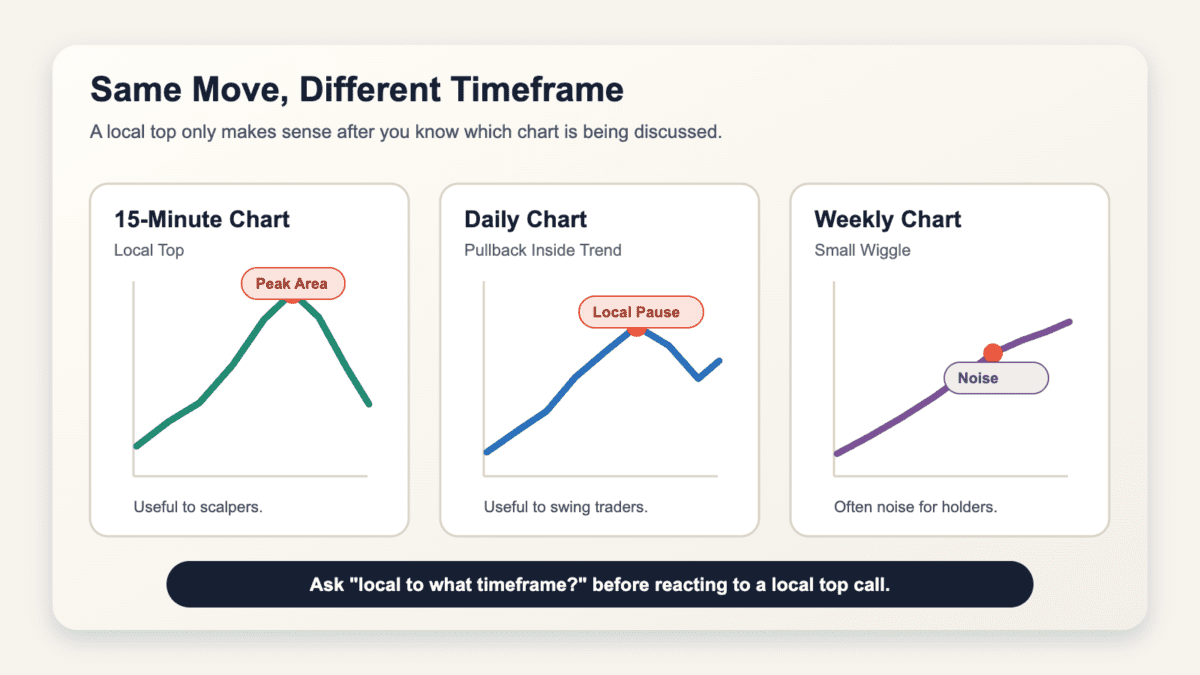
On a 15-minute chart, a local top might be the high of a fast intraday pump. A trader using tight stops may care because the next move could be a quick rejection. The same move on the daily chart may look like a normal pullback inside an uptrend.
On a weekly chart, that entire drama can shrink into one tiny wick. A holder who bought Bitcoin for a multi-year thesis should not react to every short-timeframe local top as if the market sent a courtroom summons.
Timeframe also changes the evidence needed. A lower-timeframe top can form with one failed breakout and a weak bounce. A daily or weekly local top usually needs more confirmation: resistance, volume change, momentum fade, and failed recovery attempts.
That is why screenshots without timeframe are weak evidence. A chart clipped to show only the last few candles can make any move look final. A wider chart may show that price is still above prior support, still making higher lows, or still inside a larger range.
Before acting on a local top call, ask three simple questions:
Those questions turn the phrase from social noise into a risk check. They will not call every high. They will stop you from taking someone else’s chart crop as your trading plan.
Common local top signs include rejection at resistance, weak follow-through after a volume spike, fading momentum, loud social FOMO, and crowded long positions. None is enough alone. Together, they can warn that the rally needs a cooldown.
A local top can be a top signal, but it is not a certified sell order. Signals are clues. They become more useful when several point in the same direction and price confirms them.
Price rejection at resistance means buyers pushed into a known area and failed to hold it. You may see a long upper wick, a fast return below the breakout level, or repeated closes under the same zone.
In crypto, this often happens after a coin runs into a prior high. Early buyers take profit. Late buyers chase the breakout. If price slips back below the level, the breakout crowd can become trapped.
The cleanest version is simple. Price breaks above resistance, pauses, then falls back below it with buyers unable to reclaim the level. That does not prove a local top by itself, but it marks a place where risk has changed.
A volume spike without follow-through can point to exhaustion. Price moves fast, volume surges, and everyone suddenly discovers the chart at the same time. Then the next candles fail to extend.
That pattern can mean buyers spent a lot of energy without gaining much ground. It can also mean sellers used the liquidity to exit into demand. In thinner altcoins, that exit can be messy because the order book may not have much depth below the pump.
Volume needs context. High volume during a breakout can be healthy if price holds the level and builds above it. High volume into a wick, followed by weak bounces, looks more like distribution or trapped late demand.
Momentum divergence appears when price makes a higher high while an indicator such as RSI makes a lower high. The chart is still printing a peak, but the push behind it is fading.
That clue is most useful after price fails to bounce strongly. A coin can diverge for a while and keep grinding upward, especially during aggressive bull phases. The warning gets sharper when price loses a level, bounces weakly, and then rolls over again.
Traditional trading education uses similar language around swing highs. IG International frames a swing high as a peak with lower highs around it, which maps neatly to how many traders identify local highs on crypto charts.
Social FOMO can mark a local top because attention often arrives late. When timelines fill with certainty, screenshots, and “last chance” energy, the easy part of the move may already be behind you.
Leverage can make that setup sharper. If open interest is crowded and funding is hot, a small drop can trigger forced exits. Then liquidations push price lower, stops trigger, and the move looks obvious only after it has already hurt people.
The lesson is to stack clues. A loud timeline plus resistance is not enough. A loud timeline, rejected breakout, weak follow-through, fading momentum, and crowded longs says more. Even then, crypto can still squeeze higher because tidy certainty has a short shelf life.
A local top means different things for different portfolios. A long-term holder may only need to avoid emotional buying, while a swing trader may need a clear invalidation level before staying in the trade.
For holders, the main risk is not missing the exact high. It is making a big portfolio change because one candle looked scary. Selling a long-term position after a local top call can create tax, fee, and re-entry problems. The exit may feel good for five minutes and awkward for the next green candle.
DCA buyers face a different problem. A local top can make a lump-sum buy feel badly timed, but a steady DCA plan is built to avoid betting everything on one entry. Pausing a plan every time social media gets nervous can turn a simple system into a mood ring with transaction fees.
Swing traders have less room to ignore the signal. If the trade was based on a breakout, and that breakout fails, the local top may invalidate the setup. The trader should already know where the idea is wrong before price gets there.
Leveraged traders need the least romance. A local top against a crowded long can turn into a liquidation cascade. Position size, stop placement, margin buffer, and funding costs belong in the plan before the trade, not in a panic after the wick.
Use the phrase by matching it to your role:
The fear underneath all of this is becoming a bagholder after buying a euphoric peak. That fear is real, but it does not make every local top a command to sell. It means your plan should not be written by the last candle.
Bitcoin local tops can affect altcoins by draining risk appetite, triggering leverage unwinds, or pushing attention into stronger large-cap names. The path is not automatic, and that is the whole annoyance.
When Bitcoin stalls after a strong move, some traders reduce risk across the board. That can hit altcoins harder because many have thinner liquidity, higher beta, and holders who arrived for quick upside. A small Bitcoin pullback can become a larger altcoin drawdown when everyone tries to exit the same crowded door.
But a Bitcoin local top can also create rotation. If Bitcoin pauses while the broader market stays confident, traders may look at Ethereum, Solana, or stronger alt sectors. ETH/BTC, Bitcoin dominance, and altcoin volume can help show whether risk is leaving crypto or rotating within it.
The low-quality end of the market usually has less patience. If a small-cap coin pumped on thin volume, a Bitcoin wobble can expose how little real demand was underneath it. Panic sellers in those moves often get called panic-selling jeets, but the slang should not hide the market structure. Weak liquidity makes exits ugly.
Altcoin holders should separate three scenarios:
None of those outcomes is guaranteed. Check whether altcoin strength is broad, liquid, and confirmed by volume, or just a handful of names floating on hype. A local top in Bitcoin is a warning to inspect risk, not proof that every alt has the same next candle.
Use a local top as a process, not a prediction. The goal is to identify where risk changes, what would confirm the idea, and what would prove it wrong.
Most local tops are recognized with lag. The exact high looks obvious after price rejects, bounces weakly, and breaks support. Before that, a top call is often just a guess wearing indicator glasses.
Start by defining the timeframe. A one-hour local top needs a different response than a weekly local top. Then mark the level where buyers failed. If price reclaims that level with strength, the local-top idea may be wrong.
Next, watch confirmation. Confirmation can mean a failed retest, lower high, support break, or weak bounce after a sharp drop. The more the chart confirms, the less weight you give one dramatic candle.
Then plan risk. A trader can size smaller, move a stop, take partial profit, or wait for a better setup. A holder may simply avoid adding a large lump sum into euphoria.
The process is easier when written before the move:
That last step prevents a common mistake. Users sell after fear, then buy back higher after relief. Or they buy into a euphoric candle and become exit liquidity for earlier holders who had their exit ready before the crowd arrived.
A local top call should slow you down. It should not make you outsource judgment to the loudest chart on your feed.
A local top sanity check helps you pause before FOMO or panic turns into a market order. The goal is not perfect timing. It is avoiding bad decisions made at maximum emotional temperature.
Start with the chart. Check whether price is at resistance, whether volume supports the move, and whether momentum is fading. Then check your own position. The same local top means one thing if a fast move can force you out and another if you are slowly buying spot over months.
| Check | What To Ask Before Acting |
|---|---|
| Timeframe | Is this local top on a chart that matches my plan? |
| Resistance | Did price reject a known level or just pause briefly? |
| Volume | Did high volume lead to progress or exhaustion? |
| Momentum | Are bounces getting weaker after the peak? |
| Leverage | Would a fast move force me out? |
| Re-entry | If I sell, what would make me buy again? |
The re-entry question deserves extra respect. Many users focus only on escape. Then price bounces, the plan disappears, and the same account that panic-sold starts chasing again.
Before buying, ask whether you are paying for confirmation or excitement. A breakout that holds above resistance is different from a vertical candle after three days of loud posts. Before selling, ask whether the local top breaks your actual thesis or only your mood.
Fees and taxes also belong in the check. A small tactical exit can become less attractive after spreads, slippage, exchange fees, and taxable events. That does not mean you should never act. It means the reason to act should be stronger than the cost of acting.
When a local top might be forming, start by slowing the decision down. The chart may move fast, but your plan should not be rebuilt by one candle.
The most useful next actions are simple:
If you are holding spot for the long term, a local top may be a reminder to avoid oversized FOMO buys. If you are trading, it may be a reason to tighten risk or wait for confirmation. And if you are already nervous and overexposed, it may be the signal to fix position size before the market fixes it for you.
The best use of a local top is humble. It tells you price may need a cooldown. It does not tell you the future, crown the final high, or justify a plan you invented after the candle closed.
If you are unsure, do less first. Cancel the revenge entry. Lower the size. Wait for the retest. A small delay will not solve every market problem, but it can stop one rushed local-top reaction from becoming the trade you keep explaining to yourself later.
A local top in crypto means price has formed a temporary peak on a specific timeframe. It often leads to a pullback or consolidation, but it does not automatically mean the larger trend is over.
No. A local top can happen many times inside a bull market. A cycle top is the larger market high, while a local top can be a short-term pause before price continues.
You usually cannot know a local top before it happens. You can spot risk building through resistance, weak follow-through, fading momentum, and crowded leverage, but confirmation often arrives after price has already turned.
A local top and a swing high are close, but they are not always identical. A swing high is a formal chart peak with lower highs around it, while local top is broader crypto slang for a temporary peak.
You do not need to stop DCA just because Bitcoin might be at a local top. Review your time horizon, position size, and rules. A DCA plan is meant to reduce the pressure of guessing one perfect entry.
People say “local top confirmed” after a pump when price reverses soon after buyers chase the move. Sometimes it is real chart commentary. Often it is crypto sarcasm aimed at bad timing, late FOMO, or a painful entry.