Physical Address
304 North Cardinal St.
Dorchester Center, MA 02124
Physical Address
304 North Cardinal St.
Dorchester Center, MA 02124


MEV protection, without the false safety glow.
MEV protection is a set of tools and transaction designs that reduce the chance of bots exploiting your onchain trade before settlement.
It can hide a pending swap from the public mempool, route it through a private path, batch it with other orders, or let solvers compete to fill it. It reduces exposure, but it does not guarantee the best price, fix thin liquidity, or make a risky token safe.
Keep that line clear. A good MEV protection setup can stop one common kind of bad fill. A weak trade can still be weak with a nicer label on the button.
MEV protection in crypto means changing how a transaction is seen, routed, ordered, or filled before it lands onchain. MEV stands for maximal extractable value. That is value block producers or adjacent actors can extract by including, excluding, or ordering transactions.
The simple version starts with a pending transaction. When you sign a swap, the route may reveal the token pair, trade size, pool, urgency, and slippage tolerance before settlement. That information can become a map for searchers, builders, validators, sequencers, relays, or other actors in transaction flow.
Three details usually create the opening:
In hostile markets, that can turn a normal swap into PVP trading against bots. You are not only asking a pool for a price. You are showing a trade that someone else may try to surround, copy, or route around before it is final.
A sandwich attack is the cleanest example. A bot sees your pending buy, buys first to move the price up, lets your buy execute at the worse price, then sells after you. Your transaction still succeeds, which makes the loss easy to miss. The receipt looks normal, while the fill quietly got taxed by timing.
MEV protection tries to break that chain in a few ways:
The key word is reduce. Protection is not a blanket guarantee, and “MEV-free” should make your eyebrow move a little. A protected route can lower one type of execution risk while leaving slippage, liquidity, routing, fees, contract risk, and token quality exactly where they were.
MEV protection helps before a swap settles because that is when a pending onchain trade can be observed and acted on. The risky window sits between signing and final execution, not after the trade is already done.
On many chains and apps, a pending transaction can enter a public mempool. Searchers watch that flow for profitable opportunities. If they see a large swap with loose slippage in a shallow pool, they may try to front-run it, sandwich it, or backrun the price movement.
The three common patterns are easy to separate:
Say you try to buy a low-liquidity token with a wide slippage setting. The pool is shallow, so your own order will move the price. A bot sees that order, buys first, lets your swap clear at a higher price, then sells into the demand your transaction created.
Exit liquidity becomes more than slang in that setup. Thin markets already make it hard to leave cleanly. MEV protection may reduce the chance of a sandwich, but it cannot create deep buyers or sellers where none exist.
Not every form of MEV is theft. Arbitrage can help align prices across pools. Liquidations can keep lending markets solvent. Backruns can capture price differences created by normal trading. The problem for most users is harmful MEV, where transaction visibility and ordering power push their execution worse without adding useful market depth.
Bad execution can come from several places at once:
So a swap can be “valid” and still feel bad. The transaction followed your slippage tolerance, paid the needed fee, and settled onchain. But the final fill can be worse than the quote. The market may have moved, the route may have gone stale, liquidity may have been thin, or another actor may have used the pending order as a signal.
MEV protection is useful when the weak point is exposure before settlement. It is less useful when the weak point is the trade itself.
MEV protection works by changing the route between your wallet and settlement. The important split is simple: some methods hide the transaction, some methods change who fills it, and some methods change how orders are matched.
Most tools act on one of three layers:
A private RPC is one common route. Instead of sending your transaction into the public mempool, your wallet or app sends it to a private endpoint. That endpoint may pass it to selected builders, relays, validators, or other infrastructure that agrees not to expose it in the same public way.
Protected mempools and private routes aim to reduce visibility. Order flow auctions add another layer. In an order flow auction, searchers or builders may compete for the right to handle flow, sometimes returning part of the value as a better execution outcome or rebate. The pitch sounds neat. The design details decide whether it actually helps.
A 2025 arXiv benchmark tested 273 submitted transactions across private MEV-protection RPCs and found that provider and order-flow-auction designs can differ in execution outcomes. For non-builders, the takeaway is simple: “protected RPC” is a category, not one universal product.
Intent-based swaps work differently. Instead of sending a detailed transaction path, you express the result you want, such as selling Token A for at least a minimum amount of Token B. Solvers then compete or coordinate to satisfy that intent. This can reduce some ordering risk, but it moves trust toward solver rules, app design, and settlement checks.
Solver routing can work well, but it still needs rules:
Batch auctions take another route. They group orders and clear them together, which can make it harder to target one visible order. Encrypted mempool designs try to hide transaction details until ordering is set. Chain-native routes may use bundle systems, leader routing, or app-specific protection instead of the Ethereum-style public mempool story.
Here is the practical split:
| Method | What It Actually Protects |
|---|---|
| Private RPC | Reduces public mempool visibility before inclusion. |
| Protected Mempool | Limits who sees pending transaction details. |
| Order Flow Auction | Lets approved actors compete to handle protected flow. |
| Solver Or Intent Route | Focuses on the user’s desired outcome, not one exposed path. |
| Batch Auction | Reduces single-order targeting by clearing grouped trades. |
| Encrypted Or Chain-Native Route | Hides or controls details through chain or app design. |
The table is not a ranking. It is a reminder that MEV protection is layered. A wallet toggle, DEX route, protected RPC, solver network, and batch auction may all use the same phrase while protecting different parts of the transaction.
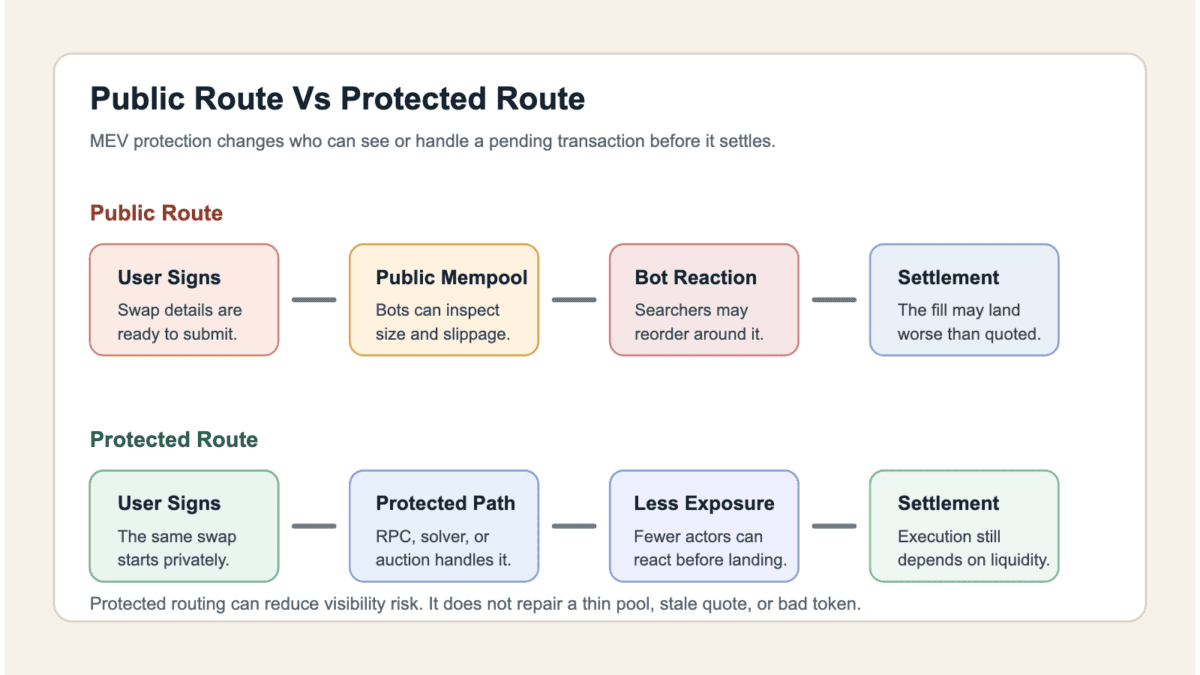
_A public route exposes pending transaction details sooner. A protected route changes who sees the order before settlement._
The tradeoff is trust. You may reduce public exposure while relying more on a wallet partner, RPC provider, relay, builder set, solver, sequencer, or app route. That can be a good trade, but it is still a trade.
MEV protection can reduce visibility-based attacks, especially sandwiching around onchain swaps. It cannot repair every cause of a bad fill, and that is where many users get overconfident.
Think of it as one control in a larger execution stack. Slippage tolerance controls how much price movement you accept. Liquidity depth controls how much the pool can absorb. Route quality controls which pools or venues the app uses. MEV protection handles part of the visibility and ordering problem.
Those controls overlap, but they are separate tools. A tight slippage setting can make a sandwich harder to profit from, but it can also make a volatile trade fail. A private route can hide the order, but it cannot stop your own size from moving a shallow pool once the trade lands.
> MEV protection is useful risk reduction, not a force field. If a token has weak liquidity, a stale quote, or a toxic contract, protection will not turn it into a clean trade.
The common failure points are worth separating before you size up:
A full port swap into a small pool is still dangerous for that reason. MEV protection may remove a bot’s easy view of the pending order, but your trade can still move the market against itself.
Large orders need different handling. Split size when it reduces price impact. Compare routes. Check pool depth. Use limit-style or intent routes when available. Avoid setting slippage so wide that the trade can survive almost any abuse.
Also watch the word “guaranteed.” A real protection tool should make these details easy to find:
If those details are missing, the product may be selling comfort instead of protection.
MEV protection changes by chain because transaction flow changes by chain. Ethereum, Solana, and L2s do not expose the same ordering surface in the same way.
Start by asking where ordering power sits:
On Ethereum, the classic story is public mempool exposure. A user submits a transaction, searchers watch pending flow, and builders or validators help shape what enters the block. Private RPCs and protected routes try to reduce that visibility or route the transaction through a narrower set of actors.
On EVM L2s, the sequencer becomes central. Many L2s do not behave like Ethereum mainnet with the same public mempool assumptions. A transaction may route through a sequencer that orders transactions before they are posted or finalized elsewhere. That can reduce some risks and create different trust questions.
Solana has a different setup again. The chain is built around high throughput, fast leaders, and a different transaction-routing environment. MEV protection on Solana can involve wallet routes, app routes, priority handling, private transaction paths, or infrastructure tied to leader and bundle flow. Copying Ethereum private-RPC advice without checking Solana-specific support is a fast way to sound confident and be wrong.
App-level protection adds another layer. A DEX, aggregator, or wallet may build protection into the swap path. That might mean private submission, intent-based routing, solver competition, batch execution, or a partner route. The user sees one button, but the back end may be doing several jobs.
Use this chain split before assuming one setting covers every trade:
| Environment | What Changes For MEV Protection |
|---|---|
| Ethereum Mainnet | Public mempool exposure makes private RPCs and protected routes especially relevant. |
| EVM L2s | Sequencer design changes where ordering power sits. |
| Solana | Fast routing, leaders, and bundle flow create different protection mechanics. |
| DEX Or Wallet App | Protection may be built into the swap route rather than a custom RPC. |
Examples such as Flashbots Protect, MEV Blocker, Jito, protected wallet routes, and solver-based swaps help name the category. They should not be read as one-size-fits-all endorsements. Chain support, failure handling, and routing rules are the real checks.
The clean habit is to ask where the transaction goes after you sign. If the answer is “public mempool,” exposure is one kind of problem. If the answer is “private route,” the next question is who handles it, what they can see, and what happens when they cannot land it.
You need MEV protection most when a pending onchain trade would be valuable for someone else to see and reorder. Large swaps, shallow pools, volatile tokens, and loose slippage settings raise that risk.
Start with the trade, not the toggle. A tiny swap in a deep pool may not need special handling beyond sane settings. A large swap in a thin meme-token pool deserves more caution, even if your wallet shows a reassuring shield icon.
Before a large onchain swap, run through the basics:
Wallet settings are still important. Many users first meet MEV protection through a swap screen, custom RPC, or crypto wallets category page that mentions transaction protection. Check what chain it supports, who the provider is, and whether the feature is on by default.
If the swap already has heavy price impact in the preview, MEV protection will not make it gentle. Price impact is your own order moving the pool. MEV is another actor exploiting transaction visibility or ordering. They can combine, but they are different problems.
A quick diagnosis helps after a bad fill:
Centralized exchanges are different. They can have bad execution, fees, spreads, and market-making games, but they do not use the same public mempool and block-ordering mechanics as onchain swaps. MEV protection mainly belongs to onchain transaction flow.
The final check is trust. A protected route should tell you what data is shared, which chains are covered, how failures work, and whether you can disable the feature. If the answer is hidden behind vague security language, keep the trade small until you understand the route.
MEV protection myths usually start when a conditional tool is sold as complete safety. “MEV-free” and “100 percent protected” are claims that need scope, not applause.
Some products can provide strong protection for specific routes, chains, and transaction types. That does not mean every wallet action is protected, every validator or builder is harmless, or every swap will receive better execution. The word “protection” only helps when you know the boundary.
Real scope should answer a few plain questions:
“Anti MEV protection” is often just another way users ask for sandwich attack protection, private routing, or bot-resistant execution. The phrase is messy, but the need is real: users want fewer bots profiting from their pending trades.
The scam side is uglier. Treat any “guaranteed MEV bot profit” offer as wallet risk, not a trading edge. Real MEV searchers compete in fast, capital-intensive markets. They do not usually hand strangers a free money machine in a comment thread.
> Never enter a seed phrase, private key, or wallet recovery phrase to enable MEV protection. A real wallet or RPC setting does not need that.
Red flags tend to repeat:
Real protection tools are usually boring in the right way. They explain supported networks, transaction types, routing partners, data handling, possible failures, and limits. They do not need a too-good-to-be-true pitch to sell the point.
Keep the categories separate. MEV protection helps users reduce execution exposure. MEV bots try to capture value. A bot pitch that asks you to connect a wallet or paste code is not protection just because it uses the same acronym.
MEV protection can reduce the chance of sandwich attacks when the route hides or protects the pending transaction before settlement. It works best when visibility is the main risk. It does not guarantee a better fill in thin, volatile, or poorly routed markets.
No. MEV protection is a risk-reduction method, not a guarantee that every transaction will avoid MEV, slippage, routing problems, fees, or failed execution. Good tools explain what they protect, where they work, and what they cannot control.
A private RPC is one form of MEV protection, but it is not the whole category. Protected DEX routes, intents, solvers, order flow auctions, batch auctions, and encrypted or chain-specific designs can protect different layers of the transaction.
MEV protection is usually worth leaving on when the wallet explains the provider, supported chains, and failure rules clearly. Still, you should understand what data is shared, who handles the route, and how to disable it if you do not trust the provider.
No. Slippage is a price-tolerance setting. MEV protection changes transaction visibility, routing, or ordering risk. Both affect swap execution, but they solve different problems. A protected route with reckless slippage can still give you an ugly fill.
Centralized exchanges do not need MEV protection in the same onchain sense. They use internal order books and exchange-controlled execution rules, not public mempool ordering. Users can still face spreads, fees, slippage, and poor execution, but that is a different risk model.
Start with the next swap you actually plan to make. MEV protection is most useful when it changes a real execution risk, not when it decorates a trade you barely understand.
Use this order before sending size:
Then read the wallet or app setting like a contract with buttons. Which chains are covered? Who receives the transaction? What happens if the private route fails? Can you turn it off? Does the tool disclose limits without hiding behind “full protection” language?
After the test trade, compare the preview with the actual fill. If the route still shows heavy price impact, widening slippage is not a fix. It only gives the trade more room to land badly.
If the route looks opaque, lower the size or use a venue you understand better. MEV protection should make execution risk easier to reason about, not harder.
MEV protection is worth using when the trade route is clear and the remaining risks are understood. It is not a substitute for liquidity, route checks, token diligence, or basic wallet safety.
End with one question for the next trade: what does this protection reduce, and what can still go wrong after I sign?