Physical Address
304 North Cardinal St.
Dorchester Center, MA 02124
Physical Address
304 North Cardinal St.
Dorchester Center, MA 02124


A plain-English MEV bot guide for traders who want fewer bad swaps and fewer bad bot pitches.
A MEV bot is software that searches blockchain transaction flow for profit opportunities created by transaction ordering, inclusion, timing, or market imbalances.
Most traders meet the term after a DEX trade feels wrong. The quote looked fine, the swap settled worse, the fee was ugly, or someone is selling a “guaranteed” bot that supposedly prints money while you sleep.
MEV bots do not all play the same role. Some rebalance markets through arbitrage or liquidations. Others push users into worse execution through sandwiches or front-running. To read the risk, look at what the bot can see, how it wins placement, and whether your trade gave it room to act.
A MEV bot in crypto is automation used by searchers to find value around pending transactions, block construction, or fast market changes. MEV stands for maximal extractable value, which is value created by how transactions are ordered, included, delayed, or routed.
That makes it different from a plain trading bot. A normal trading bot may buy when a price crosses a moving average. A MEV bot cares about placement. It wants to land before, after, or near another action because that order changes the outcome.
The setup usually has several roles. A user sends a transaction. A public mempool, private route, or relay may expose useful information. A searcher runs the bot. Builders, validators, leaders, or sequencers decide what lands and in what order.
That sounds abstract until a swap enters the picture. If your trade will move a low-liquidity pool, a bot may see room for arbitrage or a sandwich. If a lending position is close to liquidation, a bot may race to liquidate it first.
Keep the boundary simple:
MEV bot meaning comes down to the source of the edge. The edge is the order of on-chain events.
A MEV bot makes money by finding a transaction or market state that changes value, then racing to place its own transaction in the best position. The bot watches, simulates, bids or bundles, and either settles the opportunity or fails.
On Ethereum-style chains, the bot may watch pending transactions in a public mempool. In other setups, it may use private relays, direct RPC paths, bundle systems, or fast data feeds. The path changes, but the contest stays familiar: see useful flow, model it quickly, and land first.
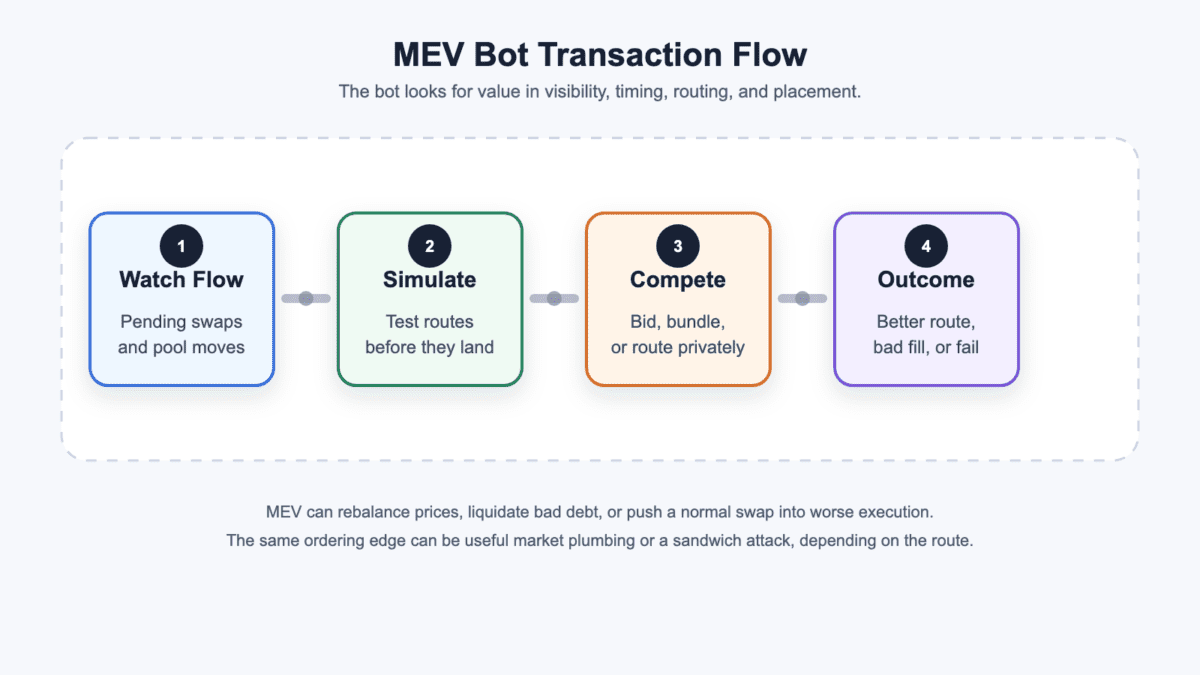
The competition can feel like a player-versus-player market because several searchers may spot the same route. They compete through priority fees, bundles, private routes, or relationships with the systems that construct blocks or slots.
| MEV Bot Strategy | What It Means For Users |
|---|---|
| Arbitrage | A bot trades price gaps between pools or venues after a state change. |
| Back-running | A bot lands after another transaction to react to the new state. |
| Front-running | A bot lands before another transaction to change conditions first. |
| Sandwiching | A bot trades before and after a user’s swap, often worsening the fill. |
| Liquidation | A bot closes risky borrowed positions when protocol rules allow it. |
The bot does not need a Hollywood hack. It needs data, timing, simulation, execution capital, and a route into the ordering process. That is already a lot.
Failed attempts are part of the model. A route can look profitable in simulation, then vanish when another bot wins, a pool changes, fees jump, or the transaction lands too late. Durable edge comes from surviving thousands of tiny races, not spotting one clever trade.
A MEV bot shows up in a DEX trade as worse execution, confusing timing, or a fill that lands near the edge of your slippage settings. But not every bad swap is MEV. Sometimes the pool was simply thin, the quote went stale, or the market moved.
Start with price impact. If your trade is large for the pool, your own order can move the price. That creates room for arbitrage, and in weaker markets it can make you feel like exit liquidity even without a clean sandwich pattern.
Slippage tolerance sets the maximum price movement your wallet will accept. Wide slippage can help a trade settle, but it also gives harmful bots more room. Tight slippage can reduce that room, but it may cause more failed swaps.
Use this table as a first pass before blaming one culprit:
| Bad Swap Symptom | Possible Cause |
|---|---|
| Output lands near minimum received | Wide slippage, sandwich risk, or fast price movement. |
| Quote changes before approval | Stale route, volatile token, or thin pool depth. |
| Transaction waits too long | Congestion, low priority fee, or weak routing. |
| Swap fails after signing | Slippage too tight, pool moved, or route became invalid. |
| Small sell moves price sharply | Low liquidity or concentrated holders. |
| Fee seems high for the trade | Priority-fee competition or inefficient routing. |
The table is a starting point, not a detective badge. It tells you what to inspect next. Look at pool depth, route, slippage, transaction timing, and whether similar swaps around yours suggest a sandwich.
For small trades in deep pools, MEV may be invisible. For large swaps, new tokens, memecoin pools, and volatile launches, the order flow is brighter. Bots tend to notice bright things.
MEV bot examples fall into two broad groups: extraction that hurts a user’s trade and activity that can keep markets working. Sandwich attacks sit in the ugly group. Arbitrage and liquidations can be useful, though they still create competition and costs.
A sandwich attack is the example most DEX users care about. The bot sees a pending swap, buys before it, lets the user’s trade move the price higher, then sells after it. The user receives less than expected while the bot captures the difference.
A simple sandwich pattern looks like this:
That is harmful because the user’s own tolerance becomes the bot’s runway. The trade still follows the contract rules, which is exactly why it feels so irritating. Code can be working as written while the outcome is still rough.
Arbitrage is different. If one DEX pool is mispriced after a large trade, an MEV bot can buy on the cheap side and sell on the expensive side. That can pull prices back into line and make future quotes cleaner.
Liquidations are different again. A lending protocol may allow liquidation when collateral falls below a required level. Bots compete to close that position, collect the incentive, and help the protocol avoid bad debt.
Focus on the mechanism, not the label. Ask whether the bot worsened a user’s execution, corrected a market imbalance, or enforced protocol rules.
Beginners can run code called a MEV bot, but running a profitable MEV bot is a very different task. The easy version is a script. The hard version is a speed, capital, routing, and risk-control system.
The simple idea hides the real stack. A serious setup needs live data, transaction simulation, private routing or bundle access, execution contracts, funded wallets, fee strategy, monitoring, logs, and a plan for failed attempts.
That stack exists because the edge is competitive. Other searchers are watching the same pools, the same pending flow, and the same liquidations. If your bot is slower, pricier, or less accurate, the opportunity belongs to someone else.
| Needed Capability | Practical Role |
|---|---|
| Fast data access | Opportunities can vanish before a normal dashboard refreshes. |
| Transaction simulation | The bot must test whether the route works before spending fees. |
| Routing access | Public, private, and bundle paths can produce different outcomes. |
| Capital and fee control | A good route can fail after gas or priority fees. |
| Monitoring | Broken assumptions need to stop before they compound. |
| Accounting records | High-volume wallet activity needs clean logs later. |
This is why “MEV bot for sale” pitches deserve a hard stare. No one normally sells a durable money printer as a passive-income script in a Telegram chat. If the edge is real, the seller has better options than renting it to strangers for lunch money.
There is still learning value. Toy simulations can teach AMMs, mempools, bundles, liquidations, and gas markets. Just keep education away from live funds before the market charges tuition.
MEV bot scams work because the topic sounds technical enough to impress beginners and profitable enough to override caution. The scammer does not need you to understand MEV. They need you to trust the button, script, or deposit address.
Common packaging includes “AI MEV bot” videos, copied Remix contracts, Telegram-only support, fake GitHub repos, guaranteed daily returns, and dashboards that show profit until withdrawal time. The pitch changes. The trick is still getting control over your wallet, funds, or approvals.
Wallet permissions are the first safety line. Review wallet settings before connecting anything that claims it can trade for you. A bot that asks for a seed phrase, private key, or broad approval has already failed the interview.
These red flags should slow you down:
Some fake MEV bot offers resemble a hard rug because the loss can be immediate. You fund the contract, approve the wrong permission, or run malicious code, and the exit is gone before the lesson finishes loading.
Open-source code is not automatic safety. You still need to understand dependencies, addresses, permissions, and what the contract can do. If the answer is “trust the tutorial,” keep the wallet empty.
You reduce MEV bot risk by limiting what your trade exposes, how much room it gives bots, and how badly it can move the market. No single toggle solves all of that. Protection is layered.
Start with the trade itself. Use realistic slippage. Check the minimum received amount. Avoid large market orders in shallow pools. Compare routes. Use limit orders when the venue supports them. Split size only when extra fees do not erase the benefit.
Routing can help when the risk comes from public visibility. For example, the Flashbots Protect settings guide says the default RPC forwards transactions only to the Flashbots block builder and sends 90% of MEV refunds to tx.origin, with the remaining 10% going to the validator.
But private routing is not a force field. It changes who can see the transaction, who handles the order flow, and what assumptions you are making about the route. It cannot repair bad pool depth, scam tokens, violent price moves, or a trade size that shoves the pool around.
| Control | What It Helps With |
|---|---|
| Tighter slippage | Reduces room for sandwich-style extraction. |
| Minimum received check | Shows the worst accepted output before signing. |
| Smaller trade size | Lowers price impact in thin pools. |
| Deeper liquidity | Makes the trade harder to move. |
| Limit orders | Sets a price boundary instead of accepting any route inside tolerance. |
| Private RPC or routing | Reduces exposure to some public mempool watchers. |
| Protected wallet swaps | Adds safer defaults when the wallet route supports them. |
| Intent or batch routes | Lets solvers compete on execution instead of exposing a raw swap path. |
Pick controls based on the actual risk. If the pool is shallow, better routing helps only so much. If the token is malicious, no private RPC makes it honest. If your slippage is wide enough to drive a small car through, bots may not need much creativity.
The best setup is boring in a useful way: sane size, deep liquidity, checked route, realistic slippage, and protection where the route actually supports it.
A MEV bot behaves differently on Ethereum, Solana, and L2s because each chain handles visibility, ordering, and routing differently. The core idea stays the same: profit can appear when someone can act on transaction order, inclusion, timing, or market state.
Ethereum examples often use public mempool, builder, validator, relay, and bundle language. A pending swap may be visible before inclusion. Searchers simulate possible outcomes, then compete through fees, bundles, or private routes.
Solana needs different wording. Solana does not map one-to-one to Ethereum’s public mempool model. Users often hear about Jito, bundles, priority fees, sniper bots, fast RPCs, and leader paths. Some of that is MEV. Some is just speed-based trading around launches.
L2s add another caveat. A rollup may depend on a sequencer, a private mempool, an app-specific route, or a builder market that differs from Ethereum mainnet. That changes what bots can see and when they can act.
So be careful with one-chain advice pretending to be universal. A private RPC, wallet toggle, or protected swap can mean different things by chain. Check what the route actually protects, which chain it supports, and whether your trade still has weak liquidity or wide slippage.
A simple chain split works better than tribal advice. Ethereum teaches the mempool and builder vocabulary. Solana teaches latency and bundle vocabulary. L2s teach sequencer and route-design caveats. MEV bots can adapt to all three.
MEV bot terms get mixed up because crypto uses “bot” for everything from a harmless alert tool to a hostile sandwich strategy. The clean split starts with where the edge comes from.
If the edge comes from transaction ordering, inclusion, block or slot timing, or reacting to another transaction’s state change, you are in MEV territory. If the edge comes from a chart signal or a copied account, it may be automation without being MEV.
Social feeds make this messier. CT hype often blurs “sniper bot,” “AI bot,” “MEV bot,” and “trading bot” into one profitable-sounding blob. That is convenient marketing. It is not precise language.
Use these boundaries:
These categories can overlap. A liquidation bot may be a MEV bot if it competes for ordering. An arbitrage bot may be a MEV bot when it depends on back-running a state change. The label is less useful than the mechanism.
When someone sells “the best MEV bot,” ask what it watches, how it routes, what permissions it needs, and why the seller is sharing the edge. That last question does a lot of work.
A real MEV bot can create recordkeeping problems because operation may involve many wallets, high transaction counts, failed attempts, DEX routes, profit consolidation, and cross-chain movement. That can be hard to explain later if your logs are messy.
This is not tax advice or legal advice. It is an operator warning. If you run bots with real size, build the paper trail before you need it.
The records should connect the money path to the strategy:
Banks, exchanges, accountants, or tax professionals may ask where funds came from. “A bot did things” is not a satisfying answer. You need a trail that connects capital, strategy, costs, realized gains, losses, and final withdrawals.
That record also separates failed attempts from profitable routes, which helps you review whether the bot has a real edge.
The issue gets sharper when wallets are reused poorly. A test wallet, scam-contract wallet, bot wallet, profit wallet, and personal wallet should not become one unlabeled mess. Separate them and document why each exists.
Also remember that rules vary by jurisdiction, platform policy, and strategy. A section in an article cannot settle that. Qualified advice is cheaper than trying to reconstruct months of high-speed transactions after someone asks for proof.
No. A MEV bot is a type of trading automation that looks for value in transaction ordering, inclusion, timing, or state changes. A normal trading bot can follow chart signals or exchange rules without depending on block or slot placement.
No. A MEV bot can perform arbitrage or liquidations that help markets stay aligned or protocols manage risk. The harmful version is usually front-running or sandwiching, where a normal user gets worse execution because the bot trades around the swap.
A MEV bot does not need to steal from your wallet to hurt a DEX trade. It can exploit public transaction flow or slippage. Fake MEV bot software is different. Scam tools can drain funds if you share keys, approve malicious contracts, or deposit into unsafe code.
No. A private RPC can reduce exposure to some public mempool watchers, but it does not fix thin liquidity, wide slippage, malicious tokens, volatile markets, or every chain-specific routing problem. It also changes who you trust with transaction flow.
It is possible, but beginners should assume the field is competitive and expensive. A real MEV bot needs fast data, simulation, routing access, capital, fee control, and monitoring. A paid script promising passive returns is usually a warning sign, not an edge.
There is no single global answer. Rules can depend on jurisdiction, venue terms, strategy, market manipulation standards, tax treatment, and how the bot handles funds or data. A generic MEV bot label is never legal clearance.
Start with the swap controls you can actually change. Check minimum received before signing, keep slippage tight enough to limit damage, and avoid market orders that are large for the pool.
Then check the route. Prefer deeper liquidity, compare aggregator quotes, and use protected routes when the wallet or DEX clearly supports them. Test with small size when a chain, token, or route is unfamiliar.
Use this short order before the next risky swap:
Reject bot offers that need trust before explanation. No seed phrases, no blind contract deposits, no guaranteed daily returns, no copied code with real funds. If a seller claims the bot prints money, ask why they are selling the printer.
If you are building, keep it educational until the logs prove otherwise. Separate test wallets from real funds, track every fee, and record why each route should work before size increases.
The boring checks are the protection. A MEV bot usually wins when a user skips them.
MEV bots are part of on-chain markets. You do not need to fear every one of them. You do need to know when your trade gives them a target.