Physical Address
304 North Cardinal St.
Dorchester Center, MA 02124
Physical Address
304 North Cardinal St.
Dorchester Center, MA 02124


A practical guide to memecoin supercycle hype, signals, and risk.
A memecoin supercycle is crypto slang for a period when meme coins as a group pull in outsized attention, liquidity, and speculation.
The phrase usually shows up when traders think memes are doing more than catching one lucky pump. They see meme coins pulling attention away from utility alts, new launches, and slower market stories.
That does not make the thesis true. It does make the phrase useful for reading hype, spotting risk, and deciding whether the chat is describing a real move or handing you the bag.
A memecoin supercycle means meme coins are acting like the market’s main attention trade, not a sideshow. Traders use the phrase when DOGE-style culture, PEPE-style virality, Solana launchpad activity, and Crypto Twitter hype seem to pull liquidity into memes across several communities at once.
The spelling varies. Some users write “meme coin supercycle”. The meaning is the same: a claimed period when memes outperform because attention itself becomes the asset.
The key word is “claimed.” A memecoin supercycle is not an indicator with a start date, end date, or clean chart signal. It is a narrative traders use to explain why memes are moving together and why retail risk appetite looks unusually focused on jokes, mascots, cult communities, and fast on-chain trading.
The label earns its keep only when it pushes you to check breadth, liquidity, and exit depth before joining the crowd.
It is also not a magic blanket for every token with a funny ticker.
A memecoin supercycle is not:
That distinction keeps simple stories from hiding complex exits. The buy button is easy. The sell route can be crowded, delayed, or missing when hype fades.
So ask the sharper question: is attention turning into broad, tradable liquidity, or are you staring at one loud chart after insiders already ate?
The memecoin supercycle thesis caught on because it named a frustration many retail traders already felt. Plenty of utility alts promised products, roadmaps, and serious language, then still underperformed or diluted holders. Meme coins offered a cleaner pitch: culture, identity, speed, and a chart anyone could understand.
Murad-style memecoin supercycle arguments lean on that shift. The bullish version says the strongest meme coins are not random jokes anymore. They are communities with shared symbols, relentless distribution, and a reason for holders to keep recruiting.
“Cult coin” language comes from that idea. The label shifts focus from technology to social coordination: shared symbols, public identity, and constant distribution. In that setup, the attention economy is not background noise. It is the market.
Several forces made the idea easy to spread:
But community demand is not the same as price support. A loyal chat can amplify a token on the way up, then pressure late holders to defend the story on the way down.
That is the sharp edge. The thesis can explain why memes pump with little visible utility. It can also explain why late buyers become the marketing budget.
At its strongest, the memecoin supercycle thesis says attention, identity, and liquidity can beat traditional fundamentals for a time. At its weakest, it becomes a slogan people use when they need new buyers.
A memecoin supercycle is bigger than one meme pump, but looser than a formal crypto market cycle. Confusion starts when traders use “meme season”, “alt season”, and “supercycle” as if they are clean categories.
These terms describe different kinds of rotation. One can overlap with another, and the market can move from one to the next faster than your group chat changes its pinned message.
| Term | What It Means And What Can Go Wrong |
|---|---|
| Single meme coin rally | One token catches attention. It can be real demand, a coordinated push, a listing reaction, or a thin-liquidity squeeze. |
| Meme season | Meme coins as a category get hot. The danger is assuming every meme token deserves a bid just because the sector looks alive. |
| Memecoin supercycle | Traders claim memes are absorbing outsized attention and liquidity across crypto. The danger is mistaking narrative dominance for a durable market regime. |
| Alt season | Many non-Bitcoin crypto assets outperform. The danger is assuming a meme-led rotation means utility alts, DeFi tokens, and older bags will follow. |
“Alt season was meme season” is a debated interpretation, not a fact. It may feel true when memes dominate feeds, launchpads, and retail flows while other alts sit still. But that does not prove memes replaced the whole alt market.
Separate breadth from noise. A meme season can be fast and narrow. A memecoin supercycle claim needs broader evidence: multiple large memes moving, fresh liquidity, active new wallets, and attention spreading beyond one ticker.
Even then, the label arrives late. By the time everyone agrees a memecoin supercycle is happening, a lot of easy entries may already be gone.
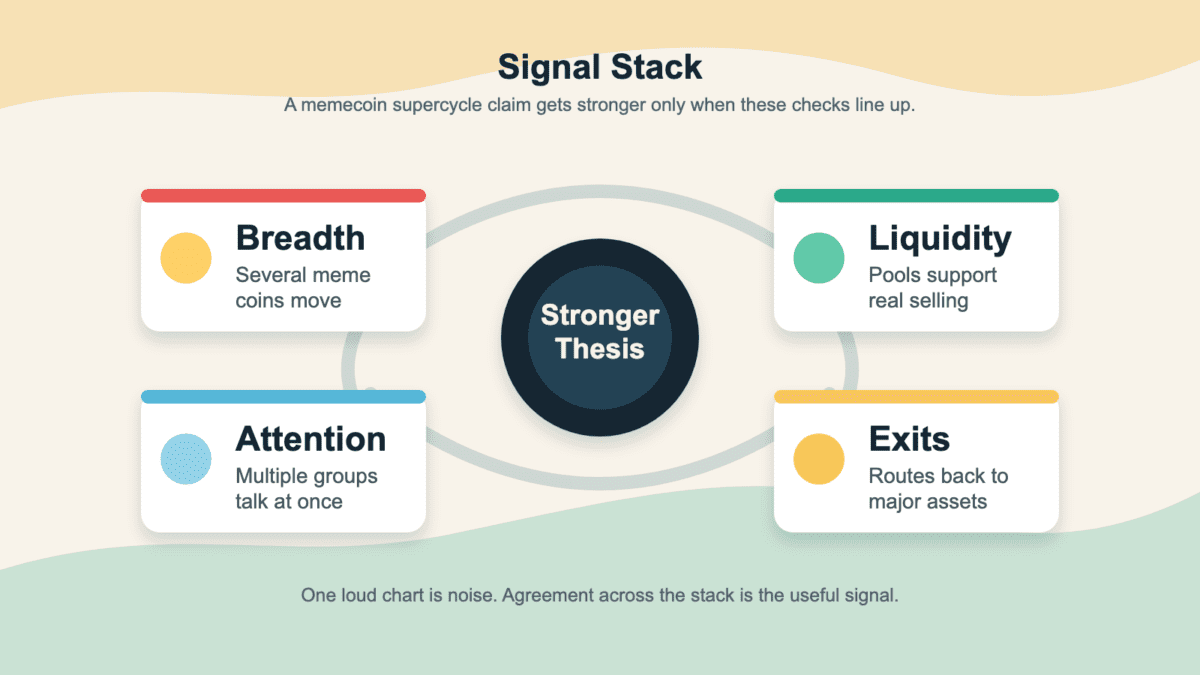
A memecoin supercycle looks more credible when several signals appear together. No single chart, influencer thread, or exchange listing proves it. Meme markets are noisy by design, and noisy markets are easy to dress up as destiny.
Start with breadth. If only one token is running, that is a token rally. If DOGE, SHIB, PEPE-style large caps, Solana memes like BONK or WIF, and newer launches all catch bids, traders have more reason to talk about a meme-wide rotation.
Then check liquidity. Stronger meme periods usually have deeper pools, tighter spreads, more active DEX trading, and easier exits into SOL, ETH, stablecoins, or centralized exchanges. Without exit depth, a green candle can be a trap in party glasses.
Useful signals include:
Each signal has a catch. Volume can be wash-heavy. Listings can arrive near local tops. Launchpads can dilute attention by minting too many disposable tokens. Social attention can be botted, bought, or recycled from old holders trying to escape.
Euphoria can become its own warning. When every post says the memecoin supercycle is obvious, that can be a top signal, not a clean entry.
Duration is also messy. A meme rotation can last days, weeks, or several market waves. It can cool while trading continues, and it can restart around a new chain, launchpad, celebrity event, or retail narrative.
The best signal is not one perfect metric. It is agreement between liquidity, breadth, attention, and exits. If one part is missing, assume the thesis is weaker than the slogan.
A memecoin supercycle can break fast because meme coins rely on attention, liquidity, and belief more than cash flows or protocol demand. When that attention fragments, exits get ugly.
Launchpad oversupply is one obvious fracture point. If thousands of new tokens compete for the same wallets, each new chart steals oxygen from the last. The result is not one huge meme wave. It is a slot machine with extra handles.
Insiders and snipers make that worse. Early wallets can buy before public attention arrives, then sell into the exact excitement that convinces late users the supercycle is starting.
That is where exit liquidity stops being a joke and becomes the trade. Someone’s perfect entry needs someone else’s late belief.
The common break points are predictable:
Not every failure is a clean rug pull. Many meme coins fade through silence, weak updates, thin liquidity, and a community that quietly stops posting. That slow abandonment is closer to a soft rug than a dramatic exploit.
Regulatory framing can add confusion, too. The SEC Staff Statement on Meme Coins describes certain meme coins as speculative, entertainment-driven assets that typically have limited or no function, while also warning that fraud can still face enforcement under other laws. That is not a personal safety net or legal advice.
A meme token can keep trading after the supercycle thesis fades. Liquidity can remain, but the easy narrative premium may be gone.
When the story weakens, holders often become unpaid marketers. If your best reason to stay is that selling would make the group angry, the market has already become personal.
Memecoin supercycle risk starts with the exit, not the story. If you cannot explain how you would sell without wrecking the price, basic due diligence is not finished.
The stakes are highest in the trenches, where on-chain meme trading happens before broad listings, clean analytics, or slower buyers arrive. Early access can be useful. It also moves the worst risks closer to your wallet.
Use a sequence, not a vibe check:
A holder map can say more than a tagline. A token with a great joke and a few giant wallets can still be a bad trade. If top wallets can crush the pool, your community thesis depends on their patience.
Contract controls deserve attention because some tokens give creators powers that buyers never notice until selling gets hard. Not every chain or interface makes this simple. If you cannot understand the risk, size as if the answer is bad.
Wallet hygiene deserves its own pause. Meme hype brings fake links, impersonators, wallet-draining sites, and seed phrase scams. Use official links, separate higher-risk wallets from long-term funds, and never accept a stranger in DMs as support.
The final check is social. Does the meme spread because people enjoy it, or because holders are begging for engagement? Real attention travels without every post sounding like a hostage note.
If the only reason to buy is that the memecoin supercycle must make everything pump, you are not trading a signal. You are buying a slogan.
A memecoin supercycle can affect your portfolio even if you never buy the smallest tokens. It changes risk appetite, attention flows, and the way traders compare old holdings with fresh opportunities.
Meme coins usually behave like high-beta attention assets. They can move harder than major coins when risk appetite is hot, then fall faster when attention leaves. That makes them weak core holdings for most users, even when the thesis is loud.
Old large-cap memes, cult memes, and fresh launchpad tokens can also behave differently. DOGE or SHIB may need broad retail attention. A newer cult token may need constant social coordination. A fresh launch may need only a few hours of liquidity and speed.
That is why being a bagholder in an old meme position is not the same as catching a new rotation. Category hype can help, but old supply, tired communities, and trapped holders can limit recovery.
Before sizing any meme exposure, define the role:
Bitcoin strength does not guarantee meme strength. SOL strength does not guarantee every Solana meme follows. Sometimes majors rise because money wants safer crypto exposure, while memes lag because retail appetite is tired.
Pre-planned exits help because meme charts punish hesitation. Decide what you will sell, where you will sell it, and what happens if liquidity vanishes. A stablecoin route is not boring when the crowd suddenly wants the same door.
The portfolio lesson is simple: a memecoin supercycle thesis belongs in the speculative corner, not the foundation.
A memecoin supercycle comes with its own vocabulary. Knowing the terms helps you hear the warning inside the hype, especially when a token community uses slang faster than it explains risk.
Start with the market-structure terms. Trenches means early, messy on-chain trading where tokens launch fast and information is thin. Exit liquidity means late buyers who let earlier holders sell. A top signal is a sign that hype may already be stretched.
Then separate failure types from normal volatility. A soft rug describes slow abandonment, weak follow-through, and quiet liquidity decay. A hard rug is sharper: theft, malicious contract behavior, or a sudden action that leaves buyers trapped.
Holder language adds another layer. A bagholder is stuck after the market moved on. Rotation means capital is leaving one sector for another. A conviction play is a position held because the thesis still looks alive, not because the holder forgot to sell.
The phrases help when they describe behavior clearly. They become dangerous when they hide weak evidence. Calling a meme a conviction play does not fix thin liquidity, silent developers, or a community that only posts when the chart is green.
These terms are not just slang decorations. They describe the mechanics that decide whether a meme run is tradable, exhausted, or dangerous.
They also keep the idea honest. If a community calls every dip a conviction test, check whether liquidity and attention still support that claim. If the only answer is “believe harder”, the vocabulary is doing marketing work.
The best use is defensive. When you can name the risk clearly, you are less likely to confuse a meme, a movement, and a crowded exit.
No. A memecoin supercycle is a claimed period when meme coins attract outsized attention and liquidity, while alt season means many non-Bitcoin crypto assets outperform. Meme season can overlap with alt season, but it can also drain attention from other alts.
The phrase became widely associated with Murad Mahmudov and the Murad memecoin supercycle thesis, especially around cult meme coins and community-driven demand. The broader idea is bigger than one person, because traders already used meme-season language before the thesis became popular.
No. A memecoin supercycle can describe strong attention and liquidity, but it does not make meme coins safe, fairly valued, or suitable as core holdings. It means the sector may be active, which also attracts snipers, insiders, copycats, and late buyers.
Some old meme coins can recover, but a new memecoin supercycle does not lift every old bag. Older tokens need active communities, real liquidity, exchange access, and a meme that still travels. Fresh launches can absorb new attention before older holders get relief.
Start by checking liquidity depth, holder concentration, sell impact, contract controls, and the route back to stablecoins or major coins. Then size small enough to be wrong. If the only pitch is urgency, you may already be the exit plan.
Not necessarily. Bitcoin can stay strong while meme coins cool, because the two trades depend on different buyers and risk levels. A healthier signal is broad meme-sector liquidity across several communities, not Bitcoin strength by itself.
Start by deciding whether you are learning a term or planning a trade. Those are different jobs. Learning needs definitions and examples. Trading needs liquidity checks, wallet hygiene, and an exit plan.
Your first pass should be boring on purpose. Write down the token, chain, entry size, sell route, and the reason the meme still travels without paid pressure. If that feels like too much work, the position is probably too big.
If you still want exposure, keep the process boring:
Then wait five minutes. That sounds small, but meme markets thrive on rushed clicks. If the trade only works when you panic-buy immediately, it probably works better for someone else.
After that pause, check whether the memecoin supercycle idea is helping you or rushing you. A useful thesis explains breadth, liquidity, and attention. A bad thesis excuses every red flag because the chart might still run.
If you are only learning, track the language before the trades. Watch how people use “supercycle”, “meme season”, and “alt season” when prices move against them. The honest explanations usually mention liquidity, timing, and uncertainty. The weaker ones blame doubt.
If you are trading, keep one written rule for taking profit and one written rule for cutting the position. Meme coins move too fast for decisions that begin after the candle turns ugly.
Keep the final rule simple: no slogan gets to skip risk checks.
The memecoin supercycle is useful language when it helps you read attention and liquidity. It becomes dangerous when it turns every joke with a chart into a destiny claim.