Physical Address
304 North Cardinal St.
Dorchester Center, MA 02124
Physical Address
304 North Cardinal St.
Dorchester Center, MA 02124


A practical arbitrage bot guide before you connect funds.
An arbitrage bot is software that watches price gaps between crypto venues or related markets and can alert you or trade automatically under preset rules.
That sounds clean until the costs arrive. A spread only becomes useful when trading fees, slippage, gas, transfer delays, funding changes, custody risk, and recordkeeping still leave a net edge.
An arbitrage bot in crypto is automation that looks for price differences across venues, pairs, pools, or related instruments. Some bots only scan and alert you. Others place orders, submit on-chain transactions, rebalance inventory, or manage offsetting spot and futures positions.
The word “bot” does a lot of work here. A scanner might never touch your funds. A true executor may need exchange API keys, wallet approvals, account balances, margin, or smart-contract interaction. Those are very different risk profiles under the same label.
Most crypto arbitrage bot setups fall into a few broad routes:
Automation does not make the setup hands-off. You still need capital in the right places, fee assumptions that match reality, logs you can read later, and a plan for when the bot stops behaving like the sales page promised.
For a beginner, the key distinction is permission. A read-only scanner can be a research tool. A trade-enabled bot is an operational system. A withdrawal-enabled bot or contract you do not understand is a custody risk before it is a trading strategy.
There is also a difference between arbitrage and “any bot that trades fast.” Arbitrage depends on a relationship between prices. If the tool is simply buying because momentum looks strong, it may be automated trading, but it is no longer an arbitrage bot in the useful sense.
An arbitrage bot finds price gaps by collecting market data, comparing quoted prices, and filtering for trades that may survive execution costs. It can watch centralized exchange order books, decentralized exchange liquidity pools, funding rates, and stale or slow-moving quotes.
Prices diverge because crypto markets are fragmented. One exchange may update faster than another. A DEX pool may become imbalanced after a large swap. A perpetual futures contract may trade rich or cheap against spot because one side is paying funding.
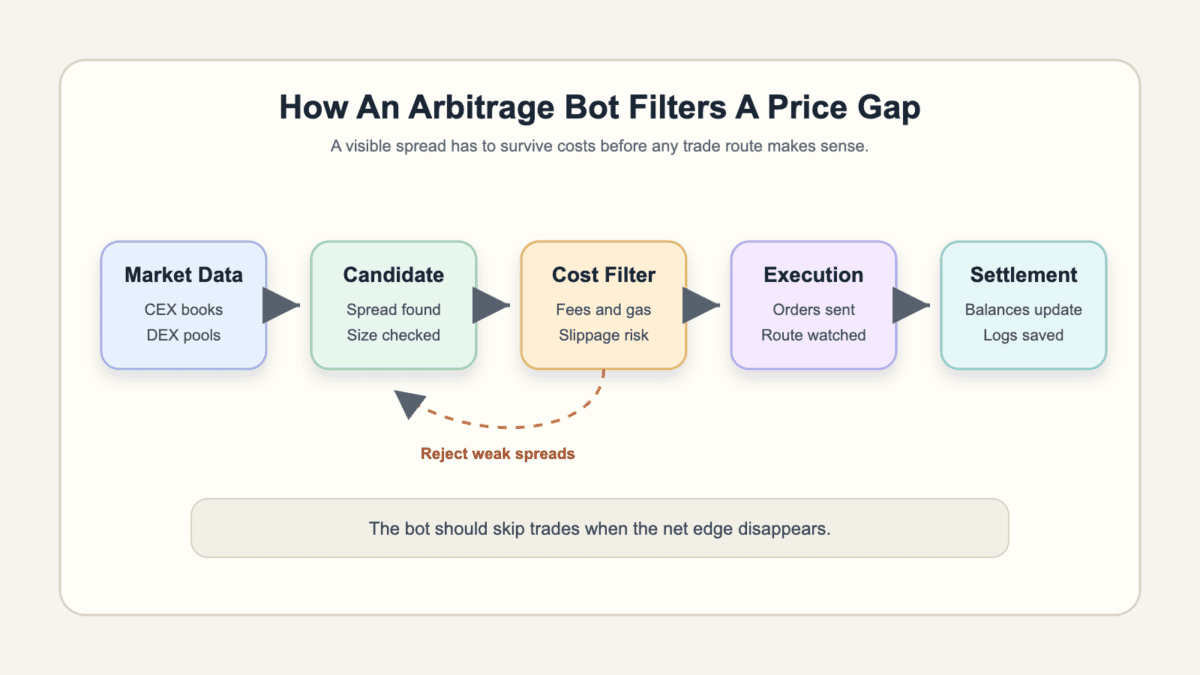
First ask whether the quote can be traded at the size, speed, and cost the bot assumes. A visible gap can be real and still useless if the available liquidity is too thin.
| Data Source | What Can Go Wrong |
|---|---|
| CEX order books | The visible quote has thin depth or moves before the order fills |
| DEX liquidity pools | The trade changes the pool price and creates slippage |
| Funding-rate data | The payment flips, caps out, or arrives after fees bite |
| Cross-venue prices | Transfers, limits, and account holds prevent fast rebalancing |
Good bots also reject bad opportunities. That is less exciting than a dashboard full of green spreads, but it is the difference between automation and expensive button-mashing.
This is why data quality matters as much as speed. A stale feed, blocked venue, or optimistic fill model can make a route look clean until the order reaches the market. The useful bot is the one that filters those traps before your balance does the field test.
Arbitrage bots are not one product category. They are a bundle of scanners, execution tools, exchange-native strategies, and on-chain systems that all use price differences in different ways.
Start by classifying the bot before judging the claim. The label matters less than where it trades, what it can control, and which costs can break the route.
| Bot Type | What To Check First |
|---|---|
| Scanner-only tool | Whether it only alerts or can actually trade |
| Cross-exchange bot | Fees, balances, withdrawal limits, and transfer delays |
| Triangular bot | Pair depth and execution order inside one venue |
| DEX or CEX-DEX bot | Gas, slippage, routing, and failed transactions |
| Flash-loan or MEV bot | Simulation, private routing, gas bidding, and contract risk |
| Spot-futures bot | Funding reversal, liquidation, margin, and venue rules |
The table is only the first pass. Each type moves the risk to a different place, so a fair review starts with the route rather than the marketing name.
Scanner-only tools find spreads and show possible routes. They may send alerts through an app, dashboard, email, or Telegram channel, but they usually leave the actual trade to you.
That makes them safer than fund-connected tools in one narrow sense. They do not need withdrawal access or order execution rights. But a scanner can still mislead if it ignores depth, fees, blocked venues, or stale prices.
Cross-exchange arbitrage bots compare the same coin across two or more centralized exchanges. The classic idea is simple: buy where the asset is cheaper and sell where it is more expensive.
The real setup is clunkier. You often need pre-funded balances on both venues because moving coins after spotting a spread is usually too slow. That creates exchange risk, KYC exposure, withdrawal-limit risk, and rebalancing work.
Triangular bots trade through three pairs on one venue. A route might move from one asset to a second asset, then a third, then back to the starting asset if the quoted cross-rates are out of line.
This avoids inter-exchange transfers, but it adds its own mess. Pair depth can be thin, fees hit every leg, and one missed fill can leave the bot holding an unwanted asset instead of closing a tidy loop.
DEX arbitrage bots look across liquidity pools, aggregators, and chains. Flash-loan arbitrage bots borrow and repay inside one transaction, so the trade must work atomically or revert.
MEV arbitrage bots compete in the transaction-ordering layer. They need indexing, simulation, gas strategy, private routing, and strong contract discipline. This is not a beginner shortcut. It is a knife drawer with Wi-Fi.
Spot-futures bots usually hold spot exposure while taking an offsetting perpetual futures position. The goal is often to collect funding or manage the spread between spot and perp pricing.
These products can look calmer than pure price-spread bots, but they still carry liquidation, margin, funding reversal, exchange, and timing risk. “Market neutral” does not mean “risk free.”
An arbitrage bot spread is only the gross difference between two prices. Profit is what remains after the trade actually executes and every cost lands.
That distinction is where many shiny screenshots fall apart. A 0.4% visible gap can disappear through taker fees, gas, slippage, partial fills, failed attempts, funding costs, withdrawals, and the work needed to rebalance accounts.
| Spread Step | Example Net-Result Check |
|---|---|
| Visible spread | The bot sees a possible gap before any order executes |
| Trading fees | Maker or taker fees reduce both sides of the route |
| Slippage | The available price worsens as the order hits liquidity |
| Gas or priority fees | On-chain execution costs can exceed the expected edge |
| Failed attempts | A reverted transaction may still burn gas |
| Rebalancing | Transfers and inventory resets create extra cost and delay |
Use the table as a checklist, not a promise. The exact math depends on venue, size, fee tier, chain, and timing. A trade that works at tiny size can fail once the order starts moving the quote.
Flashy “easy spread” content can also turn late users into exit liquidity for someone else’s route. If a public channel shows the same opportunity to thousands of people, the edge may already belong to the first wallets that acted.
The dull test is the useful one: record the bot’s assumed price, executable price, all fees, final balance, and time to rebalance. If the log does not show net profit after costs, the spread was just decoration.
Arbitrage bots can still be profitable in narrow setups, but obvious public routes are crowded. Retail users usually need a real edge before automation helps.
That edge can come from lower fees, better routing, faster data, pre-funded inventory, smaller venues, less obvious pairs, strong backtesting, or a narrow chain where the trader understands liquidity better than casual users do.
Retail traders sometimes find learning value before they find profit. A bot can teach order-book depth, gas math, pool behavior, and funding mechanics. That is useful, but it is not the same as a repeatable edge at meaningful size.
Capital placement also changes the answer. A small trader may not have enough balance on each venue to use a spread after fees. A larger trader may have enough size, but slippage and risk limits then become harder to ignore.
The risk is that “still profitable” gets used as bait. Paid bot groups can drift into stale claims, vague screenshots, and abandoned support. At that point, the setup starts to look closer to a soft rug than a trading tool.
Ask these questions before you believe a profit claim:
An arbitrage bot can help a prepared trader execute a narrow edge. It cannot manufacture one from a crowded route, a slow account, or a spreadsheet that forgot taker fees exist.
An arbitrage bot can lose money even when the market does not crash. Execution problems, venue rules, and custody mistakes can turn a neutral-looking trade into a messy loss.
Partial fills are a common problem. The bot buys one side, misses the other side, and ends up exposed to price movement. Stale quotes create a similar trap because the opportunity existed on the screen, not in the order book.
Custody risk depends on the route. CEX bots may require balances on multiple exchanges. DEX bots may need hot wallets, contract approvals, and clean separation between execution wallets and long-term storage. That is where a careful crypto wallets setup stops being just a neat filing system.
Common failure points include:
None of these risks is exotic. They are ordinary operational problems, which is why they hurt. The bot may be fast, but the account, chain, venue, and user still have to keep up.
You do not need to fear every bot. You do need to test the boring failure cases before size increases. Force a rejected trade, stop the bot mid-route, export the logs, and confirm what happens when only one side fills.
Evaluate an arbitrage bot by checking what it can do with your funds, what assumptions it uses, and whether you can verify the results independently. A slick dashboard is not enough.
Start with control. A scanner that only reads prices is different from a hosted executor that can trade through API keys. An exchange-native bot is different again because the funds stay inside that venue, but the user still accepts venue rules, outages, margin logic, and withdrawal limits.
Use this checklist before connecting accounts or paying for software:
Malicious contracts and withdrawal-enabled bots move the concern from bad performance to direct fund loss. That is closer to hard rug territory because the risk is not merely that the tool underdelivers. Your balance or exit can be taken away.
Open-source tools can be useful for builders, but “open source” is not a magic shield. You still need to understand the code, dependencies, keys, and wallet permissions before letting anything submit orders or transactions.
Backtests deserve the same skepticism. A backtest that uses perfect fills, ignores transfer delays, and applies today’s fee tier to past trades can make a fragile route look clean. Paper trading should prove the assumptions before the bot touches real balances.
Arbitrage bot scams usually sell certainty where the real trade has uncertainty. Guaranteed daily returns, “AI bot” hype, copied smart contracts, and tax-to-withdraw dashboards are all reasons to slow down.
A 2025 SentinelLABS report found that one fake trading-bot campaign drained more than $900,000 from user wallet deposits. The recurring pattern is painfully simple: the victim is pushed to run code or connect funds before they understand what the contract or tool can do.
> Any bot tutorial that asks for a seed phrase, withdrawal-enabled API key, or blind contract deployment should fail your first safety check.
Unsafe tutorials often use technical theater. They show Remix, contract code, a fake transaction path, or a dashboard with calm profit numbers. The user feels like they are doing something advanced. That is exactly the point.
Red flags deserve a hard stop:
Scam risk is highest when custody, urgency, and opacity meet. If the tool controls the route, hides the math, and tells you to hurry, the spread is not the urgent part.
Arbitrage bot records matter because successful automation can create many small trades across exchanges, wallets, contracts, and funding settlements. If the bot works, paperwork can become the next problem.
Keep records from the first test, not only after the strategy scales. Rebuilding the trail later is miserable, and banks or tax professionals may ask where funds moved, why they moved, and which trades produced the balance.
Save the records that explain the route:
Keep strategy notes plain. Write what the bot was supposed to do, which venues it used, which wallet funded it, and when the setup changed. Those notes can connect thousands of small events into one understandable trail.
Do the same for failed attempts. A reverted transaction, a missed fill, or a paused withdrawal may explain why balances look odd later. Clean failure notes are boring until they save hours of reconstruction.
If the bot uses multiple wallets, label them before the first live trade. Separate execution, treasury, and test wallets where possible, and keep screenshots or exports that connect deposits to later withdrawals. The cleaner the map, the easier it is to explain a balance that moved through several venues.
Tax treatment depends on the user’s jurisdiction, account type, and trade structure. The practical step is simple: preserve the raw trail and ask a qualified tax professional before assuming small automated trades are too small to matter.
An arbitrage bot is a type of trading bot, but not every trading bot is an arbitrage bot. Arbitrage bots focus on price gaps, related-market spreads, funding differences, or pool imbalances.
Other trading bots may run DCA, grid trading, market making, copy trading, or signals. The label only tells you it automates trading. The strategy tells you what risk you are actually taking.
An arbitrage bot is rarely passive in the way ads imply. It can automate scanning and execution, but the user still needs setup, monitoring, capital placement, records, and risk controls.
If a tool promises passive daily profit without explaining fees, losing routes, custody, and withdrawal limits, be skeptical. Good automation reduces manual work. It does not remove trade risk.
Many arbitrage bots need API keys when they trade on centralized exchanges. Scanner-only tools may not need trading keys because they only read prices or send alerts.
If you use API keys, keep withdrawal permissions disabled unless there is a specific, well-understood reason. A bot that can trade is risky enough. A bot that can withdraw funds is a different threat.
Flash-loan arbitrage bots are usually not good for beginners. They require smart contracts, route simulation, gas modeling, transaction timing, and awareness of MEV competition.
A beginner can study the concept safely through paper examples or testnets. Deploying copied code with real funds is a fast way to learn the wrong lesson.
An arbitrage bot can be legal when it follows the rules of the venue, chain, and user’s jurisdiction. But legality depends on where the user lives, which venues they access, and how the strategy operates.
Exchange terms, tax reporting, market-abuse rules, sanctions checks, and source-of-funds questions can all matter. Keep records and get professional advice when real money, margin, or cross-border transfers are involved.
Start with observation before execution. A beginner should understand where the spread appears, what can erase it, and what the bot would be allowed to do with funds.
Begin with a scanner or a paper setup if possible. Watch the same route for several sessions and write down the expected net result before any trade happens. Then compare that expectation with the actual executable price.
Next, separate learning from trading. If the goal is education, simulated fills and tiny live tests are enough. If the goal is real capital deployment, the bar rises to repeatable logs, permission control, venue resilience, and a written loss limit.
The clean path is boring on purpose:
Give each test a stop rule. For example, pause after repeated missed fills, unexpected permissions, missing logs, or a net result that no longer matches the model. A bot without a stop rule is just a faster argument with your balance.
Only scale after the small test behaves like the model. Even then, increase size slowly because slippage and route competition can change as soon as trade size becomes meaningful.
Stop if real results do not match the assumptions. An arbitrage bot is only useful when the net edge survives contact with fees, liquidity, venues, and records. Otherwise, it is just a fast way to document a bad idea.