Physical Address
304 North Cardinal St.
Dorchester Center, MA 02124
Physical Address
304 North Cardinal St.
Dorchester Center, MA 02124


Know what Ethereum Blobs change before you trust cheap L2 fees.
In Ethereum, a Blob is a temporary packet of transaction data attached to a special Blob-carrying transaction, mainly used by rollups to post data to Ethereum more cheaply than permanent calldata.
That is the clean answer before the upgrade jargon rolls in. A Blob is not a token, wallet feature, file-storage app, or secret place to hide data. It is part of Ethereum’s rollup scaling design, and most users feel it through L2 fees rather than by sending Blob transactions themselves.
The catch: Blobs lower one major cost input. They do not make every L2 cheap, every bridge safe, or every ETH value argument simple. Fees did not get solved in one swing. One important part of the stack got cheaper.
A Blob in Ethereum is a temporary data packet attached to a special transaction type. Rollups use Blobs to publish transaction data to Ethereum without forcing every byte into permanent calldata.
The name sounds broad because “blob” is also a normal computing term. In Ethereum, it has a narrower job: data availability for rollups after the Dencun upgrade and EIP-4844.
Rule out the common wrong meanings first:
Most users do not create Blob transactions manually. A rollup, sequencer, or builder handles that layer.
You use an L2 app, swap, bridge funds, mint something, or send a payment. Behind the scenes, the rollup may batch many user actions and post data to Ethereum through a Blob.
For users, the point is simple. A Blob gives rollups a cheaper temporary data lane. That can reduce one part of L2 costs, while the final wallet quote can still include several other charges.
That is why the term keeps appearing in ETH debates. Blobs change how rollups pay Ethereum for data. That affects fees, burn, margins, and market narratives. A tiny word, naturally, now carries a full argument on its back.
An Ethereum Blob works by separating rollup data availability from normal smart-contract execution. The Blob carries data, while Ethereum stores enough commitments and transaction information to prove that the data was available.
Ethereum.org explains that Dencun introduced Blobs so rollups could post cheaper temporary data to Ethereum, with Blob data guaranteed to be available for around 18 days, or 4096 epochs, before it can be pruned. That is the core shift. Rollups still rely on Ethereum, but they no longer need to push every batch through the older calldata route.
The flow looks like this:
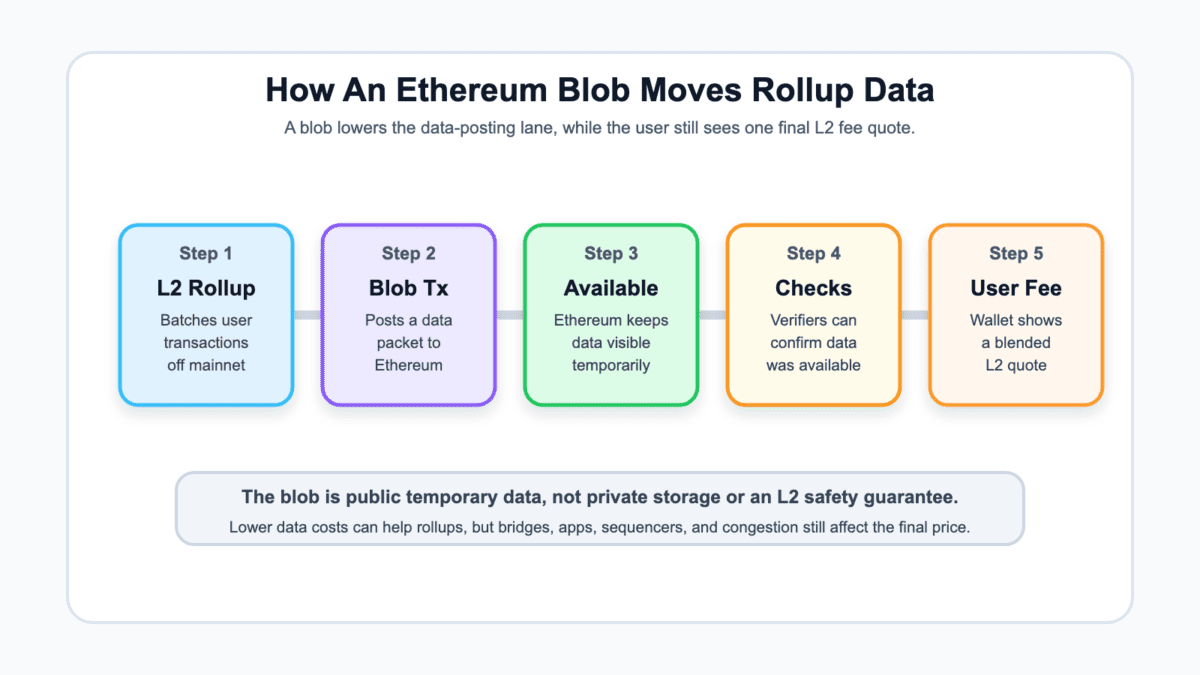
That EVM split explains the design. Normal smart-contract calldata can be read by contracts during execution. Blob data sits beside the execution layer, so it works for rollup data availability rather than direct contract logic.
KZG commitments are the cryptographic glue. You do not need the math to use an L2. The simple version: commitments let Ethereum and verifiers check that a Blob belongs to the transaction without forcing every node to keep the full data forever.
Builders may care about type-3 transactions, sidecars, libraries, and RPC support. Most users only need the user-facing result: the rollup posts data through a Blob, and that data lane can change the cost behind an L2 transaction.
Blob, calldata, Blobspace, blockspace, and Blob gas are related terms, but they do not mean the same thing. Mix them together, and a fee chart turns into soup.
The clean split is this. A Blob is the data packet. Blobspace is Ethereum’s temporary room for those packets. Blob gas prices that room. Calldata is older execution-layer data. Blockspace is the broader scarce space inside blocks.
Use this table when the terms start blending:
| Term | Plain meaning |
|---|---|
| Blob | Temporary data packet attached to a Blob-carrying Ethereum transaction. |
| Calldata | Transaction data stored through the execution layer and kept more permanently. |
| Blobspace | Ethereum’s temporary data-availability capacity for Blobs. |
| Blockspace | Scarce room in blocks for transactions, execution, and included data. |
| Blob Gas | The separate fee lane used to price Blob data. |
| Normal Gas | The fee lane for Ethereum execution and ordinary transaction work. |
Each lane can move differently. Normal Ethereum gas can be calm while Blob gas jumps. Blob gas can be cheap while an L2 app fee still feels high. And a rollup can use Blobs while a bridge or app adds its own charge.
Calldata has not vanished either. It remains relevant for Ethereum transactions, older rollup patterns, fallback choices, and developer analysis. Blobs simply gave rollups a purpose-built data lane that does not require the same permanent storage burden.
So when someone says “Blobs made Ethereum cheap,” translate the sentence carefully. Blobs made a major rollup data cost cheaper. They did not flatten the whole Ethereum fee stack in one move.
Rollups use Blobs because they need to publish verifiable data without paying to store all of it forever as calldata. Blobs fit that job better than the old route.
A rollup processes activity away from Ethereum mainnet. It orders transactions, batches them, and posts enough data back to Ethereum so the result can be checked. That connection keeps the L2 tied to Ethereum instead of drifting into a private database with better branding.
A simple rollup batch might work like this:
This is why Base, Arbitrum, Optimism, and other rollups often appear in Blob discussions. The user may never click a “send Blob” button, but the rollup can use Blobs on the user’s behalf.
Then the market starts talking. Cheaper rollup data can become a crypto meta around L2 scaling, ETH usefulness, or new app activity. That narrative can be useful, but it is not proof that every related token or app is worth touching.
Rollups also have choices. Some designs may use calldata, Blobs, another data-availability route, or a mix depending on cost, security, and technical constraints. So “this is an L2” does not automatically mean “it uses Blobs in the way you expect.”
Keep the takeaway narrower. Blobs give rollups a cheaper Ethereum data lane. They improve one infrastructure problem, while rollup design still decides how much of that benefit reaches users.
Blobs affect L2 fees by lowering the rollup’s data-posting cost, which is one part of the final price users see. They do not control every line inside a wallet quote.
This is the main practical misunderstanding. A rollup may pay less to publish data to Ethereum, but the user still sees a blended quote. That quote can include L2 execution, sequencer pricing, bridge routing, liquidity conditions, app fees, and congestion.
The fee stack is easier to read when separated:
| Fee component | Why it can still affect the quote |
|---|---|
| Rollup data posting | Blobs can lower this input compared with calldata. |
| L2 execution | The rollup still processes your transaction. |
| Sequencer pricing | The operator may smooth, subsidize, or mark up costs. |
| Bridge route | A bridge can add its own fee or use a costly path. |
| App fee | A swap, mint, or market can charge separately. |
| Congestion | Busy periods can raise costs even when Blob gas is low. |
That is why a cheap Blob gas chart may not match your wallet screen. The chart can be telling the truth while another part of the route adds the cost.
Before blaming Blobs for an expensive L2 transaction, check the full path:
That check saves time. It can also prevent a bad trade. If you assume every L2 fee move comes from Blob gas, you may misread the rollup’s margins, user demand, or app-level pricing.
Read the signal narrowly. Blobs made a large rollup cost input cheaper. The final transaction cost still depends on the route, the rollup, the app, and how crowded the lane is when you use it.
Blobs mean ETH investors have to separate usefulness from fee burn. Cheaper Blobspace can help L2 activity grow, but low Blob fees can also reduce near-term burn compared with hotter fee periods.
That tension is why Blob debates get loud. ETH holders want Ethereum to be useful, scalable, and economically valuable. Blobs help the usefulness side by making rollup data cheaper. But if that data stays very cheap, the burn story can feel less exciting.
The tradeoff looks like this:
This is where ETH holder culture can turn a technical fee lane into a mood ring. One camp sees cheap Blobs as Ethereum finally scaling. Another sees weak Blob fees and worries about value capture. Both can be partly right.
Roadmap work such as Pectra and PeerDAS fits this debate because capacity can change over time. More capacity can make rollup data cheaper. It can also make fee signals harder to read unless demand grows with the new room.
None of this is a clean price prediction. ETH value depends on usage, issuance, staking, liquidity, risk appetite, regulation, and broader market conditions. Blobs are an infrastructure signal. They are not a price candle with better manners.
Blobs do not solve bridge risk, centralized sequencers, upgrade keys, liquidity fragmentation, app scams, or bad token design. Lower data cost is not the same thing as lower user risk.
This is the section to remember when the market gets excited. A rollup can use Blobs and still have a bridge with trust assumptions. It can have cheap fees and still rely on a centralized sequencer. It can have growing activity and still host apps that do not deserve your funds.
> Lower data costs can help an L2, but they do not make custody, bridges, apps, or tokens safe by default.
The practical risk list is blunt:
That is why wallet safety still belongs in any L2 workflow. Check permissions, bridge routes, withdrawal assumptions, and where your assets sit. A cheaper data lane does not protect a careless token approval.
The same caution applies to trades. If a new L2 narrative gets loud, users can become someone else’s exit liquidity while telling themselves they are “playing the Blob meta.” The infrastructure may be real. The trade can still be dreadful.
Blobs reduce one cost burden for rollups. They do not certify decentralization, safety, liquidity depth, or token value. Keep those checks separate, because the market loves bundling unrelated claims into one shiny chart.
Ethereum Blobs are temporary, but they are not private. Temporary availability means the data does not need to remain on Ethereum nodes forever. It does not mean the data was hidden.
This is an easy mistake to make. A Blob can be public while it is available, and third parties may capture, index, or archive the data. If sensitive information appears in public Blob data, later pruning does not undo the exposure.
> Temporary does not mean secret. Do not put private wallet data, identity details, trading strategy data, or sensitive app information in public Blob data.
The permanence question has two sides. Ethereum’s design lets nodes prune old Blob data after the availability window. But rollup operators, explorers, indexers, researchers, and archives may keep copies for analysis, dispute support, or product features.
A Blob is best understood as temporary Ethereum data availability, not disappearing ink. It is available long enough for rollups and verifiers to do their job. After that, the base network does not need every node to keep carrying the full Blob history.
For most people, the rule is simple. Do not use direct Blob demos as private upload tools. If a tool asks you to post arbitrary data through Ethereum, assume the data can become public and persistent elsewhere.
That boundary is good design, not a flaw. Blobs exist to help rollups make data checkable without permanent calldata costs. They were not built to replace encrypted storage, private messaging, or careful wallet hygiene.
You can check Ethereum Blobs through explorers and dashboards, but one snapshot is not a full investment signal. Start with the question you are trying to answer.
If you want to understand a transaction, use an explorer that shows Blob transactions. If you want to inspect rollup costs, use rollup cost dashboards. And if you are building with type-3 transactions, use official developer materials rather than a random social post with half the code missing.
Use this quick checklist:
The last point saves headaches. Dashboards may show base fee, total cost, per-Blob cost, per-byte cost, rollup spend, or delayed indexed data. Each view answers a different question.
Also watch the time window. Blobs are temporary at the base layer, while explorers and archives may preserve copies. A dashboard can help with current activity, but it should not be your only source for a trade, bridge choice, or risk call.
For day-to-day use, that check is enough. Ask whether Blobs explain the specific cost you are seeing, or whether another fee component is responsible. The second answer is common. Crypto rarely misses a chance to add another fee line.
A Blob in Ethereum is a temporary data packet attached to a special transaction type, mainly used by rollups to post data to Ethereum more cheaply than calldata.
Most users experience Blobs indirectly. They use an L2, while the rollup handles Blob posting behind the scenes.
No. A Blob is the temporary data packet, while Blobspace is Ethereum’s temporary capacity for those packets.
Blob gas prices access to Blobspace. That separate fee lane is why Blob costs can move differently from normal Ethereum gas.
Blobs can make some L2 transactions cheaper by lowering rollup data-posting costs. They do not make normal Ethereum L1 execution gas cheaper by themselves.
Your final fee can still include L2 execution, sequencer policy, bridge fees, app fees, congestion, and route costs.
Usually no. Normal users mostly feel Blobs through rollups, which may post Blob data after batching many L2 transactions.
Direct Blob transactions are mainly a builder or infrastructure topic. If you are just using an L2 app, the rollup usually handles that layer.
No. Ethereum Blobs are temporary, but they are public while available and may be archived by third parties.
Do not put sensitive information in Blob data. Pruning by Ethereum nodes later does not guarantee that nobody saved a copy.
Start with the role Blobs play, not the upgrade jargon. A Blob is temporary Ethereum data used mainly by rollups. That sentence prevents most bad takes.
Then check the fee stack before making a claim:
If you are using an L2, compare the wallet quote with the route. A cheap Blob market will not save a bridge path that adds its own cost, an app that charges extra, or a congested L2 pricing users aggressively.
If you are watching ETH, separate activity from burn. Low Blob fees can be good for rollup use and dull for fee-burn charts at the same time. That is not a contradiction. It is the tradeoff Ethereum chose by scaling data capacity.
If you are building, stay close to official developer materials before sending type-3 transactions. Blob formats, library support, and RPC behavior can change faster than beginner explainers should pretend.
For users, Blobs are mostly a hidden cost input. For rollups, they are a cheaper way to publish data. For ETH investors, they are a useful but messy signal about scaling, demand, and fee burn.
That is enough to read the next Blob chart with less panic. It will not make the jargon pretty. It will make it less expensive.