Physical Address
304 North Cardinal St.
Dorchester Center, MA 02124
Physical Address
304 North Cardinal St.
Dorchester Center, MA 02124


A practical guide to the costs and limits of censorship-resistant crypto routes.
Censorship resistance trade means choosing crypto rails that are harder to block, then paying for that choice with more cost, delay, responsibility, and inconvenience.
In this phrase, “trade” means tradeoff. It is not a chart setup, an arbitrage trick, or a magic route around every rule. You move closer to open networks, self-custody, DEXs, privacy tools, and direct protocol access. In return, you give up some speed, support, liquidity, and easy recovery. Useful, yes. Easy to overdo.
Censorship resistance trade means accepting friction so one company, app, exchange, bank, or infrastructure provider has less power to stop your transaction. Plainly, you are buying more access resilience with less convenience.
That is different from using “censorship-resistant trading” as a slogan. A DEX swap, Bitcoin withdrawal, or privacy-coin transfer can be harder to block than a custodial exchange order. But none of those routes makes you invisible, immune to bad fills, or free from laws.
Censorship resistance is a spectrum. A system is more censorship resistant when no single actor can easily stop valid transactions from being included, settled, or accessed.
Censorship proof is a much stronger claim. In real crypto use, that claim usually breaks down once you inspect the full route. You may control the wallet, but the app can geoblock. The smart contract may be live, but the RPC can fail. The stablecoin may move on-chain, but the issuer or off-ramp can still intervene. That difference changes how you plan.
The trade exists because the conveniences users like often create gatekeepers. Fast account login, customer support, fraud review, fiat deposits, tax reports, and easy password resets all require someone to operate a service.
Open crypto rails reduce some of that control, then hand more responsibility back to you. So the censorship resistance trade is not “freedom good, convenience bad.” It is a risk swap.
You reduce account freezes, withdrawal blocks, and venue dependence. In return, you accept keys, fees, delays, and less help when something goes sideways.
The censorship resistance trade shows up whenever your crypto route depends on more than the chain itself. You may think you own an asset, but the route can still depend on an exchange account, a withdrawal queue, a hosted website, a wallet app, a bridge, and a bank.
Stress makes those gates visible. Exchanges can pause withdrawals. Apps can block regions. Banks can refuse transfers. Payment rails can narrow. A chain can keep producing blocks while the easiest route into or out of that chain stops working. Here is the simple contrast:
Neither route wins every time. A custodial app may be safer for a first small purchase because it offers support and records. A self-custody wallet may be safer for long-term holding because no exchange account stands between you and withdrawal.
The trade gets sharper for traders. If you need to move during a volatile market, a permissionless route can still function when an account-based route blocks you. But the same route may be slower, more expensive, and less liquid right when every second is costly.
Censorship resistance gives you fewer permission checks. It does not give you better execution by default.
The censorship resistance trade can protect access to valid transactions and open protocols. It cannot protect you from every bad outcome in crypto. Beginners save themselves trouble by keeping that line clear.
Think in layers. Custody is who controls the asset. Inclusion is whether the network can process your transaction. Service access is whether an app, exchange, issuer, or bank lets you use its rails. That split is the difference between a network that can process your transaction and a service that will actually help you use it.
| Protects Against | Still Does Not Fix |
|---|---|
| One exchange blocking your withdrawal | A lost seed phrase |
| One hosted frontend refusing access | A scam transaction you signed |
| One RPC provider failing or filtering | Token volatility |
| A single custodian freezing an account | Tax, reporting, or record-keeping duties |
| A sequencer delaying fast L2 execution forever | Bad liquidity or wide slippage |
| A bank refusing a fiat transfer | Guaranteed cash-out access |
The table shows why the phrase needs limits. A censorship-resistant blockchain can help a valid transaction find a path to inclusion. It cannot reverse an approval you signed, refund a bridge mistake, or add depth to a thin market.
Self-custody is a good example. It can remove exchange custody risk. It also makes you the recovery department, fraud department, and midnight panic desk. Very modern. Very unforgiving.
So use censorship resistance as a route property, not a safety blanket. Ask what it protects, then ask what it leaves exposed.
The censorship resistance trade costs real convenience. Moving away from a custodial account usually means more steps, more fees, more personal responsibility, and fewer people to call when something breaks.
The cost depends on the route. With Bitcoin self-custody, you may accept slower settlement and key-management risk. With Ethereum mainnet, you may accept gas spikes. With an L2 DEX, you may accept sequencer and bridge timing. With a privacy coin, you may accept thinner liquidity and fewer exchange venues.
Wallet choice becomes part of the trade. If you are leaving a custodial account, you need wallets that fit the job, not just the cleanest app icon.
| Route | Main Tradeoff |
|---|---|
| CEX account | Easy fiat, records, and support, but account controls and withdrawal pauses |
| Self-custody BTC | Direct control, but slower settlement and irreversible key mistakes |
| Ethereum mainnet | Strong settlement access, but gas and priority fees can spike |
| L2 DEX | Faster and cheaper trades, but sequencer and bridge timing matter |
| Privacy coin | Better fungibility, but thinner exchange access and liquidity |
| Stablecoin transfer | Fast dollar-like movement, but issuer and off-ramp controls remain |
| Bridge route | Cross-chain access, but bridge delay, contract risk, and exit limits |
The cost side is easy to ignore when markets are quiet. It gets loud when fees spike, a bridge queues exits, or a DEX route slips more than expected.
There is also an operational cost. You need backups, test transactions, separate wallets, approval hygiene, and records. Censorship resistance asks you to act more like an operator and less like a customer.
That is not bad. It is just the bill.
The censorship resistance trade breaks down when users inspect only the blockchain and ignore the rest of the route. A transaction can be valid on an open network while another layer blocks access, delays execution, freezes an asset, or refuses cash-out.
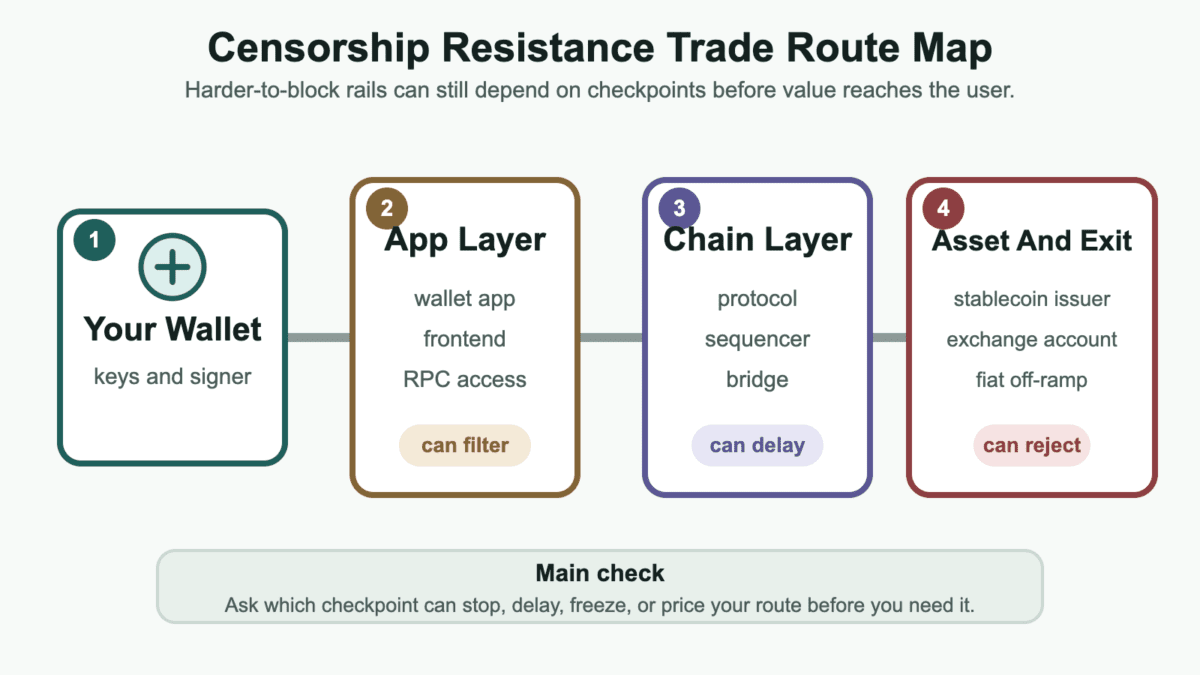
Exchanges are convenient because they bundle custody, trading, fiat rails, support, and records. That bundle is also the control point. KYC, sanctions screening, compliance reviews, and withdrawal queues can all decide whether your trade route keeps moving.
That bundle is not automatically bad. Many users need records, support, and safer fiat rails more than they need direct protocol access. But if your goal is censorship resistance, a CEX account is not the end of the analysis.
Wallet apps and hosted frontends can block regions or remove features even when the underlying contract still exists. RPC providers can fail, filter, or throttle requests. The protocol may be open, but your normal doorway may be closed.
Self-custody also makes wallet activity public on many chains. Tiny unsolicited transfers, spam tokens, and address clutter can show up without your consent. That is where dust in crypto becomes more than trivia, because a public wallet can collect noise that a custodial account hides from view.
L2s make trading cheaper and faster, but many depend on sequencers for quick ordering. If the sequencer delays or refuses a transaction, the chain may still have an escape path through the base layer.
That escape path can be slow. On Arbitrum, a user can bypass the sequencer through the delayed inbox, and Arbitrum’s transaction lifecycle guide says force inclusion becomes available if 24 hours pass without processing. That is valuable censorship resistance, but it is not the same as instant execution during a liquidation.
Validators and miners decide block inclusion inside the protocol rules. They can be influenced by fees, relay choices, MEV opportunities, and network conditions. A valid transaction may still wait behind more profitable or higher-priority transactions.
For a long-term transfer, delay may be annoying. For a perp position, liquidation, auction, or volatile token exit, delay can change the outcome. Eventually included is not the same as well executed.
Stablecoins add another layer. A stablecoin can move on a permissionless chain while the issuer, exchange, or off-ramp remains permissioned.
That means the chain may process your transfer, but the exit can still fail. You may not get the bank transfer, card spend, exchange withdrawal, or merchant payment you expected. Crypto rails can reduce one gatekeeper while leaving the final door guarded.
Before trusting any route, check the choke points:
The route is only as censorship resistant as its weakest required step.
The censorship resistance trade changes DeFi risk by moving the problem from account permission to execution quality. You may avoid a login gate, but you still face liquidity, timing, MEV, gas, oracle, and bridge risk.
For traders, the shift shows up in execution. A DEX can be open to your wallet and still give you a terrible fill. An L2 can be cheap and fast until the sequencer, bridge, or oracle timing becomes the bottleneck. A perps venue can be permissionless and still liquidate you with brutal efficiency.
| Route | What To Check Before Trading |
|---|---|
| Mainnet DEX swap | Gas cost, minimum received, pool depth, and MEV exposure |
| L2 DEX swap | Sequencer status, bridge exit timing, liquidity, and oracle freshness |
| Perp DEX | Funding, liquidation engine, oracle path, margin rules, and venue controls |
| Thin long-tail pool | Slippage, token taxes, exit size, and whether buyers actually exist |
| Bridge-assisted route | Bridge delay, supported assets, fees, and emergency exit path |
Liquidity is the first real limit. If the pool is shallow, the route may be permissionless in theory and painful in practice. Thin markets can turn you into exit liquidity before you finish admiring the decentralization.
MEV is the second limit. Visible transactions can be reordered, sandwiched, or competed against. That does not mean every DEX trade is doomed. It means a censorship-resistant venue can still feel like PVP trading when everyone sees the same flow and faster actors have better tooling.
Timing is the third limit. A transaction that can eventually be included may still miss the trade, fail the liquidation defense, or settle after the price moved. This is why “harder to censor” and “better execution” must stay separate in your head.
Use permissionless routes when access is the problem. Use execution checks when price, size, and timing are the problem.
A censorship resistance trade is worth the friction when the main risk is being blocked by a custodian, app, payment rail, or local access point. The benefit is situational. It is not a badge of purity.
The case gets stronger when you need asset control more than hand-holding. It also gets stronger when your route would otherwise depend on one account, one bank, one exchange, or one hosted app at the worst possible moment.
Consider the harder route when these signals show up:
Those signals do not make the route risk-free. They only make the cost easier to justify.
A good example is long-term BTC storage. If your main risk is an exchange withdrawal freeze, self-custody can make sense. If your main risk is losing a seed phrase, a regulated account with support may be safer until you know what you are doing.
Another example is a DEX-only asset. If there is no credible CEX market, permissionless access may be the only route. But you still need to check liquidity, contract risk, approvals, and whether you can exit without moving the market against yourself.
The friction is worth paying only when it reduces the risk that can hurt you first.
A centralized route can beat the censorship resistance trade when support, records, fiat access, and mistake recovery matter more than direct protocol access. Beginners often underestimate that side because self-custody sounds cleaner than it feels at 2 a.m.
For small balances, a CEX may be the simpler tool. You get account statements, familiar order forms, tax exports, customer support, and easier fiat deposits. Those are real benefits, even if crypto culture sometimes talks about them like training wheels with paperwork.
A centralized route may be safer when:
Scale changes the answer too. A small first purchase may need clean records and a support desk more than direct settlement. A larger long-term position may need withdrawal access, self-custody practice, and a backup route before the exchange becomes the bottleneck.
The tradeoff is that the same route can add account freezes, withdrawal limits, KYC reviews, and service outages. That is the price of outsourcing custody and access.
Use the route that fits the first serious risk. If the first serious risk is your own operational mistake, centralization may help. If the first serious risk is a gatekeeper blocking access, censorship-resistant rails may help.
Censorship resistance trade examples work best when you follow the asset from holding to exit. The same asset can be easy to buy, hard to withdraw, simple to trade, or painful to cash out depending on where it sits.
Bitcoin shows the custody version. BTC on an exchange gives speed, a login, and fiat rails. BTC in self-custody gives direct control, but you now own confirmation timing, address checks, key backups, and transaction fees.
DeFi shows the venue version. An unlisted token may trade only through a DEX. That can give open access, but it may also mean thin pools, unknown contracts, weak market makers, and no support desk. A permissionless swap button is not a quality seal.
L2 trading shows the timing version. An L2 DEX may be cheap enough for active trading. But if sequencer ordering, bridge exits, or oracle updates become the bottleneck, the censorship resistance trade shifts from “can I trade?” to “can I trade in time?”
Privacy coins show the fungibility version. A privacy coin can make it harder to track transaction history and discriminate against specific coins. The tradeoff is access. Fewer venues, thinner books, and more compliance pressure can make buying, selling, or reporting the position harder.
Stablecoins show the asset-control version. A stablecoin transfer can move quickly across a public chain. But the token can still depend on an issuer, exchange, and fiat off-ramp. The rail may be open while the dollar exit remains permissioned.
Each example teaches the same lesson:
The censorship resistance trade is not one decision. It is a route-by-route inspection.
Start with the censorship resistance trade by mapping the route before moving serious funds. Do not begin with ideology. Begin with where the asset sits, who can stop it, and what you would do if the easy path failed.
Start small. Make a test withdrawal, test a wallet backup, inspect a DEX route, and learn the off-ramp before a stressful market forces you to improvise. Panic is a poor operations manual.
Write the route down in plain words. “Exchange to wallet to L2 bridge to DEX to stablecoin to bank” is already enough to reveal several gates. Then ask which one would fail first if the market moved fast, your region was blocked, or the app you normally use went down.
Use this checklist before choosing the harder route:
Then decide what the tradeoff buys you. If it removes a gatekeeper you genuinely worry about, the friction may be worth it. If it only makes a simple task harder, use the simpler route and keep learning.
For larger balances, split the job. Keep long-term storage boring. Keep trading wallets small. Keep off-ramp tests current enough that you are not discovering limits during a withdrawal freeze or gas spike.
The goal is not maximum difficulty. The goal is fewer fragile dependencies where they actually matter.
No. Censorship resistance trade is not a chart setup or arbitrage method. It means the tradeoff of using harder-to-block crypto routes while accepting more friction, cost, delay, and responsibility.
If someone uses the phrase around trading, they usually mean the route, not the signal. A DEX swap, self-custody withdrawal, or privacy-coin transfer can reduce one gatekeeper. It does not tell you when to buy or sell.
Censorship resistance trade means choosing crypto rails that reduce one party’s power to block a transaction. The cost is usually worse convenience, weaker support, higher operational burden, or thinner liquidity.
That is why the phrase works better as a tradeoff than as a slogan. You are not asking whether a route is perfectly free from control. You are asking which control point you reduce and which new risk you accept.
Bitcoin transactions can be delayed, priced out by fees, or affected by infrastructure choices, but the network is designed so no single company controls valid transaction inclusion. The censorship resistance trade appears when you withdraw from a custodian and accept self-custody risk.
BTC on an exchange is easier to trade and cash out. BTC in your own wallet reduces exchange custody risk, but you must handle addresses, backups, fees, and confirmation timing yourself.
Yes, DEXs can be part of the censorship resistance trade because they reduce account-based access controls. But they still have risks, including frontend blocks, RPC failures, smart contract bugs, slippage, MEV, and weak liquidity.
The protocol may be open while the easiest website is not. Serious users should know a backup access path, check liquidity before sizing up, and avoid assuming a permissionless venue is a safe venue.
An L2 sequencer can delay or fail to include a transaction in the fast path, depending on the network design. Some rollups have fallback routes through a base layer, but that delay can still hurt active trades.
That is the difference between eventual access and timely execution. If you are defending a liquidation, exiting a thin pool, or moving through a bridge, a fallback path may be useful but still too slow for the trade you wanted.
A stablecoin can use a permissionless chain while still depending on an issuer, exchange, and fiat off-ramp. That makes it useful for transfers, but not fully censorship resistant across the whole route.
The chain may process the transaction, yet the issuer, venue, or bank can still shape the outcome. Stablecoins are powerful payment tools, but they are not the same as bearer cash in a self-custody wallet.