Physical Address
304 North Cardinal St.
Dorchester Center, MA 02124
Physical Address
304 North Cardinal St.
Dorchester Center, MA 02124


A plain-English guide to complete bonding, Pump.fun graduation, and post-curve risk.
Complete bonding in crypto means a launchpad token’s bonding curve has reached its completion condition and is moving into the next trading phase.
You will usually see it around Pump.fun, Solana memecoins, progress bars, graduation alerts, and traders saying a token “bonded” or “completed the curve.”
That sounds like a finish line. It is closer to a venue change with a crowd standing around it: useful, noisy, and not automatically safer.
Complete bonding means the bonding-curve phase has ended, so the token is ready for its next platform-defined market state. In current crypto usage, that phrase usually belongs to launchpad tokens. It is not staking, validator bonding, or team vesting.
A bonding curve is the pricing path before completion. Buyers and sellers trade against it until the platform’s condition is met. After that, the token can graduate, migrate, or trade through a different market setup.
Start with the translation:
Launchpad traders compress several states into chat-speed labels. You may see “bonded,” “curve complete,” “complete the curve,” “graduated,” and “migration” in the same conversation. Those labels are related, but they are not always identical.
For a trader, the difference decides what to check next. If the curve is only complete, you still need to confirm the live venue. If migration already happened, your attention shifts to pool depth, slippage, holder behavior, and whether the first rush created a real market or only a cleaner exit lane.
That is the line worth keeping on screen. Complete bonding is a milestone, not a safety badge. It shows a mechanical condition was reached. It does not verify the creator, clean up wallet concentration, deepen liquidity, or stop early buyers from selling.
Complete bonding on Pump.fun is the move from launchpad-curve trading toward graduated trading. A token starts on a bonding curve. Traders buy and sell against that curve, progress reaches the completion condition, and the token moves toward the post-curve venue.
That lifecycle is why the term shows up so often in memecoin launchpad culture. Traders watch progress bars to catch the final stretch, sell into graduation attention, or avoid being late to a crowded trade. If you spend time trading in the trenches, these alerts become part of the background noise.
Current Pump.fun wording explains why Raydium and PumpSwap get mixed together. Older guides and older community threads often talk about Raydium migration. As of May 21, 2026, Pump.fun lists bonding-curve trades at a 1.25% total fee and describes graduated coins as having canonical PumpSwap pools with market-cap-based fee tiers. So current venue language points at PumpSwap, while older guides can still sound Raydium-era.
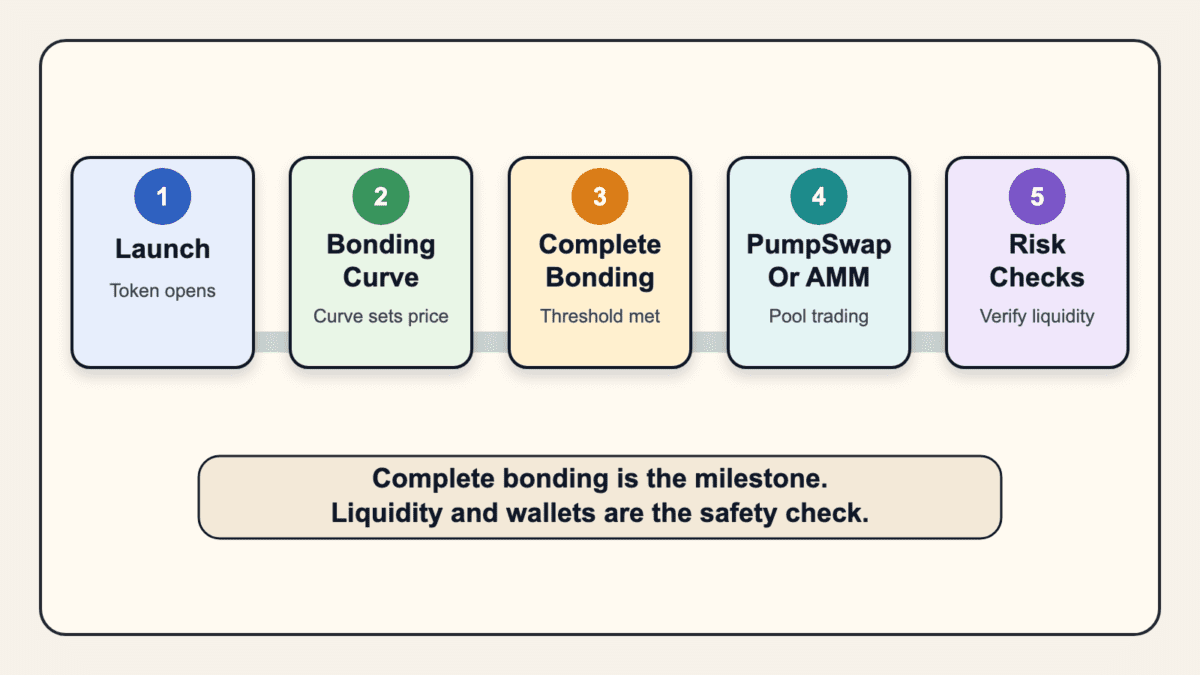
Read the process as stages, not curve math.
| Stage | What Changes For Traders |
|---|---|
| Launch | The token opens on the launchpad and early trades start forming the curve. |
| Bonding Curve Trading | Buys and sells affect the launchpad curve before the token graduates. |
| Complete Bonding | The curve reaches its completion condition and the token enters a transition state. |
| PumpSwap Or AMM Trading | Trading moves toward an AMM-style pool, depending on the platform route. |
| Post-Completion Checks | Traders verify venue, pool address, liquidity depth, holders, and slippage. |
Each launchpad can set its own route. Pump.fun is one major context for this term, but complete bonding remains platform-specific. If a tool shows a token as complete, confirm what that status means inside that tool before clicking the next trade button.
After complete bonding, a token can move from curve-based trading into AMM-style trading. That changes price formation, liquidity behavior, chart routing, and the execution risks you face as a buyer or seller.
During the bonding phase, the curve itself drives pricing. After graduation or migration, trading usually depends more on pool liquidity, arbitrage, live buy-sell flow, and slippage. The token may look like one continuous chart, but the market plumbing changed underneath.
A before-and-after view keeps the trade risk easier to read.
| Before Complete Bonding | After Complete Bonding |
|---|---|
| Trades route through the launchpad curve. | Trades may route through PumpSwap or another AMM venue. |
| The curve controls the price path. | Pool depth and live order flow shape price impact. |
| The progress bar is the main milestone. | The pool address and venue become more important. |
| A late buy can face steep curve pricing. | A late buy can face thin liquidity and fast selling. |
| Some tools focus on curve progress. | Trackers may need to follow the post-curve pool. |
For holders, token identity still comes back to the mint address. The question is not whether the ticker changed. It is where this exact token now trades, and whether the pool matches the token you meant to buy or sell.
This is why charts can feel strange around complete bonding. One tool may update quickly. Another may lag. A copied DEX link may point at the wrong pool. A fake ticker can look close enough to trap rushed buyers.
So follow the mint, not the mood. If the mint, launchpad page, pool address, and venue label do not line up, wait. The market will still be chaotic five minutes from now.
Complete bonding does not make a token safe. It only proves the curve reached a platform condition. It does not prove honest creators, broad holder distribution, real volume, deep liquidity, or lasting demand.
The milestone can remove one narrow uncertainty: the token made it through the curve phase. That gives you a useful status signal. But it does not stop early buyers from selling into new attention, and it does not prevent wallet clusters from controlling a large share of supply.
> A completed curve can still leave you buying someone else’s exit.
Late buyers near or after complete bonding can become exit liquidity for earlier wallets. That can happen even when the launchpad process works exactly as designed. The system can function, and your trade can still be badly timed.
Before you call completion bullish, check for danger signs:
A completed curve also does not remove rug risk. A hard rug is a destructive break in market trust, such as draining liquidity or abusing mint controls. Complete bonding may change which paths are possible on a specific platform, but it does not certify the project.
A slower sell-off can hurt just as much. A team can keep posting, sell gradually, rotate wallets, and let the chart bleed while pretending everything is normal. Complete bonding only tells you the launch phase hit a milestone. The safety check still sits in wallets, liquidity, permissions, and behavior after the crowd arrives.
Complete bonding, bonding curve, and graduation describe different points in the same launchpad lifecycle. People use them loosely in chats, but the differences matter when you are trying to trade the right state.
The bonding curve is the mechanism before completion. Complete bonding is the status where that curve reaches the platform condition. Graduation is the move into the next recognized phase, which may include PumpSwap or another AMM-style venue depending on the platform.
| Term | Meaning In This Context |
|---|---|
| Bonding Curve | The launchpad pricing path used before the token completes. |
| Complete Bonding | The curve reached the platform’s completion condition. |
| Bonded | Community shorthand for a token that completed its curve. |
| Graduation | The token qualified for the next launchpad or market phase. |
| Migration | Trading or liquidity moved into the destination venue. |
| Liquidity Pool | The post-curve pool that supports AMM trading. |
| AMM | The automated market maker model used after many migrations. |
| PumpSwap | A common current Pump.fun post-graduation venue context. |
| Raydium | A venue often named in older Pump.fun migration material. |
Use the table as a quick translation layer, then verify the live platform state. A label in a chat is helpful only if the venue, pool, and token identity agree.
The table is not a universal law. Platforms can change routes, fees, thresholds, and labels. Data tools can also split states more finely than social posts do.
So precise language helps. If someone says “bonded,” ask what is actually live: the completion status, the graduation event, or the pool where trading now happens.
Before buying near complete bonding, run checks that show whether the token, venue, liquidity, and wallet picture make sense. The goal is not to predict the next candle. The goal is to avoid obvious bad fills and fake confidence.
Start with identity. Match the token mint across the launchpad, explorer, and trading interface. Then confirm the current state: still bonding, complete but transitioning, or already trading through a post-curve pool.
This checklist starts with the things that can wreck the trade before price even matters.
| Check | What It Tells You |
|---|---|
| Current Status | Whether the token is bonding, complete, graduated, or already trading in a pool. |
| Mint Address | Whether you are looking at the correct token instead of a copycat. |
| Pool Address | Whether the post-curve trading venue is real and matched to the token. |
| Liquidity Depth | Whether the pool can absorb your trade without brutal price impact. |
| Trade Size | Whether your order is too large for the live market. |
| Slippage Setting | Whether your wallet may accept a worse fill than expected. |
| Holder Spread | Whether a few wallets can dominate exits. |
| Creator Wallet | Whether the creator is adding confidence or selling into buyers. |
| Bundle Signs | Whether early supply may be concentrated through coordinated wallets. |
| Volume Quality | Whether activity looks organic or manufactured. |
| First Post-Curve Candles | Whether the chart survives after the graduation attention spike. |
Only then look at price. A trade can be directionally right and still be executed badly. Poor slippage, wrong pool routing, and thin liquidity can turn a decent idea into an instant donation.
Bots and trading terminals can make complete bonding feel like a speed contest. Sometimes it is. But speed without verification is just panic with a transaction signature.
If you cannot confirm the venue or pool, do not guess. If your planned trade size overwhelms pool depth, reduce it or skip it. If early wallets are already unloading, the progress bar may be telling you where the exit door is, not where the opportunity starts.
Keep records if you trade both phases. A token can move from a curve to a pool, and your wallet history may span both venues. Clean records help with tracking, tax review, and any later look at what actually happened.
Common complete bonding mistakes start when users treat a platform milestone like a market guarantee. The phrase sounds official, so it can feel like safety, profit, or clean liquidity. By itself, it gives you none of those.
The first mistake is chasing fixed threshold claims. Different guides, terminals, and old threads may show different numbers because platform rules, SOL price, paired assets, market-cap displays, and calculation methods can differ. The clean answer is simple: the curve completes when that platform’s current condition is met.
Side by side, the common traps are easier to spot:
| Mistake | Better Read |
|---|---|
| “Complete bonding means safe.” | It means a curve condition was reached. Safety still needs checks. |
| “Graduation means profit.” | It can also give early holders a better exit. |
| “All migrated tokens use the same venue.” | Venue rules can change by platform and date. |
| “The final stretch is easy money.” | It can be crowded, botted, and slippage-heavy. |
| “A completed curve cannot rug.” | Wallets, liquidity, permissions, and selling behavior still matter. |
The second mistake is assuming every completed token goes to the same venue. Older Pump.fun material often says Raydium. Newer material often points to PumpSwap. Other launchpads can use different routes. If the article, chart, and tool disagree, check the platform state instead of picking the answer that confirms your trade.
The third mistake is calling every post-completion dump a rug. Sometimes it is a soft rug pattern. Sometimes it is just early buyers selling, hype cooling, or liquidity being too thin for the number of people trying to exit.
Let complete bonding slow you down, not speed you up. The final stretch can be exciting, but a progress bar is not a risk model. It is one signal inside a much messier trade.
Related terms for complete bonding traders are useful only when they explain behavior around the milestone. Here, the useful thread is attention, liquidity, and wallet incentives colliding in public.
Late-buyer liquidity pressure is the plain version: newer buyers absorb earlier sellers. That can happen right after complete bonding because the token has more visibility and more people are watching the same alert.
Bagholder risk appears when someone keeps holding after the attention spike fades, liquidity thins, and the market stops caring. A completed curve does not protect you from that state.
A hard rug is abrupt and destructive, while slower sell-offs are often wrapped in updates, excuses, and social noise. Complete bonding can come before several of those outcomes.
Launchpad slang adds the cultural layer. Traders say bonded, graduated, bundled, and final stretch because these markets move fast and punish slow interpretation. The vocabulary helps, but the mechanics matter more.
Complete bonding means a launchpad token’s bonding curve reached its completion condition. The token is then ready for the next platform-defined trading phase, such as graduation or AMM-style trading.
It does not mean the token is safe, fairly distributed, or guaranteed to keep going up. It only describes the launchpad lifecycle state.
When a Pump.fun token completes bonding, the token moves out of the bonding-curve phase and toward the post-curve trading setup. In current Pump.fun context, users often see PumpSwap language around graduated tokens.
Older guides and threads may still mention Raydium. That is why you should check the live launchpad state and destination pool instead of relying on an old rule.
Complete bonding and graduation are closely related, but they are not always the same label. Complete bonding means the curve reached its condition, while graduation usually means the token qualified for the next market phase.
Some tools blur the terms. For trades, verify the actual state, venue, mint, and pool address before acting.
No, complete bonding does not mean a token is safe. It does not prove honest creators, clean holder distribution, deep liquidity, or real demand.
It can mark a useful lifecycle event, but the real checks still happen after that: wallets, pool depth, slippage, trade routing, and whether early holders are selling.
Yes, a token can dump after complete bonding. Early buyers may sell into new attention, bots may crowd the transition, and thin liquidity can make price moves sharper.
Completion can attract buyers, but it can also create the exit window those early buyers wanted. That is the awkward part, and it is not rare.
Complete bonding does not always send a token to one universal venue. Older Pump.fun material often mentions Raydium, while current Pump.fun context commonly points to PumpSwap after graduation.
The correct answer is platform-specific and time-specific. Check the launchpad page, token mint, venue label, and destination pool before trading.