Physical Address
304 North Cardinal St.
Dorchester Center, MA 02124
Physical Address
304 North Cardinal St.
Dorchester Center, MA 02124


Cross-chain intent makes routes easier, not risk-free.
A cross-chain intent is a signed crypto request that states the result you want on another chain.
Instead of choosing every bridge, swap, gas token, and route yourself, you sign constraints. The system then asks solvers or fillers to deliver that outcome. The cleaner button helps, but it still deserves a receipt, a price check, and a refund path.
Cross-chain intent in crypto means you tell a system the final result you want, then let specialized actors compete to make it happen. You might want 1,000 USDC from Arbitrum to arrive as USDC on Base, with a set recipient, minimum output, and deadline.
That is different from a vague wish. A real intent has constraints the system can verify. It says what asset starts the route, what asset should land, where it should land, who receives it, how much must arrive, and when the order should expire.
The user-facing promise is simple:
That makes cross-chain intent a route model, not magic. It does not make chains merge. It does not make liquidity infinite. It just moves the route work from the user into a market of systems that try to satisfy the signed request.
The phrase also gets stretched by marketing. When a wallet says “intent,” ask whether you can see the destination chain, output token, recipient, minimum received, expiry, fee, and refund path. If those details are hidden, the nice button may be doing a lot of trust-me tap dancing.
A cross-chain intent works by turning your requested outcome into an order that another actor can fill. The exact steps differ by protocol, but the broad flow is creation, commitment, fill, verification, settlement, and either completion or expiry.
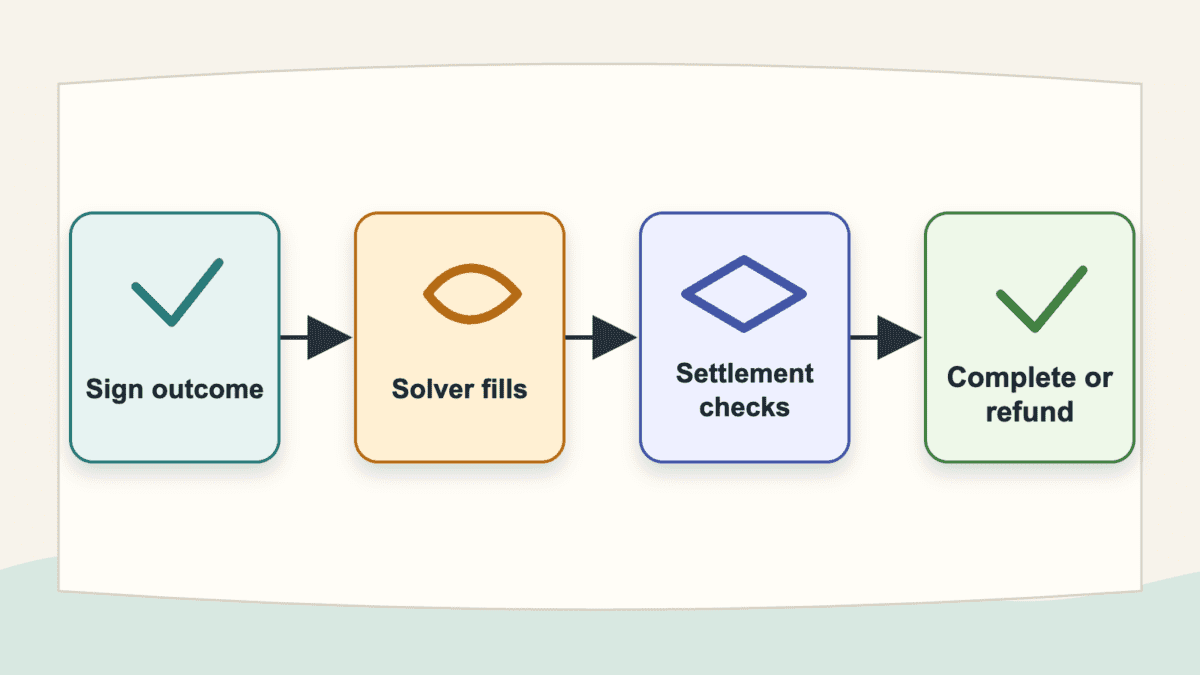
One useful example is a stablecoin route. You hold USDC on Arbitrum and want USDC on Base. You approve the terms, then a solver or relayer may deliver the Base USDC from its own inventory. Settlement later verifies that the fill matched your order and repays the actor that fronted liquidity.
Across uses initiation, fill, and settlement as one implementation model. That is not every product’s exact design, but it is a useful map for what happens after the wallet prompt.
The route usually includes these checks:
The key user detail is the signed constraint. If the destination token, amount, chain, or recipient can drift after signing, you are no longer just outsourcing routing. You are outsourcing judgment. That is where the shiny UX becomes expensive.
A cross-chain intent is fulfilled by actors that can supply destination-chain liquidity and get paid for doing it. Different systems call them solvers, fillers, relayers, market makers, or routing partners. The names vary, but the job is similar.
They look at your order and decide whether they can fill it profitably. That means inventory, chain support, fees, settlement risk, and timing all matter. A fast fill often happens because someone else fronts capital before final settlement catches up.
| Actor | What They Do |
|---|---|
| Solver | Finds or supplies a route that satisfies the requested outcome. |
| Filler | ERC-7683 term for the actor that fulfills the order on the destination chain. |
| Relayer | Delivers funds or messages and later seeks repayment from settlement. |
| RFQ Market Maker | Quotes a price for filling a specific route or order. |
| Settlement Contract | Verifies fills and handles payment or accounting. |
The tradeoff is not “trust nobody” versus “trust the solver.” A good design limits what the solver can change. It should not be able to send the wrong token, miss the minimum output, or redirect funds to a different recipient and still count as a valid fill.
But solver quality still affects price and reliability. If only one solver wants your route, the spread may be worse. If no solver has inventory on the destination chain, the order may sit until expiry. Solver competition is the point. Solver concentration is the part to watch.
Cross-chain intent, bridges, and bridge aggregators all help move assets across chains. The difference is who makes the route decisions and what the user signs. None of the three is automatically best.
A traditional bridge often asks you to choose the bridge, lock or burn an asset, wait for confirmation, then claim or receive a wrapped or native asset on the destination chain. A bridge aggregator compares routes, but you may still need to evaluate bridge risk, gas, slippage, and the destination token.
| Route Type | What Changes For The User |
|---|---|
| Traditional Bridge | You choose the bridge and usually accept its timing, asset model, and claim flow. |
| Bridge Aggregator | You compare several bridge or swap routes through one interface. |
| Cross-Chain Intent | You sign the desired outcome and let solvers compete to fill it. |
An intent-based bridge can feel cleaner because the user sees the result first. That is useful when you care about exact output, destination chain, and one wallet action. It is less useful if the route hides the cost or gives you no practical support path when it fails.
The right choice depends on size, urgency, asset support, destination liquidity, and how inspectable the quote is. For a small, deep, same-chain swap, a normal DEX route may be simpler. For a cross-chain stablecoin move into a destination app, a cross-chain intent may remove several manual mistakes.
The comparison should stay sober. “Old bridge bad, intent route good” is lazy. A transparent bridge can beat a murky intent route. Crypto is rude like that.
ERC-7683 matters for cross-chain intent because it gives systems a shared way to express and settle cross-chain orders. It is not a wallet, bridge, chain, app, or guarantee that a route is safe.
The ERC-7683 spec describes generic order structs and settlement interfaces for cross-chain value-transfer systems. In plain English, it helps different systems describe what a user wants, what a filler must deliver, and how settlement can verify the result.
Use this split when names start blending together:
The standard helps because filler networks and order-distribution systems need common language. Without that, each route becomes its own little island, and solvers must integrate each system separately. That can reduce competition and make fills slower or more expensive.
But a standard does not audit every implementation. It does not promise deep liquidity, perfect refunds, or the best quote. It gives builders a cleaner common format. Users still need to inspect the product using that format.
Cross-chain intent is the order model. Chain abstraction is the broader user experience that hides chain selection, gas handling, routing, and app switching. The two are related, but they are not the same thing.
A chain-abstraction app may use cross-chain intents under the hood. For example, it may let you deposit into an app from any supported chain, pay gas in the asset you already hold, and land the correct token on the destination chain. The intent is the signed outcome request inside that flow.
The boundary is easier to see in practice:
This distinction protects you from buzzword soup. A product can call itself chain-abstracted and still use a bad route. Another product can use intents and still expose too little detail. The label is less important than the quote, constraints, supported chains, and failure handling.
When you see chain abstraction intents, read the screen like a trade ticket. The route can be simpler. Your checks should not be.
Cross-chain intent helps most when the user wants an exact cross-chain outcome and the manual path has too many moving pieces. Stablecoin transfers, cross-chain swaps, app deposits, and capital movement between L2s are good examples.
It can also help when liquidity is fragmented. A trader may want to follow capital rotation from one chain narrative to another, but funds sit on the wrong network. Intent-based routing can reduce bridge hunting, destination gas mistakes, and app switching.
Useful situations often share a few traits:
Stablecoin payments are the cleanest example. If someone needs USDC on Base and you hold USDC on Arbitrum, the intent can express the target amount and destination address. The system then competes to satisfy that request.
Larger or more complex routes may also benefit from solver competition. A solver with better inventory can sometimes fill faster than a user manually hopping across bridges and DEXs. But “sometimes” is doing real work there. Compare the output, not the slogan.
Cross-chain intent may not help when the route is already simple, liquid, and cheap. A same-chain swap between deep pairs does not need a grand backstage production. It needs a fair quote and low slippage.
It may also disappoint on thin routes. If the destination token has weak liquidity, an intent route can deliver the asset but still leave you trapped near exit liquidity conditions. Getting the token is not the same as getting a clean exit.
Watch for these weak-fit cases:
The useful habit is comparison. Check the intent quote against a bridge aggregator and a normal DEX path when time allows. If the intent route gives less output, less visibility, and a fuzzier refund path, the simpler route may be better.
Good infrastructure should reduce work. It should not ask you to stop asking obvious questions.
Cross-chain intent risks start with the same boring facts that protect most crypto moves: chain, token, recipient, amount, approval, deadline, and refund path. The smoother the interface, the more important those details become.
Solver risk is the first special case. A solver may fill slowly, quote a wide spread, skip an unprofitable order, or fail during stress. A 2026 arXiv paper on liquidity-exhaustion attacks analyzed 3.5 million cross-chain intents across Mayan Swift, Across, and deBridge, which is a useful reminder that solver liquidity and delayed settlement are real availability variables.
Settlement risk is the second. A fill must be verified and the actor that fronted liquidity must be repaid. If verification, messaging, challenge periods, or settlement contracts break down, users may see delays even when the destination action looked successful.
Before signing, run this checklist:
Wallet UX deserves its own check. Cross-chain intent flows may use embedded wallets, session keys, permissions, or token approvals. Keep your crypto wallets tight: separate hot wallets from savings, revoke stale approvals, and avoid signing vague permissions for large balances.
Also check the leftovers. Some routes leave tiny amounts of gas tokens, wrapped tokens, or failed-claim remnants. That dust can clutter accounting, expose wallet patterns, or tempt users into clicking cleanup links they should ignore.
The safest useful rule is simple. If you cannot explain what lands, where it lands, by when, and what happens if it does not land, reduce the size or skip the route.
Cross-chain intent language gets easier once the main roles are separated. The table below keeps the terms short so you can read a quote or support ticket without drowning in protocol alphabet soup.
| Term | Plain Meaning |
|---|---|
| Intent | A signed request for a specific outcome. |
| Solver | Actor that finds or supplies a route. |
| Filler | Actor that fulfills the destination side of an order. |
| Relayer | Actor that delivers funds or messages and seeks repayment. |
| RFQ | Request-for-quote process for a specific fill. |
| Order | The structured record of your requested outcome. |
| Resource Lock | A way to reserve funds for fulfillment. |
| Settlement | Verification and payment after a fill. |
| Origin Chain | The chain where your funds start. |
| Destination Chain | The chain where the result should land. |
| Minimum Received | The lowest output you agreed to accept. |
| Expiry | The time when the order should stop being fillable. |
| Finality | The point where chain history is hard to reverse. |
Most mistakes happen when one of these terms is hidden. If a route shows the outcome but hides the expiry, minimum received, or settlement status, ask why. The answer may be harmless. The silence rarely is.
Cross-chain intent sits next to several concepts users already meet in wallets, trading screens, and cross-chain apps. These are not substitutes for the term, but they help explain what can go right or wrong.
Crypto wallets are the closest neighbor because every intent starts with a signature or approval. Check hot-wallet separation, approval hygiene, and custody habits before a route gets fancy.
Exit liquidity matters when the destination token is thin. A solver can deliver the asset, but it cannot make a weak market deep just because the route looked clean.
Capital rotation explains why traders care about speed between chains. Narratives move, liquidity moves, and users often want assets positioned before the next crowded trade arrives.
Dust explains the small leftovers that cross-chain routes can leave behind. Small amounts are not always dangerous, but they can make wallet tracking messier.
Crypto meta is the warning label for hype. When “intents” becomes the hot phrasing of the week, separate the useful route model from the branding fog.
Liquidity hunt helps explain why route quality and destination depth matter when users chase new pools or crowded narratives. A solver can make movement easier. It cannot turn weak depth into good execution.
Chain abstraction and omnichain design are also nearby ideas. Chain abstraction hides chain work from the user experience. Omnichain design describes apps or assets built to operate across chains. Cross-chain intent is narrower: it is the signed outcome order that can power part of that experience.
Sometimes, but not automatically. A cross-chain intent can reduce manual bridge steps and route mistakes, but it still depends on solvers, settlement, liquidity, finality, and refund handling.
No. A cross-chain intent can invite solver competition, but the final quote still depends on liquidity, inventory, fees, spread, urgency, and supported routes.
The order should expire or move into a refund path, depending on the design. Check the deadline, refund method, and support record before signing.
No. ERC-7683 is a standard for expressing and settling cross-chain orders. A cross-chain intent is the broader user request that products and protocols may implement in different ways.
No, but support is product-specific. Many current examples focus on Ethereum and L2 routes, while some products explore Solana, Bitcoin-related assets, or other non-EVM routes.
Yes, stablecoin payments are one of the clearest use cases. A cross-chain intent can specify the destination chain, token, recipient, amount, and deadline in one request.
Start with the quote, not the branding. A cross-chain intent is only useful if it gives you a clear result, fair output, and a failure path you understand before money moves.
Before using a new route, make it prove four things: output, cost, timing, and fallback. You should see the destination token, minimum received, fees or spread, deadline, and refund path without hunting through three support pages.
Use this quick routine before trusting a new route:
Keep the first route boring. A common stablecoin move between supported chains is a better test than an obscure token into thin destination liquidity. If the first transaction needs a wide approval or vague fallback, that is a product signal, not homework you should politely ignore.
Then read the route from what it shows. If it hides the output token, deadline, fees, or refund path, it is asking for more trust than a cross-chain intent should need.
The point is not to fear every new routing model. The point is to keep the boring checks alive while the interface gets smoother. That is where most of the money-saving happens.