Physical Address
304 North Cardinal St.
Dorchester Center, MA 02124
Physical Address
304 North Cardinal St.
Dorchester Center, MA 02124


Decode cult coin hype before buying.
A cult coin is a crypto token whose demand depends mainly on community belief, identity, memes, and coordinated attention rather than formal utility.
The phrase usually appears in meme-coin, CT, Reddit, Telegram, and Discord discussions, where holders talk about conviction, movements, armies, and long-term belief. In crypto, though, cult coin can also point to named CULT assets, including Milady Cult Coin, Cult DAO, or smaller same-name tokens.
That overlap creates the real risk. You may be reading about a market nickname, a specific token, or a community story wrapped around thin liquidity. Define the label first, then verify the chain, contract, and community before money gets involved.
A cult coin means a token where community belief is the main product. The token may have a meme, slogan, mascot, lore, or shared identity that gives holders something to rally around, but market value usually depends on attention staying alive.
That makes the term different from a formal asset class. There is no regulator, protocol standard, or exchange category that certifies a cult coin. It is a market nickname for tokens that feel like belief-driven narratives with unusually loyal holders.
The upside is durable attention. A strong community can keep a token visible after the first meme fades. The risk is social pressure. A loud community can make weak liquidity, insider selling, and basic questions look like betrayal.
So a cult coin sits between culture and risk. It can be a community coin with staying power, or it can be a nicer slogan for coordinated exit liquidity. The label alone proves nothing. It only tells you what to inspect next.
Cult coin, meme coin, cult token, and CULT token are not interchangeable labels. They can overlap in social posts, but they can point to different ideas, contracts, and risk profiles.
Keep the distinction clear because the same phrase often gets attached to named assets. Same word, same ticker, and same vibe can still mean different chains, different communities, and different wallets.
| Phrase or asset | What users should check |
|---|---|
| Cult coin as a category label | Check whether the source means a belief-driven meme or narrative token, not a specific asset. |
| Cult token as a close variant | Check whether the phrase is being used generically or as shorthand for a named token. |
| Milady Cult Coin | Check the official project links, chain, contract address, and whether the source is discussing the Milady-linked asset. |
| Cult DAO | Check whether the source means the older DAO project, not a meme-coin community label. |
| Small same-name CULT pages | Check chain, contract, liquidity, holder distribution, and whether the token is unrelated to other CULT assets. |
For named assets, verify identity from primary references such as CULT, INC. and Cult DAO. For market context, CoinGecko’s Milady Cult Coin page listed the named asset at about $6.8 million in market cap when its data last updated on June 5, 2026. Then compare the chain and contract address against the venue you plan to use.
This is not paperwork for fun. Buying the wrong CULT token can mean entering a smaller pool, a different contract, or a dead community while thinking you found the asset everyone was discussing.
Cult coins attract traders because they turn holding into belonging. The community sells identity, shared language, and the feeling that early holders are part of something before the crowd notices.
That can be powerful in meme markets. A normal meme coin may live on one joke. A cult meme coin tries to become a repeated ritual: post the meme, defend the thesis, recruit friends, mock sellers, and keep the ticker visible.
Several drivers make the category attractive:
The trap is that none of those drivers proves future demand. A cult coin community can be committed and still be early, late, overvalued, or quietly distributing bags into new buyers.
So the bull case needs limits. Community can support attention, liquidity, and resilience. It cannot magically create fair distribution, clean contracts, honest promoters, or an exit when the room goes silent.
Cult coin communities create momentum by turning attention into a daily habit. The token becomes visible because holders keep posting, raiding, making memes, joining chats, and repeating the same simple belief until outsiders recognize it.
The process often starts on CT, Telegram, Discord, Reddit, or launchpad feeds. Early buyers in the trading trenches share screenshots, contract addresses, memes, and short claims that make the token feel alive.
Momentum can become market structure when more watchlists, DEX swaps, wallet trackers, and group chats start reacting to the same ticker. But activity can also be manufactured, especially when paid promoters, bots, or coordinated raids create the look of demand.
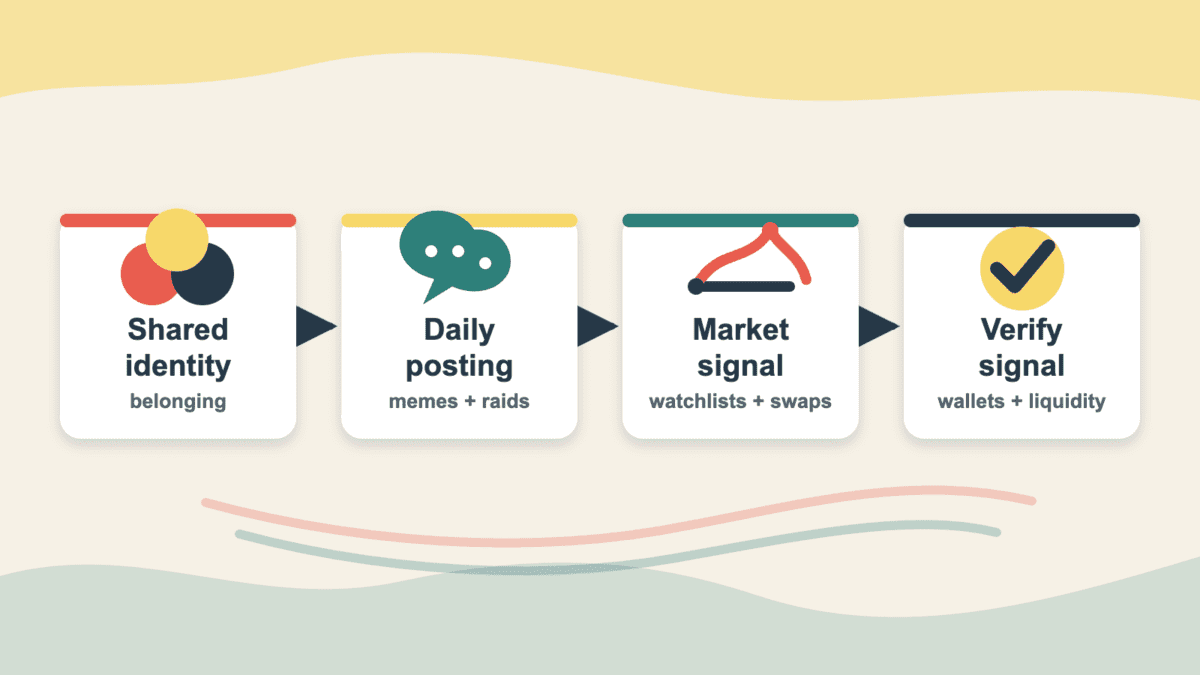
The attention loop works only when the signal survives wallet, liquidity, and source checks.
That check is useful because real signal and theater can look similar at speed.
| Organic momentum | Manufactured hype |
|---|---|
| Long-running community accounts keep posting through flat price action. | Fresh accounts repeat identical slogans after a price spike. |
| Holders answer basic questions without attacking them. | Questions about wallets, liquidity, or contracts are dismissed as FUD. |
| Memes evolve and spread outside one chat. | Engagement depends on raids, paid KOL posts, or giveaway loops. |
| Volume appears across normal users and venues. | Volume looks sudden, thin, or tied to a few wallets. |
| The community can explain the story without promising gains. | The pitch relies on targets, urgency, and shame. |
So keep the final check blunt. If a cult coin needs constant pressure to keep users from asking simple questions, the community may be defending price, not building belief.
Cult coin risk starts when belief outruns verification. A strong community can keep a token interesting, but it can also hide thin liquidity, concentrated wallets, unclear contracts, paid promotion, and pressure to hold past reason.
The biggest practical risk is becoming exit liquidity for earlier buyers. That can happen even without one dramatic scam. A cult coin can rise on attention, draw in late buyers, then fade as insiders, early holders, or impatient traders sell into the crowd.
Community can be valuable. It still cannot replace utility. A token with loyal holders may have no product demand, no revenue, no clear token role, and no reason for outsiders to buy after the story stops trending.
That does not make every cult coin fake. It means the community claim needs supporting checks:
The answers do not need to be perfect. They need to be clear enough that you can size risk without guessing.
Conviction becomes dangerous when the community treats doubt as disloyalty. That is when a cult coin can pressure users into holding because selling looks shameful, not because the thesis improved.
Watch how the group responds to bad news. A healthy community can discuss liquidity, wallet concentration, contract risk, and failed promises. An unhealthy one turns every concern into FUD and every seller into a villain.
These are the risk patterns to separate:
None of this means you must avoid every cult coin. It means the louder the belief gets, the more calmly you should check the plumbing.
Research a cult coin by verifying the asset first, then the community story. Start with identity, contract, liquidity, wallets, and venue access before you decide whether the meme has staying power.
The check cannot guarantee anything. It can still prevent obvious mistakes, like buying the wrong token, trusting a fake link, or entering a pool where one wallet can flatten the chart.
Use this checklist before you buy:
If the community attacks basic diligence, that is useful information. A serious cult coin community should be able to survive questions about liquidity, contracts, and who owns the supply.
The final step is position sizing. A cult coin can move fast, but thin pools punish large orders and rushed exits. If the trade needs perfect timing, perfect loyalty, and perfect social mood, it is not a stable plan. It is a group chat with a chart attached.
Cult coin examples should teach classification, not serve as a buy list. The useful question is not “Which cult coin should I buy?” It is “What kind of thing am I looking at?”
Some tokens get called cult coins because their holders build a strong identity around them. Others show up because their ticker is CULT. Others are older named projects, small same-name tokens, or memes with loyal communities that may still fade.
Use examples as teaching cases, not recommendations.
| Example type | What it teaches |
|---|---|
| Widely discussed cult-label meme coins | Community identity can become the main demand driver. |
| Milady Cult Coin | A named CULT asset can appear in search results while the user wanted the broader term. |
| Cult DAO | A separate DAO concept can share similar wording without being the same category. |
| Small same-name CULT tokens | A familiar ticker can hide a different chain, contract, or liquidity profile. |
| Faded community coins | Loud communities can still become inactive, illiquid, or forgotten. |
A loud token can also become a dead coin if trading, development, and community activity dry up. Volume does not stay because holders chant hard enough. It stays because buyers and sellers still have a reason to show up.
Timing can hurt too. When a cult coin starts appearing everywhere, that visibility can be a top signal rather than proof that it is still early. Attention helps. Late attention can still be expensive.
Related cult coin terms help decode the behavior around the trade. They are useful because cult communities often use slang to shape how holders think about risk, loyalty, and timing.
A narrative coin trades on a broader story, which is often the base layer for cult coin demand. A conviction play is a personal thesis, while a cult coin tries to turn group belief into the thesis.
The social setting changes how the phrase travels. CT explains where many phrases spread, and trenches explains the high-risk early-token environment where cult calls often start.
Risk slang completes the map:
Other risk terms covered above fill in the same pressure pattern: social loyalty can blur exits, scams, and loss discipline. The point is not to collect slang for its own sake. Notice when language helps you understand risk, and when it nudges you to ignore it.
A cult coin in crypto is a token whose appeal depends mainly on community belief, identity, memes, and coordinated attention. It is usually a nickname, not an official token class.
No. A cult coin is often a meme coin, but the phrase points to unusually strong holder identity and community belief. A normal meme coin may run on one joke. A cult coin tries to turn the community itself into the reason to hold.
No. Cult coin can mean a generic market label, while Cult DAO is a separate named project. Always check the exact chain, contract address, official links, and context before assuming a source means one specific CULT asset.
No. Milady Cult Coin is a named CULT asset, while cult coin can also describe a broader category of belief-driven meme or community tokens. The similar wording is exactly why contract and chain checks matter.
Yes, but utility must be verified separately. A cult coin can have products, governance, fees, or real users, but community strength alone does not prove any of those things.
Buying a cult coin is high risk because demand can depend heavily on social attention, thin liquidity, and group conviction. The main checks are contract identity, liquidity, top wallets, supply releases, volume quality, and whether the community tolerates basic questions.
Start with identity checks, not hype. Before you buy a cult coin, make sure you know whether the source means the general category, Milady Cult Coin, Cult DAO, or another same-name CULT token.
Then slow the trade down long enough to check whether the community story matches the market structure. A good meme can still sit on weak liquidity, a crowded wallet map, or a contract you did not mean to touch.
Use these steps before the group chat starts calling caution FUD:
If those checks feel boring, good. Boring checks are how you avoid buying a slogan, a fake contract, or someone else’s exit plan with nicer branding. The meme can wait five minutes. Your wallet cannot always recover from one lazy click.