Physical Address
304 North Cardinal St.
Dorchester Center, MA 02124
Physical Address
304 North Cardinal St.
Dorchester Center, MA 02124

A clear guide to DePIN, rewards, examples, and token risk.
DePIN is a crypto model where people provide infrastructure and earn token rewards for verified work.
DePIN stands for Decentralized Physical Infrastructure Networks. A network needs storage, wireless coverage, compute, maps, sensors, or bandwidth, and crypto rewards help attract contributors before normal customer demand can pay.
That makes DePIN a practical crypto question, not just an acronym. The hard test is whether the network can survive after token incentives stop doing most of the heavy lifting.
DePIN is short for decentralized physical infrastructure networks, a crypto model for coordinating infrastructure supplied by independent contributors. The resource can be physical, like wireless coverage or map imagery, or digital, like storage, compute, rendering, or bandwidth.
A router, dashcam, GPU, or hard drive does not become a business by itself. Coordination is the point. A DePIN network gives contributors rules, verification methods, and token rewards so useful supply can appear before the network has a mature customer base.
That cold-start model gives DePIN its real meaning. A traditional infrastructure company usually raises capital, buys assets, hires operators, and sells the service. A DePIN project tries to pull supply from a distributed crowd, then reward early contribution.
That can be powerful. It can also get messy fast.
If the resource is useful and customers pay for it, token rewards may help bootstrap a real network. If the resource is low quality, fake, oversupplied, or unwanted, the token becomes a subsidy machine. “Real-world infrastructure” is only the start of the due diligence.
DePIN works in crypto by connecting four moving parts: a resource, a verification method, token rewards, and customer demand. Contributors supply something useful, the network checks it, rewards are paid, and customer demand must follow.
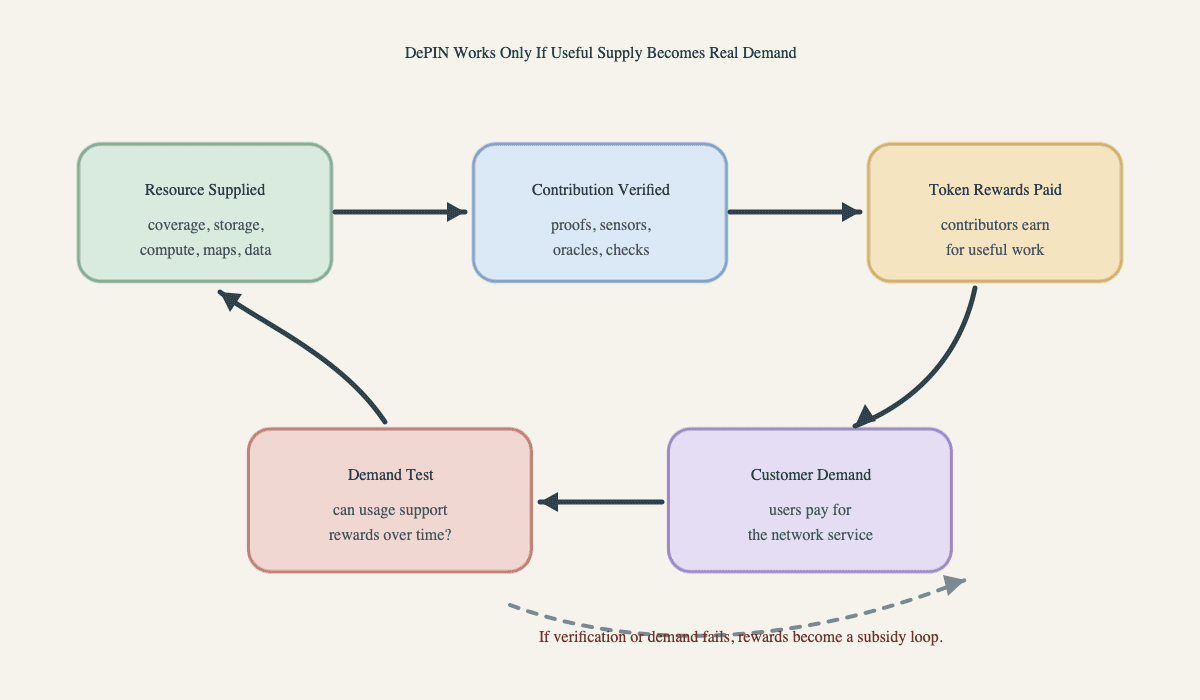
The resource layer is the thing contributors bring. It may be a hotspot, storage capacity, GPU time, bandwidth, vehicle data, street imagery, energy data, or another service the network wants to coordinate.
Quality beats raw count. Ten devices in a useless location may be worth less than one device where demand is strong. This is where DePIN crypto starts looking like operations work.
The verification layer checks whether the resource was actually provided. Storage can use cryptographic proof. Wireless may use location, signal, and traffic checks. Mapping may use freshness and image quality.
Filecoin uses Proof-of-Replication and Proof-of-Spacetime as ways to check storage. Physical networks are harder because devices can lie, locations can be spoofed, and useful service can be hard to measure.
The reward layer pays contributors, often before customer revenue is deep enough to carry the network. That is the bootstrapping trick. It is also the source of many bad incentives.
If rewards are too generous, contributors may farm emissions instead of building useful supply. If rewards are too stingy, operators leave. If rewards are paid in a token with weak liquidity, everyone may learn about exit liquidity at the same time.
The demand layer is the test that separates an infrastructure network from a token farm. Someone must want the coverage, data, compute, storage, or service enough to pay for it.
Demand can come late, but it cannot stay imaginary forever. DePIN explained only through rewards leaves out the hard part. The signal is whether the service solves a real problem better, cheaper, or more openly than a centralized provider.
DePIN categories usually split into PRNs and DRNs. PRNs are physical resource networks tied to place. DRNs are digital resource networks that can often serve demand from many locations.
The distinction changes reward design, fraud risk, customer demand, hardware needs, and how you evaluate a project.
| DePIN Category | What It Means For Users And Investors |
|---|---|
| Physical Resource Networks | PRNs depend on location. Wireless coverage, mapping, sensors, energy, mobility, and vehicle data only help if they exist where demand exists. |
| Digital Resource Networks | DRNs are more location-flexible. Storage, compute, rendering, bandwidth, and data services can often serve users across regions. |
Physical resource networks can have stronger local moats. A wireless hotspot in a high-demand area may beat many devices in quiet areas. But PRNs face harder verification. Location spoofing, duplicate coverage, and low-quality sensor data can distort rewards.
Digital resource networks can scale more cleanly because the resource is easier to route. Storage and compute do not always need to sit beside the end user. But DRNs still need quality checks, uptime, pricing, and customer demand.
Use the PRN versus DRN split as a first map. Then ask the useful boring question: who pays, why do they pay, and can the network prove the supply is real?
DePIN rewards work by paying contributors for verified supply, useful activity, or both. Rewards can be real, but they are not reliable passive income by default.
The loose phrase “DePIN mining” usually means running hardware or supplying resources for tokens. It is not the same as Bitcoin mining. The contributor is not necessarily securing a base blockchain. They may be providing coverage, data, storage, compute, or another service to a specific network.
Reward math starts with costs. A hardware operator may need a device, electricity, internet, maintenance, location, and time. A digital contributor may need server capacity, bandwidth, uptime, or technical setup. Then token price and liquidity enter the room.
Check the reward setup before treating it as income:
Hivemapper is a useful example because mapping rewards tie to coverage, freshness, quality, and region progress. That does not make every mapping reward attractive. It shows why DePIN income depends on contribution quality.
Some contributors will optimize the reward system like farmers. Some will sell quickly, which is where jeets become part of the token story. If paying customers do not absorb that pressure, early rewards can become later dilution.
People participate in DePIN in several different roles. Buying a token, running hardware, using the service, and building on the network are not the same decision.
Each role has a different risk. A token buyer can be wrong even if operators earn rewards. A hardware operator can lose money even if the token chart looks strong.
| Role | Main Question To Answer First |
|---|---|
| Token buyer | Does the token capture value from real network use, or only from narrative demand? |
| Hardware operator | Do rewards beat hardware, electricity, time, location, and cashout costs? |
| Service user | Is the DePIN service cheaper, reliable, private, or better than the normal option? |
| Builder | Can the network bootstrap useful supply without wasting incentives? |
Token custody is another practical detail. If you earn or buy DePIN tokens, decide where they sit, what wallet is supported, and how recovery works before the first reward arrives. Start with crypto wallets only when custody becomes part of the decision.
Start with your role. Then evaluate the matching cost, risk, and exit route.
DePIN examples are useful when they explain the category, not when they become a disguised “best tokens” list. Use named projects as mental models, then research each one on its own merits.
Filecoin is a storage example. Storage providers make capacity available, and the network uses proof systems to check that data is stored as promised. That makes it a useful DRN example.
Helium is a wireless example. Hotspot operators provide coverage and can earn HNT incentives for coverage and traffic. It shows why location can dominate reward quality.
Hivemapper is a mapping example. Drivers collect street-level imagery, and the network rewards useful map contributions. It shows why DePIN can tie rewards to freshness and geography.
For a scale check, the Hivemapper Foundation lists 700M+ total kilometers mapped. That is useful context, but contribution quality and customer demand still matter more than the headline number.
Render Network and Akash are compute-related examples. They help explain why AI x DePIN appears in market conversations. Compute demand is real, but token exposure still depends on pricing, utilization, reliability, and customer preference.
DIMO and IoTeX sit closer to device and vehicle data. They highlight privacy and data-quality issues. A network that touches location, cars, phones, or sensors needs stronger trust boundaries than a token dashboard suggests.
The common lesson is simple. Good DePIN projects need useful supply, credible verification, and paying demand. A long project list without those three pieces is just a menu with no prices.
Research DePIN tokens by separating the infrastructure thesis from the token thesis. A network can be interesting while its token still has poor value capture, weak liquidity, or ugly emissions.
Start with demand. Who pays for the service today, and what would make them keep paying without token subsidies? Then move to operators. Are contributors profitable after hardware, electricity, uptime, shipping, and token volatility?
Now check the token itself. DePIN coins often trade on narrative before the network proves durable revenue. That can fit a high-risk thesis, but it is not cash flow from infrastructure.
Use this checklist before you call a DePIN token a conviction play:
Social discovery can help, but it is not proof. Crypto Twitter may surface early DePIN projects, and the trenches can expose small-cap chatter quickly. Still, social proof should not replace demand and operator economics.
That is especially true when referrals, airdrop points, and device sales enter the pitch. A token can look like infrastructure while behaving like a marketing campaign with a chart attached.
DePIN risks start with the same problem that makes the sector interesting: the network must create supply before demand is mature. If demand never arrives, rewards can inflate supply without building a durable service.
The first failure mode is cold-start failure. A project may attract operators with tokens, but the service may not become useful enough for customers. When rewards fall, operators churn. Then the service worsens, and the token chart gets educational.
The second failure mode is verification failure. Fake location data, spoofed devices, duplicate coverage, low-quality imagery, idle compute, and Sybil attacks can drain rewards from real contributors. If the network cannot police quality, honest operators subsidize noise.
The third failure mode is token failure. Emissions, vesting releases, thin liquidity, weak exchange access, and constant operator selling can pressure the token even while the project looks busy. Late buyers can become stuck if hype outruns demand.
Watch for these warning signs:
Outright fraud can still happen. A fake infrastructure story can end quickly. A stalled network with a living token can decay slowly. A tiny DePIN token with no proven demand may be closer to a lottery ticket than an infrastructure allocation.
“Real-world” is not a shield. It is a claim that needs proof.
DePIN privacy risk comes from the same thing that makes verification useful. The network may need to prove where a device is, what it saw, what it served, or whether it stayed online.
That can involve device identity, location, bandwidth metadata, street imagery, vehicle data, sensor readings, or usage patterns. A storage network may expose different risks than a mapping or wireless network, but the privacy question is similar: what data is collected, who can see it, and how long does it remain useful?
Verification also creates a tradeoff. Weak checks invite fraud. Strong checks can require more sensitive data. A good DePIN design narrows what must be revealed.
Ask these practical questions before contributing data:
The answer may be acceptable for one role and unacceptable for another. Running a home device, mapping roads, sharing vehicle data, and renting GPU capacity carry different footprints.
DePIN should prove useful work without turning every contributor into a walking data exhaust pipe. If that boundary is unclear, wait.
DePIN overlaps with several crypto ideas, but it is not the same thing as RWA, DeFi, mining, or traditional infrastructure. The difference is the job each model does.
DePIN coordinates supply for resource networks. Nearby concepts may tokenize assets, run financial markets, secure blockchains, or build infrastructure through centralized capital. Market threads blur the words, so keep the comparison practical.
| Concept | How It Differs From DePIN |
|---|---|
| RWA | RWA usually tokenizes claims on existing assets, while DePIN tries to coordinate active infrastructure supply. |
| DeFi | DeFi runs financial protocols, while DePIN connects tokens to resources like coverage, storage, compute, or data. |
| Crypto mining | Mining usually secures a blockchain or earns block rewards, while DePIN rewards useful resource contribution. |
| Traditional infrastructure | Traditional infrastructure starts with centralized capital and operators, while DePIN uses distributed contributors and token incentives. |
The comparison also helps with risk. RWA risk often centers on legal claims, custodians, and asset backing. DeFi risk centers on smart contracts, liquidations, and protocol design. Mining risk centers on hardware, power, and network rewards.
DePIN borrows pieces from all of them. It can have hardware costs like mining, token mechanics like DeFi, real-world claims like RWA, and service reliability issues like normal infrastructure.
Do not file DePIN under one old category. Use the overlap to ask better questions.
DePIN fits into crypto narratives because it points at services people can understand: wireless coverage, compute, storage, maps, sensors, and data. That is more concrete than another token promising vibes.
Traders often group DePIN with AI, RWA, Solana, and infrastructure rotations. AI x DePIN makes sense when the network supplies compute, data, or sensors that AI systems may need. Solana appears often because several DePIN projects have used its speed, fees, or user base. RWA appears because both narratives point toward real-world activity.
But narrative fit is not project quality. A narrative coin can rise because capital wants the theme, not because the network has durable demand. A hot market theme can pull weak projects upward with strong ones.
That is where timing risk enters. If every thread suddenly calls DePIN the obvious future, the market may already be pricing the easy story. A late top signal does not mean the idea is bad. It means your entry needs a tougher reason than “the sector is trending.”
Use narrative attention as a starting filter. Then go back to resource quality, verification, demand, token value capture, and liquidity. The token chart is the loud part. The network still has to work.
Start with DePIN by choosing a resource category first, not a token ticker. Storage, wireless, compute, mapping, vehicle data, and sensors all have different cost structures and proof problems.
Then read the official materials for one network in that category. Look for hardware requirements, reward rules, supported wallets, customer demand, token emissions, and operator support. If the project cannot explain those pieces clearly, do not let a referral link explain them for you.
Use a small action list before spending money:
Team transparency helps, but it is not a guarantee. A doxxed dev can still run a weak project, and an anonymous team can still build useful software. Use identity as one input beside demand, proof quality, and economics.
If you want token exposure, start smaller than your excitement wants. If you want to run hardware, price the boring costs first. DePIN has real ideas in it, but the shill density can still fog up the glass.
Related DePIN terms help explain market behavior around these networks. Use them when a DePIN pitch mixes rewards, hype, and token exits in one breath.
Start with the sell-pressure terms, because reward tokens often move before the service proves demand. Then move into narrative terms, team-risk language, and holder psychology. That path matches how DePIN usually reaches traders: first as infrastructure, then as a chart, then as a crowd story.
Exit liquidity is central because DePIN rewards can create sell pressure before demand catches up.
Farming helps explain why contributors may optimize emissions instead of long-term service quality. That behavior can be rational for them and bad for the network.
Crypto meta explains why DePIN can heat up when traders rotate into AI, RWA, Solana, or infrastructure themes. The theme can be real while individual tokens stay fragile.
Hard rugs and soft rugs help separate outright abuse from slow project decay. DePIN can face both.
Bagholder is the risk label for those who buy a sector story late, ignore liquidity, and hold through reward dilution.
Together, these terms keep the research honest. DePIN may involve real hardware, real data, and real customers. The token still trades in a market where incentives, narratives, and exits can overpower the infrastructure story.
DePIN means Decentralized Physical Infrastructure Networks. In crypto, it describes networks that reward people or companies for providing resources like wireless coverage, storage, compute, mapping, bandwidth, sensors, or vehicle data. It is not a decentralized personal information network.
DePIN works by asking contributors to supply a resource, verifying that contribution, paying token rewards, and building demand for the service. It works best when rewards attract useful supply early, then real usage supports the network later. If demand never arrives, rewards can become a subsidy loop.
You can earn money with DePIN in some networks, but earnings are not guaranteed passive income. Net results depend on hardware cost, location, electricity, uptime, reward rules, token price, liquidity, and withdrawal friction. A reward estimate only helps after costs are included.
DePIN is not the same as crypto mining. Mining usually secures a blockchain and earns block rewards. DePIN usually rewards contributors for providing a resource, such as coverage, storage, compute, or data. People may say “DePIN mining” casually, but the mechanics differ.
A DePIN project becomes risky when token incentives hide weak demand, poor verification, unprofitable operators, thin liquidity, unclear emissions, hardware churn, or privacy problems. The biggest trap is assuming real-world activity automatically makes the token valuable.
Most DePIN projects use a token because rewards help bootstrap supply before customer revenue is mature. But the token needs a clear job. If it only funds emissions or pays operators without customer demand, the network may stay busy while the token weakens.