Physical Address
304 North Cardinal St.
Dorchester Center, MA 02124
Physical Address
304 North Cardinal St.
Dorchester Center, MA 02124


A practical guide to emission APR, fee APR, reward tokens, and DeFi yield risk.
In crypto, emission APR is the annualized value of incentive tokens a protocol distributes to eligible DeFi users.
You usually see it on staking dashboards, liquidity pool pages, yield farms, reward contracts, or campaign pools. The number can represent real claimable tokens, but it is still a projection.
It is not a promise that your wallet ends the year up by that percentage. Ask what token pays it, who funds it, and how long it can last. Then ask what happens when everyone else spots the same shiny number.
Emission APR means a DeFi protocol is paying users with incentive tokens and annualizing that reward value into an APR. The protocol may distribute newly minted tokens, treasury-held tokens, partner incentives, or campaign rewards.
Protocols use the label when they want users to supply capital or take a specific action. You may see emission APR beside LP farms, staking positions, vault deposits, gauge pools, concentrated-liquidity ranges, or limited-time reward campaigns.
The label usually points to a few setup types:
The payment source is the key. Fee APR usually comes from activity, such as trading fees or borrower interest. Emission APR usually comes from a reward budget. That budget can be useful. It can also be temporary fuel for a pool that still has to prove lasting demand.
Think of emission APR as the subsidy layer on top of a position. It may pay real tokens into your wallet, but those tokens still have price risk, sell pressure, claim friction, tax treatment, and liquidity limits.
That is why a large emission APR can point to several different setups:
The number is useful only after you know what creates it. Otherwise, it is just yield confetti with decimals.
Emission APR differs from fee APR because it usually pays from a token incentive budget, while fee APR usually pays from protocol activity. The confusion starts when DeFi dashboards stack both numbers near one pool.
Use this table to separate the labels before you compare pools.
| Metric | What It Usually Means |
|---|---|
| Fee APR | Annualized return from trading fees, lending interest, or another activity-backed source. |
| Emission APR | Annualized value of incentive tokens paid to eligible users. |
| Reward APR | Often another name for token incentive APR, though some protocols use it more broadly. |
| Total APR | A blended rate that may combine fee APR, emission APR, base rewards, and campaigns. |
| APY | A compounding-adjusted estimate that assumes rewards are reinvested under stated conditions. |
One detail is easy to miss. Every protocol can define its labels slightly differently. One app may call token incentives reward APR. Another may call them emission APR. A third may fold them into total APR and make you click twice to see the split.
DeFiLlama’s yield API listed 1,890 tracked pools with a nonzero reward APY on June 5, 2026. That is why the reward layer deserves its own check before you compare headline rates.
So never compare the biggest number against another biggest number. Compare the payment source, payment asset, eligibility rule, and compounding assumption.
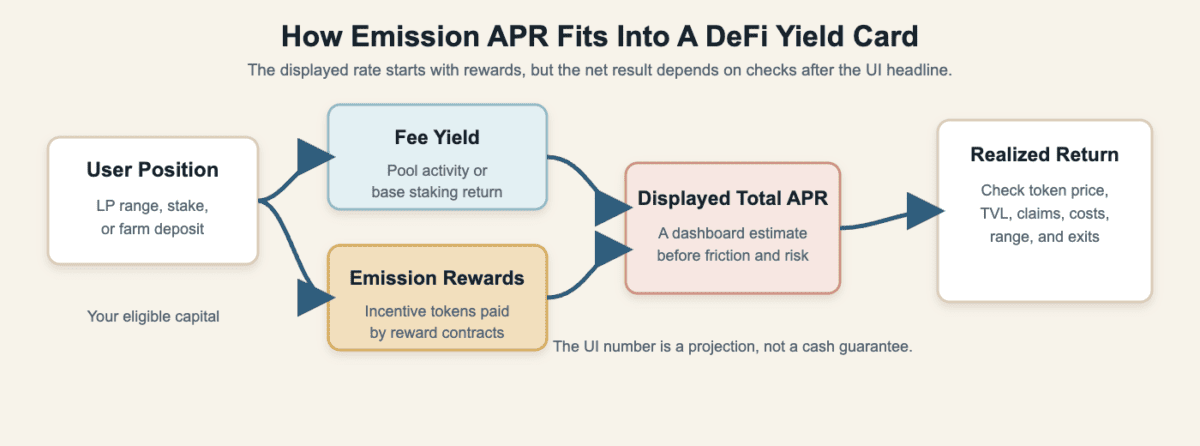
Emission APR can be real claimable yield without being guaranteed profit. If the reward token falls before you sell, or if gas and slippage eat the claim, the realized return can land far below the displayed APR.
APY adds another layer. APR states a rate without compounding. APY assumes compounding. But compounding emission rewards only works if you can claim, sell or restake, and keep the same rate available. That is a lot of “if” for one small letter.
Emission APR is usually calculated by valuing the annual reward stream, then dividing it by the eligible capital sharing those rewards. The plain formula is annualized token emissions times reward-token price, divided by eligible liquidity value.
EmplifAI’s APR guide uses the same core pieces: reward emissions, reward-token price, and the value of liquidity receiving those rewards. The exact formula changes by protocol. The money flow is the same.
Here is the simple version in words:
That last line carries most of the fine print. A farm may distribute rewards by pool weight. A gauge may route more incentives to one pool than another. A concentrated-liquidity pool may show different rates after you choose a range.
In farming rewards, the position record often decides whether you earn incentives. That record might be an LP token, a staked receipt, a vault share, or a position NFT.
Small changes can move the APR. If the reward token trades at $1 today, the displayed emission APR can fall when it drops to $0.50. If twice as much eligible capital enters the same pool, the same reward budget gets split more ways.
So the calculation is not magic. It is a reward budget divided by eligible capital, with token price doing the dramatic hand gestures.
Emission APR changes fast because the numerator and denominator both move. Reward value can change, eligible liquidity can change, and a protocol can alter the incentive budget.
A pool showing a high number today may show a lower one tomorrow without anything being broken. The rewards may be the same, but the token price or eligible TVL may not be.
Common causes include:
Picture a pool paying 1,000 reward tokens per day. If $100,000 of eligible liquidity shares the rewards, the displayed APR can look generous. If $500,000 piles in after the number circulates, each dollar of capital receives a smaller slice.
That is APR compression. It is common when a yield campaign becomes obvious. A suddenly absurd rate can even act like a top signal for the easy phase of the incentive trade. That is especially true when social feeds start posting screenshots instead of details.
Position-specific APR makes this trickier. In concentrated liquidity, a pool page may show a headline estimate before you choose an exact range. After you set a narrow or inactive range, your position may earn a different mix of fees and emissions.
The cleaner habit is boring but effective: refresh the dashboard after setting the exact position, check the reward contract or campaign page, and assume the displayed rate can move before your first claim.
Emission APR can be real yield in the narrow sense that it pays real tokens. But the market phrase “real yield” usually means yield backed by fees, borrowers, or outside cash flow instead of new token incentives.
Keep that distinction clear because emissions are often a subsidy. A subsidy can be valid. Protocols use incentives to attract liquidity, create deeper markets, and reward early participants. The problem starts when users confuse a temporary reward budget with durable economic demand.
Use this table to separate the two ideas.
| Yield Source | What To Check |
|---|---|
| Fee-backed yield | Volume, borrower demand, utilization, fee rates, and whether activity stays after incentives fade. |
| Token-emission yield | Reward-token supply, token price, liquidity, campaign duration, and whether demand absorbs new supply. |
| Treasury subsidy | Budget size, end date, governance control, and whether the pool becomes useful without payments. |
| Third-party incentive | Sponsor, payment asset, claim route, and whether rewards continue after the campaign. |
| Compounded yield | Claim costs, reinvestment path, rate stability, and whether APY assumptions are realistic. |
Fee-backed yield can still fall. Trading volume dries up. Borrow demand changes. Utilization drops. So “real yield” is not a safety sticker.
Emission APR is also not automatically fake. It becomes weaker when the reward token has thin liquidity, weak demand, heavy sell pressure, or no reason to hold after farmers collect it.
So check source and durability. If the emission APR helps a useful market reach depth, it may be a rational incentive. If the rate only distracts from bad liquidity, vague rules, or a token nobody wants, the number is doing sales work.
Check emission APR before depositing by tracing the reward from source to exit. You want to know what pays you, whether you qualify, and how much friction sits between the dashboard rate and spendable value.
Start with the reward token. If you cannot name it, sell it, bridge it, or value it with any confidence, the APR is already incomplete.
Use this checklist before moving funds:
Wallet setup can change the net result. If claiming rewards requires a new chain, bridge, or connected app, use the same caution you would use for wallets and approvals. A reward is not worth much if the claim route pushes you into sloppy signing.
Position size is the quiet risk control. High emission APR can tempt users to full port into a fragile setup. That turns a yield experiment into a portfolio-level bet on token price, pool depth, contract safety, and timing.
These checks are not meant to kill every trade. They stop the UI from making the trade for you.
Emission APR creates token-holder risk when new or newly released rewards enter circulation faster than demand grows. One user’s yield can become another holder’s dilution.
That does not mean emissions are always bad. Incentives can deepen liquidity, support market making, and bring users into a protocol. But the token has to absorb the supply later.
The holder risk shows up through several paths:
Offsetting factors can help. Fee revenue, buybacks, burns, sticky liquidity, product usage, and real demand can reduce the pressure. None of them makes dilution disappear by default.
The late-buyer problem is especially sharp when high emission APR attracts attention after the best entry window has passed. If new buyers provide exit liquidity for early farmers selling rewards, the yield story can become a holder problem.
That is how a user earning tokens and a bagholder holding those tokens can exist in the same market. The first person sees rewards. The second person sees supply pressure with better branding.
High emission APR can be worth chasing when the reward source is clear, the token has real liquidity, and the user has a plan for claims, exits, and position size. The rate alone is never enough.
The best version is an early incentive campaign with transparent rules, deepening volume, active liquidity, and a reward token that can be sold without wrecking the price. You know the campaign may compress, and you enter with that in mind.
Watch for the cleaner setup:
Now the rough version. A giant emission APR can also signal low TVL, thin reward-token liquidity, new contracts, vague incentives, or a pool that needs dramatic numbers because normal demand is absent.
That is not the same as a hard rug. A hard rug is a malicious or abrupt failure path. Emission decay can be slower. It can look closer to a soft rug when promises fade, rules shift, or liquidity quietly leaves.
Some users treat high emission APR like a lottery ticket: small size, clear downside, and no fantasy that a subsidy is permanent income. That mindset is cleaner than calling every giant rate an “opportunity” and then acting shocked when gravity clocks in.
Emission APR sits inside a wider DeFi vocabulary. These terms help because each one describes a different part of the reward, liquidity, or holder-risk chain.
A crypto farm is the broader place where users deposit assets to earn rewards. Emission APR is one way a farm advertises those rewards.
Exit liquidity explains why reward-token depth matters. If everyone wants to sell the same emitted token, someone must take the other side.
A bagholder is the user left holding a weak asset after the stronger story fades. Emission rewards can create that setup when supply hits faster than demand.
A conviction play is different from forgetting to sell rewards. Holding an emitted token should be intentional, not the default after a claim.
A lottery ticket trade is the speculative version of the same idea. You might size small for upside, but you should not confuse that with dependable yield.
Taken together, these terms keep emission APR in context. The dashboard number is one input. The reward token, buyer demand, exit path, and holding plan decide whether the input becomes useful.
Start with the reward source, then work outward. Emission APR is clearest when you separate the UI number from the path your money actually takes.
Before depositing, run these checks in order:
After that, decide what role the position plays. A small farm can be a paid test of a protocol. A large LP position is different. It adds reward-token exposure, pool-asset exposure, smart contract exposure, and timing risk at once.
Also decide what you will do with rewards before they arrive. Selling every claim can reduce token exposure, but gas and slippage still count. Holding rewards only makes sense when you want that token for reasons beyond the APR.
Then compare the rate with the job it is doing. A fair incentive can help a pool grow. A desperate incentive can simply rent attention.
A useful emission APR pays you for a risk you understand. The bad version pays you in a token you never meant to own, then asks the market to be polite about it.
Emission APR in crypto is the annualized value of incentive tokens a protocol pays to eligible users, usually in DeFi pools, farms, staking dashboards, or reward campaigns.
It is separate from normal fee income unless the dashboard clearly combines the two. Always check what token pays the emission APR and whether the rate applies to your exact position.
No, emission APR is not guaranteed. It is usually a projection based on current reward emissions, reward-token price, eligible liquidity, and protocol rules.
The rate can change before you claim. Token price, TVL, pool weights, range activity, gas costs, and campaign dates can all alter the result.
No, emission APR is not the same as APY. Emission APR describes the annualized value of incentive rewards, while APY includes compounding assumptions.
An app may convert reward APR into APY if it assumes reinvestment. That assumption only helps if you can claim, reinvest, and keep earning similar rates.
Emission APR is often higher than fee APR because a protocol is subsidizing the pool with token rewards. Fee APR depends more on activity, such as trading volume or borrowing demand.
A high emission APR can also reflect low TVL or a volatile reward token. It may be attractive, but it is not automatically stronger than a lower fee-backed rate.
Yes, emission APR can dilute a token when new or newly released rewards enter circulation faster than demand grows. The risk is stronger when farmers sell rewards into thin liquidity.
Dilution can be offset by demand, revenue, burns, buybacks, or useful liquidity. But those offsets need evidence. They are not granted by a dashboard label.
Whether to sell emission APR rewards depends on your reward-token thesis, liquidity, taxes, claim costs, and original strategy. Selling can reduce token exposure, while holding adds price risk.
If holding is deliberate, write down why the token deserves that risk. If you cannot explain the hold, claiming and forgetting is not strategy. It is just slower decision-making.