Physical Address
304 North Cardinal St.
Dorchester Center, MA 02124
Physical Address
304 North Cardinal St.
Dorchester Center, MA 02124


Understand fee switch mechanics before a token rally does the talking.
A fee switch is a protocol setting that redirects part of crypto fees toward a treasury, token mechanism, stakers, or another approved destination.
The phrase usually appears around DeFi protocols, especially DEXs such as Uniswap. It sounds like someone flipped a magic revenue button. The useful question is duller: where did the fee come from, who received it before, and where does it go after the switch turns on?
A fee switch in crypto is a governance or contract mechanism that turns on protocol fee capture. It can redirect an existing fee, add a protocol share, or activate a dormant fee route.
The phrase is bigger than any single protocol. In one design, captured fees may go to a DAO treasury. In another, they may fund a buyback, token burn, staking reward, delegate reward, public-goods budget, or protocol-owned liquidity.
The switch does not automatically pay tokenholders. That is the first trap. A fee switch can make a governance token more useful, but only if the route creates real value for that token without damaging the activity that produced the fees.
Think about the before-and-after state:
The destination carries the real economic signal. “Fee switch on” can mean treasury revenue, a burn, or rewards. It can also mean a worse deal for LPs if their fee share gets clipped.
So the clean definition is simple: a fee switch changes who captures protocol activity. The harder part is deciding whether that change strengthens the protocol or just creates a better headline.
A fee switch moves value by changing the route a fee takes after users create protocol activity. The fee starts with a swap, loan, bridge, mint, route, or other transaction. Then it splits between existing receivers and the protocol capture route.
That sounds abstract until you follow the money. A trader may pay the same visible swap fee. LPs may receive a smaller share. The protocol may capture the difference. Then governance decides whether that value funds a treasury, burns tokens, rewards stakers, supports grants, builds protocol-owned liquidity, or supports another approved budget.
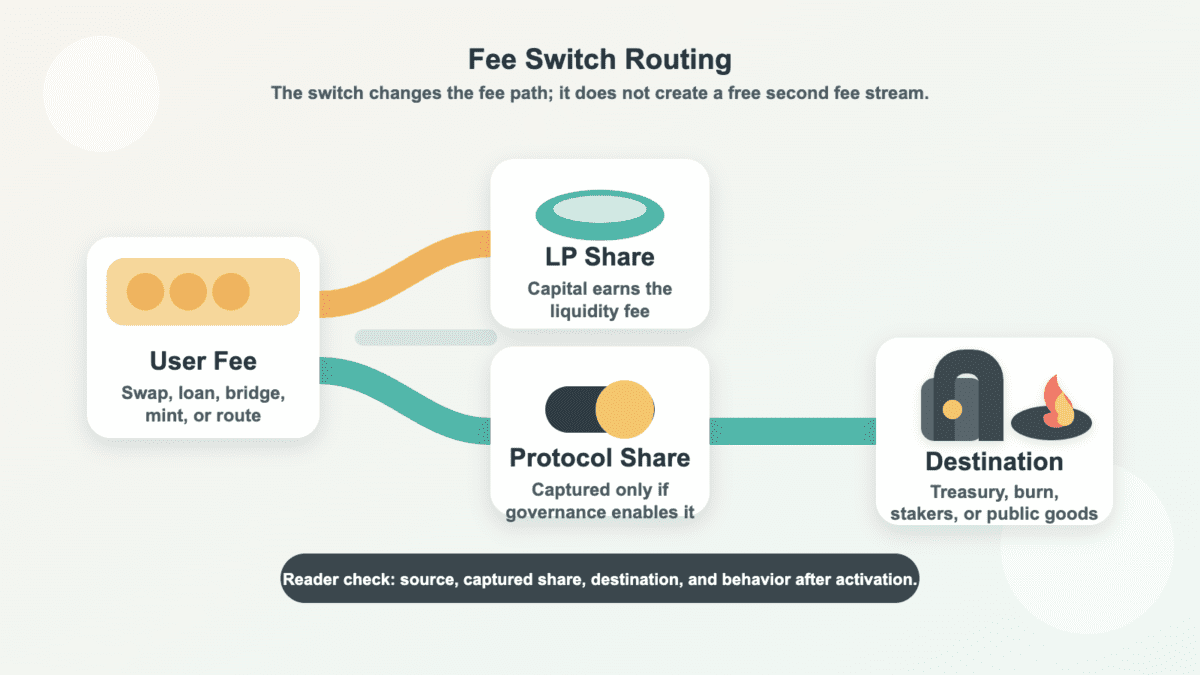
Uniswap’s official UNIfication proposal gives a concrete DEX example and said the first rollout would start with v2 pools plus v3 pools that make up 80-95% of LP fees on Ethereum mainnet. In its v2 example, LP fees are 0.30% with protocol fees off, then 0.25% goes to LPs and 0.05% goes to protocol fees after activation.
That example is useful because the trader’s headline fee does not need to rise. The protocol share can come out of the fee that previously went entirely to LPs. LP reaction is central here. If the protocol captures too much, some LPs may move capital to another venue.
The usual fee switch path has four checks:
The last check is where many bullish threads get lazy. A protocol can capture fees only if users still trade, borrow, mint, or route through it. If liquidity thins or volume leaves, the switch may capture a larger slice of a smaller pie.
A fee switch is not the same thing as every fee a crypto user sees. It usually controls protocol capture. Swap fees, gas fees, LP fees, and interface fees belong to different layers.
One fee can disappear while another turns on. A front end could remove an interface fee while the underlying protocol activates protocol fees. A trader may see a similar quote, while LPs and tokenholders get a different economic split.
Use this table before reacting to a proposal headline:
| Fee Type | What It Means For A Fee Switch |
|---|---|
| Swap fee | The trader pays it during a swap. A fee switch may redirect part of it. |
| LP fee | Liquidity providers earn it for supplying liquidity. Protocol capture can reduce this share. |
| Protocol fee | The captured share controlled by governance or contract settings. |
| Interface fee | A front-end or app fee. It can change separately from protocol fees. |
| Gas fee | A network cost paid to validators, sequencers, or block producers, not protocol revenue. |
The table is boring by design. Crypto fee screens often make different costs look like one blob. That blur helps nobody except the person selling the cleanest narrative.
When a fee switch claim appears, ask which row changed. If gas rose, that is chain congestion. If an interface fee vanished, that may be a front-end business decision. If the protocol fee activates, the economic route changed inside the protocol.
A fee switch benefits the party that receives or controls the captured value. That can include a DAO treasury, tokenholders, stakers, delegates, developers, public-goods programs, or the protocol itself.
Tokenholders usually care first because a fee switch can make a governance token look closer to a value-accrual asset. But the route decides the impact. A buyback is not the same as a burn. A burn is not the same as direct income. Treasury capture is not the same as a holder payout.
The benefits usually split by stakeholder:
That is why a fee switch can support a conviction play only when the thesis is specific. “Fees are on” is not enough. You need to know the destination, expected size, durability, and cost to the rest of the protocol.
Some designs avoid direct tokenholder payouts because legal, tax, governance, and operational questions can get awkward fast. A burn or treasury route may be easier to run, but it still has to create enough value to matter.
A fee switch can improve alignment when activity is strong and the capture route is clear. It can also create a new conflict if tokenholders win by making LPs or users worse off.
A fee switch can hurt liquidity providers when protocol capture reduces the fee share LPs used to earn. LPs supply the capital that makes many DeFi markets work, so their response can decide whether the switch succeeds.
Imagine a pool where LPs previously received the full trading fee. If governance redirects part of that fee to the protocol, LP income falls unless something else improves. More volume, incentives, lower adverse selection, or better routing can offset the cut. Without that support, LPs may leave.
The risk is not just “LPs earn less.” The damage can spread:
| LP Risk | What To Check |
|---|---|
| Lower LP returns | Compare the old LP share with the new net share after protocol capture. |
| Liquidity migration | Watch whether capital moves to competing pools, chains, or DEXs. |
| Higher slippage | Check whether thinner liquidity makes trades execute worse. |
| Volume decline | See whether routers and aggregators send flow elsewhere. |
| Incentive dependence | Ask whether subsidies are masking weak fee economics. |
That is why fee-switch design often rolls out by pool, chain, tier, or product instead of everywhere at once. A stablecoin pool may react differently from a volatile long-tail pool. A high-volume pair may tolerate protocol capture better than a fragile market with mercenary liquidity.
Traders may not care about LP returns directly. They care when worse liquidity leads to worse execution. If a fee switch pushes LPs away, users can face higher slippage even if the visible swap fee looks unchanged.
The best designs admit this tradeoff. They monitor liquidity, volume, slippage, and routing after activation. The weakest designs pretend LPs will absorb the hit forever because the token chart enjoyed one loud afternoon.
A fee switch does not guarantee a higher token price because markets price expectations, not just mechanisms. The captured value must be large enough, durable enough, and clearly connected to the token.
Token burns are the classic example. A burn can reduce supply, but price still depends on demand, market liquidity, valuation, emissions, vesting, and what buyers already expected. A small burn against a large token value can be real and still barely move the math.
Fee-switch hype can also arrive late. If everyone already bought the rumor, the activation can become headline exit liquidity for traders who entered earlier.
Check the bullish case against the failure case:
| Bullish Signal | Failure Check |
|---|---|
| Protocol fees are meaningful | Fee capture is tiny versus token value. |
| Volume stays strong | LPs leave and volume drops. |
| Burn or buyback route is clear | Treasury capture never reaches token demand. |
| Governance controls are credible | Parameters can change or stall. |
| Market has not priced it in | The token already rallied on the rumor. |
Direct payouts can look stronger than burns, but they bring their own baggage. They may create legal, tax, eligibility, treasury, and governance questions. The cleanest headline is not always the cleanest operating model.
There is no button that makes arithmetic optional. If a fee switch creates $10 of value and the market adds $100 of valuation for it, the story may be ahead of the spreadsheet. That is where a celebrated catalyst can become a top signal instead of a fresh opportunity.
Fee switch examples in DeFi usually fall into a few routes: protocol fees, treasury capture, buybacks, burns, staking rewards, delegate rewards, public-goods funding, or protocol-owned liquidity. Uniswap is the best-known example, but it is not the whole category.
Uniswap dominates the conversation because its governance debates made the phrase common. The broader lesson is that a fee switch is a design choice. Different protocols can activate different fees, send funds to different places, and create different stakeholder tradeoffs.
Here are the common routes users should recognize:
| Fee-Switch Route | What The User Should Understand |
|---|---|
| Treasury capture | Fees fund the DAO or protocol budget, but holders may not receive direct value. |
| Buyback and burn | Fees can reduce supply, but price still depends on demand and scale. |
| Staking rewards | Fees may reward stakers, often with extra eligibility and lockup rules. |
| Protocol-owned liquidity | Captured value can deepen liquidity, but it may not create immediate token demand. |
| Public-goods funding | Fees support shared work, which may improve the protocol indirectly. |
| Fee committee or governance route | Parameters can change, so users must track controls and oversight. |
Fee-switch news can also spark market rotation into DeFi tokens. That does not prove every protocol has strong value accrual. It only proves attention moved. Crypto has a long history of mistaking attention for cash flow with better lighting.
Examples should stay protocol-specific. If one protocol burns tokens, another pays stakers, and a third funds treasury work, those are not interchangeable. The phrase “real yield” only deserves trust when the fee source, route, and user impact are visible.
Evaluate a fee switch by separating three choices: buying the token, supplying liquidity, and voting on governance. They are different decisions with different risks.
A token buyer wants durable value accrual. An LP wants net returns after fees, incentives, impermanent loss, and opportunity cost. A voter wants a design that captures value without damaging the protocol’s usage. One switch can look good for one group and bad for another.
Start with these checks:
The phrase “activation scope” deserves extra attention. A switch may cover one pool, one chain, one product, one fee tier, or one protocol version. A headline can make a partial rollout sound like full protocol monetization.
Dashboards help only when you know what they measure. Fees, revenue, retained revenue, burned value, treasury inflow, and tokenholder distribution are different numbers. If a dashboard blends them, slow down.
The same caution applies to position size. A fee switch can be part of a thesis, but it should not turn a single catalyst into bagholder risk with a nicer spreadsheet. Size the trade around uncertainty, not the loudest governance thread.
Related fee switch concepts help you avoid mixing protocol economics with trader slang. Protocol revenue is the broad bucket. A fee switch is one way to capture it.
LP fees, token burns, and value accrual sit on the mechanical side. LP fees show who may give up margin. Burns and treasury routes show where captured value lands. Value accrual asks whether protocol activity reaches the token in a measurable way.
For market behavior, top signal helps when a fee-switch headline already looks crowded. Use market rotation when DeFi tokens move together after one protocol activates a stronger fee route.
Keep the concepts separate. A fee switch can be a legitimate protocol improvement, a marginal tweak, or a loud narrative. The name alone does not tell you which version is on your screen.
A fee switch can be good for a crypto token when it creates clear, durable value accrual. It is weak when captured fees are tiny, unclear, or disconnected from the token.
A fee switch does not always mean tokenholders get paid. Fees may go to a treasury, burn route, stakers, public goods, or protocol-owned liquidity instead.
A fee switch can make trading more expensive if it raises the total fee or reduces liquidity enough to worsen execution. In some DEX designs, the visible trader fee may stay similar while LPs receive less.
Liquidity providers dislike some fee switches because protocol capture can reduce their fee share. If the new economics are not competitive, LPs may move liquidity elsewhere.
A fee switch is not the same as a token burn. The switch captures or redirects fees. A burn is only one possible destination for those captured fees.
Start with the proposal, not the chart. A fee switch claim should show the fee source, captured share, destination, activation scope, and controls before you decide whether it changes anything meaningful.
Then separate the decision you are making. A trader cares about execution. An LP cares about net yield after the fee split. A tokenholder cares about whether captured value reaches the token in a durable way. A voter has to weigh all three groups, because a protocol can add treasury revenue and lose users at the same time.
Compare the claim with behavior after activation. Strong designs can keep volume and liquidity while capturing value. Weak designs may celebrate a new fee route while the users who create those fees quietly leave.
Use this checklist before buying, LPing, or voting:
After activation, watch the boring numbers. Volume, liquidity depth, slippage, retained revenue, and burn or treasury cadence tell you more than the first reaction candle. If the dashboard only shows gross fees, check whether the protocol actually keeps any of them.
End with one habit: make the fee route explainable in plain English. If the route, amount, and user impact are clear, you have something to analyze. If the claim stops at “fees are on,” the analysis has not started yet.