Physical Address
304 North Cardinal St.
Dorchester Center, MA 02124
Physical Address
304 North Cardinal St.
Dorchester Center, MA 02124


Track NFT floors without worshipping one number.
A floor watcher in crypto is a person, alert, bot, or dashboard that tracks an NFT collection’s floor price and nearby market signals.
The phrase usually belongs to NFT trading. It is not a formal job title, and it is not stock-exchange surveillance. A floor can move because demand is returning, because one seller undercut everyone, or because a bot-heavy drop made the first market look hotter than it is.
A floor watcher in crypto watches NFT floor prices and the market behavior around them. The watcher can be a human refreshing a marketplace, a saved watchlist, a price alert, a Discord bot, or an analytics dashboard.
The “floor” is the lowest active listing in an NFT collection. If the cheapest listed item is 0.40 ETH, that is the visible floor. If someone buys it, cancels it, or lists a cheaper one, the floor changes.
The label can describe several setups:
But a useful NFT floor watcher does not stare at one number like it owes them rent. The job is to notice whether the floor move has support from real trades, bids, volume, and buyer interest.
The phrase is community shorthand. You may see people call themselves floor watchers because they track collections all day. You may also see tools use watcher language for alerts, charts, or collection monitoring.
That last point is where beginners get trapped. Automation can tell you that a floor changed. It cannot tell you whether the change is healthy, thin, manipulated, or just another tiny market doing tiny-market things.
So the cleaner definition is broad. A floor watcher tracks NFT floor price changes, then checks whether the rest of the market agrees.
Floor price is the lowest current ask in a collection, while last sale and top bid show different sides of the market. A floor watcher needs all three because each one answers a separate question.
The Coinbase NFT floor-price explainer ties floor values to liquidity, marketplace fragmentation, and outliers. That is the key warning. The floor can be visible, current, and still weak evidence.
Use this table before reading the floor as value.
| Signal | What It Actually Tells You |
|---|---|
| Floor price | The cheapest active listing a buyer can try to buy now. |
| Last sale | The most recent price where a trade actually happened. |
| Top bid | The strongest visible offer from a buyer right now. |
| Collection offer | The best broad bid for many items in the collection. |
| Trait floor | The cheapest listing for a specific trait or rarity group. |
| Listing depth | How many NFTs sit near the floor before price moves. |
| Recent volume | Whether floor moves have real trading behind them. |
The common mistake is using the collection floor to price every NFT in the collection. That only works for true floor items. A rare trait, clean serial, low mint number, or culturally important piece may trade differently.
The opposite mistake is assuming your item deserves a premium when buyers only bid near the floor. A pretty listing price is still just a wish until someone pays it.
Use the quick read:
Last sale adds another check. A floor that rises after one sale may look bullish. Ten sales near the new range tell a stronger story. One sale and no bids tell a thinner one.
A floor watcher watches the floor, then checks the signals that explain whether the move is useful. The goal is not to build a trading terminal. The goal is to avoid making a real decision from one fragile number.
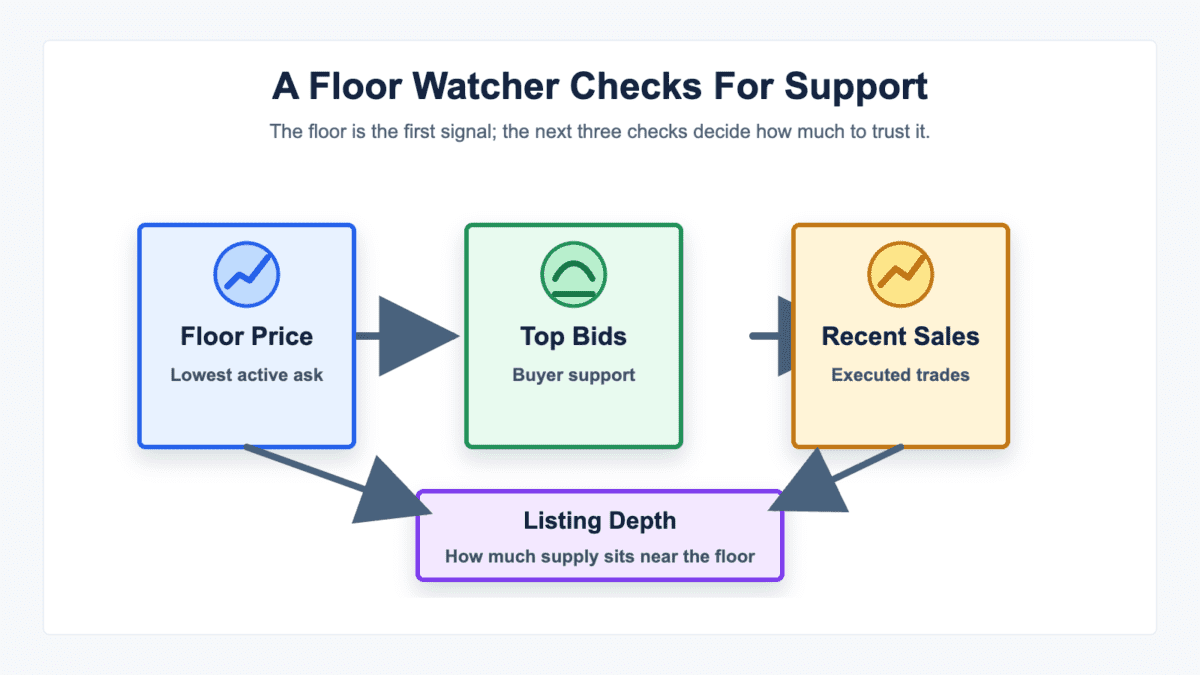
Start with the market signals closest to the trade:
OpenSea Help lists six watchlist stats for collections: floor-price change, top offer, volume, sales, owners, and item count. That is close to the right habit. A watchlist should be a scan surface, not a final answer.
Two broader checks explain many floor moves:
The practical habit is simple. If floor, bids, sales, and volume all point in the same direction, the signal is stronger. If they disagree, slow down.
Human floor watchers make the decision, while tools reduce the refresh work. Alerts are useful because they save time. They are dangerous when they turn every small move into an emotional emergency.
CoinStats Help covers NFT floor price alerts by collection, target price or percentage, frequency, and notes. The useful part is not just the alert. It is the note explaining why that alert exists.
Different watcher types solve different problems.
| Watcher Type | Best Use |
|---|---|
| Manual watchlist | Fast checks for a few collections you know well. |
| Marketplace alert | Simple floor changes without extra setup. |
| Portfolio tracker | Seeing how owned NFTs move together. |
| Analytics dashboard | Comparing bids, volume, listings, and sales. |
| Discord bot | Community updates during active drops or sweeps. |
| Custom API tracker | Power-user alerts across venues and traits. |
Manual watching works when you follow a small number of collections. You know the art, traits, memes, and buyer base. The screen does not have to explain every move because you already know the context.
Bots and alerts help when speed is part of the trade. They can catch a quick undercut, a sudden sweep, or a floor breaking a level you care about. But they also create noise. A floor moving 4% may be meaningless if no one is buying.
Dashboards help when you need depth. A good dashboard lets you compare floor, bids, volume, trait data, and marketplace spread without pretending one chart has divine powers.
The best setup is boring: one watchlist, one or two useful alerts, and a written reason for each alert. If the alert fires and you cannot remember why you set it, that is not market intelligence. That is a notification with a costume.
Floor watching misleads traders when the floor looks like value, demand, or safety by itself. It is only the lowest ask, and the lowest ask can change for reasons that have little to do with durable buyer interest.
The common mismatches are easy to miss:
A whale or small group may buy the cheapest listings, lift the visible number, and leave late buyers thinking the collection has broad demand.
That can create exit liquidity risk in thin collections. The late buyer is not joining a healthy market. They may be providing the exit path for someone faster, earlier, or less sentimental.
A falling floor can mislead in the other direction. One desperate seller can list far below the cluster and make every dashboard look worse. If bids stay firm and recent sales hold up, the market may not be as broken as the lowest ask suggests.
The floor can also become a top signal when a collection spikes after social hype, influencer attention, or forced FOMO. It can look like confirmation right when the trade has become crowded.
The reverse is not automatic either. A floor drop is not always a bottom signal. Buyers still need bids, sales, active holders, and a reason for demand to return.
Thin NFT markets can feel like PVP in crypto because every entry and exit affects someone else. If the next buyer has to rescue your listing, you are not investing in a clean order book.
Thin floors happen when only a few listings sit near the cheapest price. One sale, cancellation, or undercut can move the floor sharply. The chart looks dramatic because there is not much supply at each level.
A fake-looking floor is different. It may appear when sellers list far above real bids, when one odd listing drags the floor down, or when trades around the floor look staged. Do not call every weird floor manipulation. Just lower your confidence.
A floor sweep happens when someone buys many low listings. That can signal demand, but it can also be a whale, bot, or coordinated hype move. The follow-up is what counts. If bids and volume vanish after the sweep, the signal was mostly fireworks.
Launch floors are especially noisy because supply is still settling. Early listings may come from bots, fast minters, scalpers, or users who only wanted a quick flip.
That first visible floor can reflect scarce listings more than stable demand. A tiny group can set the early range before normal collectors even open the marketplace.
For new drops, wait for more information if you can. Check sales count, how many owners list, whether bids appear under the floor, and whether the community is still active after the first rush fades.
Floor watching helps before buying, selling, or holding when it turns a noisy price into a checklist. It should slow bad decisions down, not decorate them with more charts.
Before buying, compare the floor with recent sales and bids. If the floor is far above accepted offers, you may be buying the seller’s hope. If bids sit close to the floor and sales keep printing, the entry has cleaner support.
Use a short pre-buy check:
Avoid going full port because one floor alert looks tempting. NFT liquidity can disappear fast, and a cheap-looking entry still needs an exit path.
Before selling, separate your NFT from the collection floor. Check trait floor, recent trait sales, top bids, royalties, gas, and whether buyers exist near your target. If your item is rare, the collection floor may undersell it. If no one cares about that trait, the floor may flatter it.
Before holding through a drop, ask whether the original reason still works. A real conviction play needs more than nostalgia and a tab left open since mint day.
If demand fades and bids vanish, constant floor watching can turn into bag maintenance. That is how a normal holder becomes a bagholder with alerts.
The clean move is to write your action rule before the alert fires. For example: buy only if bids rise with sales, sell only if trait bids weaken, or do nothing unless the project update changes demand. Future you will be less dramatic if present you leaves instructions.
Safer floor watching means checking public market data without giving every dashboard, bot, or stranger access to your wallet. You usually do not need to connect a wallet just to see a public collection floor.
Use read-only surfaces first. Marketplace watchlists, public collection pages, and reputable analytics tools can show floors, bids, sales, and volume without asking you to sign anything.
Keep the safety checklist close:
That last point connects to dust in crypto. Random wallet clutter can lure users into clicking, approving, or visiting fake claim pages. Floor watching should reduce bad clicks, not add new ones.
Discord bots need extra caution. A bot in a server may be helpful, but fake bot links and impersonator accounts are common enough to deserve suspicion. Use official links, bookmarks, and marketplace pages you typed or saved yourself.
The safest habit is boring again. Watch public data, write down your rules, and handle wallet prompts as a separate risk event. A floor alert is not a reason to sign a transaction.
Related terms help floor watchers describe what they are seeing. The words are not just slang. They name the pressure points around thin NFT markets.
Group the terms by the job they do:
Floor sweep is the NFT-specific action to remember. Watching the floor means monitoring low listings. Sweeping the floor means buying many of them. One is observation. The other moves the market and can make everyone else refresh harder.
Use these terms as labels after you inspect the data, not as substitutes for inspection. A floor can look bullish, bearish, dead, or swept. The useful question is still the same: who is bidding, who is selling, and how deep is the market?
Start with one collection and one reason to watch it. If you are watching ten floors with no plan, you are not tracking the market. You are collecting anxiety in tab form.
Pick the collection, then decide what would make you act. A buy rule might require the floor to fall near recent sale prices while bids remain firm. A sell rule might require bids to weaken, trait premiums to fade, or project activity to dry up.
Use these first steps:
Then give every alert a job. One alert might mean “inspect bids.” Another might mean “review trait listings.” Very few alerts should mean “act immediately.”
Floor watching is useful when it turns a jumpy number into a calmer process. The floor is the headline. Your job is to read the rest of the market before the headline gets expensive.
Usually, no. In crypto, a floor watcher is normally community shorthand for a person, bot, alert, or dashboard that tracks NFT floor prices and related market signals.
No. Watching the floor means monitoring the cheapest listings and nearby signals. Sweeping the floor means buying many low listings, which can push the visible floor higher.
Not reliably. A floor watcher can spot changes in floors, bids, sales, and volume, but those signals do not guarantee future demand or resale value.
An NFT floor drop means the cheapest active listing got cheaper. It may show weak demand, one undercut seller, bad project news, thin listings, or a broader move in ETH or SOL.
Buying the floor can be the cheapest way into a collection, but it is not always the best NFT or the safest trade. Check recent sales, bids, traits, and fees first.
Yes. Public marketplace pages, watchlists, and analytics dashboards can show floor prices, bids, sales, and volume without needing a wallet connection.