Physical Address
304 North Cardinal St.
Dorchester Center, MA 02124
Physical Address
304 North Cardinal St.
Dorchester Center, MA 02124


Avoid costly fresh wallet traps before you buy.
A fresh wallet is a crypto wallet address that looks newly created, newly funded, newly active, or low-history in the context you are checking.
The label only describes visible wallet history. It does not prove the owner is new, independent, skilled, safe, private, or bullish.
You will see the phrase in token scanners, Solana meme-coin chats, DEX dashboards, wallet-security advice, and whale-flow headlines. The same label can mean a trading clue, a burner setup, a privacy attempt, or stage lighting for fake demand.
In crypto, a fresh wallet is an address that looks new or low-history for the specific check in front of you. The same address can read differently because tools, traders, and communities do not all use the phrase the same way.
One tool may call a wallet fresh because it was just created. Another may mean it was funded recently, made its first token buy, or has almost no previous swaps.
In meme-coin trading, “freshies” is shorthand for wallets that look new to a token or launch.
Start with the context, then check what the label can and cannot tell you.
| Fresh-Wallet Context | What It Can And Cannot Tell You |
|---|---|
| Newly created address | The address has little history, but the owner may control many older wallets. |
| Newly funded address | Capital just arrived, but the funding source may reveal the real connection. |
| Newly active address | The wallet started trading or swapping, but the activity may be a test or bot flow. |
| Low-history wallet | The address looks quiet, but it may be one part of a larger wallet cluster. |
The correction is blunt: fresh does not mean new investor, smart money, safe funds, clean identity, private wallet, or future price direction.
It means “check the next layer.” Look at who funded it, when it moved, whether similar wallets moved together, and what the wallet does after the first obvious action.
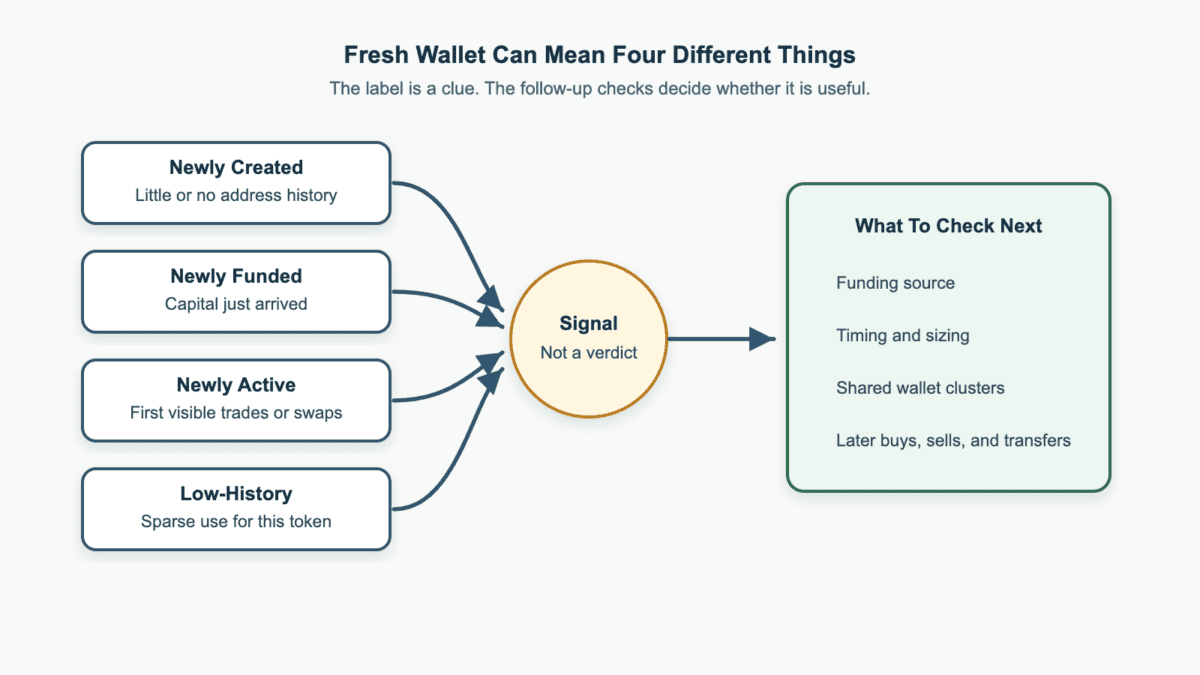
_A fresh wallet label starts the investigation. It does not finish it._
Fresh wallet activity can point to possible new demand, hidden positioning, token-launch interest, or exchange-flow changes before the story becomes obvious. You may see it in token scanners, DEX dashboards, Telegram calls, X posts, wallet trackers, and exchange-withdrawal news.
A Solana meme coin may show several new buyers after launch. That can be early interest, or it can be a cluster staged to make holder growth look alive.
A large Binance withdrawal may also land in a new Ethereum or Solana address and get framed as whale accumulation. Neither example is a trade setup by itself.
Context decides how useful the signal is:
Run these checks before reading too much into fresh wallet activity:
The useful habit is to separate “new address moved” from “smart money is buying.” The first is visible. The second is a story that still needs evidence.
Fresh wallet buys can look bullish, but new-looking addresses can be staged, automated, or controlled by the same party. The label can make demand look cleaner than it is.
This is common around thin DEX tokens and meme-coin launches. A group can fund several wallets, split buys into similar sizes, create more holders, and make the tape look active.
Volume-bot services also market fresh-wallet style activity because many small new wallets can look more organic than one obvious buyer.
> Fresh-wallet counts are easiest to misread when a trader is already hunting for a reason to buy.
That is where exit-liquidity risk shows up. Late buyers may think they are following new demand when they are really providing the exit path for faster wallets.
Compare the signal before trusting it.
| Good Signal | Bad Signal |
|---|---|
| Wallets are funded from different sources and buy at different times. | Wallets share one funding path and buy in the same tight window. |
| Buys are sized differently and fit the available liquidity. | Buys have similar sizes that look scripted. |
| Wallets keep holding or interact like real users. | Wallets vanish, dump quickly, or only touch one token. |
| Holder growth matches real value held. | Holder count rises while balances stay tiny or clustered. |
Fresh wallet buys can still be useful. The signal gets stronger only when wallets keep behaving independently after the first buy.
Checking fresh wallet activity before buying a token means following the money before following the crowd. A new address becomes useful only after you know where funds came from and how the wallet behaves next.
On Solana, users often check this around Pump.fun launches, Raydium pools, Jupiter swaps, Solscan histories, Birdeye charts, and DEXScreener-style feeds. The same logic works on Ethereum with Etherscan, Uniswap, token holders, and approval history.
Before buying, run a short workflow:
Do not turn this into a guaranteed scam detector. Clean-looking wallets can still lose money, and messy wallets can still belong to normal users.
The goal is to remove weak evidence. If fresh wallets all share one funder, buy together, never act again, and appear beside shallow liquidity, the “new demand” story has not earned your money.
Fresh wallets help with security when you need separation. A new wallet can keep risky app activity away from long-term holdings, isolate test swaps, or replace a wallet after serious key exposure.
This is where the phrase overlaps with burner wallets. A burner wallet is a low-value wallet used for unfamiliar apps, experimental mints, meme-coin trading, or other places where you do not want your main funds exposed.
For broader wallet setup habits, CryptoProcent’s wallet setup category is the natural place to start.
A fresh wallet can help in these cases:
But a fresh wallet does not help when the risky condition follows you.
Watch for cases a new address cannot fix:
Random tokens are another common trigger. A surprise token appearing in your wallet is usually less dangerous than the action it tries to bait.
Understand dust-token risk before clicking a claim site, selling through an unknown app, or signing a cleanup transaction.
If a wallet was drained, slow down and sort the problem. A bad approval, exposed seed phrase, malicious browser extension, and compromised device all need different fixes.
Chainalysis reported that private key compromises accounted for 43.8% of stolen crypto in 2024. That is why a fresh wallet only helps after the exposed-key problem is actually fixed.
Fresh wallet privacy is limited because a new address can still be linked by how it is funded, when it moves, and which counterparties it touches. A fresh address has little public history, but the public trail can still connect dots if you fund it from Coinbase, your main wallet, or the same known address you always use.
This is the privacy trap. The wallet may look clean by itself, while the money trail still points back to the old identity, exchange account, or main address.
Watch the visible links that can weaken privacy:
Fresh also does not mean invisible to tax systems, exchanges, analytics providers, or compliance workflows. It is a wallet-history concept, not a legal eraser.
So use a fresh wallet for cleaner separation, not magical privacy. If privacy is the goal, the funding path and later behavior deserve more attention than the age of the address.
Tax and compliance duties do not disappear either. A new address can make records cleaner, but it does not erase what happened before the transfer.
Fresh wallet, sniper wallet, funding wallet, deployer wallet, and holder count are different labels. Meme-coin traders blur them together because they often appear on the same launch screen.
The clean split is useful. A fresh wallet describes visible wallet history. A sniper wallet describes launch timing. A funding wallet describes where capital came from.
A deployer wallet describes token control. Holder count describes how many addresses hold the token.
| Label | What It Means |
|---|---|
| Fresh wallet | A wallet that looks new, newly funded, newly active, or low-history. |
| Sniper wallet | A wallet that buys extremely early, often through automated launch tools. |
| Funding wallet | A wallet that sends capital to one or more other wallets. |
| Deployer wallet | A wallet that creates, configures, or controls a token. |
| Holder count | The raw number of token-holding addresses, not proof of real demand. |
The table keeps one label from doing too much work. A token can have many holders and still have weak demand. A wallet can be fresh without being a sniper, and a deployer can use fresh wallets to hide links.
When these labels point to the same cluster, slow down. The risk rises when the deployer, funder, early buyers, and holder growth all look more connected than the chart suggests.
Common fresh wallet mistakes start when users turn a useful label into a verdict. Fresh means low visible history. It does not award a halo.
Here are the traps that cost the most:
Freshies can be worth watching, but slang should not flatten the analysis. A wallet label does not know your entry, stop, liquidity, or time horizon.
The worst version is buying late because fresh wallets bought early. If the cluster exits into new buyers, the late trader gets bagholder risk with a cleaner-looking chart screenshot.
Related fresh wallet terms help you read wallet activity without turning every address into a prophecy. Use them as checks around the signal.
The closest terms separate wallet purpose, control, and market quality:
Holder count is the easiest metric to overrate. More addresses can look healthy, but tiny balances, shared funders, and synchronized behavior can make demand look broader than it really is.
The unlinked labels still matter too. Burner wallet, Sybil wallet, funding wallet, sniper wallet, and deployer wallet all describe different checks. Keep them separate before making a trade or moving funds.
A fresh wallet in crypto is an address that looks newly created, newly funded, newly active, or low-history in the context being checked. It describes visible wallet history, not owner identity.
Fresh wallet buys can be bullish only when they are independent, meaningfully sized, and followed by real holding or use. They can also be staged, automated, or short-lived.
Yes. Fresh wallet activity can be manufactured through coordinated wallets, bots, shared funding sources, same-size buys, and holder farming. The funding path usually tells you more than the label.
No. A fresh wallet is any new or low-history address, while a burner wallet is intentionally used to isolate risk from a main wallet.
A fresh wallet can reduce visible history, but it does not make crypto private by itself. Funding paths, timing, counterparties, and later transfers can still connect addresses.
A fresh wallet looks new or low-history. A sniper wallet buys extremely early, usually around a token launch. One label describes history, while the other describes timing.
Start with context. Ask whether the fresh wallet label is being used for a token buy, an exchange withdrawal, a security move, or a privacy attempt. That one question prevents most bad reads because each context needs different evidence.
A token-scanner fresh wallet signal needs funding and cluster checks. A security fresh wallet needs seed, device, approval, and app checks. A privacy fresh wallet needs funding-path and later-behavior checks.
Then reduce the signal to checks you can actually verify:
Fresh wallet activity is useful when it points you toward better questions. It becomes dangerous when it replaces those questions.
If you cannot trace the funding path, cluster behavior, or later sells, lower your confidence. A clean-looking address is still just one clue on a public chain.
Use fresh wallets to separate signals from noise, not to skip the part where you verify who funded the wallet and what happened after the first move.