Physical Address
304 North Cardinal St.
Dorchester Center, MA 02124
Physical Address
304 North Cardinal St.
Dorchester Center, MA 02124


Governance minimization, explained for crypto risk checks.
Governance minimization is the design choice of reducing how much a crypto protocol depends on token votes, admins, committees, or founders after launch.
The risk starts when “decentralized” does not tell you who can change the rules. A protocol may have a DAO, a governance token, a multisig, and a voting forum, while the real risk still sits in a few upgrade keys, parameter switches, or emergency powers.
Governance minimization is the attempt to make those powers narrower. The goal is not to make humans disappear from crypto. The goal is to make the parts users rely on harder to capture, harder to politicize, and easier to trust without watching every vote.
Governance minimization in crypto means reducing the power and reliance on governance wherever a protocol can safely define rules in advance. The idea is closely associated with Paradigm, which framed minimized governance as a way to make protocols more credibly neutral.
In plain terms, fewer people should be able to change the parts everyone depends on. That includes token holders, founders, committees, multisigs, and admin-key holders. If a market formula, fee cap, collateral rule, or pool-creation process can be set in code, governance minimization asks why voters should keep changing it every week.
A normal DAO may vote on many routine decisions. A governance-minimized protocol tries to remove routine decisions from politics and leave only the hard cases for humans.
That usually means reducing these control surfaces:
The key word is “discretionary.” Governance minimization does not mean every setting is frozen forever. It means the protocol should avoid open-ended human control when a predictable rule can do the job.
That is why the term shows up around DeFi protocols, DAOs, and governance tokens. Users want to know whether the protocol is dependable, or whether a vote can quietly move the goalposts after money is already inside.
A governance-minimized protocol should make boring behavior the default. Users should not need to predict delegate politics just to know whether a pool will keep charging the same fee, whether a market can stay open, or whether a core contract can be replaced overnight.
For crypto investors, governance minimization turns a protocol claim into a money-risk question: who can change the rules behind deposits, fees, upgrades, treasury spending, and token value? A smart contract is not only code. It is also a permission map.
If governance can change a lending market, users need to know who controls collateral listings, liquidation settings, oracle feeds, pause powers, and upgrade paths. If governance can change a DEX, users need to know who can turn on fees, redirect value, or change pool behavior.
The investor concern is not abstract DAO theory. It is whether exposure can change after money is already in.
Governance can shape several money risks:
Minimized governance can reduce capture risk because fewer levers exist. A protocol with fewer adjustable settings gives hostile voters, short-term token holders, and insiders less to grab. That is the appeal of credible neutrality: users and builders can depend on rules without begging a voting bloc to stay polite.
But the token side gets more complicated. Some governance-token stories imply that token holders can steer value toward themselves. If the protocol later removes those levers, late buyers may discover they were buying a control narrative more than real control. That can leave slower buyers funding the exit while early holders sell a story the contracts no longer support.
The useful investor question is narrower than “is there a DAO?” Ask what that DAO can still change, and how much time users get before the change lands.
Governance minimization keeps governance for decisions that code cannot safely handle ahead of time. It narrows the job instead of pretending coordination no longer exists.
That distinction prevents a lot of bad analysis. A protocol can minimize routine voting while still needing humans for emergencies, oracle disputes, treasury spending, or migration choices. Some systems also need governance early, then reduce it as the protocol becomes more mature.
Common misunderstandings usually look like this:
Essential governance is the part humans may still need to handle. Oracles may need judgment when data breaks. Treasuries may need budgeting. Lending protocols may need collateral reviews. A stablecoin design may need risk parameters that cannot be perfectly known before new assets exist.
There is also social governance. Bitcoin and Ethereum have no simple token-vote switch for their core rules, but communities can still coordinate around upgrades, clients, forks, and norms. That governance is slower and more constrained, which is often the point.
The point is not to abolish governance. The point is to remove unnecessary control and leave human power only where it earns its keep.
Governance minimization works by shrinking the number of protocol decisions that require ongoing votes or privileged operators. The protocol tries to turn repeated judgment calls into bounded rules, automatic actions, or slow, reviewable governance paths.
This can happen at several layers. Some contracts are immutable. Some use proxy contracts but require a timelock before upgrades execute. Some allow parameter changes only inside fixed ranges. Some use veto councils for emergencies, while routine actions stay permissionless.
Automation is not magic. It is pre-decided governance. Someone still chose the formula, threshold, delay, role, or oracle path.
Here is the control map to inspect:
| Design Choice | What To Check |
|---|---|
| Immutable contracts | Can the code be upgraded, migrated, or replaced? |
| Bounded parameters | Are fee caps, collateral factors, or rates limited by code? |
| Timelocks | How long do users get before a passed change executes? |
| Veto councils | Who can block danger, and who can remove the veto? |
| Permissionless actions | Can users list markets, create pools, or exit without approval? |
| Oracle automation | What happens if the price feed breaks or lags? |
| Proxy contracts | Who controls the implementation address? |
| Delegated operators | What can keepers, signers, or security councils do alone? |
The cleanest designs make ordinary use boring. Pools open under known rules. Fees stay within stated ranges. A market keeps working even if voters ignore the forum for a month.
The harder designs admit where humans still matter. A security council may pause a market during an exploit. A DAO may approve a new collateral type. A veto role may stop a malicious proposal. Those powers can protect users, but they also become trust points.
This is where labels can mislead. “Immutable” sounds final, but some protocols keep a migration path. “DAO-controlled” sounds public, but execution may still depend on a small signer group. “Autonomous” sounds clean, but an oracle or keeper network may still need maintenance.
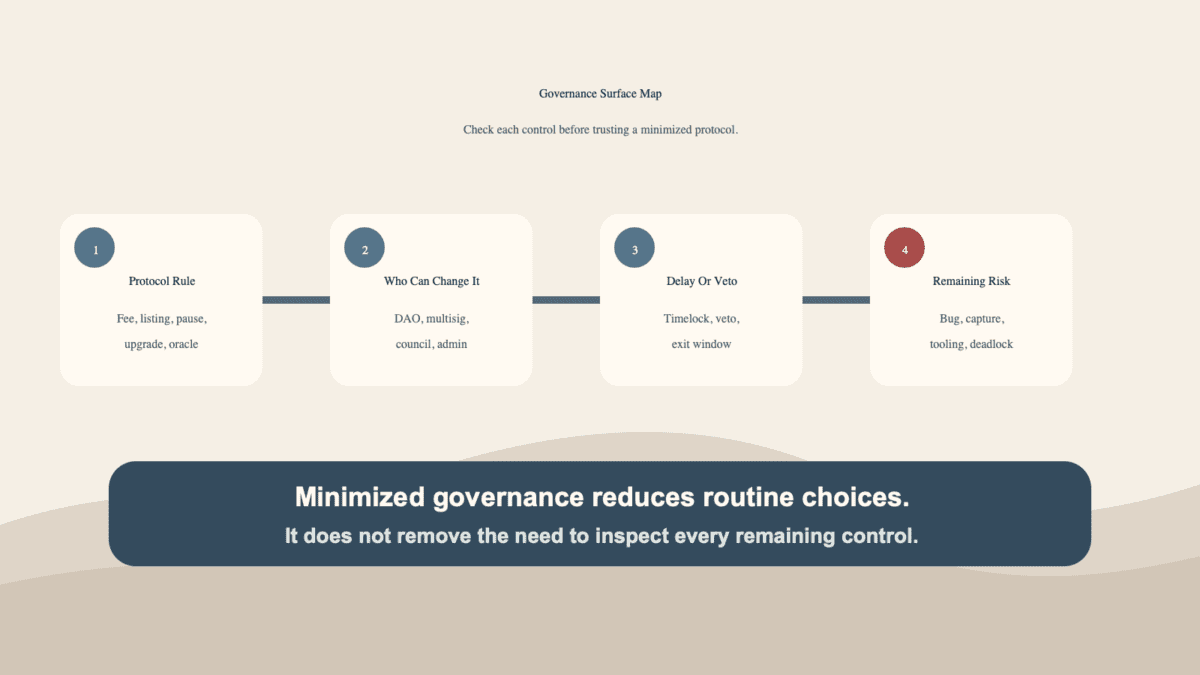
The main test is whether each remaining power has a clear scope. “Governance can change anything” is not minimization. “Governance can change this parameter within this range after this delay” is much closer.
When a protocol explains the scope clearly, users can choose the risk. When the scope is vague, the protocol is asking users to trust a slogan and do contract archaeology later. That is not a great onboarding flow unless the product is stress.
Governance minimization and active governance solve different problems. Minimized governance works best when a protocol can run on predictable rules. Active governance works better when the system needs human judgment often.
A simple lending primitive with one collateral type may be able to hard-code most rules. A complex lending market with many collateral types may need risk teams, oracle reviews, liquidation changes, and treasury decisions. One wants fewer levers. The other needs careful levers.
That does not make active governance bad. It makes it expensive. Votes require attention, coordination, review, delegation, execution, and often a lot of forum archaeology.
The better fit depends on the protocol situation:
| Protocol Situation | Better Fit |
|---|---|
| Mature, simple rule set | Governance minimization |
| Constant collateral onboarding | Active governance |
| Permissionless DEX pool creation | Governance minimization |
| Treasury grants and budgeting | Active governance |
| Emergency pause authority | Narrow emergency governance |
| Oracle dispute handling | Active governance with strict scope |
| Core fee formula with known limits | Governance minimization |
| Front-end policy or legal coordination | Active governance or off-chain operators |
Quorum debates show the cost. If voter participation falls, a DAO can lower quorum, delegate more power, or reduce the number of things that need votes. Each option has a cost. Lower quorum can weaken security. More delegation can concentrate power. Fewer votes can make the protocol easier to depend on.
In May 2025, the Arbitrum governance forum proposed cutting the DAO’s constitutional quorum threshold from 5% to 4.5%. The small change still showed the active-governance grind: even healthy DAOs sometimes adjust rules just to keep legitimate proposals from stalling.
Minimization is usually strongest where the protocol wants to become infrastructure. Active governance is strongest where the protocol still needs adaptation, judgment, and funded maintenance.
That split also changes what users should monitor. In a minimized protocol, watch the rare powers that remain. In an active DAO, watch the health of participation, delegate concentration, proposal quality, and execution discipline.
The mistake is using either model as branding. A protocol should not claim minimized governance while keeping broad upgrade powers. A DAO should not pretend active voting is community control if only a few wallets decide everything.
Good governance design makes the workload match the risk. Boring, repeatable actions should not need constant politics. Risky, judgment-heavy actions should not hide behind automation theater.
Governance minimization creates a real trade-off. Fewer people can change the rules, but fewer people can rescue the system when rules fail.
That trade-off is why minimized governance is not a trust badge by itself. Immutable code can protect users from hostile upgrades. It can also trap users in a broken design. A long timelock can create an exit window. It can also slow emergency response during an exploit.
The best designs make those trade-offs visible before a crisis.
Watch for these remaining risks:
The hidden-dependency problem is easy to miss. Voting may be on-chain, but normal users still rely on interfaces, relayers, indexers, proposal decoders, simulations, and funded maintainers. If those tools vanish, ordinary governance can become unusable even when the contracts still exist.
Minimized governance also changes attack shape. A wide governance surface can enable malicious upgrades, treasury grabs, or abusive emergency actions. In the worst case, a privileged control path can look less like decentralization and more like a hard rug wearing a DAO badge.
But removing every lever is not always safer. A stablecoin with live collateral risk may need parameter changes. A lending market may need a bad asset frozen. A bridge may need emergency response. A protocol with no credible path for those moments can be neutral right up until it becomes unusable.
So the trade-off is not “governance good” versus “governance bad.” It is narrower: which powers should be impossible, which should be slow, and which should remain available under strict limits?
The answer can change as a protocol matures. Early systems often need more human control because product risk, oracle risk, and user behavior are still being discovered. Older systems can usually remove more control because the dangerous edge cases are better known.
Users should be suspicious of both extremes. Unlimited governance can become politics over user funds. Absolute rigidity can become a refusal to fix known damage. The useful middle is explicit: narrow powers, clear limits, public delays, and enough response capacity for real emergencies.
Checking governance minimization starts with one question: what can still change after you deposit, build, vote, or buy the token? The answer is usually scattered across docs, contracts, vote dashboards, forums, and multisig records.
Start with contract control. If the protocol uses proxy contracts, find who can upgrade them. If a multisig controls upgrades, check signer count, signer identity, execution threshold, and whether a timelock stands between approval and execution.
Operator identity matters most when a few humans can act quickly. An anon dev is not automatically unsafe, but anonymous control over upgrades, pause powers, or treasury movements raises the trust burden.
Use this checklist before treating a protocol as governance-minimized:
Then compare the public story with the actual powers. A protocol that claims “community owned” but lets a small signer group upgrade contracts tomorrow is asking for trust. A protocol that claims “immutable” but depends on an upgradeable oracle adapter still has a live control surface.
The best evidence is specific. Look for addresses, contract names, role lists, timelock queues, on-chain votes, signer thresholds, audit notes, and forum explanations that match the deployed code. Vague assurances are cheap. Clear control maps take work.
Gradual abuse deserves special attention. Governance can harm users without one dramatic exploit. Fees can drift, rewards can shift, treasury spending can favor insiders, and risk parameters can slowly tilt against smaller users. That pattern sits closer to a soft rug than a clean hack, which makes it harder to spot early.
The last check is exit quality. A timelock is useful only if users can understand the proposal, withdraw funds, repay loans, or migrate before execution. If the exit path is slow, expensive, or unclear, the protocol’s minimized governance may still leave users cornered.
Good minimization feels boring after inspection. You can name the few remaining powers, the people or contracts behind them, the delay before action, and the exact risk each power exists to handle.
If you cannot name those pieces, slow down. The protocol may still be worth using, but it should be treated as trust-dependent until the control surface is clear.
Governance minimization can make a governance token less powerful in some ways and more honest in others. The token may still matter, but its value story should match the actual control it grants.
A broad governance token can vote on upgrades, fees, grants, emissions, collateral, treasury spending, and protocol direction. A minimized protocol may remove many of those levers. That can be good for users because rules are harder to change. It can be awkward for token holders who expected direct control over revenue or protocol policy.
This is where user safety and tokenholder upside can split.
Token holders may still have meaningful roles:
But a token should not promise control the protocol no longer gives. If the contracts cannot be upgraded, the token cannot magically upgrade them. If fee switches are capped, token holders cannot vote past the cap without changing deeper governance rights.
Delegation also changes the picture. Many holders do not vote directly, so delegates become the practical control layer. That can improve expertise, but it can also concentrate power in a small political class.
For investors, the clean habit is to separate protocol quality from token value. A governance-minimized protocol may be excellent infrastructure while the token has limited cash-flow rights, limited control, or mainly coordination value. That is not automatically bad. It just needs to be priced as reality, not as folklore.
This also helps avoid a common trap. A protocol can be more trustworthy because token holders have fewer ways to interfere, while the token itself becomes harder to analyze. The product can improve while the token thesis becomes narrower.
Governance minimization becomes easier to understand when the nearby terms are separated. These concepts often appear together, but they do different jobs.
The idea of exit liquidity fits when the governance-token story is stronger than the token’s real powers. It helps explain who may be left holding risk when early holders sell control that the protocol no longer grants.
A conviction play lens helps when judging a long-term governance-token thesis. It separates durable belief from a token narrative that depends on future control, fee switches, or political influence.
For the design side, keep the core concepts separate. Credible neutrality means rules are hard for one group to bend. Essential governance means humans still handle choices code cannot safely pre-decide. Timelocks create review time. Veto rights stop danger without controlling every action. Admin keys remain privileged controls that can upgrade, pause, configure, or move parts of a protocol.
The useful habit is to map each term to a power. If the concept cannot answer who can change what, when, and with which limits, it may be more branding than risk information.
That map also keeps comparisons honest. A timelock is not decentralization by itself. A veto is not full control. Admin keys are not always malicious, but they are never invisible risk. Each term earns trust only when the protocol shows the exact limits.
Once those limits are visible, governance minimization becomes less mystical. It is just a smaller set of human levers around a larger set of predictable protocol rules.
No. Governance minimization can support decentralization, but it is not the same thing. Decentralization describes how control is distributed. Governance minimization describes how much discretionary control remains in the first place.
A protocol can have many voters and still too many powerful levers. Another protocol can have fewer governance actions because the rules are mostly fixed. You need to check both distribution and scope.
Yes, a governance-minimized protocol can still be upgraded if the upgrade path is narrow, delayed, and clearly disclosed. The important question is who can upgrade it, what they can change, and how much time users get before execution.
Some protocols minimize governance gradually. They may start upgradeable, then freeze contracts, narrow parameters, or move users to more immutable versions after the design matures.
Governance minimization can make a crypto protocol safer from capture, surprise upgrades, and token-holder value extraction. It does not remove bugs, oracle failures, front-end risk, or the need for emergency judgment.
The safety gain depends on what powers were removed and what powers remain. A narrow, delayed upgrade path is very different from a hidden admin key with instant control.
If a governance-minimized protocol has a bug, the response depends on the remaining controls. The protocol may use an emergency pause, a council, a migration, a voluntary user exit, or a social fork.
That is the downside of hard rules. They can protect users from abusive changes, but they can also make urgent fixes slower or messier.
Governance tokens can matter less when governance minimization removes broad control rights. They may still matter for narrow upgrades, vetoes, council elections, treasury budgets, or maintenance funding.
The real test is what the token can actually change. If the token narrative promises power the contracts do not grant, the market story is ahead of the mechanics.
Check whether the protocol has admin keys, proxy contracts, timelocks, emergency powers, governance thresholds, concentrated voting power, treasury controls, oracle controls, and a clear exit window.
Then compare those controls with the public claim. Real governance minimization is specific. It tells you which powers are impossible, which are bounded, and which are still trusted.
Start with the control surface, not the slogan. A protocol that says “governance minimized” should make its remaining powers easy to find and hard to abuse.
Write down the control map before you rely on the protocol. Name the contract role, the actor behind it, the delay before action, and the user exit path before execution.
Use these first checks:
Then decide what you are trusting. You may be trusting immutable code, a bounded DAO, a security council, signers, an oracle process, a front-end team, or some blend of them.
Size changes the work. A small test position may only justify a fast scan. A large deposit, lending loop, treasury allocation, or long-term token thesis deserves a deeper read of contracts, forums, and governance history before the money moves.
Do not demand perfection. Demand clarity. A protocol can have emergency powers and still be honest about them. The danger is when broad control is hidden behind minimized language.
Governance minimization is useful when it makes that trust smaller and clearer. If the control map stays blurry, the protocol has not reduced governance risk. It has just made the risk better dressed.