Physical Address
304 North Cardinal St.
Dorchester Center, MA 02124
Physical Address
304 North Cardinal St.
Dorchester Center, MA 02124


A plain-English guide to liquid restaking, LRT yield, risk layers, and safer evaluation checks.
Liquid restaking lets you route staked crypto into restaking and receive a movable token for that position.
That movable token is usually called a liquid restaking token, or LRT. The appeal is simple: your staked ETH or LST exposure may keep earning while the receipt token can still sit in a wallet, trade, or move through DeFi.
The tradeoff shows up fast. Liquid restaking adds more layers between you and the asset. More layers can mean more reward paths, but also more contract risk, operator risk, AVS risk, depeg risk, and exit friction.
Liquid restaking lets a crypto holder restake already staked exposure and receive a transferable receipt token. In most beginner examples, the path starts with ETH or a liquid staking token, then moves into a restaking route.
The restaking route may help secure extra services beyond ordinary Ethereum staking. In return, the user receives an LRT that represents the restaked position. The LRT can be held, traded, supplied to a DeFi app, or sold on a secondary market if there is enough liquidity.
Take a simple example. A user holds staked ETH exposure through an LST. They deposit that LST into a liquid restaking protocol. The protocol handles the restaking route, and the wallet receives an LRT that tracks the position.
From the user’s side, the balance now looks simpler than the machinery underneath. The wallet shows a token. The position underneath still depends on staking, the LST route if one was used, the restaking protocol, operator choices, AVS rules, withdrawal timing, and the market for the LRT.
That is the core tradeoff. Liquid restaking can make a restaked position easier to move, but it also turns one staking decision into a layered DeFi position. Before the yield number gets interesting, the user needs to know what backs the LRT and how the exit works.
Keep the stack separate:
Liquid restaking does not create a second, clean copy of the same ETH. It wraps a position that already has dependencies. The LRT makes the position easier to move, but it also gives the position more places to break.
Liquid restaking works by routing staked exposure through a restaking system, then issuing an LRT that represents the resulting position. The user may never run validator software, AVS software, or operator infrastructure.
The abstraction is the product. It is also the risk. The protocol and its operators handle complex work for the user, and the LRT turns that work into a token the user can hold or use elsewhere.
For the base restaking model, Ethereum’s restaking overview defines restaking as using already-staked ETH to secure other decentralized services and earn possible extra rewards. It also notes that EigenLayer has grown to thousands of people restaking millions of ETH. Liquid restaking is no longer a tiny side experiment. It adds the receipt-token layer on top.
The flow starts with a position that already has staking exposure. That may be ETH staked through a route, or an LST such as stETH or rETH that represents staked ETH under a protocol’s rules.
The liquid restaking protocol then takes that exposure into a restaking route. In many cases, it delegates or coordinates the position through operators that support one or more AVSs. The user receives an LRT, such as eETH, weETH, ezETH, or rsETH, depending on the protocol.
Here is the clean version of the path:
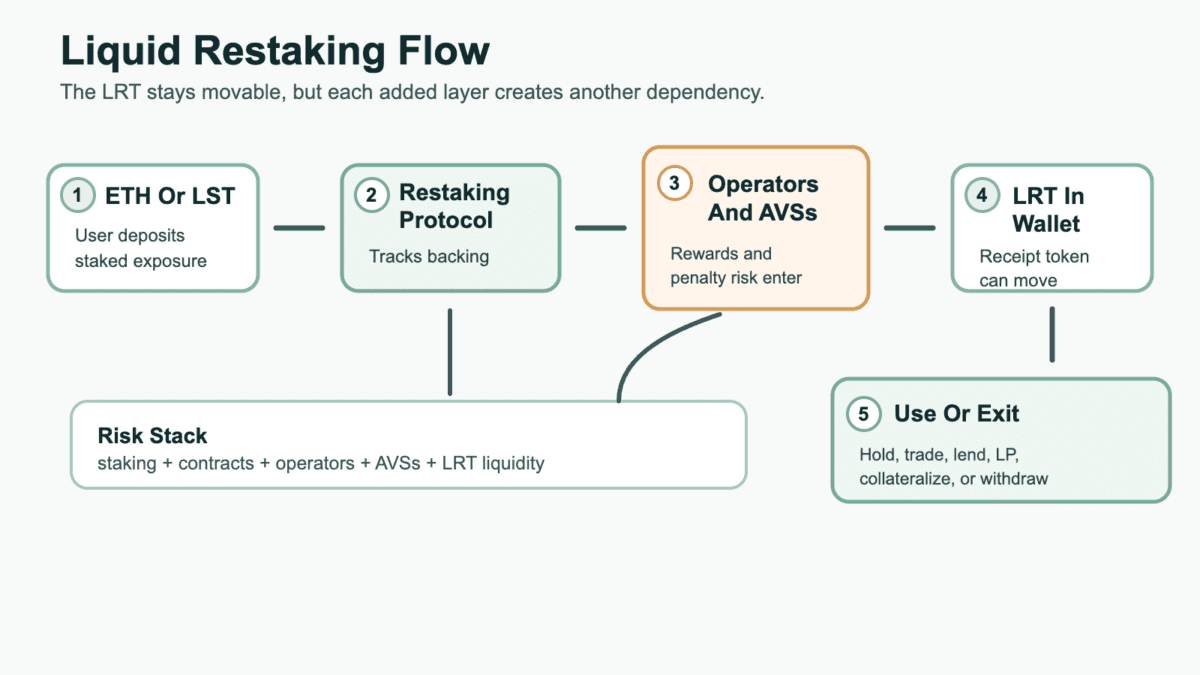
The LRT is the part most users touch. It may appear in a wallet, a DEX pool, a lending market, or a dashboard. But the token is only the visible layer. The backing route underneath still deserves the homework.
AVS means Actively Validated Service in many restaking discussions. You may also see similar names across different platforms. In plain English, an AVS is a service that receives security from restaked stake and may pay rewards for that support.
Operators sit between the user’s restaked exposure and those services. They run the software, accept service-specific obligations, and may face penalties if they fail the rules tied to an AVS.
AVSs and operators are where liquid restaking changes the risk profile. Ordinary staking already has validator and network risk. Restaking adds AVS rules and operator choices. Liquid restaking adds an LRT protocol, token accounting, market liquidity, and DeFi reuse.
Rewards can come from several places:
Those sources are not equally durable. Base staking rewards and temporary campaign incentives do not belong in the same drawer. One is tied to network staking. The other can fade when the marketing budget stops smiling.
Liquid restaking sits between several similar-sounding DeFi terms. The confusion makes sense because the same ETH exposure can move through more than one route.
The clean distinction is this: liquid staking makes a staked position transferable, restaking adds extra services to that staked exposure, and liquid restaking wraps the restaked exposure into an LRT. Lending and looping are separate DeFi strategies that may use those tokens.
Use this table to keep the terms apart.
| Route | What It Means |
|---|---|
| Liquid staking | You stake through a route and receive an LST that represents staked exposure. The main added risks are protocol, validator, liquidity, and redemption risk. |
| Restaking | You use already-staked exposure to help secure extra services. The main added risks are AVS rules, operator behavior, and possible slashing. |
| Liquid restaking | You restake exposure through a protocol and receive an LRT. The main added risks are the LRT wrapper, market liquidity, depeg risk, and route opacity. |
| Lending | You supply an asset so borrowers can use it. The yield usually comes from borrower demand, not from securing AVSs. |
| Looping | You borrow against a position and repeat the exposure. This can magnify yield, but it also magnifies liquidation risk. |
These routes can combine. A user might hold an LST, restake it, receive an LRT, then use that LRT as collateral. At that point, the position is no longer a quiet staking receipt. It is a layered DeFi position.
That does not make it automatically bad. It means the user must name each layer before comparing yield. If the stack takes three minutes to explain, it deserves more than three seconds of sizing.
Crypto investors use liquid restaking because it can make staked exposure more capital-efficient. The position may support extra services, earn extra rewards, and still leave the user with a token that can move through DeFi.
That can appeal to ETH holders who dislike idle capital. It can also appeal to DeFi users who want a receipt token they can trade, lend, LP, or use as collateral while the underlying exposure remains tied to staking and restaking.
The main benefits are practical, not magical:
Points and incentives also pulled users into the category. Some liquid restaking campaigns looked close to farming future rewards, where users chased possible airdrops rather than only current yield.
That incentive layer deserves a raised eyebrow. Points, emissions, and token rewards can help, but they are not the same as durable cash flow. If the yield looks free, the invoice may be hiding in a different contract.
The strongest case for liquid restaking is not “more APY.” It is controlled exposure where the user understands the asset, the LRT, the withdrawal path, and the risk stack. Without that, a neat dashboard can become a very expensive vocabulary lesson.
Liquid restaking risk is a stack, not a single warning label. The position can face ordinary staking risk, restaking risk, LRT protocol risk, market-liquidity risk, wallet risk, and DeFi collateral risk.
That stack is why the word “liquid” deserves care. The LRT may be transferable, but a transferable token can still trade at a discount, lose market depth, depend on a withdrawal queue, or create liquidation pressure.
Here is the broad risk map before the details.
| Risk Layer | What To Check |
|---|---|
| Slashing and AVS rules | Which services the position secures, what penalties can apply, and who chooses operators. |
| Smart contracts | Audits, bug bounties, upgrade controls, incident history, and admin permissions. |
| LRT liquidity | Market depth, redemption route, withdrawal timing, slippage, and possible depeg behavior. |
| Collateral use | Borrow limits, liquidation thresholds, oracle design, and exit options during stress. |
| Wallet and tax friction | Approvals, fake links, chain support, swaps, rewards, transfers, and records. |
The table is not a one-minute checklist. It is a map of where losses can enter. Each layer needs its own answer before the LRT becomes part of a larger DeFi position.
Slashing risk means restaked exposure may be penalized if an operator breaks rules tied to a service. The exact rules depend on the protocol, the operator, and the AVS design.
This is different from ordinary liquid staking. In liquid staking, the core concern is usually validator performance, protocol accounting, and redemption. In liquid restaking, the position may also inherit obligations from external services.
The user may not choose every AVS directly. Some LRT protocols package operator and AVS exposure for the user. That can make the product easier to hold, but harder to inspect.
Before using an LRT, ask these questions:
If the answers are vague, the yield should be treated as vague too.
Smart contract risk enters when deposits, withdrawals, accounting, reward claims, or LRT minting rely on code. Liquid restaking protocols sit in the middle of valuable assets, so a bug can affect more than a small dashboard balance.
Protocol design changes who can intervene. Some systems have upgrade keys, governance controls, operator whitelists, or emergency pauses. Those controls may protect users during a crisis, but they also create trust assumptions.
Fake front ends and malicious tokens add another layer. A user may think they are minting a known LRT, but they are signing a wallet approval on a lookalike site. That can feel like hard rug risk even when the real protocol had nothing to do with the loss.
The careful habit is boring. Use official URLs, verify token contracts, avoid help DMs, read approval screens, and keep large positions away from fresh or untested contracts.
An LRT depeg happens when the token trades away from its expected relationship with the underlying position. Sometimes the discount reflects normal market stress. Sometimes it reflects a deeper concern about withdrawals, backing, liquidity, or trust.
Exit liquidity becomes more than market slang when an LRT is under pressure. A token can be “liquid” because it trades, yet still be expensive to sell in size. Thin pools can turn a simple exit into a painful haircut.
Withdrawal queues create another path. A protocol redemption route may take time, while a secondary-market sale may be faster but priced worse. The tradeoff changes during market stress.
Know both exits before entering:
“I can sell it somewhere” is not an exit plan. It is a hope with a swap button.
Using an LRT as collateral adds a new failure path. The token’s price, oracle treatment, lending-market rules, borrow health, and liquidation threshold can matter as much as the restaking route itself.
For example, a user supplies an LRT to a lending market and borrows stablecoins. If the LRT trades down, liquidity dries up, or the collateral factor changes, the user’s position can move toward liquidation even if the underlying ETH thesis has not changed.
Loops make this sharper. A loop can supply an LRT, borrow against it, buy or mint more exposure, and repeat. That may increase apparent yield, but it also makes exits harder. Each turn adds another place where slippage, rates, or liquidation can bite.
Before borrowing against an LRT, check the collateral rules, oracle source, liquidation threshold, borrow asset, and unwind path. If the only exit plan is “markets stay calm,” the plan needs work.
Liquid restaking can create more records than simple holding. A user may swap ETH into an LST, deposit into an LRT protocol, receive an LRT, claim rewards, move across apps, borrow, repay, redeem, or sell.
Tax treatment varies by country, and this article is not tax advice. The practical point is simpler: recordkeeping gets harder as the route gets more complex.
Track the basics from the start:
Waiting until tax season to rebuild a DeFi trail is how a yield strategy becomes admin cardio. Save exports early, name wallets clearly, and keep notes on why each position exists.
Evaluating a liquid restaking token starts with the boring facts: what backs it, where it lives, how it exits, and who controls the route. A nice ticker is not a risk report.
The first check is identity. Confirm the official protocol URL, token contract, supported chain, and deposit route before connecting a wallet. Lookalike tokens and copied front ends are common around anything that smells like rewards.
Run this checklist before minting, buying, bridging, lending, or borrowing against an LRT:
Wallet hygiene belongs in this section because LRTs require signed transactions. If you compare tools, focus on custody, approvals, and wallet separation, not just the cleanest app screen.
Do not evaluate an LRT only by the headline yield. Evaluate the route. A lower-looking reward with cleaner liquidity and clearer controls can beat a flashy number attached to a fog machine.
Liquid restaking can be worth it for users who already understand ETH staking, liquid staking, and DeFi risk. It is a poor fit for users who want simple yield, instant exits, or a position they never need to monitor.
The answer depends on what job the LRT does in the portfolio. Holding a small LRT position for extra restaking exposure is different from using the same token as collateral inside a borrow loop.
Timing counts too. Early points, emissions, and airdrop hopes can make a route look better than its steady-state economics. Once incentives cool, the remaining question is whether the extra reward source still pays for the extra contract, operator, AVS, liquidity, and monitoring risk.
A careful user separates the base asset from the strategy. ETH exposure, liquid staking exposure, liquid restaking exposure, and collateralized LRT exposure are different jobs. Blending them into one “yield” bucket hides the risk that needs sizing.
Liquid restaking may fit when:
It is a weaker fit when:
Keep the comparison plain. ETH is the cleanest exposure. Basic liquid staking adds a receipt token. Liquid restaking adds restaking and LRT layers. Collateralized LRT use adds lending-market risk on top.
More layers can be useful. They just need to earn their keep. If the LRT only makes sense while markets are calm, liquidity is deep, incentives are rich, and every withdrawal path works, the margin of safety is thin.
No. Liquid staking gives you an LST that represents a staked position. Liquid restaking uses staked exposure in a restaking route and gives you an LRT that represents the restaked position.
The terms are close because the assets can connect. A user may start with an LST, then use it in liquid restaking. The risk profile changes once restaking, operators, AVSs, and an LRT wrapper enter.
Yes. Liquid restaking can lose money through smart contract failures, slashing exposure, LRT depegs, thin liquidity, withdrawal delays, wallet mistakes, collateral liquidation, or the market price of the underlying asset falling.
The loss does not need one dramatic failure. Several small issues can stack. A modest depeg, a bad borrow position, and a rushed exit can hurt even when the protocol itself still operates.
Liquid restaking yield can come from base staking rewards, AVS rewards, protocol incentives, token emissions, points campaigns, fees, or market pricing. Those sources are not equally stable.
Headline yield needs context. A route supported by temporary incentives can look attractive for a while, then cool quickly when the campaign changes or when point expectations fade.
Yes. A liquid restaking token can trade below its expected value if liquidity thins, confidence drops, withdrawals slow, collateral demand changes, or markets price in extra risk.
A depeg does not always mean the token is permanently broken. It does mean the exit route has changed. Selling fast may cost more than waiting for a protocol withdrawal.
Liquid restaking is usually not the first staking route beginners should use. It combines staking, restaking, token wrappers, wallet approvals, market liquidity, and sometimes DeFi collateral.
A beginner who wants simple exposure should understand ETH, basic staking, and liquid staking first. Liquid restaking is easier to evaluate once those pieces are already clear.
Often, yes, if the LRT trades on a market with enough liquidity. Selling can be faster than waiting for a withdrawal route, but the price may include slippage, spreads, or a discount.
That tradeoff is the point. Market sale buys speed. Protocol withdrawal may be cleaner but slower. Know which path you would use before the position is under pressure.
Start with the asset path, not the reward number. If you cannot explain what you deposit, what token you receive, and how you exit, the yield is arriving too early in the conversation.
The best first move is to compare liquid restaking with the simpler route you already understand. If basic ETH staking or liquid staking would solve the job, adding an LRT should have a clear reason. More moving parts should buy something specific, such as restaking exposure, DeFi flexibility, or a reward source you can explain.
Use this order before touching an LRT:
Then test the exit on paper. Write down whether you would redeem through the protocol, sell on a market, repay a loan first, bridge assets, or wait through a queue. A position is much easier to size when the bad-day route is visible before the bad day arrives.
Recordkeeping belongs in the starting plan too. Save transaction notes, reward records, wallet labels, and the reason for the position while the route is fresh. Liquid restaking can be a useful DeFi tool for careful users, but it is still a layered position. If the extra yield only makes sense when every layer behaves perfectly, the math is already arguing with you.