Physical Address
304 North Cardinal St.
Dorchester Center, MA 02124
Physical Address
304 North Cardinal St.
Dorchester Center, MA 02124


A practical guide to tired crypto narratives, late entries, and risk checks.
Narrative exhaustion in crypto is the point where a market story stops pulling in enough fresh attention, liquidity, and belief to move related assets the way it once did.
You see it when a theme still has believers, but the market stops rewarding the pitch. The feed keeps talking, catalysts land with a thud, and holders start wondering whether they are early, patient, or just providing the exit ramp. It is trader language, not a formal indicator.
Narrative exhaustion in crypto means a theme has stopped working as a simple reason to buy. The story may still sound logical, but it no longer attracts enough new buyers to support the same price action.
It starts with the same engine behind any narrative-driven trade. A market story gives traders a quick way to group tokens together. AI tokens, meme coins, real-world assets, gaming, privacy, and chain-specific trades can all become easy labels when attention is flowing.
The phrase usually points to three fading forces:
The problem begins when the label becomes more crowded than persuasive. People keep repeating the old pitch, but fewer new participants care. The theme can still have serious projects inside it. Narrative exhaustion only says the market story has lost its pull.
For traders and holders, the consequence is practical. A tired narrative can make normal risk feel worse because exits get harder, rallies become shorter, and every update needs more explanation than before.
That is the key boundary. Narrative exhaustion describes a weakening market story, not a final verdict on every token attached to it. The mistake is using the phrase as a lazy label for every red candle. Use it more narrowly: ask whether attention still becomes demand, and whether the market still rewards proof.
Crypto narratives get exhausted because attention is scarce and copycats are cheap. Once a theme works, the market quickly produces more tokens, more threads, more pitch decks, and more “early” calls that are not early anymore.
A crypto meta can begin with a real shift. A new app category may gain users. A chain may get faster or cheaper. A regulatory change may make a sector easier to understand. But once the market names the theme, traders start buying the label, not just the evidence.
The usual causes are not mysterious:
That creates a crowded trade. More projects attach themselves to the same story, influencers repeat the pitch, and new launches arrive with low circulating supply plus high future valuations.
This is why a good idea can become a bad trade. The story may still be true in a broad sense, but the market has already priced the easy version of it. Crypto rotates quickly because it trades all day, every day, which is useful for attention merchants and less useful for anyone entering late.
Narrative exhaustion in the market usually appears before everyone agrees the theme is tired. The first signs are often subtle: good news fails to move price, volume fades after rallies, and the same talking points get recycled with louder language.
The strongest clue is reaction, not opinion. A narrative is still healthy when fresh catalysts bring fresh demand. It is weaker when product updates, listings, partnerships, or roadmap progress produce only short spikes that sellers quickly absorb.
Watch for a cluster of signals, not one magic clue:
Tools such as the DefiLlama Narrative Tracker can help compare category performance instead of relying only on one favorite token. In a June 21, 2026 check, DefiLlama listed 22 narrative categories, which is a useful reminder that a tired story is usually a basket problem before it is a single-token excuse. Data does not remove judgment, and none of this proves a clean top. A tired story can chop sideways for months or revive after a real catalyst.
The useful question is whether attention still turns into demand. If the answer keeps getting weaker, the narrative is no longer doing the work it once did. The diagram below shows the basic shift from a story that still attracts buyers to one that has started to exhaust them.
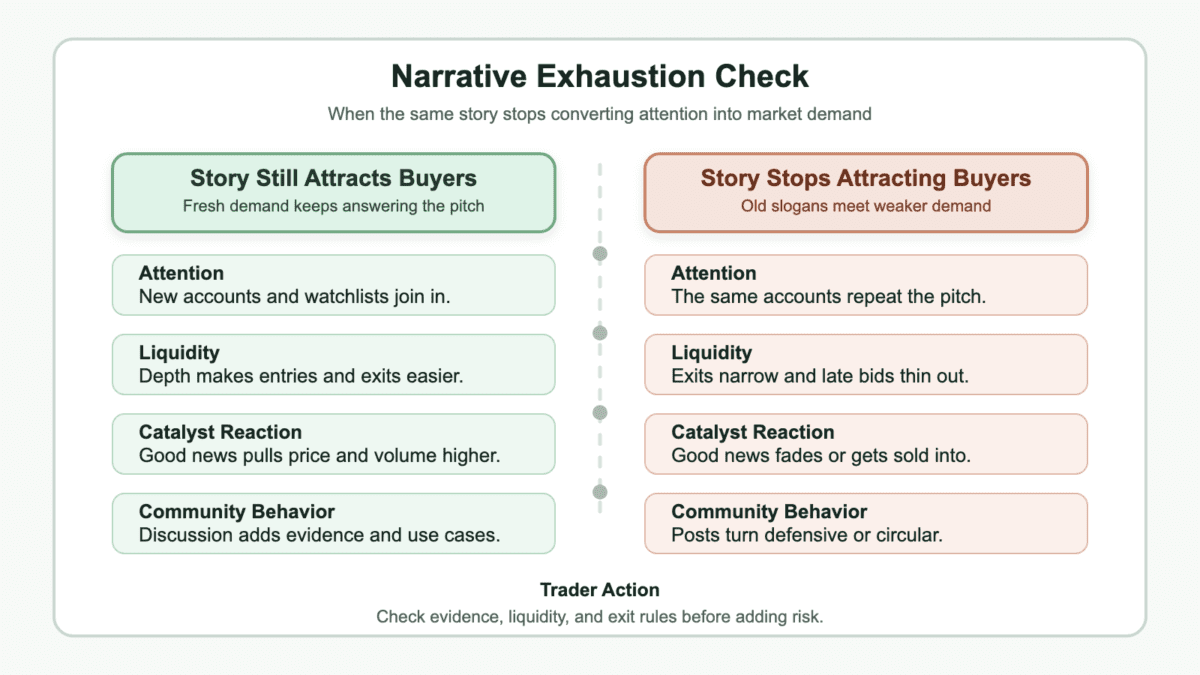
_Comparison chart: signs of a healthy crypto narrative versus an exhausted one._
Narrative exhaustion is easy to confuse with other market problems. That confusion can be expensive because each situation calls for a different check.
A tired narrative means the story has lost force. A bear market means broad risk appetite is weak. A broken thesis means the original reason for holding no longer stands. Use the table as a sorting tool before making the issue bigger or smaller than it is.
| Situation | What To Check Next |
|---|---|
| Narrative Exhaustion | Check whether attention, liquidity, and catalyst reactions are fading across the theme. |
| Broad Bear Market | Compare the token with BTC, ETH, and its closest category before blaming the story alone. |
| Broken Thesis | Revisit the original reason for owning it and look for evidence that no longer holds. |
| Resting Narrative | Check whether usage, development, security, and liquidity continue during quiet periods. |
| Scam Or Rug Risk | Check contract controls, insiders, liquidity locks, team history, and unusual wallet behavior. |
The table keeps one mistake from becoming five. A weak chart can sit inside a weak market without proving fraud. A real product can suffer from boredom without being dead. And a scam can hide behind “the narrative is just tired” until exits are already crowded.
When in doubt, separate market mood from project evidence. Mood can recover quickly. A broken thesis needs fresh proof. Fraud risk needs distance, not optimism with a nicer hat.
Narrative exhaustion hits altcoins and meme coins harder because many of them depend on fresh attention to keep liquidity moving. When attention leaves, the exit door can feel much smaller than the entry.
Large assets usually have deeper venues, broader ownership, and more reasons for people to trade them. Smaller tokens often rely on one dominant story, one launch venue, one social cluster, or one chain’s risk appetite. If that story weakens, buyers can disappear faster than holders expect.
The pressure points are familiar:
That is where exit liquidity becomes more than slang. Late buyers in an exhausted theme may become the demand that earlier buyers use to leave. Nobody writes that on the launch page, funny how that works.
This does not mean every altcoin or meme coin is doomed when a narrative gets tired. It means the margin for error is smaller. A token with real demand, strong liquidity, and a clear reason to exist can survive a quiet period.
The practical check is depth. If the story fades and the market still offers decent liquidity, real usage, and fresh buyers for clear reasons, the risk may be manageable. If the only support left is hope and a slogan, the trade has changed.
Traders use narrative exhaustion as context, not as a standalone signal. It can warn that a trade is crowded, but it cannot tell you the exact top, bottom, or next candle.
That distinction keeps the signal honest because fatigue can show up in opposite places. Near a top, everyone may have already bought the story. Near a bottom, apathy may be high and sellers may be nearly done. In the middle, it may just be long, boring chop. Markets enjoy being annoying. Very on brand.
A practical trading check looks like this:
Use narrative fatigue as confirmation. Pair it with trend, volume, liquidity, catalyst reaction, relative strength, and position size. If several checks point the same way, the story may be losing power.
Order helps here. First decide whether the story is actually tiring. Then decide whether the trade setup still pays you for the risk. A weak story with thin liquidity is different from boredom inside a still-strong trend.
The hardest part is avoiding cleverness. Buying only because everyone sounds bored is not a strategy. Selling only because the phrase “dead narrative” is trending is not much better. Use the phrase as a warning light, then look under the hood before touching the wheel.
When you are stuck in narrative exhaustion, start by separating frustration from the original thesis. Feeling tired is real, but it does not answer whether the position still deserves risk.
This is the classic bagholder trap. A holder keeps defending the old story because selling would confirm the mistake. The feed becomes a courtroom, every small update becomes evidence, and the position quietly turns from a plan into a personality test.
Use a checklist before adding, trimming, or rage-selling:
This is not financial advice. It is basic damage control. The goal is to turn a vague feeling into a cleaner risk review.
If the position still has evidence, liquidity, and a clear invalidation point, you may decide to wait. If the story now depends on louder posts and weaker proof, waiting may only make the exit more emotional later. Write rules before the next candle gives you a new excuse.
Narrative exhaustion can be a quiet phase, not a funeral. Some themes lose hype while the better projects keep building, serving users, and improving market structure.
The word “dead” gets traders into trouble because it can flatten every quiet period into the same verdict. A quiet chain, sector, or app category can still have active users, developer work, security progress, useful fees, and enough liquidity to survive. The public story may be tired while the underlying work keeps moving.
Useful checks include:
The difference is evidence. A resting narrative still has signs of life that do not rely on social pressure alone. A dead or broken one needs the market to forget the missing proof.
This is where patience and bag defense can look annoyingly similar. Waiting makes sense only when the quiet period still has measurable support: users remain, liquidity is usable, builders keep shipping, and strong assets in the group hold up better than weak copies. Without that, “resting” becomes a softer word for drifting.
Ethereum, Solana, NFTs, play-to-earn, AI tokens, and RWA themes have all seen periods where attention and evidence moved at different speeds. That does not make every comeback likely. A resting narrative gives you proof to examine. A dead narrative mostly gives you nostalgia, slogans, and a community calendar full of cope.
So avoid the one-word verdict. Ask whether the theme has durable activity after hype fades. If it does, the narrative may only need time and a real catalyst. If it does not, the old story is probably doing more emotional work than market work.
Several crypto terms sit close to narrative exhaustion. They describe different parts of the same attention cycle, so knowing the difference helps you avoid one big mental junk drawer.
A narrative coin is the asset tied to a market story. The broader market theme is the playbook people are chasing. Late-buyer risk appears when a crowded theme needs new demand for older holders to leave.
The useful distinction is scope. One term describes the asset, one describes the broader crowd behavior, and another describes the risk of arriving after the easy money already moved. If you mix them together, every tired chart starts looking like the same problem.
Start with these related guides when you need a cleaner next step:
Top signal and bottom signal language can overlap with fatigue. A tired story may look like distribution near highs, or apathy near lows. The same word can describe very different risk depending on price, liquidity, and catalyst reaction.
The overlap is useful. The confusion is not. Keep the terms separate before changing size, adding to a position, or deciding that boredom is secretly bullish. Crypto already has enough mental junk drawers.
No. Narrative exhaustion means a crypto story has stopped attracting enough fresh attention, liquidity, and belief. Capitulation is a sharper emotional and market event where holders give up, often after heavy losses.
They can overlap, but they are not the same. A narrative can feel exhausted for months without a clear capitulation moment. And capitulation can happen in a broad market selloff even when no single story caused it.
Yes, narrative exhaustion in crypto can reverse, but usually only when new evidence or fresh liquidity changes the story. A theme may come back after real usage improves, a stronger catalyst appears, weak competitors disappear, or the broader market starts rewarding risk again.
The warning is simple: a comeback needs more than people saying the word “undervalued” with increasing volume. Look for stronger demand, better reaction to news, and clearer proof than the last cycle had.
No, narrative exhaustion does not automatically mean you should sell. It means the original reason for holding needs a fresh risk check.
Start with your thesis, then compare it with current evidence. Check liquidity, relative strength, scheduled supply releases, and how the market reacts to good news. If the position now needs more belief than proof, reduce the risk or write a clearer exit rule.
Narrative exhaustion hits altcoins harder because many smaller tokens depend on narrow liquidity and constant attention. When the story fades, buyers can disappear faster than holders expect.
Altcoins also compete inside crowded baskets. If twenty tokens claim the same theme, attention splits. The weaker names often lose liquidity first, especially when vesting releases, market-maker exits, or influencer rotation add pressure.
Narrative exhaustion can appear near a top or a bottom, so it should not be used alone. Near tops, it can show that everyone has already heard the story. Near bottoms, it can show apathy after long underperformance.
The difference comes from confirmation. Check trend, volume, liquidity, catalyst reaction, and relative strength. If those disagree with the fatigue story, the phrase may be describing mood more than market structure.
Avoid buying into narrative exhaustion by checking whether the story still attracts new demand. Do not buy only because the label sounds current or because a familiar account says the theme is back.
Before entering, name the narrative, compare related assets, check liquidity, review token supply, and write what would prove you wrong. If good news no longer moves the group, wait for better evidence or use smaller size.
Start by naming the exact narrative you are dealing with. “AI coins,” “meme launchpads,” “RWA,” or “Solana beta” is clearer than “my bags are cursed,” although the second one may feel more emotionally accurate.
Then write what would make the story stronger. That may be more users, deeper liquidity, better catalyst reaction, cleaner token supply, or stronger relative performance against similar assets.
Do the same for weakness. Write what would prove the story is not just quiet, but worse than before. That might be a failed catalyst, shrinking liquidity, weaker leaders, worsening vesting pressure, or a community that has more explanations than evidence.
Use a short action list:
If the answers are mixed, reduce the problem before trying to solve the whole market. Smaller size, clearer invalidation, and fewer revenge entries beat a heroic thesis taped to a falling chart.
Then set a review point. Do not re-open the same debate every five minutes because a chart twitched. Pick the next real catalyst, liquidity check, vesting date, or relative-strength level that would change the decision.
That gives the position a process. You can wait with a reason, trim with a reason, or leave with a reason. All three are cleaner than refreshing the feed until someone says the comforting version out loud.
Narrative exhaustion is not a prophecy. It is a prompt to slow down, check the trade, and stop letting yesterday’s story manage today’s risk. The market may revive the theme later. Your job is to survive long enough to know whether that revival is real.