Physical Address
304 North Cardinal St.
Dorchester Center, MA 02124
Physical Address
304 North Cardinal St.
Dorchester Center, MA 02124


A plain-English guide to narrative premium, token value, and hype risk.
Narrative premium is the extra value crypto markets assign to an asset because its story feels bigger than its current proof.
That premium can be useful, rational, temporary, exaggerated, or dangerous. The hard part is knowing whether attention points toward future demand, or whether you are paying extra because everyone else found the same slogan five minutes earlier.
Narrative premium in crypto is the extra value a token, sector, or crypto-linked asset gets because the market believes a story will become important. It sits above what current usage, fees, revenue, liquidity, or utility can clearly support.
That does not make it fake by default. Markets often price the future before the future arrives. The problem starts when the story becomes the whole valuation and proof keeps arriving late.
It helps to separate narrative premium from nearby ideas:
A narrative coin is one asset whose demand depends heavily on a broader story. Narrative premium is wider than that. It can attach to Bitcoin’s digital-gold story, AI tokens, meme coins, real-world asset themes, prediction markets, or digital asset treasury companies.
Ask a simple question: what is the market paying for that has not been proven yet? If that answer is clear, you can test it. If the answer is only “vibes are strong,” the premium may be doing most of the heavy lifting.
Narrative premium moves crypto prices early because crypto markets are built for fast belief. Tokens trade nonstop, many assets lack clean cash-flow anchors, and social channels can coordinate attention before product metrics update.
That makes crypto different from slower markets. A strong story can reach traders, funds, launchpads, influencers, and exchanges before a project has stable users. Price then becomes part of the advertisement, which can pull in even more buyers.
That speed changes the burden of proof. In a slower market, weak evidence may hold price back until sales, users, or margins improve. In crypto, the story can run first, and the evidence gets graded later.
Several forces make the gap between story and proof wider:
The attention economy powers much of this. Attention is not the same as adoption, but it can still move capital when traders expect other traders to care.
That is why narrative premium can appear before a product has revenue, before a network has durable use, or before a token has a clear way to absorb demand. It is a market bet that the story will become real enough later.
The bet can work when proof follows. It gets ugly when the market keeps raising the price of a future that the project has not started to deliver.
Narrative premium gets priced into a token when attention becomes demand and demand becomes visible price action. The story is only the spark. Liquidity, access, promotion, and feedback loops turn it into market behavior.
The path usually starts with a simple claim. AI will change crypto. Real-world assets will bring institutions on-chain. Meme coins will capture culture. Prediction markets will become the public scoreboard. Each claim may contain truth, but the token price can run far ahead of the proof.
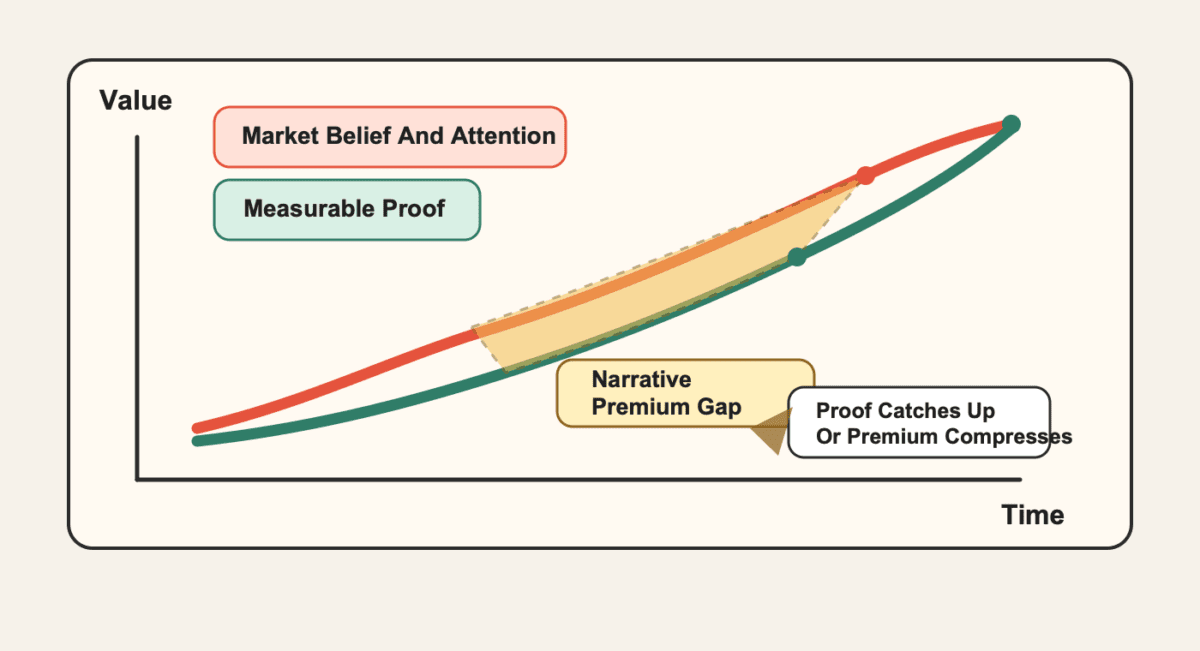
The pricing chain often looks like this:
An active crypto meta can feed that process. A meta is the market’s active theme, while narrative premium is the extra value the market attaches because that theme feels valuable.
Organic adoption and coordinated amplification can look similar on a chart. So do not stop at popularity. Check whether demand, liquidity, and proof are improving together.
Test narrative premium by asking what evidence would justify the extra value, then checking whether the token actually benefits from that evidence. A good story can still be a weak holder thesis if adoption flows around the token instead of through it.
Start with the remove-the-token test. If the product, network, or business can succeed while the token remains optional, diluted, or economically disconnected, the premium may belong to the story but not to token holders.
Use the checks below before paying up for a crowded theme:
| Check | What To Look For |
|---|---|
| Story | A clear claim that can be tested, not only a broad slogan. |
| Token Capture | Fees, collateral, burns, staking, governance, settlement, access, or another reason usage creates token demand. |
| Liquidity | Enough depth to enter and exit without relying on a thin pool or one venue. |
| Proof | Usage, retention, revenue, integrations, transparent benchmarks, or independent demand. |
| Attention | Rising interest that is not already saturated across every feed and group chat. |
| Compression | A clear event, delay, exploit, supply release, competitor, or failed claim that could shrink the premium. |
Late entries turn ugly when early holders can sell the story to people who only found it after the easy move. That is where exit liquidity stops being slang and becomes a portfolio problem.
A tracker can help, but it cannot do the thinking for you. In its live view checked on June 21, 2026, the DefiLlama Narrative Tracker listed 22 narrative categories, which can reveal where attention is spreading. It does not prove that any single token deserves its premium.
The strongest setup is alignment. Social attention rises, liquidity deepens, product proof improves, and the token has a clear way to capture some of that demand. If only price and posts are moving, the premium is fragile.
Examples make narrative premium clearer because the premium changes by category. The same term can cover durable belief, cultural momentum, speculative heat, and plain promotion dressed up as a thesis.
The point is not to label each example good or bad. The point is to ask what the market is pricing before proof is complete.
| Example | What The Premium Is Pricing |
|---|---|
| Bitcoin | The digital-gold story, long-term scarcity belief, censorship resistance, and institutional access. |
| Ethereum | Smart-contract settlement, developer activity, app demand, and its role as base infrastructure. |
| Solana | High-throughput apps, consumer crypto, fast retail activity, and chain-level momentum. |
| Meme Coins | Culture, identity, humor, attention, and the chance that social coordination keeps demand alive. |
| AI Tokens | Future demand for agents, compute, data, automation, or AI-native crypto rails. |
| Real-World Assets | The belief that more off-chain value will move through tokenized rails. |
| Stablecoin Themes | Payment usage, liquidity, settlement, and distribution, though value may not flow to a volatile token. |
| Digital Asset Treasury Companies | Public-market access to crypto exposure, management story, and balance-sheet premium or discount. |
Bitcoin shows that narrative premium can be serious. Its digital-gold story is not a meme in the same way a dog token is a meme, but it still depends on belief that the asset will keep serving that role.
AI tokens show the proof problem. A project may use AI branding, but users still need to know what the tool does, who pays for it, what the token does, and whether the claim survives outside a launch thread.
RWA and stablecoin stories show the token-capture problem. A category can gain real usage while a specific token captures little value. The infrastructure may win while the ticker lags.
Meme coins show memetic valuation crypto at its purest. The story, symbol, and community can be the product. That can create powerful demand, but it also makes attention fatigue brutal when the joke stops compounding.
Narrative premium compresses when the market stops paying for possibility and starts asking for proof. The same story that lifted price can become a burden once expectations get too large.
Compression can happen slowly through boredom or quickly through a hard trigger. A failed launch, weak benchmark, exploit, regulatory setback, vesting release, diluted supply, or better competitor can make buyers reprice the premium fast.
Watch for warning signs before the story turns into a trap:
A top signal is not one magic clue. It is usually a cluster of crowding signs, stretched expectations, and weak follow-through. Narrative premium fades the same way: first the story gets crowded, then the market demands proof, then late buyers discover gravity.
Compression does not always mean the asset goes to zero. Sometimes proof catches up and the premium becomes less speculative. Sometimes price falls while the product keeps improving. Sometimes the story was the product, and the market simply moves on.
Traders and investors can use narrative premium as a risk tool, not a permission slip. The term helps explain why a market is moving, but it does not prove the move is early, durable, or worth chasing.
Use it by separating the moving parts. Keep the story, the proof, the token design, and the trade plan apart. If one part is empty, do not let the loudest part answer for it.
That separation helps in both investing and narrative trading. A trader may care about momentum and timing. A longer-term holder may care about adoption and token capture. Both still need to know what would make the premium shrink.
Practical checks help before the feed gets noisy:
A conviction play should have a reason beyond “the market is talking about it.” Conviction means you know what would prove the thesis wrong. Chasing a slogan means you are borrowing someone else’s urgency.
For long-term holders, narrative premium can explain why price gets ahead of adoption. For traders, it can explain where momentum is coming from. In both cases, the hard skill is refusing to confuse a loud market with a settled one.
If the story is still early, the plan should say what evidence comes next. If the story is already everywhere, the plan should say why you are not simply buying someone else’s exit.
Narrative premium differs from hype, a meta, and exit liquidity because it names the value gap created by belief. The other terms describe excitement, market theme, or late-buyer risk.
These phrases overlap in real crypto conversations. A meta can create hype. Hype can inflate narrative premium. Late buyers can become exit liquidity after the premium exhausts itself. Very tidy. Also very expensive when misread.
The distinction is useful because each term points to a different problem. Hype asks how loud the crowd is. A meta asks what theme the market is copying. Narrative premium asks how much price depends on a future that still needs proof.
| Term | How It Differs From Narrative Premium |
|---|---|
| Hype | Raw excitement or promotion, with or without a durable thesis. |
| Meta | The active market theme traders are copying, funding, and discussing. |
| Narrative Premium | The extra value assigned because the story is expected to become important. |
| Exit Liquidity | Late demand that lets earlier holders sell after the story gets crowded. |
| Token-Capture Risk | The chance that adoption helps the project but not the token. |
Use the terms in order. First name the story. Then ask whether it has become a meta. Then estimate whether price includes a premium. Then check whether late demand is becoming the exit route.
That order keeps the phrase useful. Narrative premium is not a fancy synonym for hype. It is a way to ask how much of the price depends on belief still waiting for proof.
It also keeps the language honest. Calling something a meta can describe current attention. Calling it narrative premium means the market has started paying extra for that attention, and now the story has to earn the price.
Narrative premium means the extra value a crypto asset receives because the market believes its story has future importance. The premium sits above what current usage, fees, revenue, liquidity, or token utility can clearly support.
It can be rational when the story points toward real future demand. It becomes risky when price depends mostly on attention and proof keeps arriving late.
Narrative premium is not the same as hype. Hype is excitement, promotion, or social noise. Narrative premium is the value gap that appears when the market prices a story before the proof is fully visible.
Hype can create or inflate the premium, but the two are not identical. A useful project can have narrative premium. A useless project can also have it, usually for less flattering reasons.
Narrative premium is not always bad for crypto investors. It can explain why capital moves early into a category before adoption, fees, users, or liquidity fully show up.
The risk is overpaying. If the market has already priced a perfect future, even good news may not be enough. The premium needs proof, token capture, and liquidity to survive.
Narrative premium is often crowded when everyone uses the same story, the obvious assets already ran, and weaker copycats appear quickly. Social agreement can feel reassuring, but late consensus is usually a poor entry signal.
Check whether liquidity is improving with proof, or only with attention. If the story is everywhere but the evidence is not improving, the premium may be closer to compression than expansion.
Strong technology can have weak narrative premium if the market does not understand it, trust it, or believe the token captures value from it. Adoption alone does not guarantee token demand.
This is common in infrastructure and enterprise-style crypto. The product can work, but holders still need a reason the token benefits from usage, fees, collateral, access, settlement, or governance.
Narrative premium can disappear quickly because attention moves faster than fundamentals. When a story stops feeling fresh, traders often rotate before product proof has time to catch up.
Compression can also come from failed milestones, delays, exploits, supply releases, new competitors, weak liquidity, or a simple loss of interest. Crypto does not wait politely for quarterly updates.
Start with narrative premium by naming the story in one sentence, then writing down what proof would make that story real. If you cannot name the proof, you are probably measuring noise.
Then check whether the token actually captures value from the story. A project can be useful while its token remains optional, diluted, or disconnected from demand.
Make the test specific enough to fail. “AI is big” is not proof. A useful test says what users want, who pays, how the token participates, and what would show that demand is getting stronger.
Use this short process before acting:
After that, compare the story with the clock. Some premiums need months of product proof. Others depend on a fast social cycle that can burn out before the next update lands. Time horizon changes the risk.
Keep the notes boring on purpose. If the thesis only sounds convincing while the chart is green, the narrative premium is already doing too much of the work.
Narrative premium is useful when it names a real gap between belief and proof. It is dangerous when it becomes a polite word for overpaying because everyone else is temporarily excited.