Physical Address
304 North Cardinal St.
Dorchester Center, MA 02124
Physical Address
304 North Cardinal St.
Dorchester Center, MA 02124


A plain-English guide to slashing risk, staking penalties, and who can lose funds.
Slashing risk is the chance that staked crypto is penalized because a validator or operator breaks network rules.
That penalty can reduce rewards, cut into principal, or force a validator out of the network, depending on the protocol and staking setup. So staking yield is not just an APY number. Slashing is the part where “passive” quietly leaves the room.
Slashing risk means your staked assets can be penalized when the validator securing a proof-of-stake network breaks important rules. The penalty is meant to protect the chain from behavior that can harm consensus, such as signing conflicting messages.
For a staker, the key issue is whether that penalty can reach their position. In some cases, the validator operator takes the hit. In others, delegators, pool users, or restakers share the loss through the rules they accepted.
That is why slashing risk belongs in the first round of staking checks. You are not only choosing a network or a yield figure. You are choosing who operates the validator, what rules apply, and how losses move if something breaks.
Here is the clean split:
Slashing rules are not identical across Ethereum, Cosmos, Polkadot, Solana, restaking systems, and smaller proof-of-stake networks. Some chains punish downtime lightly. Some slash specific safety violations. Some pass losses through to delegators. So ask the specific version: “What exactly am I staking into?”
Keep slashing risk near the top of any staking decision. It is not the only risk, but it is the one that can turn a yield product into a loss event without the token price doing anything dramatic.
Slashing risk is only one part of staking risk. Many users blend every staking downside into one warning label, then either panic or ignore the whole thing. Neither response helps.
A token can fall in price while you are staked. Rewards can be lower than expected. Withdrawals can take days or weeks. A smart contract can fail. Those can all cost money, but they are not the same as a validator being slashed.
The distinction becomes most useful when you compare staking routes, especially if you use liquid staking or a custodial app. A liquid staking token can move away from the value of the underlying staked asset, while slashing risk sits underneath the validator set that supports it.
| Risk | What Can Cost You Money |
|---|---|
| Slashing risk | A validator or operator breaks protocol rules and a penalty hits staked assets. |
| Missed rewards | A validator performs poorly, so expected yield drops. |
| Inactivity penalties | Some networks penalize validators for being offline without treating it as a slash. |
| Unbonding liquidity risk | You cannot sell or move assets while waiting for withdrawals. |
| Market risk | The token price falls while your assets are staked or locked. |
| Custody risk | A platform, app, or provider controls access to the staking position. |
| Smart contract risk | A staking pool, LST, or restaking contract has a bug or exploit. |
This table is not here to make slashing look bigger than every other risk. It does the opposite. It keeps the risk stack honest, so you do not blame slashing for a market dump or ignore it because an APY page says the validator has good uptime.
Good staking decisions separate the risks first. Then they ask whether the extra yield pays enough for the specific risk being added.
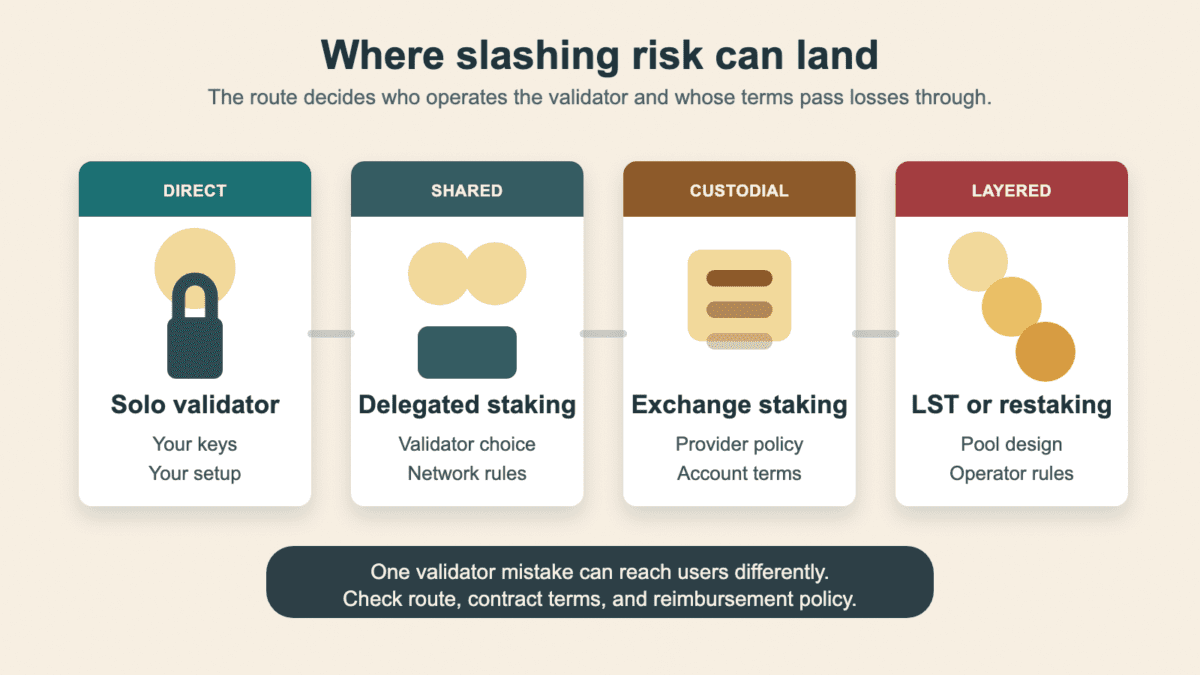
Slashing risk lands differently depending on who controls the validator and how your stake is routed. A solo validator has a direct relationship with the network. A delegator, exchange user, liquid staking holder, or restaker usually depends on another operator’s setup.
That setup decides who can make the mistake, who absorbs the penalty, and whether any provider promises to reimburse users. Do not assume a platform eats every loss just because the interface looks friendly. The terms are doing the real work.
Custody is part of this question. If you stake from your own wallet, you need to understand the delegation or validator relationship. If you use a platform, you may also need account controls, identity checks, and provider policies. That is where crypto wallets and KYC in crypto connect to staking risk: they shape control, access, and account limits.
| Staking Route | What To Check Before Using It |
|---|---|
| Solo validator | Your keys, failover setup, client setup, monitoring, and slashing protection. |
| Delegated staking | Whether delegators share penalties and how the validator has performed. |
| Exchange staking | Who runs the validator, whether losses are reimbursed, and what account limits apply. |
| Pooled or liquid staking | Operator diversity, pool design, smart contract risk, and token liquidity. |
| Restaking | Extra operator duties, restaking contract risk, and service-specific slashing rules. |
The table has a blunt message: “I am not running the validator” does not always mean “I have no slashing exposure.” It means someone else is operating the machinery that can create the penalty.
For smaller positions, that may be an acceptable tradeoff. For larger positions, provider choice, diversification, and exit timing become more important. The more layers between you and the validator, the more terms you need to read before the yield number gets exciting.
Slashing risk usually comes from validator behavior that threatens the network’s ability to agree on the right chain. The exact trigger changes by protocol, but the core idea is simple: the network punishes validators for actions that make consensus less trustworthy.
That split changes the risk math. Missed yield is one problem. A penalty against staked collateral is another.
Common causes include:
Downtime needs careful handling. Some networks classify offline validators as a performance problem, some apply inactivity penalties, and some may use harsher rules in specific contexts. Do not assume every offline event is a slash. That mistake shows up often in staking discussions, and it muddies the useful part.
For Ethereum, Ethereum.org separates ordinary rewards and penalties from slashing and says a 32 ETH validator immediately burns 0.0078125 ETH when slashed before the 36-day removal period and correlation penalty can add more damage. That is the shape users need to remember, even if they skip the math.
Slashing protection is boring until it becomes priceless. Validators need sane key management, careful failover, monitored clients, and operators who know that “turn it off and on again” is not always a staking strategy.
Correlated slashing risk is the danger that many validators get penalized for the same shared mistake. One validator failing is bad. Many validators failing together can be much worse because the network sees a broader consensus problem.
The shared mistake can come from the same validator client, hosting provider, key-management tool, operator process, or staking service. If hundreds or thousands of validators rely on the same fragile setup, a single fault can spread like a bad configuration file with ambition.
Picture two staking providers. One spreads validators across different clients, operators, and infrastructure. The other runs a huge cluster with similar tooling and one operational process. Both may look stable on quiet days, but the second setup can create more correlated slashing risk if that shared process fails.
This is the part many APY screens hide badly. Shared tooling can make operations cheaper and cleaner, but it can also make one mistake repeat at scale. If the same key process, client bug, or hosting failure touches many validators, the loss is no longer a neat one-validator problem.
Useful checks are simple, even when the backend is not:
This is why bigger is not automatically safer. Scale can improve operations, but concentration can also make one failure travel farther. The answer depends on how the staking setup is built, not just how familiar the provider name sounds.
For users, the takeaway is not to become a validator engineer overnight. It is to notice whether a provider explains concentration risk in plain language. If the risk page only says slashing is rare, it has not answered the correlated slashing risk question.
Slashing risk in liquid staking starts with the validators behind the pool, then adds the token wrapper on top. When you hold a liquid staking token, you may not choose a validator directly, but the pool still depends on validators doing their jobs correctly.
That creates two layers. First, the underlying stake can face validator penalties. Second, the liquid staking token can face market, liquidity, depeg, or smart contract risk. Those are separate problems, but they can stack during stress. Nice UX does not cancel physics.
Liquid staking users should ask how the pool chooses operators, spreads validator exposure, handles slashing events, and communicates losses. A token that trades freely can still reflect bad news from the validator layer. If the pool’s risk policy is vague, that is a signal by itself.
Restaking adds another layer because the same staked asset can help secure extra services. In a restaking setup, operators may have duties beyond the base chain, and those extra services can define their own penalty conditions. EigenLayer is the well-known example, but the wider lesson is broader: extra yield can mean extra rules.
Keep the warning tight:
This does not make liquid staking or restaking unusable. It means the user should know which layer creates the yield and which layer can create the penalty. If that answer is fuzzy, the APY is probably doing too much talking.
Checking slashing risk starts with the staking route, then moves to the operator. A solo validator needs operational controls. A delegator needs validator selection. An exchange user needs provider terms. A liquid staking or restaking user needs to understand the pool, contracts, and operators.
Start with the questions that expose real risk:
Then look for signs of maturity. Serious staking providers usually explain slashing protection, key management, client diversity, incident response, withdrawal timing, and validator performance. They do not hide the risk behind one soft sentence and a large APY.
Also check your own concentration. If most of your staking exposure sits with one operator, one token wrapper, or one restaking strategy, a rare event can still hit a meaningful part of your portfolio. “Low probability” feels different when the position is oversized.
The strongest check is boring but effective: write down what can go wrong before you stake. If you cannot name the penalty path, the person who bears it, and the exit process, you are not evaluating yield. You are admiring a number.
Start with the route, not the reward. Slashing risk changes depending on whether you are solo staking, delegating, using an exchange, holding a liquid staking token, or restaking into additional services.
A high advertised APY can make every route look similar at first glance. They are not similar once you ask who runs the validator, who controls withdrawals, and who eats a penalty. That is the work to do before the yield starts looking friendly.
Use this quick order before committing funds:
If you are comparing yield products, separate staking penalties from broader DeFi yield risk. A staking provider, restaking vault, and farming in crypto strategy may all quote returns, but they do not fail in the same way.
For exchange, pooled, or restaking products, read the loss language before the reward language. Reimbursement promises, withdrawal timing, operator concentration, and contract exposure all change the real tradeoff. None of that makes staking bad. It just makes vague yield marketing less useful.
Build one simple habit: ask what has to go wrong for you to lose money. If the answer is clear, you can size the position with your eyes open. If the answer is a shrug wrapped in an APY, keep walking.
Slashing risk usually does not mean every coin in your wallet can disappear. It applies to the staked position and depends on the network, validator behavior, staking route, and provider terms.
The worst case is not the same everywhere. An isolated validator mistake may create a smaller penalty, while a severe or correlated event can be more painful. For exchange, liquid staking, and restaking users, the terms decide how losses pass through.
Slashing risk is not automatically higher on an exchange, but an exchange adds provider risk. The platform may choose the validator, custody the asset, set the fee, control withdrawals, and define whether users are reimbursed after a penalty.
Convenience reduces your operational burden. It does not erase the underlying staking rules. Check who runs the validators and what the platform promises before assuming the exchange shields you from losses.
Slashing risk is not the same as missing rewards. Missed rewards usually mean the validator performed poorly or was offline, so the yield is lower than expected.
A slash is a penalty for a rule violation. It can reduce the staked position and may force validator exit, depending on the network. Both can hurt returns, but they are different events.
Restaking can add slashing risk because it can place the same staked asset under extra operator duties and service-specific rules. The base staking layer still counts, but it may no longer be the only penalty path.
That does not make restaking automatically reckless. It means you need to understand the operator, the services being secured, the contracts involved, and what behavior can trigger penalties.
Liquid staking tokens can be affected by slashing risk because they represent exposure to staked assets behind the token. If validators in the pool are penalized, the pool’s value or redemption terms may reflect that loss.
They can also carry separate risks, such as smart contract bugs, liquidity stress, or price differences from the underlying asset. The token may trade easily, but the staking layer still exists underneath.
Slashing risk is generally treated as a low-probability event on mature staking networks and with competent operators. But low probability is not the same as no risk.
Ask whether the loss would matter if it happened. Check the validator setup, provider terms, operator concentration, and your own position size before relying on yield alone.