Physical Address
304 North Cardinal St.
Dorchester Center, MA 02124
Physical Address
304 North Cardinal St.
Dorchester Center, MA 02124


Sleeper coin meaning, risks, and research checks.
A sleeper coin is crypto slang for a coin or token that traders think is being ignored by the wider market but could outperform if attention, liquidity, or adoption arrives.
The phrase is useful because some assets really do sit outside the crowd’s focus until a catalyst changes the story. It is also risky because crypto has a long habit of calling bags “overlooked opportunities” when a seller needs fresh buyers. Sleeper coin can describe a large altcoin, a low-cap DEX token, a narrative play, or a specific token that uses Sleeper in its name.
A sleeper coin in crypto is an asset that traders believe the wider market has not priced in, noticed, or understood yet. The label usually points to perceived upside before a larger crowd arrives.
That makes the term subjective. One trader might call a top-75 altcoin a sleeper because attention moved elsewhere. Another might use the same phrase for a tiny token with thin liquidity, one chart, and a Discord full of people saying “early.”
The important part is what the word does not prove:
Sometimes that belief has evidence behind it. A project may have real users, a useful product, better tokenomics than competitors, or a catalyst that has not reached mainstream crypto feeds. But the phrase can also dress up a weak pitch. “People are sleeping on this” often means “I bought before you.”
So the first job is translation. When you see sleeper coin, ask what is supposedly being missed.
The answer should point to something testable: adoption, revenue, liquidity, a listing, a narrative shift, a product launch, or price action that already ran once. If the answer is only “it is cheap,” slow down. Cheap token price is not cheap valuation, and future supply can sit behind a tiny unit price.
Traders call a crypto a sleeper coin when they think attention has not caught up with a thesis. That thesis might be about fundamentals, a narrative, a catalyst, or a chart that looks ignored after a long drawdown.
The phrase shows up often on CT, Reddit, YouTube, Binance Square, and low-cap lists. Sometimes it is used for serious research. Sometimes it is the soft-focus filter on a shill. Context does most of the work.
Common sleeper coin claims usually point to one of these ideas:
A narrative coin is a close cousin. AI, RWA, DePIN, privacy, gaming, and Layer 2 tokens can all become sleeper candidates when traders expect a category to heat up.
That adds one more check:
“People are sleeping on it” usually means the speaker believes the crowd is late. Sometimes they are right. Sometimes they are just early to a bad idea, which is a very expensive kind of punctual.
Sleeper coin overlaps with hidden gem, low-cap coin, undervalued coin, moonshot, and narrative coin. Those terms sound similar, but they point to different claims.
Each term needs a different check. A low-cap coin needs liquidity review. An undervalued coin needs a valuation thesis. A moonshot needs risk sizing. A sleeper coin needs proof that the market is missing something real.
| Term | What It Usually Means |
|---|---|
| Sleeper coin | A coin or token someone believes is overlooked and could outperform later. |
| Hidden gem crypto | A lesser-known asset promoted as undiscovered or underappreciated. |
| Low-cap crypto coin | A smaller asset by market cap, often with higher volatility and weaker liquidity. |
| Undervalued crypto coin | A token claimed to be priced below its real or future value. |
| Moonshot coin | A high-risk token pitched around extreme upside. |
| Narrative coin | A token linked to a market story such as AI, RWA, DePIN, privacy, or gaming. |
Low token price belongs nowhere in that table as proof. A coin priced at fractions of a cent can still be expensive if the supply is huge. Market cap, fully diluted valuation, and liquid supply tell you more than the number after the decimal.
The clean distinction is this: sleeper coin is about attention, hidden gem is about discovery, low-cap is about size, undervalued is about valuation, and moonshot is about payoff shape. They can overlap, but they are not synonyms.
Sleeper coin can be slang, but Sleeper can also appear as a specific token name or part of a token name. That ambiguity is where beginners can get sent down the wrong hallway.
For example, Coinbase has a Sleeper price page. When checked on June 22, 2026, that page showed 1 SLEEPER at $0.000001932 while marking market cap, FDV, circulating supply, and 24-hour volume as “Not enough data.” Other wallet or token pages may show Sleeper-related names on different chains. Those pages prove the naming ambiguity exists. They do not prove every Sleeper result is the same asset, or that any one of them is worth buying.
If you meant a token named Sleeper, verify the exact asset before doing anything else. Token names can repeat across chains, tickers can collide, and meme labels can look official inside a wallet interface.
Run this check before you assume a page is the token you meant:
Do not rely on name alone. A token called Sleeper on Base, a Solana meme token with sleeper in the name, and a generic wallet page can all look relevant in search while describing different things.
Also avoid live price claims unless you have verified the exact contract and chain. With small tokens, stale pages and wrong contracts are not small errors. They can send users into thin markets, fake pools, or approvals they never meant to sign.
Researching a sleeper coin starts by turning the pitch into a testable thesis. If the thesis cannot survive plain English, it probably should not get capital.
Write one sentence first: “This coin could outperform because…” Then fill in the part after because. Attention alone is not enough. You need the mechanism that could turn attention into demand for that token.
Use these checks before you buy or size a position:
| Check | What It Tells You |
|---|---|
| Market cap | Shows valuation better than token price. |
| FDV | Reveals what the whole supply is priced at today. |
| Circulating supply | Shows how much supply is actually in the market. |
| 24h volume | Helps test whether entries and exits are realistic. |
| Liquidity depth | Thin pools create slippage and ugly exits. |
| Holder concentration | A few wallets can dominate sell pressure. |
| Unlocks and emissions | Future supply can weaken a good-looking chart. |
| Token role | A useful product does not always need a valuable token. |
| Team and docs | Vague claims make risk harder to map. |
| Wallet and contract risk | Unknown contracts can create approval or sell problems. |
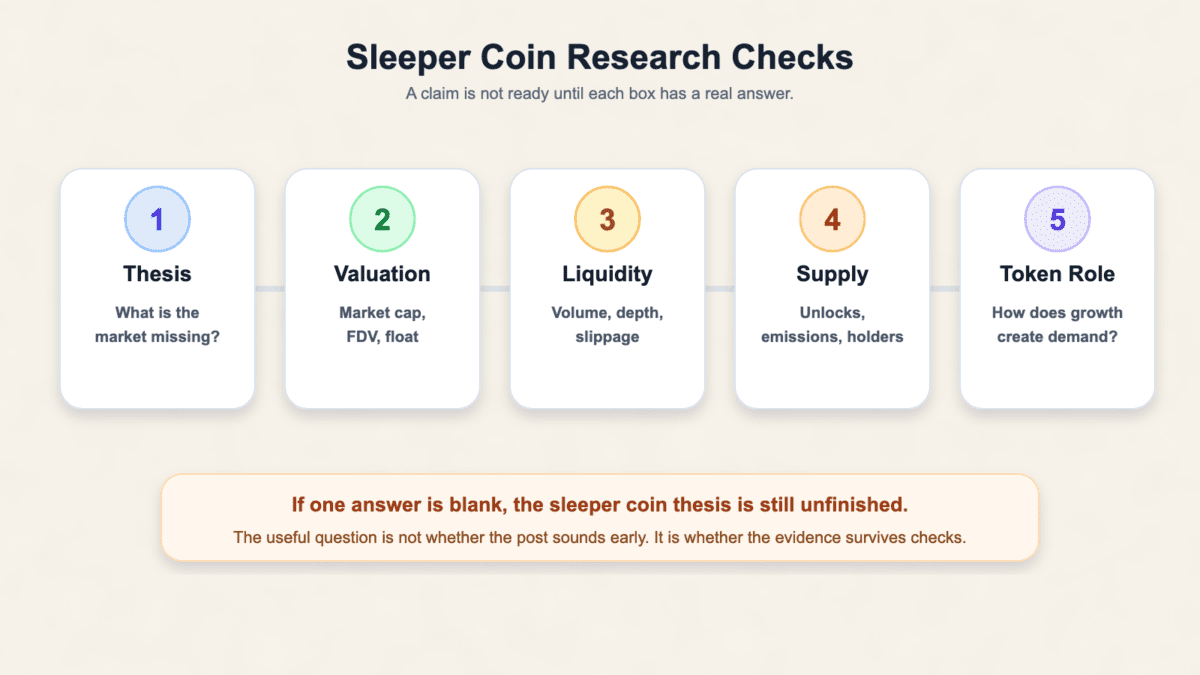
That checklist is not paperwork. It is how you catch the difference between “ignored” and “empty.” Some ignored projects stay ignored long enough to become a dead coin, even if the original story sounded clever.
Liquidity deserves extra attention. A small position can look profitable on a chart, then lose the gain to slippage when you try to exit. If your planned trade size moves the market, the displayed price is more mood board than quote.
Supply pressure can break a good-looking setup. FDV, vesting releases, emissions, and insider allocations can turn a sleeper coin into a treadmill. The token may need constant new demand just to absorb new supply.
Then check value capture with blunt questions:
If the answers are vague, the sleeper coin thesis is still unfinished. A useful product can exist beside a weak token.
Sleeper coin red flags matter most when the pitch asks you to act before you can verify the basics. Urgency is common in thin markets because late caution is bad for early sellers.
The loudest warning is not always price. It is a mismatch between confidence and evidence. If a post promises a massive move but cannot answer contract, liquidity, supply, or token-use questions, the pitch is asking you to buy the mood.
Watch for these red flags:
Thin liquidity can turn a buyer into exit liquidity for earlier holders. That is not a moral judgment. It is market structure. Someone needs the next bid.
Contract risk is harsher. If selling is disabled, liquidity is pulled, or control functions are abused, the setup moves toward a hard rug. A sleeper label cannot soften that.
A typical social post might sound sharp: “Low cap, real utility, early community, big listing soon.” The missing parts are the point.
Use the post as a test:
If the post cannot answer those, it is not a thesis yet. It is a flyer with better typography.
A useful project can still be a bad sleeper coin trade when the token does not capture the value created by the product. Crypto users often blur those two ideas, and that blur gets expensive.
An app can grow while its token drifts lower. A chain can process activity while value accrues to validators, sequencers, apps, stablecoin issuers, or users instead of the token. A protocol can have loyal users and still emit too much supply.
Ask the token question directly:
| Strong Project Signal | Token Question To Ask |
|---|---|
| More users | Do users need the token, or only the product? |
| More fees | Do fees support the token, treasury, or someone else? |
| More integrations | Do integrations create demand or just visibility? |
| More holders | Are holders buyers, recipients, farmers, or insiders? |
| More attention | Does attention bring durable liquidity or one hot week? |
The project-token gap is why “real use case” is not a complete buy signal. It is a starting point. You still need tokenomics, demand, liquidity, and timing.
Vesting releases and emissions can overwhelm a real product. If new supply enters faster than demand grows, the chart may not care that the app is useful. The market is rude like that.
Market timing can decide whether a thesis survives, especially when the setup needs months to play out.
Watch for three pressure points:
So look for value capture before romance. The useful question is not “Is the project good?” It is “What makes this token worth owning if the project succeeds?”
If a sleeper coin starts pumping, review the original thesis before the chart rewrites your memory. A rising price can confirm attention. It can also hide worsening risk.
Start with liquidity. Can you actually exit the size you hold? If the pool is thin, the quoted gain may shrink when real selling begins. Then check whether the move came from real news, wider narrative rotation, paid promotion, or one fast candle that everyone is pretending to understand.
Use a simple pump review:
The goal is not to call the exact top. That game has humbled better traders. The goal is to avoid moving the target every time price rises.
A sleeper coin can turn into a bagholder trap when the holder refuses to update after the easy part of the move is over. The label changes from “overlooked” to “early” to “long term” without new evidence.
Partial exits are not betrayal. They are risk management:
If the position has grown beyond the risk you originally accepted, the trade changed even if the story still sounds good.
Start with the thesis, not the ticker. A sleeper coin should earn attention through evidence before it earns a place in your wallet.
The practical path is short:
That process will filter out many exciting posts. Good. Filtering is the job. A strong sleeper coin claim should become clearer when checked, not angrier.
Before funding a wallet or opening a DEX page, write down the part of the story that would change your mind. Maybe liquidity is too thin. Maybe the contract is not the one you expected. Maybe the token has no clear role even though the project sounds useful.
Keep the notes specific enough to use later:
Those notes help when the chart starts moving. They keep the trade tied to evidence instead of mood, replies, or someone else’s urgency.
“Early” is not the same as “good.” Early can mean overlooked, but it can also mean illiquid, unproven, poorly distributed, or impossible to exit cleanly. If the checks keep producing blank answers, waiting is a valid move.
A sleeper coin means a coin or token that traders believe is overlooked by the wider market but could outperform later. The phrase is slang, so it describes a belief about attention and upside, not a verified asset class.
No. A sleeper coin can be low-cap, but the terms are different. Low-cap describes market size, while sleeper coin describes the idea that the market is missing something.
Yes. A sleeper coin can be a large cryptocurrency if traders believe it is being ignored compared with its adoption, catalysts, or sector narrative. The key is perceived neglect, not small size.
Sleeper coin is usually slang, but Sleeper can also appear as a token name or part of a token name. If you mean a specific asset, verify the chain, contract address, liquidity, holders, and official links.
Traders find sleeper coins by watching narratives, developer activity, user growth, liquidity changes, listings, catalysts, and social attention. The harder part is proving the token captures value if the thesis works.
Yes. Sleeper coins can carry high risk because attention is uncertain, liquidity can be thin, and social pitches often hide weak tokenomics. The biggest protection is checking the asset before the story gets loud.