Physical Address
304 North Cardinal St.
Dorchester Center, MA 02124
Physical Address
304 North Cardinal St.
Dorchester Center, MA 02124


A plain-English guide to stablecoin peg risk.
A stablecoin peg is the target value a stablecoin tries to hold against another asset, usually $1.
That target can make a dollar stablecoin feel simple. But the peg is not tape over market risk. It holds only when reserves, collateral, redemption routes, liquidity, and market confidence keep working at the same time.
A stablecoin peg is the reference price a stablecoin is built to track. For most dollar stablecoins, that reference price is $1. A token pegged to the euro, gold, or another asset uses a different reference value.
The important part is that a peg is both a design promise and a market process. The issuer or protocol may design the token around a target. But users experience the peg through exchange prices, DEX pools, wallet balances, lending markets, and withdrawal routes. Split it this way:
So a dollar pegged stablecoin can trade at $0.999, $1.001, or another small spread without the whole design failing. That can happen because of trading fees, thin liquidity, network congestion, or venue-specific demand.
The problem starts when the price gap becomes wider, lasts longer, appears across more venues, or comes with a clear cause. A reserve scare, redemption halt, bridge issue, or collateral crash can turn normal drift into a real depeg.
Keep the distinction clear: a stablecoin peg tells you what the token is trying to be worth. It does not tell you whether the token can still get there under stress.
A stablecoin peg gives stablecoins their cash-like role inside much of crypto trading and DeFi. Users hold them as dry powder, quote currency, collateral, lending assets, and a place to pause between volatile positions.
Say a trader sells ETH into USDC after a sharp rally. The goal is not to exit crypto rails completely. The goal is to stop taking ETH price risk while staying ready for the next trade. That rotation only works cleanly if the stablecoin stays close to its target.
You see that assumption in a few common places:
That assumption shapes real behavior. A trader may use stablecoins to buy dips, pay funding, settle OTC trades, bridge between chains, or move funds between exchanges. A DeFi user may deposit a stablecoin into a lending market or liquidity pool because the asset looks less volatile than BTC or ETH.
But stablecoin risk is different from price volatility. You may avoid a 10% ETH move and still take issuer, protocol, chain, bridge, or pool risk. “Stable” is useful marketing. It is not a force field. That creates two checks before you park funds:
This is also why crypto rotation often involves stablecoins. Traders rotate from risk assets into dollar tokens, then rotate back when conditions change. If the peg weakens during that pause, the parking spot was not as boring as it looked.
The takeaway for newer users is simple. Many crypto actions assume the token is still worth roughly its target value. When that assumption breaks, trades, loans, collateral ratios, and exits can all change at once.
A stablecoin peg holds near $1 when the market has a reason and a route to push the price back toward the target. That route can come from issuer redemption, collateral rules, liquid order books, DEX pools, market makers, protocol incentives, or arbitrage traders.
If a redeemable stablecoin trades at $0.98, a qualified participant may buy it cheaply and redeem it near $1. If it trades at $1.02, new supply or selling pressure can pull the price back down. The spread is the bait. The working exit route is the hook. The defense loop usually needs three things:
Ordinary holders do not always get the same route. Some stablecoins limit direct redemption to approved customers, minimum sizes, business accounts, or specific jurisdictions. A 2025 NBER working paper found that Tether allowed only 6 agents in an average month to redeem stablecoins for cash, which helps explain why retail users often depend on market liquidity instead of a neat one-click redemption.
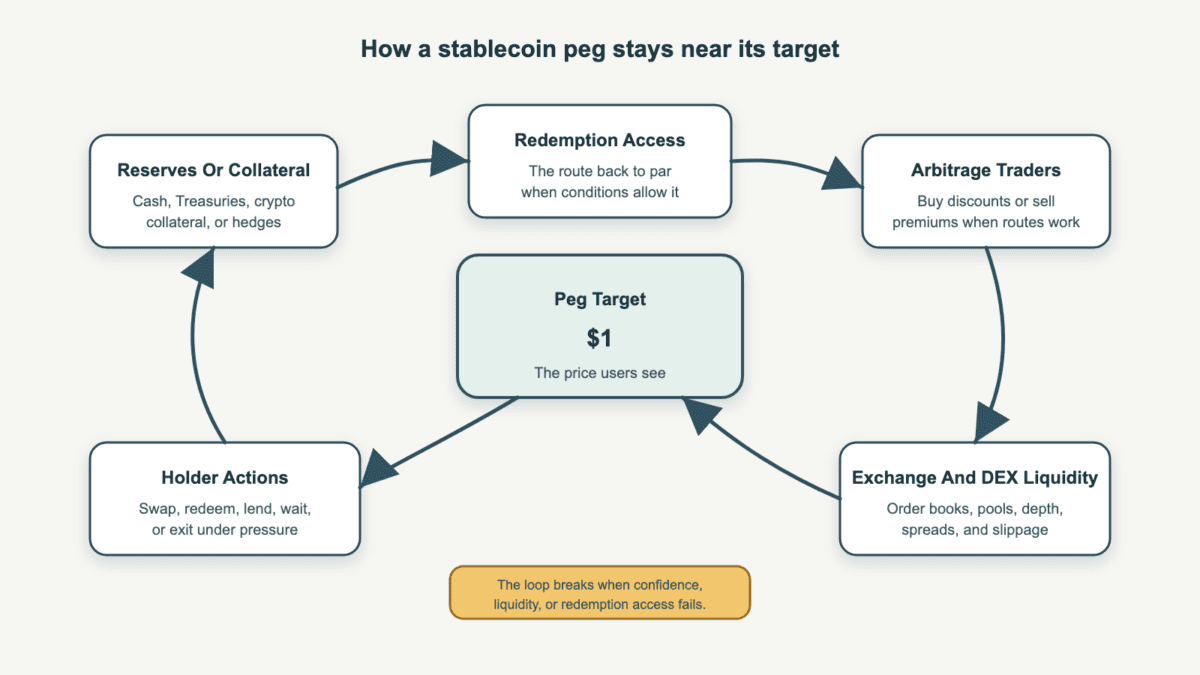
Fiat-backed stablecoin pegs rely on reserves and redemption confidence. The clean version is simple: users believe each token can be exchanged for the referenced fiat value, so market makers buy discounts and sell premiums.
The hard part is trust. Users need confidence that reserves exist, banking routes work, redemptions are honored, and the issuer can survive heavy outflows. If any of those assumptions weakens, the market may demand a discount.
Crypto-backed stablecoin pegs use collateral posted on-chain. The token can stay near target when the collateral is worth more than the debt and liquidations work before losses eat the buffer.
This design is more transparent in some ways, but it can be more volatile. If collateral prices fall fast, oracles lag, liquidators fail, or governance parameters are too loose, the peg can come under pressure.
Synthetic and yield-bearing stablecoin pegs may depend on hedges, basis trades, staking rewards, points programs, or other strategies. The token can look dollar-like while the engine underneath is doing something much busier.
Yield is the clue. Extra return usually means someone is being paid for risk, complexity, lockup, or demand. It is not proof that the peg is safer.
Algorithmic stablecoin pegs rely more on incentives than hard reserves. They may expand or contract supply through another token, mint-burn rules, or market rewards.
That can work until confidence breaks. When everyone wants out at once, incentives can become reflexive. The support token falls, redemption confidence falls with it, and the peg defense starts chasing its own shadow.
Stablecoin peg mechanisms should be compared by what actually pulls price back toward target. The label matters less than the support behind it.
Start with your own route. If you hold the token on an exchange, secondary-market depth may matter more than issuer terms. If you hold it in DeFi, pool balance, oracle pricing, chain health, and withdrawal routes become part of the peg experience. A stablecoin can look healthy in one venue while your actual exit is thin, expensive, or paused.
The table below keeps the focus on what a user can check. It avoids the usual taxonomy soup, which sounds neat right up until a pool starts leaning sideways.
| Peg Mechanism | What The User Should Verify |
|---|---|
| Fiat-backed reserves | Reserve disclosures, redemption access, banking routes, issuer controls, and secondary-market liquidity. |
| Crypto-backed collateral | Collateral ratio, liquidation design, oracle quality, governance controls, and collateral concentration. |
| Synthetic or yield-bearing design | Hedge quality, strategy risk, withdrawal rules, counterparty exposure, and what generates the yield. |
| Algorithmic incentives | Whether demand can survive stress without hard reserves, and what happens when the support token falls. |
Read the rows as failure tests, not labels. A fiat-backed stablecoin still needs working banks and redemption routes. A crypto-backed design still needs enough collateral and fast liquidations. A synthetic or yield-bearing token still needs the strategy behind it to survive stress. An algorithmic design still needs demand when confidence is weakest.
The best question is not “which type is safest?” That answer changes by asset, venue, chain, holder size, and market stress.
A better question is more direct: what has to keep working for this stablecoin peg to hold? If the answer includes a black box, a fragile route, or a yield source you cannot explain, keep the position small enough to survive being wrong.
A stablecoin peg break is a meaningful move away from the target value, not every tiny print around $1. The word “meaningful” depends on depth, duration, venue breadth, liquidity, and cause.
A token at $0.999 on one exchange can be normal. A token at $0.97 across major venues, with thin bids and paused redemption, is a different animal. Same chart shape, very different risk. Use the market context before naming the problem:
Above-peg moves count too. If a dollar stablecoin trades at $1.03, buyers are paying more than the reference value. That can happen because of demand, scarce liquidity, withdrawal limits, or yield strategies where users overpay for future returns.
Use this simple check before calling every wobble a depeg:
| Signal | What To Check Next |
|---|---|
| Tiny drift around $1 | Spreads, fees, venue depth, and whether other markets show the same price. |
| Persistent discount | Redemption status, issuer updates, exchange depth, and pool imbalance. |
| Above-peg premium | Withdrawal limits, scarce supply, yield demand, and whether buyers can later exit near $1. |
| One-venue price gap | Local liquidity, chain status, bridge routes, and whether deposits or withdrawals are paused. |
| Broad market run | Reserve confidence, collateral health, redemption access, and where real bids still exist. |
Not every $0.999 print is a crisis. Crypto does not need help inventing panic.
But do not ignore a discount just because the token still has “USD” in the ticker. A stablecoin peg break becomes more serious when the gap widens, liquidity leaves, redemptions slow, and the explanation gets vague.
A stablecoin peg can fail when the mechanism that should restore the target price stops working. That failure can come from bad reserves, but reserves are only one route. Liquidity, redemption, collateral, smart contracts, or confidence can fail first.
Most peg failures are a chain reaction. One concern creates selling pressure. Selling pressure widens the discount. The discount creates more concern. Then the exit door gets crowded, and the price starts measuring panic as much as value.
Reserve or redemption stress appears when users doubt whether the stablecoin can be exchanged near par. This can involve banking access, reserve quality, withdrawal delays, issuer limits, or unclear disclosure.
The user-facing sign is not always a dramatic announcement. It may be a wider spread, slower withdrawals, louder issuer questions, or a sudden shift from “redeemable” to “redeemable if you meet these conditions.”
Market liquidity stress appears when there are not enough buyers, market makers, pools, or redemption actors to close the gap. A stablecoin can be theoretically redeemable and still trade poorly where you are trying to exit.
This is why price venue matters. One DEX pool can skew because a large seller drained one side. One exchange can show a worse quote because deposits are paused. A real market-wide depeg is broader than one ugly pool.
Crypto-backed and DeFi-native stablecoins can fail through collateral mechanics. If collateral falls too fast, liquidations stall, oracles misprice, or smart contracts break, the peg can lose support even without a traditional bank-style reserve issue.
Bridge risk also fits here. A bridged stablecoin can trade differently from the native asset if the bridge, chain, or wrapper loses trust. The ticker may look familiar, but the exit route is not identical.
Synthetic and yield-bearing stablecoins can fail when hedges break, yield sources dry up, incentives change, or holders rush out of the same strategy. A high APY is not a safety rating. It is often the market waving a little risk flag.
Algorithmic designs can be even more reflexive. If the peg relies on confidence in another token, and that token falls during redemptions, the system may need new demand exactly when demand has left the building.
Before holding or lending against a stablecoin peg, check what supports the token and how you can exit. The goal is not to crown one safest stablecoin. The goal is to avoid taking a risk you did not know you owned.
Start with the stablecoin design. Is it fiat-backed, crypto-backed, synthetic, yield-bearing, or algorithmic? Then check the part that would fail first under stress. Use this checklist before you move serious funds:
Yield deserves extra caution. Stablecoin lending, staking, and stablecoin farming can add platform risk, smart contract risk, liquidation risk, lockup risk, and APY compression. The stablecoin peg is only one layer.
Custody matters too. If you hold stablecoins on-chain, your wallet, chain, bridge, and withdrawal route are part of the real exit plan. A basic wallet setup check is not glamorous, but neither is discovering your only exit route is broken during a depeg.
The best pre-use check is boring by design. If you cannot explain what restores the peg, where liquidity sits, and how you would leave, keep the position smaller until you can.
If a stablecoin peg starts slipping, slow down and verify the problem before reacting. One bad quote can be noise. A broad discount with broken exits can be a real warning.
Check prices across venues first. Compare centralized exchanges, DEX pools, aggregators, and the chain where you actually hold the token. Look for depth, not only the last traded price. Then separate the market quote from your own exit:
Then check the exit route. Are deposits open? Are withdrawals open? Is direct redemption available to your account type? Are bridges moving? Are lending positions close to liquidation because collateral is repricing?
A calm response usually starts with these checks:
The ugly part of a depeg is that your personal exit can be worse than the headline price. If the market has thin bids, you may become someone else’s exit liquidity by selling into a bad pool.
Waiting is not always smarter. Selling is not always smarter either. The right move depends on size, venue, taxes, liquidity, redemptions, and whether the cause is temporary friction or structural failure.
> A depeg response should be calm, not automatic.
The worst move is usually autopilot. A stablecoin holder can become a bagholder when they assume the ticker will return to $1 without checking whether the support system still exists.
Stablecoin peg risk comes with a small vocabulary that shows up fast during stress. Knowing the terms helps you read markets without getting dragged around by panic posts.
A depeg is a meaningful break from the target value. A repeg is a return toward the target after stress. Above peg means the token trades above the reference value, which can be risky if you buy at a premium and later exit near $1. Separate those terms early.
Dry powder is capital parked for future trades. A liquidity pool can skew under one-sided selling. A collateral ratio is the buffer behind some crypto-backed stablecoins. Redemption is the route from token back to the reference value.
Those terms connect through exit conditions. A stablecoin is only useful as dry powder if it stays liquid, and a redemption promise only helps if your route is actually open. If the displayed price looks better than the trade you can execute, the missing piece is often exit liquidity.
A bagholder is the person left holding a token after the market has stopped believing the easy recovery story. In peg stress, that is exactly the role you want to avoid.
Keep the terms grounded. During a depeg, clean vocabulary beats loud certainty. The market already has enough smoke machines.
Start with the design, then check the exit. A stablecoin peg only deserves trust when you know what supports it and what route you would use under stress.
These practical steps cover most users before they hold, lend, farm, or swap a dollar token:
Use the checklist in order. First identify the peg mechanism, because a fiat-backed token, a crypto-backed token, and a synthetic dollar can fail in different ways. Then match that design to the venue you actually use. A good reserve report is less helpful if your exchange has paused withdrawals, and a healthy DEX pool is less helpful if your token sits on a bridge people no longer trust.
Then decide how much uncertainty you can carry. Small balances used for trading fees or quick rotations are different from a large lending position, a borrowed loop, or the main dollar asset in your portfolio. The same stablecoin peg can be a minor nuisance for one user and a serious liquidity problem for another.
That may sound cautious. Good. Stablecoins are supposed to be boring. If a peg needs faith, speed, and perfect market weather to survive, it is not boring enough.
Stablecoin peg means the target value a stablecoin tries to track against another asset. For a dollar stablecoin, the peg is usually $1.
The peg does not mean the token will always trade at exactly $1. Small differences can happen because of spreads, fees, liquidity, and venue-specific demand.
No, a stablecoin peg is not guaranteed. It depends on the stablecoin design, reserves or collateral, redemption access, liquidity, and market confidence.
Even strong stablecoins can trade slightly away from target during stress. The key question is whether the support system can pull the price back.
Stablecoins maintain their peg through reserves, collateral, redemption, arbitrage, liquidity, and protocol incentives. The exact mix depends on the stablecoin type.
Fiat-backed stablecoins lean on reserves and redemption confidence. Crypto-backed stablecoins lean on collateral and liquidations. Synthetic and algorithmic designs add more moving parts.
Stablecoins trade slightly above or below $1 because markets have spreads, fees, thin liquidity, temporary demand, and venue differences. A tiny move is not automatically a depeg.
The move becomes more concerning when it is wider, lasts longer, appears across many venues, or comes with halted redemptions or liquidity stress.
Yes, a stablecoin can recover after losing its peg if confidence returns and the mechanism still works. That usually means redemptions, liquidity, collateral, or market-maker support must come back.
Recovery is not automatic. If the cause is structural, such as failed collateral or a broken incentive design, the peg may not return.
Stablecoin yield can increase peg risk when the yield comes from lending, borrowed exposure, synthetic trades, lockups, or platform incentives. The yield source matters more than the headline APY.
If you cannot explain where the yield comes from, assume it adds risk somewhere. The dollar label does not make the strategy cash.