Physical Address
304 North Cardinal St.
Dorchester Center, MA 02124
Physical Address
304 North Cardinal St.
Dorchester Center, MA 02124


Spot supply shock larp before scarcity hype moves you.
Supply shock larp is a scarcity narrative that sounds like proof before the proof is actually in.
People use the phrase when a post, chart, or project pitch acts certain while the proof is still thin. The claim may involve Bitcoin halvings, exchange reserves, token burns, liquidity locks, staking, whale accumulation, or insider unlocks.
That does not make every supply-shock thesis fake. The setup needs checks before it becomes your entry, your hold thesis, or your next expensive mistake.
Supply shock larp is when someone performs certainty about a crypto supply squeeze before the evidence proves that sellable supply is actually tight. It mixes a market term with internet slang.
A supply shock is a sudden change in available supply. A Ledger glossary definition is useful because it covers both reduced supply and sudden added supply. Both can move price when demand cannot adjust smoothly.
LARP comes from live-action role-playing. In crypto slang, it often points to performing status, insider access, size, expertise, or proof that is not verified. The Gate glossary connects the term to fake insiders, fake whales, and staged credibility in crypto communities.
So the phrase is not a formal finance category. It is a trader warning.
You will usually see it on CT, Telegram, Discord, Reddit, or token chats when someone says:
A wrong supply thesis is not automatically LARP. Markets are messy, and smart people misread them often. It becomes LARP-like when fake certainty, fake authority, misleading charts, or vague locked-supply claims pressure others to buy, hold, or ignore exits.
A real crypto supply shock appears when tradable supply changes faster than the market expected and demand remains strong enough to compete for what is left. In practice, the useful word is tradable.
Total supply is not the same as available float. Circulating supply is not always easy to sell. Exchange balances do not capture every OTC desk, custodian, bridge, wallet, staking contract, treasury, or long-term holder willing to sell at a higher price.
Real supply pressure usually needs several inputs to line up:
Demand is the other half. A shrinking float without real buyers can sit there quietly, like a locked door in an empty shop. A smaller sellable supply only creates market pressure when buyers must compete for it.
Crypto supply shock is often weaker than it sounds. A post may show falling exchange reserves, but not returning sellers. It may cite burns, but not pool depth. It may cite low float, but not insider allocations or vesting.
For Bitcoin, the halving cuts new issuance by protocol design. That can support a scarcity thesis, but it does not prove timing. ETFs, miners, treasuries, long-term holders, macro liquidity, and derivatives positioning can all change the path between lower new supply and price.
For altcoins, the supply map can be even trickier. Vesting, emissions, bridge releases, staking exits, foundation wallets, market makers, and team allocations can create supply where the hype post pretends none exists.
Traders call some supply-shock claims a LARP when the presentation looks stronger than the evidence. The problem is not optimism. The problem is performance dressed as proof.
Scarcity stories travel well because they are easy to repeat. A low-float token can look like a narrative coin before anyone checks whether the float is actually trapped. A clean chart can make the case feel scientific, even when the inputs are soft.
The claim starts looking LARP-like when these patterns appear:
Good thesis-building looks different. A real conviction play can still be wrong, but it shows its work. It names the measured supply, the demand source, the sellers, the timing risk, and what would disprove the trade.
That last part is where many larped claims break. If the thesis cannot survive outside the influencer thread, cropped chart, or project chat, the performance may be carrying the weight.
Supply shock larp examples usually turn a real supply detail into an overconfident price story. The detail may be true. The conclusion may still be overcooked.
The table below, “Supply-Shock Claims And What To Verify,” separates common claims from the checks that matter before any trade.
| Claim | What To Verify |
|---|---|
| Bitcoin halving means a price squeeze is guaranteed | New issuance, spot demand, ETF flows, miner selling, macro liquidity, and holders returning at higher prices |
| Exchange reserves are falling, so no supply remains | Reserve source, exchange coverage, custodian treatment, OTC supply, bridges, and net flows |
| Meme-coin burns make a squeeze inevitable | Burn transaction, pool depth, holder concentration, mint rights, and liquidity lock terms |
| A token unlock will dump immediately | Unlock size, recipient behavior, vesting terms, liquidity, hedging, and prior wallet history |
| Whales are absorbing the float | Wallet clustering, exchange deposits, distribution, transfer history, and whether the wallets are real holders |
Use the table as a filter, not a verdict machine. Strong claims should get easier to verify as more money depends on them. Weak ones usually ask for trust first and details later.
Bitcoin supply shock claims usually point to halvings, lower exchange balances, ETF absorption, and long-term holder behavior. Those inputs can support a scarcity thesis, but they do not prove a vertical move by themselves.
Halvings reduce new issuance. They do not remove existing coins from willing sellers. Lower exchange balances can mean holders moved to custody, ETFs, cold wallets, DeFi wrappers, or OTC venues. Some of those coins may return if price makes selling attractive.
A Bitcoin supply-shock chart needs more than a dramatic line. Check the reserve methodology, time period, exchange coverage, ETF treatment, and whether demand is measured or assumed.
Meme-coin supply shock claims often mix real burns with thin liquidity. A burn transaction can be real, but price still depends on demand, pool depth, holder concentration, and whether new tokens can be minted.
Low liquidity cuts both ways. It can make a small buy look heroic, then make your exit look like furniture moving through a keyhole. It can also turn a low-float pitch into a lottery ticket fake thesis.
Also check whether capital is simply chasing the newest scarcity story. During fast rotation cycles, money can move into a token before the supply claim has earned the attention.
Token unlocks can create supply pressure in the opposite direction. Instead of fewer sellable tokens, new transferable supply may hit a market that cannot absorb it.
Unlocked does not always mean sold. Recipients may hold, stake, hedge, lend, or sell slowly. But an unlock calendar still changes the risk map, especially when insiders, foundations, or investors receive tokens into weak liquidity.
An updated CoinGecko tokenomics guide notes that Solana, BNB, Celo, and Flow allocated more than 40% of token supplies to insiders. Supply type, allocation, vesting, and float checks are exactly where many “supply shock incoming” posts get sloppy.
Supply shock, demand shock, and liquidity squeeze describe different pressure points. Mixing them up makes weak market claims sound cleaner than they are.
The table below, “Market Pressure Terms Compared,” keeps the language practical.
| Term | What It Means In A Trade |
|---|---|
| Supply shock | Sellable supply changes suddenly while demand has to compete for what remains |
| Demand shock | New buyers arrive suddenly while supply has not changed much |
| Liquidity squeeze | The market can move sharply because order books or pools are thin |
| Narrative squeeze | Attention piles into a story before the supply and demand proof is clear |
The distinction protects you from bad shortcuts. A burn may reduce supply, but weak demand can still leave price flat. A celebrity post may create demand, but supply may be deep enough to absorb it. A tiny pool can create a wild candle without proving scarcity.
Supply shock larp often blurs all four. It calls attention a supply squeeze, calls thin liquidity “locked supply,” or calls a one-day pump proof that sellers are gone. The labels are less important than the evidence behind them.
To check a supply-shock claim before trading, follow the supply, then follow the sellers, then test whether demand is real. This sequence keeps hype from replacing your proof chain.
Start by naming the exact supply being measured. Is the claim about total supply, circulating supply, exchange supply, liquid float, burned supply, staked supply, locked LP, unlocked tokens, or team wallets?
Then run the claim through these checks:
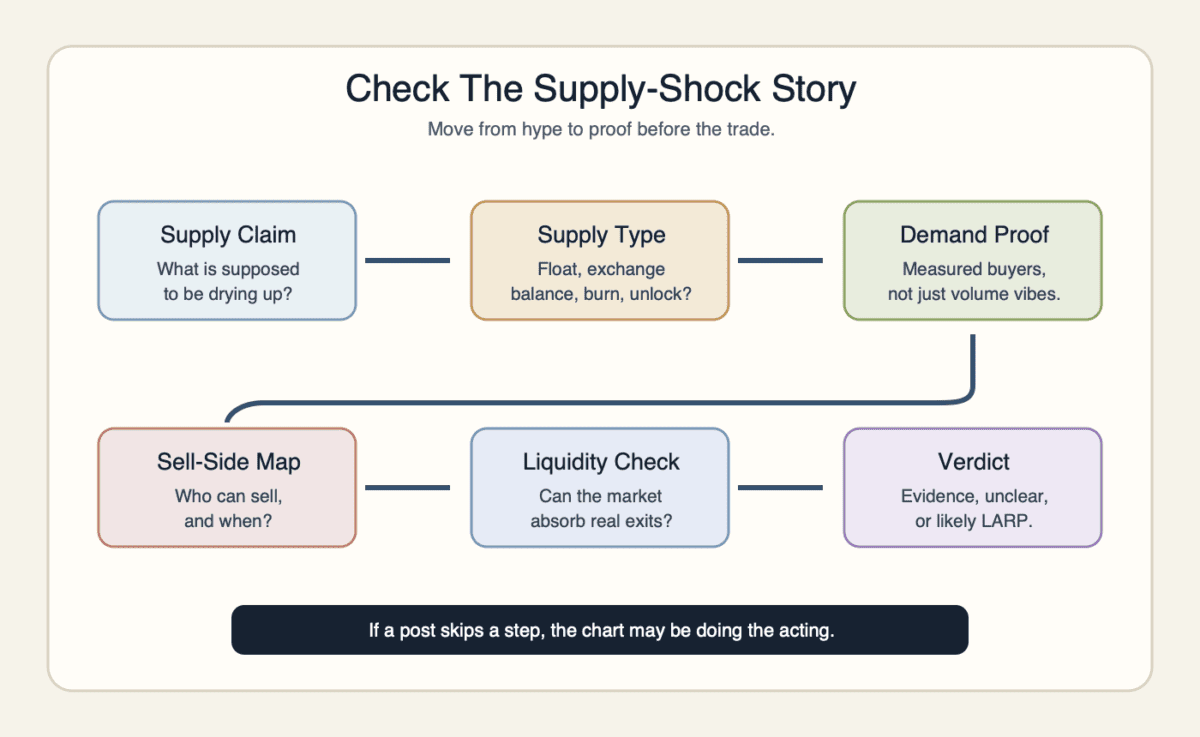
Do not stop at “coins left exchanges.” Ask where they went. Self-custody, ETF custody, bridge movement, and OTC routing can all make exchange balances harder to read.
Do not stop at “tokens burned.” Ask whether mint rights, treasury wallets, emissions, or insider allocations can add supply later. A burn is cleaner when contract permissions, liquidity locks, and holder distribution support the same story.
The fastest check is blunt: what supply changed, who can still sell, and where is buyer pressure coming from? If the answer is mostly vibes, the chart may be part of the act.
Supply shock larp red flags appear when a claim gets louder as evidence gets thinner. The more urgent the tone, the more calmly you should check the mechanics.
Watch for these warning signs:
Extreme certainty can become a top signal when everyone acts like the squeeze is already settled. Price can still drift or chop up. The easy part of the story is often already priced into attention.
Project-control risks add another layer. An anon dev is not automatically bad, but anonymous control plus vague liquidity locks and supply claims deserves harder checking. If the hype slowly fades while insiders keep optionality, the setup can drift toward a soft rug without one dramatic exploit.
The red flag cluster is more useful than any single warning. One weak chart may be sloppy. Urgency, hidden supply, no method, and concentrated holders together are a very different trade.
Also watch how the account reacts to questions. Strong claims usually tolerate basic checks. Weak ones often answer with status, mockery, or “you will see” instead of wallets, dates, and method.
If you already hold a token built on a supply-shock story, reduce the claim to checks you can verify. Your goal is not to win an argument. Your goal is to avoid becoming the liquidity plan.
Start with exit reality. Check pool depth, order-book depth, slippage, wallet concentration, and recent sell behavior. A position can look fine on paper and still be hard to exit without moving price.
Then inspect the supply map:
The social story gets expensive there. If the claim fades, late buyers may become exit liquidity for earlier holders. Holding too long because the scarcity pitch feels heroic can turn into bagholder behavior.
Averaging down deserves extra caution. If the original thesis was weak supply proof, adding size may only increase exposure to the same bad information.
None of this requires panic-selling. It requires separating your position from the slogan that sold it. A smaller, better-understood risk beats a larger position defended by screenshots and group chat pressure.
Related terms help because supply shock larp sits between market mechanics and social performance. The phrase is not only about supply. It is also about how attention changes risk.
These concepts give you cleaner language for nearby situations:
The links are related because they describe the mechanics around the phrase. Attention explains spread. Narrative explains why a story becomes tradable. Conviction explains the difference between work and performance. Exit liquidity explains the cost of being late.
Use related slang as a map, not decoration. If a term does not help you identify the claim, seller, evidence, or risk, it is just another shiny noun on the feed.
No. Supply shock larp is a warning about weak proof or performed certainty. It can overlap with scams when the story is used to deceive buyers, but the phrase can also describe exaggerated or sloppy hype.
The useful move is to check the claim before labeling the person. If there is no supply method, no seller map, and no demand proof, the trade is weak even before anyone proves bad intent.
No. A reduced supply can support price only when demand holds or grows. A sudden increase in sellable supply, such as an unlock or emission wave, can create downside pressure.
Price also depends on liquidity. A thin market can jump on small buys, then fall just as fast when sellers arrive. In that pattern, movement does not equal proven scarcity.
Yes. Bitcoin can face real supply pressure when new issuance falls, demand absorbs available coins, and sellers do not return quickly. A halving or reserve chart alone does not prove the timing.
The stronger Bitcoin case combines issuance, spot demand, ETF flows, miner behavior, long-term holder behavior, and macro liquidity. One clean chart can start the question. It should not end it.
Token burns can reduce supply, but they do not guarantee a squeeze. Demand, liquidity, holder concentration, mint rights, and future emissions can still weaken the claim.
A burn is more convincing when it is permanent, visible on-chain, large enough to affect liquid supply, and not offset by future minting or insider supply.
No. Exchange reserves are a clue, not proof. Coins can move to custodians, ETFs, cold wallets, bridges, OTC desks, or other venues and still return when price rises.
Reserve charts are better when the source defines exchange coverage, custodian handling, net flows, and methodology. Without that, the chart may only show location changes.
A wrong prediction can be honest and well-reasoned. LARP adds performance: fake certainty, fake status, weak evidence, or pressure that asks others to trust the role before the proof.
That difference keeps the term useful. Calling every miss a LARP makes the word lazy. Saving it for performed proof makes it a sharper risk signal.
Start by slowing the trade down until the supply claim becomes specific. “Supply shock incoming” is not enough. You need the measured supply, the demand source, the sellers, and the exit conditions.
Use this quick sequence before you size anything:
Use this last point as your final risk test. A full port on unverified scarcity is not conviction. It is letting someone else’s chart choose your risk.
If the story survives those checks, you still need sizing, invalidation, and an exit plan. If it fails them, the best trade may be no trade while the feed keeps performing.
Supply shock claims can be real. They can also be scarcity with a fog machine. The difference is whether the story survives float, demand, liquidity, and seller checks after the timeline stops clapping.